YoLink Water Leak Sensor With Rope Cable Review: Long-Range LoRa Detection Without WiFi Dependence
A water leak sensor is only useful if it can detect a problem in the right place and still communicate when something goes wrong. That can become difficult in basements, utility rooms, garages, behind appliances, or other areas where WiFi coverage is weak.
The YoLink water leak sensor with rope-style sensing cable is designed around that problem. Instead of relying directly on WiFi, it uses LoRa-based communication through the YoLink ecosystem, with an advertised open-air range of up to roughly one-quarter mile. It also supports YoLink's device-to-device Control-D2D functionality, allowing compatible devices to continue interacting locally even if internet connectivity or AC power is interrupted.
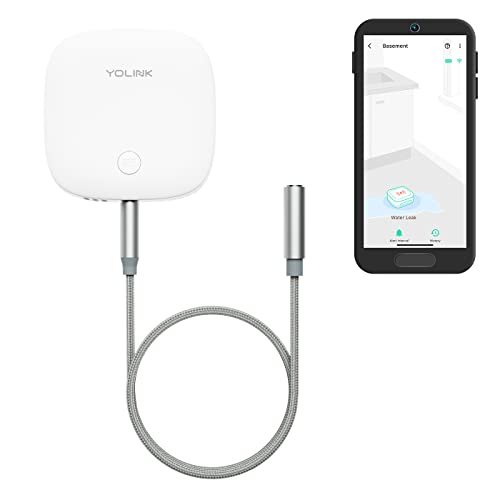
The other distinctive feature is the 4.2-foot water-sensing cable. Rather than detecting moisture at only one small point, the cable can be routed under appliances, around a water heater, or along a specific area where escaping water is likely to travel.
For homeowners building a more resilient smart leak-detection system, that combination of long-range connectivity, flexible sensing coverage, battery operation, and local automation is compelling. However, a YoLink hub is required, and the sensor itself is primarily a detector rather than a shutoff valve.
What Is the YoLink Rope-Cable Water Leak Sensor?
This YoLink device is a battery-powered smart water leak detector that uses a flexible sensing cable rather than relying solely on point contacts.
The supplied cable measures approximately 4.2 feet, or 1.2 meters, and additional compatible sensing cables can be added when broader coverage is needed.
The sensor communicates over YoLink's LoRa-based wireless network.
For smart monitoring and app functionality, it requires a compatible YoLink hub, which is not included with the sensor according to the supplied product information.
This architecture is particularly well suited to homeowners who want to monitor difficult locations without placing a WiFi-connected device at every leak-prone point.
Why Rope-Style Leak Detection Is Different
Many water leak detectors use small metal contacts on the bottom of the sensor.
That works well when water pools directly underneath the device.
The limitation is coverage.
A compact puck placed beside a water heater may remain dry while water escapes on the opposite side of the tank. A sensor behind a dishwasher may be difficult to position exactly where a leak would first appear.
A rope-style sensing cable addresses this by expanding the physical detection area.
Instead of watching one small point, the cable can follow the perimeter or pathway where water is most likely to travel.
A 4.2-Foot Water-Sensing Cable
The included cable measures approximately 4.2 feet.
That is long enough for several practical installation strategies.
It can be routed underneath the front edge of a dishwasher, placed behind a washing machine, positioned along the bottom of a sink cabinet, or wrapped around part of a water heater's base.
The purpose is not simply to maximize cable length.
The cable should be positioned strategically so that escaping water is likely to contact it as early as possible.
Extending the Detection Area
The product information states that additional compatible cables can be connected.
This can make the system useful for larger or unusually shaped spaces.
For example, a longer sensing path could be installed around a large water heater or along several sides of a utility area.
An extension cable can also be useful in narrow spaces where the main sensor body cannot physically fit.
Before creating a very long sensing run, check the manufacturer's current recommendations regarding supported cable length and configuration.
LoRa-Based Long-Range Connectivity
The sensor uses LoRa technology rather than connecting directly to the home's WiFi network.
According to the supplied specifications, communication can reach up to approximately one-quarter mile in open-air conditions.
Indoor performance will naturally be shorter and depends on walls, floors, metal structures, concrete, appliances, and other obstacles.
Even so, LoRa is designed specifically for long-range, low-power communication, making it well suited to smart sensors.
Why LoRa Matters for Water Leak Sensors
Leak sensors often need to be placed exactly where WiFi is weakest.
Basements, mechanical rooms, garages, detached structures, and spaces behind appliances are all common examples.
A WiFi-only leak detector may struggle to maintain a stable connection in those environments.
LoRa reduces that dependence by allowing the sensor to communicate over a long-range local radio link to the YoLink hub.
That can make the system more suitable for larger homes and properties with difficult layouts.
No Direct Dependence on WiFi at the Sensor
One of the practical advantages is that the sensor itself does not need to join your WiFi network.
This means you do not need to worry about entering WiFi credentials into each leak detector or ensuring every sensor sits within strong router coverage.
The hub handles the broader connection between the YoLink ecosystem and the internet.
For homes with many sensors, this can be easier to manage than dozens of independent WiFi devices.
A YoLink Hub Is Required
The most important limitation is straightforward: the sensor requires a YoLink hub.
The supplied information specifically notes that the device will not operate as intended without one.
The hub is not included with this particular sensor package.
YoLink offers different hub options, including its original hub and SpeakerHub products.
If you already have a YoLink ecosystem, this may not be a concern.
If this is your first YoLink product, the hub should be included when calculating the total cost of the system.
What the Hub Does
The hub acts as the communication bridge between YoLink's LoRa devices and connected services.
Through the hub, the sensor can report events to the YoLink app and participate in automations.
Depending on the specific hub, additional alerting features may also be available.
The hub should be positioned where it can maintain reliable communication with the sensors while also remaining connected to the local network.
Control-D2D Device-to-Device Communication
One of YoLink's more distinctive technologies is Control-D2D, or device-to-device communication.
This allows compatible YoLink devices to be paired directly so that certain actions can continue locally even when internet access is lost.
This is especially relevant for leak protection.
A cloud-dependent automation might fail if the internet connection drops at exactly the wrong moment.
Direct local pairing can reduce that dependency.
Why Offline Operation Matters
Smart-home systems are often judged by how well they work when everything is functioning normally.
Safety-oriented systems should also be evaluated for what happens when something fails.
Internet outages, router problems, and AC power interruptions are all realistic events.
According to the supplied product information, Control-D2D allows paired YoLink devices to continue working together even when WiFi or internet service becomes unavailable.
That can provide a more resilient response than relying exclusively on cloud automation.
Pairing With a Smart Shutoff Valve
The sensor itself detects water; it does not physically stop a leak.
However, a compatible YoLink shutoff device can potentially be paired through Control-D2D.
In that type of setup, the leak sensor can act as the trigger while the valve provides the response.
This is significantly more useful than an alarm-only system if automatic intervention is required.
The exact compatibility and pairing procedure should be confirmed for the specific YoLink valve being used.
What Happens During a Power Outage?
The sensor is battery powered, so it does not require an AC outlet for normal operation.
That is important during power failures.
The supplied product information also states that certain Control-D2D interactions can continue even when AC power is lost, provided the paired devices themselves retain power.
The actual behavior of the broader system will depend on which hub and paired devices are involved.
Remote app notifications may still be unavailable if the local internet connection or network equipment loses power.
Local device-to-device protection and remote cloud access should therefore be considered separately.
More Than Two Years of Battery Life
YoLink states that the sensor can provide more than two years of battery life under expected operating conditions.
Battery life is especially important for leak sensors because they are often installed in places that are inconvenient to access.
Long runtime reduces maintenance.
However, actual battery life can vary according to environmental conditions, alarm activity, signal quality, and the battery used.
A safety sensor should still be checked periodically rather than assumed to remain functional for years without testing.
No AC Outlet Required
Because the sensor operates from batteries, it can be placed almost anywhere.
This is a major advantage in locations such as:
- Under kitchen cabinets
- Behind dishwashers
- Around water heaters
- Near sump pumps
- Beneath washing machines
- In basements
- Inside utility rooms
- Near refrigerator water lines
There is no need to route an extension cord or find an outlet near the sensing point.
That keeps installation simple and avoids creating another electrical dependency.
Scan & Play Setup
The sensor uses YoLink's Scan & Play QR-code onboarding system.
Rather than manually entering long device identifiers, users can scan the product's QR code through the app to add it to the system.
This simplifies initial setup, especially when several sensors are being installed.
After pairing, each sensor should be given a descriptive location name so alerts can immediately identify where water has been detected.
Easy Wall Mounting
The main sensor body can be mounted to a wall or other convenient location while the sensing cable remains on the floor.
This can help protect the electronics from direct standing water while allowing the detection cable to remain exactly where it is needed.
It also keeps the sensor body accessible for battery changes and testing.
The cable itself should not be stretched so tightly that it becomes difficult to reposition or inspect.
Best Places to Use the Rope Sensor
The strongest use cases are areas where leaks may appear across a broader path rather than at one predictable point.
Around a Water Heater
A water heater can leak from several locations, including fittings, valves, the drain, or the tank itself.
A sensing cable can be routed around the base so that water escaping from several directions has a greater chance of being detected quickly.
Beneath a Dishwasher
Dishwashers are difficult to monitor with standard puck sensors because much of the plumbing sits beneath or behind the appliance.
A slim sensing cable can be routed into the confined space below the front or along the edge where water would emerge.
Behind a Washing Machine
A washing machine has both hot- and cold-water hoses, drain connections, and internal components that can leak.
A rope sensor can span a larger area behind the appliance than a small point detector.
Under a Sink
Sink cabinets contain multiple potential leak sources.
The rope can be routed below supply lines, shutoff valves, drain traps, filters, or garbage disposals.
This may be particularly useful in wide cabinets where a single compact sensor would cover only one corner.
Near a Sump Pump
A sump pump area can benefit from broader water detection, especially if the leak or overflow path is difficult to predict.
A sensing cable can be positioned around the most likely perimeter of unwanted water.
Cable Placement Matters More Than Length
A common mistake is assuming that a longer cable automatically means better protection.
Detection quality still depends on positioning.
If the cable is routed on the wrong side of a floor slope, water may flow away from it.
Before installation, consider the likely direction of water movement.
The best placement is usually at the lowest point or across the path water would naturally take.
Avoid Routine Splash Zones
The cable should not be placed where normal household activity frequently makes it wet.
A leak detector that triggers during ordinary floor cleaning or minor splashes will quickly become frustrating.
Frequent nuisance alarms can lead users to disable notifications or move the sensor away from where it is useful.
The ideal location is one where contact with water almost always indicates an abnormal condition.
Local Alerts vs. Remote Notifications
A connected leak system can respond in more than one way.
Remote notifications can inform you while you are away.
Local automations can trigger another YoLink device even if the internet is unavailable.
This distinction is important.
App alerts provide awareness.
Control-D2D can provide resilience.
Using both together gives the system more value than relying on either method alone.
Sensor vs. Leak Alarm vs. Automatic Shutoff
There are three broad levels of leak protection.
A basic alarm detects water and makes noise.
A smart sensor detects water and can send notifications.
A sensor paired with an automatic valve can detect water and shut off the supply.
The YoLink sensor fits primarily into the second category by itself, but its Control-D2D capability allows it to participate in the third category when paired with compatible hardware.
That scalability is one of its strongest features.
YoLink vs. WiFi Leak Sensors
Direct WiFi sensors can be convenient because they often do not require a hub.
For a single kitchen sink, that simplicity may be attractive.
YoLink becomes more compelling when range, battery life, and offline automation matter.
A LoRa-based network can cover larger properties more effectively, while Control-D2D can continue selected actions without internet connectivity.
The tradeoff is the required hub and commitment to another smart-home ecosystem.
YoLink vs. Zigbee Leak Sensors
Zigbee also provides low-power sensor networking and can support local automations.
The difference is ecosystem and range.
YoLink's LoRa implementation emphasizes particularly long communication distances, while Zigbee often relies on a mesh of powered routing devices to extend coverage.
Neither approach is universally better.
For a compact smart home already using Zigbee, a Zigbee sensor may be the more natural choice.
For large properties or difficult-to-reach locations, YoLink's range may be especially attractive.
Common Setup Mistakes
One mistake is purchasing the sensor without realizing that a YoLink hub is mandatory.
Another is placing the sensing rope in a convenient location rather than the actual likely water path.
Users should also avoid assuming that remote notifications are identical to local protection.
If internet access fails, app alerts may not arrive even though a configured D2D action can still occur.
Finally, a long battery-life estimate should not be interpreted as permission to ignore the device for years.
Leak protection equipment should be tested periodically.
Best Practices for Initial Installation
Add the sensor to the YoLink app before mounting it permanently.
Give it a specific name such as Water Heater Leak Sensor or Dishwasher Leak Cable.
Position the main sensor body somewhere accessible and dry.
Lay the sensing cable along the area most likely to encounter escaping water.
Then perform a controlled test according to the manufacturer's instructions.
Confirm that the system registers the leak event and that any configured notification or device-to-device automation actually occurs.
Test Device-to-Device Automations
If the sensor is paired with a shutoff valve or another YoLink device through Control-D2D, test that automation separately.
A particularly valuable test is confirming that the paired action can occur without depending on internet access.
This is the feature that differentiates the system from many cloud-only smart leak solutions.
Do not rely on a configuration until its real-world response has been verified.
Check Batteries and Cable Condition
Periodic maintenance should include more than looking at battery status.
Inspect the sensing cable for physical damage, contamination, or displacement.
Make sure cleaning, appliance movement, or stored items have not pushed it away from the intended detection zone.
A perfectly functioning sensor cannot provide useful protection if the cable has been moved somewhere water will never reach.
Advantages of the YoLink Rope Water Leak Sensor
The most significant advantage is flexible physical coverage.
The rope-style sensing cable can monitor a larger or more precisely defined area than a small point detector.
LoRa connectivity provides long-range communication without requiring the sensor itself to connect to WiFi.
Battery operation allows installation in locations without outlets.
Control-D2D offers the possibility of continued local automation when internet service is unavailable.
The system can also be expanded within the broader YoLink ecosystem, including pairing with compatible valves and alerting devices.
Potential Drawbacks
The required hub is the biggest limitation for first-time users.
Someone who only wants one simple water sensor may find a standalone WiFi or audible alarm less expensive.
The product also detects water but does not stop it by itself.
Automatic shutoff requires compatible additional hardware.
Remote features depend on the broader YoLink hub and network environment.
The sensing cable must also be positioned correctly to provide useful coverage.
Finally, the advertised open-air communication range should not be interpreted as guaranteed indoor performance through multiple walls and floors.
Who Should Consider This Sensor?
This product makes the most sense for people who need long-range, flexible water leak detection or who already use YoLink devices.
It is particularly well suited to:
- Large homes
- Basements
- Detached garages
- Utility rooms
- Water heaters
- Dishwashers
- Washing machines
- Remote corners of a property
- Locations where WiFi coverage is weak
- Smart homes using YoLink shutoff valves
It may be unnecessary for someone who only needs a cheap audible sensor under one easily accessible sink.
Is It Suitable for a Vacation Home?
Potentially, yes.
Long-range connectivity and remote notifications can make it useful in a property that is frequently unoccupied.
Control-D2D becomes even more valuable if the sensor is paired with a compatible automatic shutoff device.
However, a complete vacation-home strategy should consider other leak sources as well.
Protecting one water heater or appliance does not automatically protect the entire plumbing system.
Is It Good for a Large Property?
This is one of the scenarios where YoLink's architecture is particularly interesting.
The advertised long-range LoRa communication can help reach devices located much farther from the hub than many typical WiFi smart-home accessories.
Real-world performance still depends on construction and placement, but the system is specifically designed with long-distance sensor connectivity in mind.
Frequently Asked Questions
What is the YoLink rope water leak sensor?
It is a battery-powered smart water detector that uses a flexible water-sensing cable and communicates through YoLink's LoRa-based network.
How long is the included sensing cable?
The supplied cable is approximately 4.2 feet, or 1.2 meters long.
Can the cable be extended?
Yes. The product information states that additional compatible sensing cables can be added.
Does it connect directly to WiFi?
No. The sensor communicates through YoLink's LoRa-based system rather than connecting directly to household WiFi.
Is a YoLink hub required?
Yes. A compatible YoLink hub is required and is not included with this sensor package.
How far can it communicate?
YoLink advertises up to approximately one-quarter mile in open-air conditions.
Indoor range will depend on the building and environment.
Does it require an electrical outlet?
No. The sensor is battery powered.
How long does the battery last?
The supplied information describes battery life of more than two years under expected conditions.
Actual performance can vary.
What is Control-D2D?
Control-D2D is YoLink's device-to-device communication system, which allows compatible devices to interact directly without relying entirely on internet or WiFi connectivity.
Can it work during an internet outage?
Certain configured local Control-D2D actions can continue without internet access according to the supplied product information.
Remote app functions may not remain available during an outage.
Can it automatically shut off water?
Not by itself.
It can potentially be paired with a compatible YoLink shutoff device to create an automatic leak-response system.
Is it good for water heaters?
Yes. The rope-style cable is particularly useful because it can cover a larger area around the base of a water heater.
Can it fit under a dishwasher?
Yes. One of the principal advantages of a slim sensing cable is its ability to reach confined spaces under appliances.
Does it need WiFi coverage where the sensor is installed?
No direct WiFi connection is required at the sensor location, although the hub and connected services still need appropriate network access for remote features.
Is it better than a basic leak alarm?
It provides significantly more smart-home capability, long-range connectivity, and automation potential.
A basic alarm may still be sufficient if you only need a local audible warning in one room.
Final Verdict
The YoLink rope-style water leak sensor is a strong option for homeowners who need broader coverage and more reliable long-range communication than a basic point sensor can provide.
Its 4.2-foot sensing cable is particularly useful around water heaters, under dishwashers, behind washing machines, and in other locations where a single contact point may miss escaping water.
LoRa-based communication reduces dependence on local WiFi coverage, while battery operation allows the sensor to be installed without an electrical outlet. The Control-D2D system is an especially important advantage because compatible YoLink devices can continue interacting locally even when internet connectivity becomes unreliable.
The main caveat is that a YoLink hub is mandatory, and the sensor alone does not physically stop the water. Buyers who want automatic shutoff will need compatible additional hardware.
For someone already invested in YoLink—or anyone building a leak-detection system across a large property—the combination of long range, rope-style sensing, battery power, and local device-to-device automation makes this a more capable solution than a simple WiFi water alarm.