YoLink LeakStop Review: Smart Automatic Sink Shutoff With LoRa Monitoring and Water-Usage Tracking
Water leak sensors are useful because they tell you when something has gone wrong. An automatic shutoff system goes one step further by actually stopping the water.
The YoLink LeakStop is designed specifically for that purpose around sinks and similar fixtures. It combines long-range LoRa connectivity, water-use monitoring, configurable limits, leak detection, automatic valve shutoff, app alerts, and smart-home integration in one system.
Its most distinctive capability is not simply detecting standing water. The LeakStop is designed to identify excessive or unexpected water use and automatically close the valve when configured thresholds are exceeded. That makes it relevant for dripping faucets, fixtures accidentally left running, supply-line problems, and other situations where water continues to flow longer than expected.
This guide examines how the system works, what its automatic shutoff feature can realistically accomplish, where LoRa connectivity helps, and what homeowners should consider before installing it.
What Is the YoLink LeakStop?
The YoLink LeakStop is a smart water monitoring and automatic shutoff device intended for sink plumbing.
It monitors water usage, communicates with the YoLink ecosystem, and can physically close a valve when certain conditions are detected.
According to the supplied product information, those conditions can include excessive daily water consumption, too many usage or flush cycles, extended water-flow duration, or detection of water through an external leak probe.
The system can also send alerts through the YoLink app and, depending on account configuration and service availability, through additional notification channels such as SMS or email.
Unlike a basic water leak alarm, the LeakStop is therefore both a monitoring device and an active control system.
Why Automatic Water Shutoff Matters
A conventional leak detector depends on someone responding to the alarm.
That may be adequate when you are home, awake, and close enough to act quickly.
It becomes less useful when a leak begins while the house is empty.
An automatic shutoff system can reduce this dependency by physically stopping water flow once its configured conditions are met.
That distinction is important.
A detector says, "There may be a problem."
A shutoff device can respond with, "There may be a problem, so I am closing the valve."
For sinks, rental units, offices, guest bathrooms, vacation properties, and other locations where water may occasionally be left running unattended, that additional response can be valuable.
Designed Specifically for Running-Water Control
One of the LeakStop's strongest selling points is its emphasis on continuous or excessive water flow, not merely pooled water.
Many leak sensors only react after water has already escaped and reached their electrical contacts.
The LeakStop takes a broader approach.
It monitors how the fixture is being used and can act when usage exceeds defined limits.
For example, if a faucet remains open far longer than normal, the system can potentially close the valve even before a large puddle reaches a traditional floor sensor.
That can make it particularly useful for situations involving:
- Faucets accidentally left running
- Unexpectedly long sink usage
- Supply-line leaks
- Excessive daily water consumption
- Repeated abnormal usage events
- Water detected by an external probe
The actual trigger behavior depends on how the system is configured.
Long-Range LoRa Connectivity
The LeakStop uses LoRa technology to communicate with the YoLink Hub.
LoRa stands for long-range radio communication and is designed for devices that need reliable connectivity while transmitting relatively small amounts of data.
According to the product information, the system can achieve up to approximately one-quarter mile of open-air range under favorable conditions.
Actual indoor range will naturally depend on walls, floors, construction materials, interference, and placement.
Even so, LoRa can be useful in situations where ordinary WiFi coverage is inconsistent.
Why LoRa Can Be Better Than WiFi for Leak Devices
A sink-mounted device may be installed beneath cabinetry, behind plumbing, in a utility room, or at the far end of a large property.
Those locations are not always friendly to WiFi.
A smart device that relies entirely on WiFi may become unreliable if signal strength is poor.
LoRa is designed to cover greater distances with low power requirements.
That can make the LeakStop particularly attractive for larger homes, detached buildings, offices, basements, garages, or other difficult-to-reach locations.
The system still requires a YoLink Hub for full connected functionality, but the individual device does not need to maintain a conventional WiFi connection directly.
A YoLink Hub Is Required
The LeakStop does not provide its full smart functionality as a completely standalone device.
A YoLink Hub is required for features such as remote monitoring, app configuration, notifications, and smart-home integrations.
This is an important consideration for first-time YoLink buyers.
If you already have a YoLink ecosystem, adding the LeakStop may be straightforward.
If this is your first YoLink product, the hub becomes part of the total cost and setup.
The hub acts as the bridge between LoRa devices and your network.
Offline Protection Is One of the Most Important Features
One of the more compelling aspects of the LeakStop is that its automatic protection does not necessarily depend entirely on an active internet connection.
According to the supplied specifications, the device can automatically close the valve when configured water-use or leak conditions are triggered even if internet service is unavailable.
That matters because water emergencies do not wait for cloud services to be online.
A system that requires constant internet connectivity for every protective action could become ineffective during a network outage.
The LeakStop's ability to carry out local shutoff logic provides a useful layer of resilience.
What Happens During a Power or Internet Outage?
The source material states that automatic shutoff can continue when power or internet service is unavailable under supported conditions.
That allows the device to respond to configured limits or leak detection without waiting for a remote cloud command.
However, remote notifications and app access naturally depend on network availability.
In other words, the protective action and the notification process should be thought of separately.
The valve may still be able to close locally even when your phone cannot immediately receive an alert.
That is a valuable distinction in any smart-home safety device.
Monitoring Water Usage
The LeakStop also functions as a water-use monitoring tool.
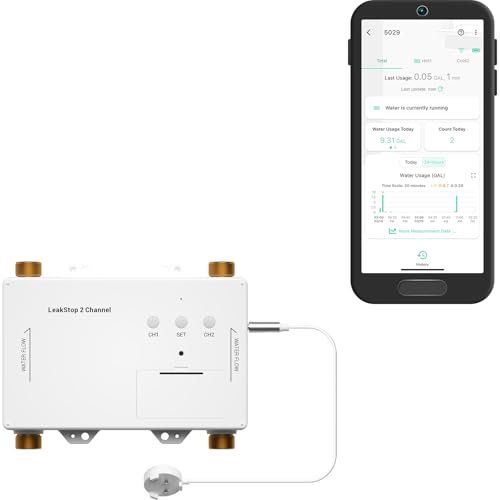
Through the YoLink app, users can track metrics such as daily consumption, monthly usage, total water use, and daily flush or activation counts.
This adds another purpose beyond emergency leak response.
For example, the system can help identify how frequently a particular fixture is used or whether consumption has changed unexpectedly over time.
That may be useful in rental properties, offices, shared bathrooms, or households trying to better understand water consumption.
Water-Usage Charts and Historical Data
The YoLink app provides visual water-use data across multiple timescales.
According to the product information, usage can be viewed through hourly, daily, and monthly charts.
This makes it easier to identify patterns than relying on cumulative totals alone.
A single day's water use may not mean much by itself.
But repeated spikes at unusual times or gradually increasing consumption can indicate changing behavior or a developing plumbing issue.
Historical visualization makes those trends easier to recognize.
Exporting Water-Usage Data
The ability to export data can be useful for people who want more detailed tracking outside the app.
Exported records may help with long-term consumption analysis, property management, maintenance reporting, or comparison between fixtures.
For most homeowners, this may be an occasional feature rather than an everyday necessity.
For landlords, facilities managers, or technically inclined users, however, having access to raw usage history can add meaningful value.
Configurable Daily Water Limits
The LeakStop allows users to set personalized water-use thresholds.
A daily consumption limit can help identify unusual fixture behavior.
For instance, if a sink normally uses only a modest amount of water but suddenly exceeds a substantially higher configured threshold, the system can treat that event as abnormal.
The threshold should be chosen carefully.
If set too low, normal usage may repeatedly trigger false alarms or shutoffs.
If set too high, the system may allow an avoidable amount of water to flow before reacting.
The best configuration usually comes from observing normal fixture behavior first and then setting limits with an appropriate margin.
Usage or Flush Count Limits
The device can also monitor how many times the fixture is used within a defined period.
This may be relevant in environments where repeated activations could indicate abnormal behavior.
A home sink may not benefit from this metric as much as certain commercial or shared-use installations, but it can still provide another way of recognizing unusual activity.
As with water-volume limits, count-based thresholds should be configured around realistic normal use rather than arbitrary numbers.
Duration-Based Protection
Flow duration is arguably one of the most practical shutoff triggers.
A faucet that remains open continuously for an unexpectedly long period often signals either human error or a malfunction.
By monitoring duration, the LeakStop can respond to this type of event without necessarily waiting for a large cumulative water-use limit to be exceeded.
This is particularly useful for sinks because one of the most common problems is simply water being left running.
A properly chosen time threshold can allow normal handwashing, cleaning, and household use while still reacting to abnormally prolonged flow.
External Water-Detection Probe
The system also supports an external detection probe for direct leak sensing.
This adds a more traditional form of leak protection.
While usage monitoring looks for abnormal water behavior inside the plumbing system, the external probe looks for water that has escaped into the surrounding area.
Combining these two approaches is useful because not every plumbing problem produces the same pattern.
A slow supply-line leak may eventually reach the probe.
A faucet accidentally left open may be detected more effectively through duration or consumption limits.
Using both methods broadens the range of scenarios the system can address.
Alerts Through the YoLink App
When an abnormal condition is detected, the LeakStop can send real-time notifications through the YoLink app.
Remote alerts are particularly useful when the property is unoccupied.
Instead of discovering a closed valve or water problem only after returning home, users can be informed while the event is happening.
That allows them to investigate remotely, contact someone nearby, or arrange professional assistance if needed.
SMS and Email Alerts
The source information also mentions SMS and email notification options.
Availability, limits, pricing, and account requirements for these services can change, so they should be verified within the current YoLink platform before relying on them.
Using multiple notification channels can provide redundancy.
A push notification may be sufficient for most users, while property managers or people monitoring second homes may prefer additional delivery methods.
Customizable Alert Behavior
Notifications can be tailored to match the importance of different events.
For example, a minor usage threshold could produce a standard alert, while a valve-closing event may deserve a more persistent notification.
The LeakStop also allows adjustment of its local audible alarm behavior.
The sound can be enabled or disabled according to the product description.
This can be useful in situations where an audible signal is desirable locally, such as a home or office, or where quieter operation is preferred.
Continuous Alerts
Continuous notification can be useful for critical water events.
A single smartphone notification can easily be missed.
Persistent or repeated alerts increase the chance that the user notices the condition before significant time passes.
The downside is alert fatigue.
If thresholds are poorly configured and frequently trigger during normal use, users may begin ignoring notifications.
Careful calibration is therefore essential.
Automatic Valve Shutoff
The automatic valve is the core protective component.
When a configured emergency condition occurs, the LeakStop can close the water supply to the monitored fixture.
This makes it fundamentally different from sensors that only generate alarms.
The valve should be considered a localized protective device.
It is designed to control the particular water line where it is installed rather than shutting down water throughout an entire property.
That can be an advantage when you want to isolate one sink without affecting showers, toilets, appliances, or other fixtures.
Local Shutoff vs. Whole-House Shutoff
Whole-house smart shutoff valves provide broad protection by closing the main water line.
That approach can be appropriate for catastrophic leak protection, but it has disadvantages.
Closing the main supply affects the entire property.
A localized system such as the LeakStop limits the response to a specific fixture.
If a bathroom sink develops a problem, that sink can potentially be isolated while the rest of the home's plumbing continues operating.
The right approach depends on risk.
Some properties may benefit from both localized protection and a whole-house emergency shutoff.
Built-In Valve Maintenance
Motorized valves can become less reliable if they remain stationary for very long periods.
The LeakStop includes a valve maintenance function intended to operate the mechanism periodically.
Routine movement can help ensure the valve remains functional when an emergency actually occurs.
This is an important but easily overlooked feature.
A shutoff valve provides little protection if it has seized or cannot close after years of inactivity.
Automated maintenance reduces the amount of manual attention required.
Installation Without a Plumber
The product is marketed as being installable without a plumber or specialized tools.
That can make it appealing to homeowners comfortable working with basic plumbing connections.
However, "easy installation" should not be interpreted as universally tool-free or risk-free.
Existing plumbing varies substantially between homes.
Corroded shutoff valves, nonstandard fittings, rigid piping, limited cabinet access, and older plumbing can complicate what appears to be a simple installation.
If you are unsure about a connection or notice deteriorated plumbing, professional help may still be the better choice.
Choosing the Correct Installation Location
The valve must be installed where it can control the water supply feeding the fixture you want to protect.
Under-sink supply plumbing is the obvious location in many installations.
Make sure there is enough physical space for the device, connections, and any required sensor cable.
The external leak probe should be placed at a location where water is likely to accumulate first.
That often means the cabinet floor beneath supply connections, faucet hoses, valves, or drain plumbing.
Smart-Home Integration
The LeakStop supports integration with several smart-home platforms, including Amazon Alexa, Google Assistant, IFTTT, and Home Assistant, according to the supplied product information.
This expands the system beyond the YoLink app.
Users can potentially incorporate water monitoring into broader automations and routines.
For example, a leak condition could trigger another smart-home action, such as turning on lights, generating an announcement, or notifying another automation platform.
The exact capabilities vary between ecosystems and can change over time, so current integrations should be checked before purchasing specifically for one automation.
Home Assistant Compatibility
Home Assistant compatibility will be especially interesting to users who prefer local or highly customizable smart-home systems.
Integrating water sensors and valve states into Home Assistant can allow more sophisticated dashboards and automation logic.
For example, water usage could be combined with occupancy information, security modes, or other sensors.
Advanced users may find this one of the strongest reasons to choose an ecosystem with broad integration support.
Voice Assistant Integration
Alexa and Google Assistant compatibility can provide convenient status checks or manual controls where supported.
Voice control should be treated as a convenience feature rather than the primary safety mechanism.
Automatic shutoff logic should remain configured independently so that protection does not depend on someone issuing a voice command during an emergency.
LeakStop vs. Basic Water Leak Sensor
A basic leak sensor costs less and is simpler.
If its contacts get wet, it sounds an alarm and perhaps sends an app notification.
That may be perfectly adequate in many situations.
The LeakStop goes significantly further by monitoring water use and physically controlling the supply valve.
This makes it a more active form of protection.
The tradeoff is greater cost, more installation work, a required hub, and more configuration.
For a low-risk location, a basic sensor may be sufficient.
For a sink where unattended running water is a realistic concern, automatic shutoff provides an additional layer of protection.
LeakStop vs. Whole-House Water Monitor
Whole-house systems monitor water at or near the property's main supply.
They can potentially detect leaks anywhere downstream and may automatically close the main valve.
This provides broad coverage but can also be more expensive and difficult to install.
The LeakStop is more targeted.
It focuses on a particular sink or water line.
That can make it easier to deploy incrementally.
Instead of modifying the main water service, homeowners can add protection only where they believe the risk justifies it.
Who Is the YoLink LeakStop Best For?
The system is particularly well suited to people who want more than a basic leak alarm but do not necessarily want to install a whole-house shutoff system.
It may make sense for:
- Vacation properties
- Rental units
- Apartments
- Office sinks
- Guest bathrooms
- Utility sinks
- Homes with children or older occupants
- Properties where faucets may accidentally be left running
- Large buildings where WiFi does not reliably reach every fixture
Its LoRa connectivity is particularly useful when the monitored location is difficult to reach with conventional WiFi.
Vacation and Second Homes
Remote properties are one of the strongest use cases.
A small leak can remain unnoticed for days or weeks when nobody is present.
Remote notifications help, but automatic shutoff is even more valuable because response time may be limited.
If the system detects an abnormal condition and closes the fixture valve locally, it can provide some protection even before someone physically reaches the property.
Rental Properties
Landlords may also find targeted water monitoring useful.
A LeakStop installed on a vulnerable sink can help identify excessive water use or prolonged flow.
However, any monitoring system used in a rental property should be deployed transparently and in accordance with applicable laws and lease requirements.
The goal should be property protection and water management, not intrusive monitoring of occupants.
Offices and Shared Spaces
Office kitchens and restroom sinks may be used by many people throughout the day.
In that environment, a faucet can occasionally be left running without one individual taking responsibility.
Usage thresholds and automatic shutoff can provide a useful safeguard.
The data-tracking component may also help facilities managers identify unusual consumption.
Common Mistakes to Avoid
One mistake is installing the system and immediately setting aggressive water limits.
Normal water usage should be observed first.
Otherwise, ordinary activity may trigger unnecessary shutoffs.
Another mistake is relying entirely on remote alerts while ignoring local automatic protection.
The strongest value of a system like the LeakStop is its ability to react even when you cannot immediately respond.
It is also important not to confuse fixture-level protection with whole-home coverage.
Protecting one sink does not protect a washing machine, water heater, dishwasher, or another bathroom unless those areas have their own sensors or shutoff solutions.
Finally, verify that the YoLink Hub is included in the package you intend to purchase or already available in your system.
Best Practices for Initial Setup
After installation, verify valve operation manually before relying on automatic protection.
Confirm that the valve can fully open and close.
Test the external leak probe with a controlled amount of water according to the manufacturer's instructions.
Then verify app notifications.
Configure usage limits conservatively at first.
Observe several days of normal behavior before tightening thresholds.
That reduces false alarms and helps establish realistic values based on how the fixture is actually used.
Test the Shutoff Function Periodically
Even with built-in valve maintenance, periodic manual testing is sensible.
Trigger or command a valve closure and confirm that water actually stops.
Check that the valve reopens normally.
Verify app connectivity and notification delivery.
A safety system should be tested occasionally rather than assumed to be functional indefinitely.
Advantages of the YoLink LeakStop
The biggest advantage is the combination of monitoring and active shutoff.
It does not simply detect water after it appears. It can respond to excessive consumption, prolonged flow, usage limits, or an external leak probe.
LoRa connectivity gives it an advantage in large properties and difficult locations where WiFi may be unreliable.
Offline shutoff capability adds resilience because protection is not entirely dependent on internet connectivity.
Detailed usage tracking, historical charts, exportable data, customizable alerts, valve maintenance, and smart-home integration make it more capable than a simple water alarm.
Potential Drawbacks
The system is more complex than a standalone sensor.
Full functionality requires a YoLink Hub.
Installation involves modifying the fixture's water supply, which may be straightforward in some homes and more complicated in others.
Thresholds also need to be configured carefully to avoid nuisance shutoffs.
It protects the specific fixture where it is installed rather than the entire property.
Remote features still depend on the hub, network, app, and internet connection even though local automatic shutoff can continue under supported offline conditions.
Finally, homeowners who only want notification of occasional floor leaks may find a simpler sensor sufficient.
Frequently Asked Questions
What does the YoLink LeakStop do?
It monitors water usage at a fixture and can automatically close the water valve when configured leak or excessive-use conditions are detected.
Does it only detect standing water?
No. In addition to an external leak probe, the system can monitor water-use volume, usage counts, and flow duration.
Can it shut off water automatically?
Yes. Automatic valve closure is one of its primary features.
Does it work without internet?
According to the product information, configured automatic shutoff behavior can continue during internet or power outages under supported operating conditions.
Remote app access and notifications naturally require connectivity.
Does it use WiFi?
The LeakStop communicates using LoRa with a YoLink Hub rather than relying directly on ordinary WiFi for device-to-hub communication.
How far can LoRa reach?
The supplied specifications advertise up to approximately one-quarter mile in open air.
Real-world indoor range will vary with walls, construction, interference, and device placement.
Is a YoLink Hub required?
Yes. A YoLink Hub is required for full smart functionality, remote monitoring, configuration, and integrations.
Can I monitor water usage?
Yes. The YoLink app can display daily, monthly, and cumulative consumption information along with usage counts and historical charts.
Can data be exported?
The product information states that water-use information can be exported for further analysis.
Can I set water-use limits?
Yes. The system allows configurable thresholds such as daily water consumption, flow duration, and usage counts.
Does it have a physical leak sensor?
Yes. An external detection probe can be used to detect escaping water.
Does it work with Alexa?
The supplied product information lists compatibility with Amazon Alexa.
Does it support Google Assistant?
Yes, according to the provided specifications.
Does it work with Home Assistant?
Home Assistant support is also listed among the available integrations.
Can it work with IFTTT?
Yes. IFTTT compatibility is included in the stated smart-home integrations.
Does it protect the entire house?
No. The LeakStop is primarily a localized shutoff solution for the water line where it is installed.
A whole-house system would be required to shut off the property's main water supply.
Can I install it myself?
The product is marketed for straightforward DIY installation without specialized tools.
Actual difficulty depends on the condition and configuration of existing plumbing.
Final Verdict
The YoLink LeakStop occupies an interesting middle ground between a simple leak detector and a full whole-house water shutoff system.
Its biggest strength is active fixture-level protection. It can monitor how a sink is being used, detect abnormal water consumption or prolonged flow, respond to an external leak probe, and automatically close the valve when configured limits are exceeded.
Long-range LoRa connectivity makes it particularly attractive for large properties and locations where WiFi coverage is unreliable. The ability to continue local shutoff behavior during network disruptions also gives the system an important advantage over cloud-dependent monitoring alone.
Water-usage charts, exportable history, configurable alerts, valve maintenance, and compatibility with Alexa, Google Assistant, IFTTT, and Home Assistant add further value for users already invested in smart-home automation.
The main limitations are the required YoLink Hub, the need to install the device directly in the water supply, and the fact that protection is localized rather than whole-house.
For someone who only wants an audible warning beneath a sink, the LeakStop may be more system than necessary. For homeowners, landlords, or property managers who specifically want automatic protection against running water and sink-related leaks, however, it offers a much more proactive approach than a conventional water sensor.