YoLink Smart Water Leak Detection and Automatic Shutoff Kit Review: Long-Range LoRa Protection with D2D Control
A basic water leak sensor can warn you that something is wrong, but it cannot stop the water. For higher-risk areas such as water heaters, washing machines, utility rooms, basements, and unattended properties, an automatic shutoff system can provide a much more useful response by detecting water and closing the main valve before the leak continues to spread.
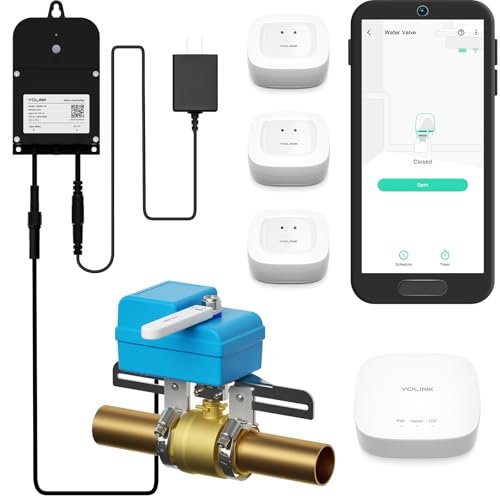
This YoLink smart water protection kit combines three water leak sensors, a smart valve controller, an EVO valve operator, and a YoLink Hub into one coordinated system. Instead of requiring plumbing modifications, the valve operator is designed to mount over a compatible existing shutoff valve and physically turn it when a leak is detected.
The system also uses YoLink's long-range LoRa-based wireless network and device-to-device, or D2D, communication. That combination is particularly attractive for homeowners who want leak protection to continue functioning locally even when internet access is unavailable or parts of the home's normal network are offline.
What Is Included in the YoLink Leak Detection Kit?
The bundle is designed as a complete leak detection and automatic shutoff system.
It includes:
- 3 YoLink Water Leak Sensors
- 1 Smart Valve Controller
- 1 EVO Valve Manipulator/Operator
- 1 YoLink Regular Hub
This means a new user can start building a working water protection system without purchasing the hub and valve-control hardware separately.
How the System Works
The system combines detection, communication, and physical valve control.
A typical leak event works like this:
- One of the water sensors detects water.
- The sensor communicates the event through the YoLink system.
- The valve controller activates the EVO valve operator.
- The operator turns the existing shutoff valve to the closed position.
- The system can send configured notifications to the user.
This is fundamentally different from a standalone water alarm because the system can take action instead of only reporting the problem.
Automatic Water Shutoff Can Reduce Continued Flow
The most important feature is automatic valve closure.
If a washing-machine hose bursts or a water heater starts leaking while nobody is home, every additional minute can allow more water into the property.
A shutoff system can reduce that continued supply.
It cannot eliminate water already released from:
- A failed water heater tank
- A full bathtub
- An appliance reservoir
but stopping incoming water can significantly limit many plumbing-related leaks.
No Plumbing Modification Required
One of the more appealing aspects of this kit is that the EVO valve operator is designed to work with an existing compatible valve rather than requiring the main line to be cut and replumbed.
That can simplify installation considerably.
Traditional automatic shutoff systems often require:
- Cutting pipe
- Adding a motorized ball valve
- Threading or soldering fittings
- Pressure testing new plumbing joints
A valve operator instead mechanically turns an existing shutoff handle.
Valve Compatibility Still Matters
"No plumbing required" does not mean every valve will work automatically.
Before purchasing, confirm:
- Valve style
- Handle shape
- Available clearance
- Pipe orientation
- Amount of torque required
The operator needs to physically grip and rotate the existing shutoff valve.
A corroded, seized, unusually shaped, or difficult-to-turn valve may not be suitable without maintenance or replacement.
Test the Existing Valve Manually First
Before relying on a motorized operator, manually open and close the shutoff valve.
It should move smoothly through its full travel.
If it is stiff, partially seized, or leaking around the stem, address that problem first.
A smart actuator cannot compensate reliably for a mechanically failing valve.
Three Leak Sensors for Multi-Area Protection
The kit includes three water sensors.
A practical starting configuration could be:
- Water heater
- Washing machine
- Kitchen or utility sink
That gives the system coverage across several common leak sources immediately.
Additional compatible YoLink sensors can be added later if broader monitoring is needed.
Best Places to Put the Leak Sensors
Good locations include:
- Beneath sinks
- Near toilets
- Beside water heaters
- Behind washing machines
- Near dishwashers
- Around sump pumps
- In basements
- Near refrigerator water lines
The most important rule is simple: place the sensor where leaking water is likely to reach it first.
Long-Range LoRa Communication
YoLink uses LoRa-based wireless communication rather than connecting every sensor directly to WiFi.
The manufacturer states a maximum open-air range of up to approximately 1/4 mile between compatible devices and the hub.
That can make the system particularly useful in locations where ordinary residential WiFi may be weak.
Useful for Basements and Remote Rooms
Long-range communication can help when sensors are placed in:
- Basements
- Attics
- Utility rooms
- Detached garages
- Storage buildings
Building materials will reduce real-world range, but LoRa is specifically designed for long-distance, low-bandwidth communication.
A leak sensor only needs to transmit small status messages, so this technology is well suited to the task.
Why LoRa Can Be Better Than Direct WiFi for Sensors
A conventional WiFi leak detector must maintain a relationship with the home's WiFi network.
That can mean:
- More battery consumption
- Poorer performance in remote areas
- More devices connected directly to the router
YoLink's architecture lets low-power devices communicate over a dedicated long-range network while the hub handles internet connectivity.
This can be more efficient when monitoring many locations.
Device-to-Device D2D Control
One of the strongest features of the YoLink ecosystem is its D2D, or device-to-device, capability.
When properly configured, compatible YoLink devices can communicate directly with one another rather than relying solely on a cloud service.
In a leak protection setup, that can allow a sensor to trigger the valve controller locally.
Why D2D Is Important for Leak Protection
Cloud-only automation has a weakness: internet connectivity.
If a leak occurs during an internet outage, a cloud-dependent system may not be able to execute its normal automation.
D2D is designed to reduce that dependency.
That means a configured leak sensor and valve controller may still be able to communicate locally even when the internet connection is unavailable.
Power Outage Considerations
The product description also emphasizes operation during power interruptions.
The water sensors are battery powered.
The Valve Controller 2 can reportedly operate on batteries for up to about two years or use direct power with batteries as backup.
That helps preserve local shutoff capability if normal AC power fails.
However, resilience depends on the configuration of the entire system.
The Hub and Internet Are Still Needed for Remote Features
Even if D2D handles local shutoff, remote features such as:
- App alerts
- Remote status
- Some third-party integrations
still depend on the hub and internet connectivity.
This distinction is important.
The system may protect locally during an outage while remote awareness is temporarily unavailable.
Long Battery Life
The YoLink water sensors are described as offering battery life of up to approximately five years.
Actual battery life will depend on:
- Number of alerts
- Signal conditions
- Temperature
- Battery quality
Even so, multi-year battery operation can significantly reduce maintenance compared with frequently charged smart devices.
Valve Controller Battery Backup
The Valve Controller 2 can reportedly operate for up to about two years on batteries, or it can use direct power while keeping the battery as backup.
For a safety-oriented device, backup power is valuable because leaks can occur during:
- Storms
- Utility outages
- Electrical failures
The backup helps reduce dependence on AC power.
YoLink Hub Provides App Connectivity
The included YoLink Hub links the long-range sensor network to online services.
Through the YoLink ecosystem, users can manage:
- Sensors
- Valve status
- Notifications
- Automation
The inclusion of the hub makes this kit more convenient for new YoLink users who do not already own one.
Notification Options
The product description lists several alert methods, including:
- App notifications
- SMS
iOS users may also be able to receive Critical Alerts depending on current app settings and platform support.
This gives users multiple ways to learn about a leak.
SMS Allowance
The supplied product description states that each account or device configuration includes a limited number of free SMS alerts per month and that additional alerts or services may be subject to current YoLink terms.
Because messaging policies and service plans can change, buyers should verify the current YoLink notification allowances before relying on a specific SMS quota.
Push notifications and email are usually the more practical primary alert methods.
App Notifications Are Usually the Most Important
For most users, push notifications provide the fastest and simplest remote warning.
Make sure the YoLink app has permission to:
- Send notifications
- Run in the background
- Use critical alerts if available
A smart leak system is less useful if the phone silently suppresses every warning.
Alexa Integration
The system is described as compatible with Amazon Alexa.
That can add voice and smart-home control for supported functions.
Voice control may be useful for:
- Checking system status
- Opening or closing the valve
- Creating routines
However, automatic leak response should be configured independently rather than relying on a user to issue a voice command.
Google Assistant Integration
Google Assistant compatibility is also listed.
As with Alexa, actual available commands may depend on the current YoLink integration and account configuration.
The most important function remains the automatic local leak-to-shutoff workflow.
IFTTT Integration
IFTTT can allow leak events to trigger actions across other internet-connected services.
Possible examples include:
- Logging events
- Sending custom notifications
- Triggering other smart devices
Because IFTTT is cloud dependent, it should be considered a convenience layer rather than the primary emergency shutoff mechanism.
Home Assistant Integration
Home Assistant support can be especially attractive to advanced smart-home users.
It may allow the leak system to participate in broader local automations or dashboards.
Potential uses include:
- Centralized leak monitoring
- Valve-state dashboards
- Notifications
- Home-mode routines
Current integration capabilities should be checked against the version of Home Assistant and YoLink support in use.
Local D2D vs. Smart-Home Integrations
The distinction is important.
Third-party platforms provide convenience and visibility.
D2D provides resilience.
For a water safety system, the core automation should ideally remain as independent as possible from:
- Cloud services
- Voice assistants
- External automation platforms
Those services can supplement the system without becoming its only path to shutoff.
Water Heater Protection
Water heaters are one of the best locations for automated leak protection.
Potential leak sources include:
- Tank corrosion
- Supply lines
- Drain valve
- Pressure-relief piping
A sensor beside the water heater can trigger the main shutoff valve if water is detected.
This is particularly valuable for heaters installed on upper floors or near finished spaces.
Washing Machine Protection
Washing-machine hose failures can release substantial water.
A sensor behind the appliance can monitor:
- Hot supply hose
- Cold supply hose
- Drain connection
- Internal appliance leakage
If water reaches the sensor, the system can shut off the main supply.
Under-Sink Protection
Kitchen and bathroom cabinets can hide leaks for a long time.
Common failures include:
- Faucet hoses
- Shutoff valves
- P-traps
- Garbage disposals
A sensor placed at the lowest point inside the cabinet can provide earlier detection.
Sump and Basement Monitoring
Basements are particularly suitable for YoLink because long-range communication can perform better than conventional WiFi in difficult areas.
Sensors can be positioned near:
- Sump pumps
- Utility sinks
- Boilers
- Water heaters
- Main plumbing equipment
Automatic Shutoff vs. Notification-Only Sensors
A notification-only system tells you that water has been detected.
This YoLink kit can go further by controlling the existing main valve.
That makes it more useful for unattended properties.
Notification-Only System
Advantages:
- Lower cost
- Simpler setup
Disadvantage:
- Someone still needs to shut off the water
Automatic Shutoff System
Advantages:
- Faster response
- Less dependence on human intervention
Disadvantage:
- More hardware and setup
Whole-House Shutoff Can Interrupt All Water
There is an important tradeoff.
If the operator controls the main household valve, any detected leak may shut off water to the entire property.
That means:
- Toilets stop refilling
- Faucets lose supply
- Appliances stop receiving water
That is usually desirable during a real leak, but false alarms can be inconvenient.
Correct sensor placement and regular testing matter.
Test the System End to End
After installation, do more than confirm that the devices appear online.
Perform a controlled test.
Verify that:
- The sensor detects water.
- The valve controller receives the command.
- The EVO operator fully closes the valve.
- Notifications arrive.
- The valve can be reopened normally.
This confirms that the entire protection chain actually works.
Test D2D Without Internet
If offline protection is a major reason for buying the system, test it deliberately.
After confirming normal operation:
- Follow the manufacturer's safe testing instructions.
- Disconnect internet access while keeping the necessary devices powered.
- Trigger a controlled leak event.
- Verify local shutoff.
This is the only reliable way to know whether the intended D2D configuration is functioning correctly.
Periodically Exercise the Valve
A shutoff valve may remain open for months or years.
Periodically operating it can help confirm that it still moves freely.
A seized manual valve can prevent the actuator from working when it is finally needed.
Follow the manufacturer's maintenance recommendations.
Common Setup Mistakes
Skipping Valve Compatibility Checks
The EVO operator must physically fit the existing valve.
Installing on a Stiff or Corroded Valve
Repair or replace problematic plumbing hardware first.
Poor Sensor Placement
Water must physically reach the sensor.
Relying Only on Cloud Automation
Use D2D where appropriate for local protection.
Never Testing the Shutoff
An untested system should not be assumed to work in an emergency.
Ignoring Battery Status
Backup operation depends on healthy batteries.
Who Is This YoLink Kit Best For?
This system may be particularly useful for:
- Homeowners
- Large properties
- Finished basements
- Vacation homes
- Rental properties
- Detached buildings
- Smart-home enthusiasts
- Homes with unreliable WiFi coverage
It is especially compelling for users who want automatic shutoff without cutting into the plumbing line.
Advantages and Considerations
Advantages
- Complete starter kit
- Three leak sensors included
- EVO valve operator included
- YoLink Hub included
- Automatic water shutoff
- No pipe cutting required for compatible valves
- LoRa long-range communication
- Up to approximately 1/4-mile open-air range
- D2D local device control
- Long sensor battery life
- Valve-controller battery backup
- App, email, and SMS notification options
- Alexa compatibility
- Google Assistant integration
- IFTTT support
- Home Assistant support
Potential Considerations
The existing shutoff valve must be compatible with the EVO operator.
A stiff or seized valve may need professional service.
Real-world range will be lower than open-air claims.
Remote alerts still depend on the hub and internet connection.
SMS allowances and service terms may change.
Automatic whole-house shutoff can interrupt water throughout the property if a sensor triggers.
Frequently Asked Questions
Does this kit include a hub?
Yes. A YoLink Regular Hub is included.
How many leak sensors are included?
Three.
Does it include an automatic shutoff device?
Yes. The kit includes a smart valve controller and EVO valve operator.
Does the installation require cutting pipes?
The product is designed to operate an existing compatible shutoff valve without cutting the plumbing.
What wireless technology does YoLink use?
LoRa-based long-range communication.
What is the stated maximum range?
Up to approximately 1/4 mile in open air.
Can it shut off water without internet access?
The system supports YoLink D2D communication, which is designed to allow compatible devices to communicate locally after proper setup.
Does the valve controller have backup power?
The product description states that it can run on batteries or use batteries as backup when externally powered.
How long do the leak sensor batteries last?
The manufacturer states up to approximately five years under typical conditions.
Does it work with Alexa?
Yes, according to the source.
Does it work with Google Assistant?
Yes.
Is Home Assistant supported?
Home Assistant integration is listed.
Does it support IFTTT?
Yes.
Can it send SMS alerts?
Yes, but SMS allowances and possible charges should be verified under current YoLink service terms.
Final Thoughts
The YoLink smart water leak detection and automatic shutoff kit is a more complete solution than a standard leak alarm because it combines detection with direct physical control of the home's existing water valve.
Its strongest features are the no-pipe-cutting valve operator, long-range LoRa communication, and D2D functionality. That architecture makes the system particularly attractive for larger homes, basements, detached structures, and properties where conventional WiFi or cloud-only automations may be less dependable.
The inclusion of three sensors, the hub, valve controller, and EVO operator also makes it a practical starter package for someone building a whole-home leak protection system from scratch.
The main requirement is compatibility: the existing shutoff valve must be suitable for the operator and mechanically healthy enough to turn reliably.
For homeowners looking for a long-range smart water leak system that can automatically shut off an existing valve and continue local D2D operation during network disruptions, this YoLink bundle offers a robust and flexible approach to water-damage prevention.