X-Sense Smart Water Leak Detector Review: App Alerts, 110 dB Alarm, IP66 Protection, and Early Leak Detection
A small leak under a washing machine, water heater, dishwasher, or sink can go unnoticed until it causes visible damage. Smart water leak detectors are designed to shorten that response time by sensing even a shallow layer of water and immediately alerting both people inside the home and users who may be away.
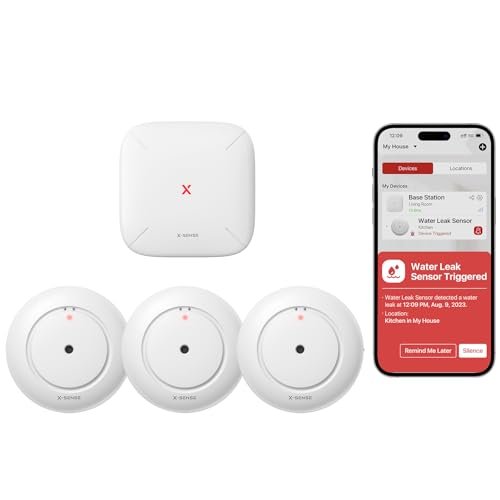
This X-Sense smart water leak detector combines local alarms with app-based remote notifications. It connects through an included base station to the X-Sense Home Security App, allowing users to receive alerts, check device status, share access with family members, and temporarily silence alarms when needed.
Its strongest features are the combination of six water-detection probes, a stated detection threshold of approximately 0.015 inch (0.4 mm), simultaneous alarm sounding from both the sensor and base station, and an IP66-rated enclosure intended for humid locations.
For homeowners who want early warning rather than waiting to discover a puddle manually, it offers a useful layer of protection around common household leak sources.
What Is the X-Sense Smart Water Leak Detector?
This system consists of a water leak sensor and a compatible base station.
The sensor is placed near an area where leaks may occur. If water reaches the detection probes, the device triggers a local alarm and sends a signal to the base station.
The connected system can then deliver a push notification through the X-Sense Home Security App.
That gives the system two complementary functions:
- Immediate local warning
- Remote smartphone notification
Why Smart Leak Detection Matters
Traditional standalone leak alarms can make a loud sound, but they only help if someone is close enough to hear them.
A connected detector adds another level of awareness because it can notify you when:
- You are at work
- You are traveling
- The leak occurs in a basement
- The appliance is in another part of the house
That remote warning can be particularly valuable when nobody is home.
2.4 GHz WiFi Requirement
The system is described as compatible with 2.4 GHz WiFi only.
It does not support 5 GHz WiFi directly.
This is common for smart-home sensors because 2.4 GHz typically offers better range through walls and floors than higher-frequency WiFi.
The Sensor Connects Through the Base Station
An important detail is that the leak sensor does not necessarily connect directly to your router.
The supplied description states that it communicates through the included base station, which then integrates with the X-Sense Home Security App.
That architecture can help centralize multiple compatible sensors in one system.
What If Your Router Uses Both 2.4 and 5 GHz?
Many modern routers broadcast both frequencies under one network name.
This may work normally, but initial setup can sometimes be easier if the router clearly exposes a 2.4 GHz network.
If pairing fails, confirm that:
- 2.4 GHz is enabled
- Signal strength is adequate
- Base station is within WiFi coverage
Real-Time Smartphone Notifications
When water is detected, the system can send a push alert to the connected phone.
That means the first indication of a leak does not have to come from walking into the room and finding water on the floor.
The app can potentially alert you within moments of detection.
Why Remote Notifications Are Useful
Consider a slow washing-machine supply-line leak while you are away from home.
A conventional audible alarm may continue sounding in an empty house.
A smart detector can instead notify you remotely so you can:
- Contact someone nearby
- Shut off the water if possible
- Return home
- Arrange emergency assistance
The sensor itself does not stop the leak, but faster awareness can improve response time.
Simultaneous Sensor and Base-Station Alarm
When triggered, both the local water sensor and the base station are described as sounding an alarm.
The maximum stated alarm volume is up to 110 dB.
That is intentionally loud so the warning can be noticed throughout more of the home.
Why Two Audible Alarm Sources Help
If the leak occurs in a basement, laundry room, or utility closet, the local detector may be partially muffled by walls or appliances.
The base station provides a second alarm source in another location.
This can make the warning easier to hear from occupied areas of the house.
A 110 dB Alarm Is Very Loud
An alarm rated up to 110 dB should be treated as a high-volume warning device.
That is useful during an emergency, but prolonged exposure at close range can be uncomfortable.
Once the leak has been identified, the alarm should be silenced using the available controls rather than leaving it sounding unnecessarily.
Multiple Ways to Silence the Alarm
The source describes several ways to mute the system.
You can reportedly silence it through:
- X-Sense app
- Base-station button
- Water-sensor button
This flexibility is useful because you may not always have your phone nearby.
“Remind Me Later” Function
The app also includes a Remind Me Later option.
This allows the alarm to be temporarily silenced rather than dismissed permanently.
Available snooze periods include:
- 10 minutes
- 30 minutes
- 2 hours
- 6 hours
- 12 hours
This can be helpful when the source of the water is known but cannot be dealt with immediately.
Temporary Silence Should Not Replace Fixing the Leak
A snooze feature is convenient, but it should not become a way to ignore an active water problem.
If the sensor repeatedly detects water, investigate the source.
Common causes include:
- Loose hose connection
- Failing appliance seal
- Condensation
- Drain backup
- Plumbing leak
The alarm is only the warning system.
Six Detection Probes
The sensor uses a combination of:
- 2 probes on top
- 4 probes on bottom
This arrangement is designed to detect both water accumulating beneath the device and water reaching it from above or around the sides.
Why Bottom Sensors Matter
Most household leaks begin at floor level.
Water from a washing machine, dishwasher, water heater, or supply hose generally spreads horizontally along the floor.
Bottom probes are therefore positioned where early contact is most likely.
Why Top Sensors Are Useful
Top probes can help detect dripping water or rising water that reaches the upper part of the sensor.
This adds another detection path rather than relying only on water underneath the device.
Detection Threshold of About 0.4 mm
The source states that the detector can respond to water levels as shallow as approximately:
0.015 inch, or 0.4 mm
That is a very small amount of standing water.
The goal is to detect a leak while it is still relatively minor rather than waiting for a deep puddle to form.
High Sensitivity Can Be Valuable
Early detection is especially useful near appliances where even a slow leak can continue for hours.
Examples include:
- Refrigerator water line
- Washing machine
- Dishwasher
- Water heater
- Sink cabinet
A sensor that reacts to shallow water may provide more warning time.
Sensitivity Also Means Placement Matters
A highly sensitive sensor can sometimes react to harmless moisture if placed poorly.
Avoid locations where routine water exposure is expected, such as:
- Directly inside a shower
- Where floors are regularly mopped wet
- Locations with frequent condensation pooling
The goal is to detect abnormal water, not normal household moisture.
IP66 Waterproof Rating
The detector is described as having an IP66 rating.
An IP66 enclosure is designed to provide strong resistance to dust ingress and powerful water jets.
That makes it better suited to humid and splash-prone environments than an ordinary indoor electronic device.
Waterproof Does Not Mean Submersible
IP66 should not be interpreted as permission to leave the detector underwater.
The rating provides protection from water exposure, but it is not the same as a continuous-submersion rating.
If the area is already deeply flooded, the sensor should be handled according to the manufacturer's instructions.
Good Locations for a Leak Sensor
The most effective placement is usually close to a plausible water source.
Typical locations include:
- Under kitchen sinks
- Under bathroom sinks
- Behind washing machines
- Near dishwashers
- Beside water heaters
- Near sump pumps
- Under refrigerator water lines
The sensor should be positioned where leaking water is likely to reach it quickly.
Water Heater Placement
A water heater can leak from:
- Tank
- Pressure-relief valve
- Drain valve
- Connections
Place the sensor on a stable floor area near the heater rather than directly underneath piping where condensation might cause nuisance alerts.
Washing Machine Placement
Washing-machine leaks can come from:
- Supply hoses
- Drain hose
- Pump
- Door seal
A sensor placed near the back or side of the machine can provide early warning if water escapes onto the floor.
Dishwasher Placement
Dishwasher leaks can be difficult to notice because much of the appliance is enclosed beneath the counter.
Placing a sensor where water would emerge from beneath the machine can help detect a problem before it spreads across the kitchen.
Under-Sink Placement
Under-sink cabinets are another good location.
Leaks often begin at:
- Supply shutoff valves
- P-trap
- Faucet hoses
- Garbage disposal
A sensor on the cabinet floor can detect water that would otherwise remain hidden.
Family Sharing
The X-Sense app allows the device to be shared with family members according to the supplied description.
This means more than one person can receive alerts or check device status.
That redundancy can be useful if the primary account holder is unavailable.
Shared Alerts Improve Response
If multiple people receive the notification, whoever is closest to home may be able to respond first.
This can be particularly useful in:
- Shared households
- Families
- Rental properties
- Multi-generational homes
Device Status Monitoring
The app can reportedly show device status remotely.
That allows users to check whether the detector is connected and functioning without physically inspecting it every time.
Low-Battery Warnings
The system also includes low-battery notifications.
This is an important feature because a leak detector that silently runs out of power provides no protection.
Replace batteries promptly when the warning appears.
Test Function
The app includes a device-test feature.
Periodic testing is a good practice because it confirms that:
- Sensor is responsive
- Base station is communicating
- Alarm sounds
- App notifications arrive
Testing is especially important after changing network equipment or moving the sensor.
How Often Should You Test It?
Follow the manufacturer's recommendations.
As a general practical habit, test leak sensors periodically and after:
- Battery replacement
- Router changes
- Moving the base station
- Moving the detector
A connected status indicator is useful, but it is not a substitute for occasional functional testing.
Smart Leak Detector vs. Standalone Alarm
A standalone detector sounds locally.
A smart detector adds remote connectivity.
Standalone Advantages
- Simpler setup
- No app required
- No WiFi dependency
Smart Detector Advantages
- Smartphone alerts
- Remote status
- Shared access
- Low-battery notifications
- Multiple alarm points
The connected model is more useful when remote awareness matters.
Leak Sensor vs. Automatic Shutoff System
This product is primarily a detector and alarm system.
It does not appear to automatically close the home's main water supply.
That distinction is important.
A detector tells you that water is present.
An automatic shutoff system can potentially stop the flow when a leak is detected.
Should You Add an Automatic Shutoff Valve?
For higher-risk properties, pairing leak sensors with an approved smart shutoff valve may provide a stronger protection strategy.
This can be especially useful for:
- Vacation homes
- Second homes
- Properties left empty frequently
Compatibility would need to be evaluated separately.
What Happens if WiFi Goes Down?
The supplied description emphasizes app notifications but also states that the detector and base station sound locally.
That local alarm is valuable because it means the system is not useful only when internet access is available.
However, remote smartphone alerts may be unavailable during a network outage.
Base Station Placement
Place the base station somewhere that has:
- Good WiFi coverage
- Reliable power
- Audible access to occupied areas
Avoid hiding it deep inside a cabinet where the alarm may be harder to hear.
Sensor-to-Base Communication
The source does not provide a specific communication range between the leak sensor and the base station.
Walls, floors, appliances, and building materials can affect wireless performance.
Test communication from the intended sensor location before relying on the setup.
Rust-Resistant Exterior
The source describes the detector as having a rust-proof exterior coating.
This is useful because leak detectors often spend years in:
- Humid utility spaces
- Laundry rooms
- Basements
The housing still deserves routine inspection if it is exposed to repeated moisture.
Common Mistakes
Placing the Sensor Too Far From the Leak Source
Water should reach it early, not only after the entire room has flooded.
Ignoring Low-Battery Alerts
Replace batteries promptly.
Assuming IP66 Means It Can Stay Submerged
It is water resistant, not necessarily designed for continuous underwater operation.
Silencing the Alarm Without Investigating
Find the actual source of the water.
Depending Entirely on Push Notifications
Local alarms remain important if the network goes down.
Who Is This Sensor Best For?
This X-Sense water leak detector is a strong fit for homeowners who want:
- Remote leak notifications
- Very loud local alarms
- Multiple detection probes
- High water sensitivity
- Family sharing
- Battery alerts
- Humidity-resistant construction
It is particularly useful near appliances and plumbing fixtures that can leak while the home is unattended.
Who May Need a More Advanced System?
A more comprehensive water-protection system may be preferable if you need:
- Automatic main-water shutoff
- Flow monitoring
- Whole-home plumbing analytics
- Integration with a building-management system
This product focuses primarily on early detection and notification.
Advantages and Considerations
Advantages
- Real-time smartphone alerts
- Up to 110 dB audible alarm
- Sensor and base station both sound
- 2 top probes and 4 bottom probes
- Detection threshold down to about 0.4 mm
- IP66-rated enclosure
- Device sharing
- Low-battery alerts
- Remote status monitoring
- Temporary alarm-snooze options
Potential Considerations
- Requires included base station
- Uses 2.4 GHz WiFi
- Does not support 5 GHz directly
- Does not appear to shut off water automatically
- App notifications depend on network connectivity
- Placement affects detection speed
Frequently Asked Questions
Does it connect directly to WiFi?
The supplied description states that it connects through the included base station.
Which WiFi band does it support?
2.4 GHz only.
Does it support 5 GHz?
No, according to the source.
Which app does it use?
The X-Sense Home Security App.
Does it send alerts when I am away from home?
Yes, provided the system remains online.
How loud is the alarm?
The source states up to 110 dB.
Does only the leak sensor sound?
No. Both the sensor and the base station are described as sounding when a leak is detected.
How many water probes does it have?
Six total: 2 top probes and 4 bottom probes.
How little water can it detect?
The source states approximately 0.015 inch or 0.4 mm.
Is the sensor waterproof?
It is rated IP66.
Can I submerge it?
IP66 does not imply continuous submersion capability.
Can I silence the alarm from my phone?
Yes.
Can I silence it manually?
Yes, using the sensor or base-station controls according to the supplied information.
What is the Remind Me Later function?
It temporarily silences the alarm for a selected period.
Which snooze periods are available?
10 minutes, 30 minutes, 2 hours, 6 hours, or 12 hours.
Does it warn me when the battery is low?
Yes.
Can family members access the sensor?
Yes. Device sharing is supported.
Does it automatically shut off the water?
The supplied description does not state that it controls a shutoff valve, so it should be treated as a detection and alert system.
Final Thoughts
The X-Sense smart water leak detector offers a practical combination of sensitive water detection, loud local alarms, and remote smartphone notifications.
Its strongest features are the six detection probes, approximately 0.4 mm water-detection threshold, up to 110 dB alarm, simultaneous base-station warning, IP66-rated housing, low-battery notifications, and family sharing through the X-Sense Home Security App.
The system is especially useful around appliances and fixtures where leaks may otherwise remain hidden for hours. Correct placement is crucial: the sensor should sit where the first escaping water is likely to travel, not merely somewhere convenient nearby.
It is also important to understand what the system does not do. It alerts you to water; it does not appear to stop the leak automatically. For homeowners who want early warning around washing machines, dishwashers, water heaters, sinks, or other vulnerable plumbing locations, however, this type of connected sensor provides a valuable extra layer of 24/7 leak awareness both inside and away from the home.