WOODBRIDGE 51-Inch Stone Resin Freestanding Bathtub Review: Compact Luxury Soaking Tub for Modern Bathrooms
A freestanding bathtub can transform a bathroom visually, but the best models also need to solve practical problems: fitting the available floor plan, retaining heat, supporting the body comfortably, staying stable during use, and remaining manageable to clean over time. Those considerations become even more important in smaller bathrooms, where many oversized soaking tubs simply take up too much space.
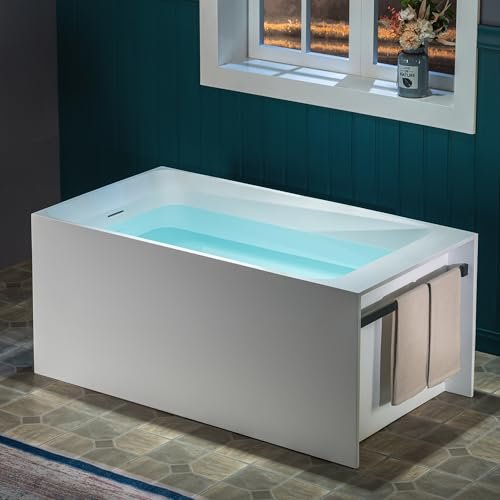
The WOODBRIDGE 51-1/8-inch stone resin freestanding soaking bathtub is designed around a more compact footprint while still offering the substantial feel of a solid-surface tub. It measures approximately 51-1/8 inches long, 27-1/2 inches wide, and 22-7/8 inches high, with a listed capacity of 44 gallons. The tub uses a matte-white solid-surface construction, incorporates an exterior towel bar, includes double-wall insulation, and weighs roughly 330 pounds.
That weight alone separates it from lightweight acrylic tubs. It can contribute to excellent stability and a more substantial feel, but it also has major implications for delivery, floor loading, and installation.
For buyers comparing compact freestanding tubs for a primary bathroom, renovation, or smaller spa-inspired space, this WOODBRIDGE model offers an appealing mix of solid construction, minimalist styling, ergonomic shaping, and practical accessories. The key is making sure its dimensions, weight, bathing well, and plumbing requirements suit the room before purchase.
What Is the WOODBRIDGE 51-Inch Freestanding Soaking Tub?
This model is a freestanding solid-surface soaking bathtub designed for bathrooms where a full 60- to 72-inch tub may be too large.
Its exterior dimensions are approximately:
51-1/8 inches long × 27-1/2 inches wide × 22-7/8 inches high.
The manufacturer lists a capacity of about 44 gallons.
Unlike a built-in alcove tub, it does not need to be enclosed by three walls. Instead, it sits independently on the bathroom floor and connects to the drain below.
That gives the room a more open, sculptural appearance and provides more flexibility in placement.
A Compact Footprint for Smaller Bathrooms
One of the strongest reasons to consider this tub is its relatively short 51-inch length.
Many freestanding bathtubs are around 59 to 67 inches long, while larger luxury tubs can exceed 70 inches.
That makes them difficult to install in smaller primary bathrooms, guest suites, condos, or renovations where floor area is limited.
At just over 51 inches, this model is significantly easier to accommodate.
Compact Does Not Mean Tiny
Although the exterior length is modest, the bathtub is designed with a curved interior to maximize usable soaking space.
That matters because exterior dimensions do not tell you exactly how comfortable a tub will feel.
The thickness of the walls, angle of the backrest, interior floor length, and width at shoulder level all affect how much usable room remains.
A well-shaped 51-inch tub can feel more comfortable than a poorly designed longer tub.
Measure Your Body as Well as Your Bathroom
Before buying any compact soaking tub, do not look only at the room dimensions.
Consider the tallest regular user.
A person who is 5'3" may find a 51-inch soaking tub comfortable, while someone well over 6 feet tall may prefer a longer model.
The important measurements include:
- Interior bottom length
- Top interior length
- Water depth
- Backrest angle
- Shoulder width
The source does not provide all of these internal measurements, so they should be checked in the current WOODBRIDGE dimensional drawing if available.
44-Gallon Capacity
The tub has a listed capacity of approximately 44 gallons.
That is moderate for a freestanding soaking tub.
A lower capacity can be beneficial because the tub requires less water to fill compared with a large 60- or 70-gallon model.
It may also reduce the demand placed on the home's water heater.
However, actual bathing volume will be lower than the total capacity once a person enters the tub.
Check Your Water Heater Capacity
A commonly overlooked detail when buying a soaking tub is whether the household water heater can supply enough hot water.
A 44-gallon tub does not necessarily require 44 gallons of pure hot water because hot and cold water are mixed.
Still, filling a deep bath can consume a substantial portion of a conventional storage water heater's usable capacity.
If you have a small electric tank, it is worth estimating whether it can provide a comfortable full bath without running cold.
Tankless systems should also be sized for the tub filler's flow rate.
Solid-Surface Construction
WOODBRIDGE describes the tub as using a combination of PMMA and MMA acrylic with aluminum powder, creating a solid-surface or stone-resin-style construction.
This differs from a typical thin-shell acrylic tub.
Solid-surface tubs generally feel denser, heavier, and more substantial.
The material can also provide a smooth, uniform appearance without the obvious hollow feel sometimes associated with lightweight fiberglass or acrylic models.
What PMMA and MMA Mean
PMMA is polymethyl methacrylate, commonly associated with acrylic surfaces.
MMA is methyl methacrylate, a key monomer used in acrylic materials.
Combined with mineral or aluminum-based filler, these materials can create a dense composite surface with a stone-like appearance.
The result is intended to offer the visual refinement of solid surface with practical resistance to moisture.
Matte White Finish
The tub uses a matte white finish rather than high-gloss acrylic.
That gives it a more architectural, contemporary appearance.
Matte surfaces tend to diffuse light rather than reflect it, which can make the tub appear softer and more sculptural.
They also pair well with modern bathroom materials such as brushed nickel, matte black, natural stone, terrazzo, concrete-look tile, and light wood cabinetry.
Matte vs. Glossy Bathtubs
A glossy acrylic tub often looks brighter and can be easier to wipe clean because of its slick surface.
A matte solid-surface tub offers a more premium, understated appearance but may show soap residue differently.
Both finishes can perform well.
The better choice depends mostly on bathroom design, maintenance preferences, and how visible water spots are in your local water conditions.
Non-Porous Surface
The supplied description emphasizes a non-porous surface.
That is useful in a bathtub because porous materials can absorb moisture, stain more easily, and become harder to sanitize.
A properly finished solid-surface tub should resist ordinary bathroom residue and be relatively easy to wipe clean.
That said, "stain resistant" does not mean completely stain proof.
Hair dyes, strongly colored bath products, oils, and harsh chemicals should still be cleaned promptly.
Easy Cleaning Without Harsh Chemicals
For normal maintenance, mild soap and a soft cloth or non-abrasive sponge are generally preferable.
Avoid aggressive scouring pads or highly abrasive powders unless WOODBRIDGE specifically recommends them.
The matte finish can be damaged by cleaning methods intended for tile or porcelain.
Following the manufacturer's care instructions is the safest way to preserve the surface.
Ergonomic Curved Interior
The bathtub uses a curved interior profile intended to support the body during soaking.
This is important in a short freestanding tub.
A vertical wall wastes potential comfort because the user has to sit upright.
A gently sloped backrest lets the body recline, making better use of the available length.
The actual comfort will depend on body size and preferred bathing position.
Soaking Tub vs. Standard Bathtub
A soaking tub emphasizes depth and immersion rather than long horizontal lounging space.
That makes a compact model particularly viable.
You may not be able to fully stretch your legs flat, but deeper water can still cover more of the torso.
For users who prefer upright soaking, a shorter deep tub can be more appealing than a long shallow one.
Double-Wall Construction and Heat Retention
WOODBRIDGE describes the tub as having double-wall insulation.
The goal is to slow heat transfer from the bathwater to the room.
This can help water stay comfortable for longer compared with a thin, uninsulated shell.
Solid-surface material also has substantial thermal mass, which can contribute to the overall bathing feel once warmed.
Heat Retention Has Limits
No freestanding bathtub can keep water hot indefinitely without an active heating system.
Heat still escapes through the open water surface, tub walls, and surrounding air.
A warmer bathroom, pre-warming the tub with hot water, and avoiding excessive air movement can all help extend a soak.
The double-wall design should be viewed as improved insulation, not active temperature maintenance.
Approximately 330 Pounds Empty
The tub's listed weight is around 330 pounds.
This is one of its most important specifications.
A lightweight acrylic freestanding tub may weigh well under 150 pounds.
At 330 pounds before water or a bather is added, the WOODBRIDGE has considerably more mass.
That creates both advantages and installation challenges.
Why Heavy Weight Can Be an Advantage
A heavy tub is less likely to feel hollow, shift, rock, or move when someone gets in and out.
Once installed correctly, the mass can create a very solid bathing experience.
It also contributes to the premium feel of stone-resin and solid-surface tubs.
Freestanding tubs sometimes feel less secure than built-in models, so additional stability can be reassuring.
Floor Loading Needs Attention
The total installed load is much greater than 330 pounds.
A 44-gallon capacity represents hundreds of additional pounds of water.
Then add the weight of the bather.
The combined load can become substantial.
For a properly built ground-floor concrete slab, this may be straightforward. On an upper floor or older wood-framed structure, it is wise to verify that the floor system can support the concentrated load.
A contractor or structural professional can evaluate questionable installations.
Delivery and Handling
A 330-pound bathtub is not a one-person delivery.
Plan how it will move from the delivery location to the bathroom before purchasing.
Consider:
- Stairs
- Narrow hallways
- Door widths
- Tight corners
- Finished flooring
- Number of installers required
A tub can fit perfectly in the bathroom but still be impossible to move through the house without planning.
Built-In Exterior Towel Bar
One unusual feature is the integrated metal towel bar on the exterior of the tub.
This can be surprisingly practical.
Freestanding tubs are often positioned away from walls, leaving bathers with nowhere convenient to reach a towel.
An integrated bar places it directly beside the bathing area.
Design Benefits of the Towel Bar
The towel bar also adds visual contrast to the otherwise minimal tub body.
Depending on the selected bathroom fixtures, it can act as a design detail rather than merely a utility component.
The source describes it as having a textured finish intended for durability.
Buyers should verify the exact towel-bar finish if they are trying to match faucets, shower hardware, or cabinet pulls.
Two Drain Cover Options
The package includes two drain covers:
- A pre-installed matte white cover
- An additional matte black cover
This is a thoughtful detail because it lets the bathtub work with more design schemes without replacing the drain trim.
The white cover creates a seamless monochromatic look.
The black cover adds contrast and coordinates well with matte-black faucets and accessories.
Included Brass Tailpiece
The drain kit also includes a brass tailpiece according to the source.
Brass is a common plumbing material because of its durability and corrosion resistance.
Having drain components included can simplify installation, although compatibility with the home's actual drain position and plumbing still needs to be checked.
Freestanding Installation
The tub is intended for freestanding installation with a floor drain connection.
This provides more layout flexibility than an alcove model.
It can be positioned:
- Against a feature wall
- Near a window
- Centered in a larger bathroom
- Between vanity zones
- In a dedicated wet-room area
However, "freestanding" does not mean installation can happen anywhere without plumbing preparation.
Drain Position Matters
Before ordering, confirm where the bathtub drain sits relative to the home's rough-in.
If the existing floor drain does not align, plumbing work may be required.
Some freestanding tub installations use specialized drain adapters that simplify final positioning, but the appropriate method depends on the tub and local plumbing arrangement.
Check the installation manual before the finished floor is completed.
Faucet Planning
The tub itself does not appear to include a tub filler in the supplied description.
That means buyers need to plan a separate faucet.
Common choices include:
Floor-Mounted Tub Filler
A freestanding floor-mounted faucet complements the tub's sculptural appearance.
It requires water lines to come through the floor and should be carefully positioned so the spout reaches comfortably over the rim.
Wall-Mounted Tub Filler
A wall-mounted filler keeps the floor cleaner visually and can be easier to stabilize.
The tub must sit close enough to the wall for the spout to reach properly.
Deck-Mounted Faucet
Some freestanding tubs support deck-mounted fixtures, but this should never be assumed.
The source does not state that this model can be drilled or deck mounted.
Follow WOODBRIDGE's instructions before modifying the tub.
Consider Tub-Filler Flow Rate
A 44-gallon soaking tub can take a long time to fill with a low-flow faucet.
A dedicated tub filler typically provides much higher flow than a standard bathroom faucet.
The plumbing supply, water heater, and drain should all be considered together.
A beautiful tub becomes frustrating if it takes an excessive amount of time to fill.
Installation on Finished Flooring
A freestanding tub generally sits directly on the finished floor.
That makes floor flatness important.
Stone-resin tubs are rigid and heavy, so they should be supported evenly.
Tile lippage or an uneven subfloor can create rocking or concentrated stress.
Verify that the floor is level before final installation.
Protect the Floor During Installation
A 330-pound tub can damage tile, stone, or wood if dragged into position.
Use appropriate moving equipment, padding, and multiple people.
Do not slide the tub across the finished floor unless the manufacturer explicitly permits it and the surface is properly protected.
Make Sure the Tub Can Be Serviced
Plumbing should remain reasonably accessible.
A freestanding design can make drain maintenance more complicated if the installer permanently seals the tub into a position with no service strategy.
Plan the drain connection before installation and follow WOODBRIDGE's instructions regarding sealant or anchoring.
Stone Resin vs. Acrylic Bathtub
A standard acrylic bathtub is lighter, typically easier to transport, and often less expensive.
Stone-resin or solid-surface tubs are heavier and can feel more substantial.
They also tend to provide a more sculptural matte appearance.
The tradeoff is installation difficulty and structural load.
Neither material is automatically better; they serve different priorities.
Stone Resin vs. Cast Iron
Cast-iron tubs are extremely durable and excellent at retaining heat once warmed.
They are also extremely heavy and usually have a traditional porcelain-enamel appearance.
A modern solid-surface tub offers a similarly substantial feel with more contemporary shapes.
It may also be easier to repair cosmetically than chipped enamel, depending on the type of damage and manufacturer's repair guidance.
Stone Resin vs. Porcelain-Enameled Steel
Steel tubs are lighter and generally more affordable.
They can feel colder initially and may produce more noise when water hits the shell.
Solid-surface construction offers more mass, quieter operation, and a more premium appearance.
The cost and installation burden are typically higher.
Is 51 Inches Large Enough for Two People?
This model should primarily be considered a single-person soaking tub.
At 51-1/8 inches long and 27-1/2 inches wide, it is compact.
Two adults are unlikely to find it comfortable for shared bathing.
Buyers looking for a two-person tub should generally consider a significantly larger model designed specifically for dual bathing.
Is It Good for Tall People?
That depends on how you like to bathe.
A tall person may still enjoy a compact soaking tub by sitting more upright with knees bent.
If you prefer to stretch out nearly flat, 51 inches will probably feel restrictive.
Check the internal bathing dimensions rather than the exterior length alone.
Is It Good for Small Bathrooms?
Yes, this is one of its strongest applications.
The shorter length can make a freestanding bath possible in a room where a 59- or 67-inch model would dominate the space.
Still, make sure there is adequate clearance around the tub for cleaning and safe access.
A tub that technically fits but leaves only a few inches of unusable space around it may not be practical.
How Much Clearance Should You Leave?
Exact requirements depend on layout and local code, but from a usability standpoint, enough space should remain to clean around the tub and move safely.
Freestanding tubs look best when they have some visual breathing room.
If a tub is jammed tightly between two walls, a built-in configuration may be more practical.
Is It Good for Primary Bathrooms?
Yes.
The matte solid-surface appearance, towel bar, drain-cover options, and substantial construction make it visually appropriate for a primary bathroom renovation.
It can work particularly well where homeowners want a luxury soaking experience but do not have room for an oversized tub.
Is It Good for Guest Bathrooms?
Potentially, but consider usage.
A 330-pound premium soaking tub may be more investment than a rarely used guest bathroom needs.
For a high-end guest suite, however, its compact footprint could be ideal.
Is It Suitable for Families With Children?
It can be used as a normal bathtub, but high freestanding sides may make bathing small children less convenient for caregivers who need to reach over the edge.
A standard alcove tub often provides easier access for young children.
The best configuration depends on whether the bathroom is intended primarily for adult soaking or family bathing.
Slip Resistance
The source does not provide a specific slip-resistance rating.
As with any smooth bathtub, use caution when entering and exiting.
A freestanding tub also lacks the nearby wall surfaces of an alcove bath, so there may be fewer natural handholds.
If accessibility is a concern, properly positioned grab bars or other supports should be considered separately.
Common Buying Mistakes
One major mistake is measuring only the available floor footprint.
You also need to measure doorways, hallways, and stairs for delivery.
Another is forgetting the filled weight when evaluating the floor.
Buyers may also overlook the water-heater capacity needed to fill a 44-gallon soaking tub.
Another mistake is purchasing the tub before finalizing drain and faucet locations.
Finally, compact exterior dimensions should not be mistaken for guaranteed comfort for every body size.
What to Check Before Buying
Before ordering this WOODBRIDGE bathtub, confirm:
- Bathroom floor dimensions
- Door and hallway clearance
- Internal bathing dimensions
- Drain rough-in location
- Faucet configuration
- Water-heater capacity
- Floor structural capacity
- Final filled weight
- Cleaning clearance
- Delivery access
- Local plumbing requirements
Doing this before purchase can prevent an expensive installation problem.
Main Advantages
The biggest strengths are its premium construction and compact dimensions.
At approximately 51-1/8 x 27-1/2 x 22-7/8 inches, the tub offers a freestanding look without requiring the space of a large luxury bathtub.
The matte-white solid-surface body, ergonomic interior, 44-gallon capacity, double-wall insulation, integrated towel bar, heavy 330-pound construction, brass tailpiece, and interchangeable matte-white and matte-black drain covers add both practical and visual value.
Its weight also gives it stability that lightweight acrylic tubs may lack.
Potential Drawbacks
The 330-pound empty weight can significantly complicate transportation and installation.
The tub may be too short for taller users who prefer to stretch out.
Floor structure should be evaluated in questionable upper-level installations.
A 44-gallon bath also places meaningful demand on the home's hot-water system.
And because the source does not provide complete interior dimensions or faucet hardware, buyers should verify those details before purchasing.
Who Should Consider This WOODBRIDGE Tub?
This model is particularly well suited to buyers who want:
- A compact freestanding bathtub
- A modern matte-white bathroom design
- A solid-surface or stone-resin feel
- A deep single-person soaking experience
- Better stability than lightweight acrylic
- Integrated towel storage
- Flexible drain-finish options
- A luxury tub for a smaller primary bathroom
It is less ideal for buyers who need a lightweight DIY installation, a two-person bath, or a long lounging tub for very tall users.
Frequently Asked Questions
How long is the bathtub?
Approximately 51-1/8 inches.
How wide is it?
Approximately 27-1/2 inches.
How tall is it?
Approximately 22-7/8 inches.
What is the capacity?
Approximately 44 gallons.
How much does the tub weigh?
Approximately 330 pounds empty, according to the supplied information.
What is the tub made from?
The source describes a solid-surface composition using high-grade PMMA and MMA acrylic with aluminum powder.
Is it a normal lightweight acrylic bathtub?
No. Its substantial weight and composite construction distinguish it from typical thin-shell acrylic tubs.
What color is it?
Matte white.
Does it have a glossy finish?
No. The supplied model uses a matte finish.
Does it have an integrated towel bar?
Yes.
Is it insulated?
The source describes double-wall construction intended to improve heat retention.
Does it include the drain?
A drain assembly with brass tailpiece and drain covers is included according to the supplied description.
What drain-cover colors are included?
Matte white and matte black.
Is the tub freestanding?
Yes.
Does it include a faucet?
A faucet is not mentioned in the supplied package details, so buyers should plan for a separate tub filler.
Is it suitable for small bathrooms?
Yes. The 51-inch length is one of the key advantages of this model.
Is it designed for two people?
Its compact dimensions make it more appropriate for one-person soaking.
Does it require professional installation?
Given the 330-pound weight, floor loading, plumbing, and drain alignment, professional installation is a sensible choice for many buyers.
Can it be installed upstairs?
Potentially, but the floor should be capable of supporting the tub, water, and bather. Structural evaluation may be appropriate in uncertain cases.
Final Verdict
The WOODBRIDGE 51-1/8-inch stone resin freestanding soaking bathtub is an attractive option for homeowners who want the look and substantial feel of a luxury solid-surface bath without committing to a large 60- or 70-inch footprint.
Its key strengths are the compact 51-inch length, 44-gallon capacity, approximately 330-pound stable construction, ergonomic curved interior, matte-white solid surface, double-wall insulation, integrated towel bar, and included dual-finish drain covers.
The substantial weight is both an advantage and a consideration. It helps the tub feel exceptionally stable, but makes delivery, floor loading, and installation more demanding than with a lightweight acrylic model.
For a smaller or mid-sized primary bathroom where space is limited but a premium freestanding soaking tub is still desired, this WOODBRIDGE model offers an appealing balance of modern design, durability, heat retention, and compact luxury.