BaldrTherm WiFi Water Leak Detector Review: Smart Alerts, 100 dB Alarm, and IPX7 Protection
Water leaks rarely announce themselves at a convenient time. A washing-machine hose can fail while nobody is home, a dishwasher can begin leaking beneath cabinetry, or a slow drip around a water heater can spread across the floor before anyone notices. A smart leak detector helps reduce that blind spot by monitoring vulnerable areas continuously and sending an alert when water is detected.
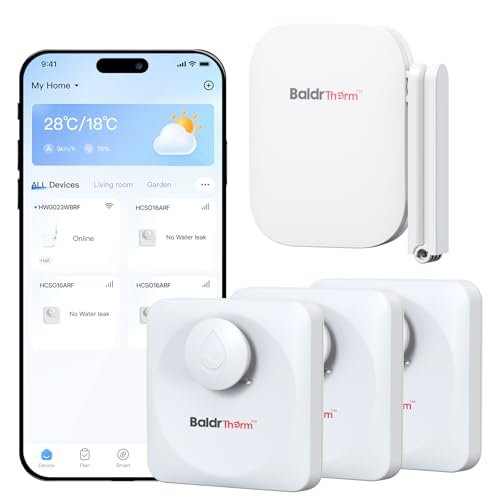
The BaldrTherm WiFi water leak detector is designed for that purpose. It combines drip and flood sensing probes with a loud local alarm, remote app notifications, email alerts, and a gateway-based WiFi connection. Its IPX7 waterproof rating also makes it suitable for humid areas where accidental water exposure is expected.
This is primarily an early-warning device, not an automatic plumbing shutoff system. Its job is to detect water quickly and alert you so that you can investigate, stop the source, and limit further damage.
What Is the BaldrTherm WiFi Water Leak Detector?
The system is designed to monitor areas where household leaks are most likely to occur.
Its key features include:
- WiFi-connected gateway
- Mobile app alerts
- Email notifications
- Drip detection
- Flood detection
- Audible alarm up to 100 dB
- Remote alarm muting
- IPX7 water resistance
- Rust-resistant exterior construction
- Three-year warranty according to the supplied information
- Included instruction manual
- Customer support
The combination of local and remote alerts makes it more useful than a basic standalone water alarm.
How Smart Leak Detection Helps Protect a Home
A traditional leak alarm only helps if someone is close enough to hear it.
A connected detector adds another layer by sending notifications through the internet.
That matters when you are:
- At work
- Traveling
- Away for the weekend
- Managing a second property
The goal is not to guarantee that no water damage occurs, but to shorten the time between the start of a leak and your awareness of it.
Remote Monitoring Through WiFi
The system uses a WiFi-connected gateway.
Once configured, the gateway allows leak events to generate remote notifications.
According to the supplied description, alerts can include:
- App notifications
- Phone alerts
- Email notifications
This gives users multiple ways to learn that a leak has been detected.
Why a Gateway Is Used
The leak sensor does not necessarily communicate directly with the home router.
Instead, the gateway acts as the connection point between the sensors and WiFi.
This architecture can make it easier to deploy multiple sensors around a home while keeping the internet connection centralized.
Before buying, confirm exactly what is included in the package and how many sensors the gateway supports.
Drip and Flood Detection
The detector uses separate sensing points intended to identify both small drips and broader water accumulation.
That is useful because household leaks do not all develop in the same way.
A failing fitting may produce an occasional drip.
A burst hose may release enough water to create a puddle almost immediately.
The ability to react to both types of events gives the device broader practical coverage.
Detecting Small Leaks Early
Slow leaks are easy to overlook because they may not immediately create a visible puddle.
A detector positioned correctly can identify water before it spreads across a large area.
Good placement is therefore just as important as sensor sensitivity.
The detector should sit where the first escaping water is most likely to travel.
Detecting Larger Flooding Events
Bottom or flood probes are intended to react when water accumulates around the sensor.
This can be valuable near appliances and plumbing fixtures capable of releasing water quickly.
Examples include:
- Washing machines
- Dishwashers
- Water heaters
- Sump pumps
- Refrigerators with water lines
Loud 100 dB Local Alarm
The source lists an alarm volume of up to 100 dB.
A loud local alarm is useful because remote notifications are not always noticed immediately.
If you are home, the audible alarm may be the fastest way to learn that something is wrong.
This is particularly useful when the detector is installed in:
- Basement
- Laundry room
- Utility closet
where leaks may otherwise go unnoticed.
Remote Mute Function
The alarm can be muted through the application according to the supplied description.
That is convenient once the problem has been identified.
The alarm can also stop after the water is removed and the sensor is dried, depending on the model's behavior.
Always follow the manufacturer's reset procedure rather than assuming the sensor is ready immediately after cleanup.
IPX7 Waterproof Rating
The detector is rated IPX7 according to the supplied product information.
That means it is designed to tolerate significant water exposure under the conditions defined by the rating.
For a leak detector, this is an important feature because the device itself may come into direct contact with the water it is detecting.
What IPX7 Does Not Mean
IPX7 should not be interpreted as unlimited underwater operation.
The sensor is intended to survive leak-related exposure, not remain permanently submerged.
It should still be installed and maintained according to the manufacturer's instructions.
Rust-Resistant Exterior
The source also describes the exterior as rust resistant.
That matters in humid environments where condensation and repeated exposure to moisture are common.
The device may therefore be suitable for locations such as:
- Laundry rooms
- Utility rooms
- Water-heater areas
- Under sinks
Regular inspection is still sensible, especially in areas with persistent moisture.
Best Places to Install the Sensor
Under the Kitchen Sink
Possible leak points include supply hoses, shutoff valves, faucet fittings, and drain connections.
Place the detector in the lowest area where water would naturally collect.
Near a Washing Machine
Monitor near the supply hoses and drain line.
Avoid placing the sensor where normal vibration or movement could damage it.
Near a Water Heater
Position the detector close to the base or near likely leak paths.
A tank failure can release significant water, so early detection is valuable.
Near a Dishwasher
Dishwasher leaks can remain hidden beneath cabinets.
Place the sensor where escaping water would be likely to reach it.
Near a Sump Pump
A failed sump pump or overflow can quickly create a basement problem.
A smart detector adds another layer of warning.
Placement Matters More Than It Seems
A leak sensor only detects water that reaches its probes.
Do not simply place it near an appliance and assume the area is protected.
Look at:
- Floor slope
- Cabinet edges
- Drain paths
- Low spots
Water follows gravity, so the best sensor location is often the lowest point in the surrounding area.
Avoid Routine Splash Zones
Do not install the sensor where ordinary use will constantly trigger it.
For example, placing it directly beside an open shower or in an area regularly soaked during cleaning may create nuisance alerts.
The goal is to detect abnormal water, not normal moisture.
Setup Considerations
The installation process generally involves:
- Positioning the sensor
- Connecting the gateway
- Joining the gateway to WiFi
- Installing the companion app
- Testing notifications
- Testing the local alarm
The exact procedure should follow the included instruction manual.
Test the System After Installation
Never assume the device is working simply because it appears connected.
Perform a controlled test and confirm that:
- Sensor detects water
- Local alarm sounds
- App notification arrives
- Email alert arrives
- Remote mute works
Testing is especially important after changing routers or WiFi settings.
WiFi Reliability Matters
Remote notifications depend on your internet connection and the gateway's ability to stay online.
If WiFi is unstable in a basement or utility room, alerts may be delayed or unavailable.
Make sure the gateway has reliable connectivity before relying on the system for remote monitoring.
Local Alarm vs. Remote Alert
Both serve different purposes.
Local Alarm
Best when someone is inside the home.
Remote Alert
Best when the house is unattended.
The strongest setup uses both rather than relying on only one notification method.
Smart Leak Detector vs. Basic Water Alarm
A basic alarm is simpler and cheaper.
It sounds when it touches water.
The BaldrTherm system adds:
- Remote notifications
- Email alerts
- Gateway connectivity
- App control
If you only need an audible alert under one sink, a basic detector may be enough.
If you want to know about leaks while away, the smart model is more useful.
Smart Leak Detector vs. Automatic Water Shutoff
This distinction is critical.
The BaldrTherm detector warns you that water is present.
It does not automatically close the home's main water valve unless paired with a separate compatible shutoff system, and no such capability is stated in the supplied description.
An automatic shutoff system can go one step further by physically stopping incoming water.
When a Shutoff System May Be Worth Considering
Automatic shutoff can be particularly useful for:
- Vacation homes
- Frequently unoccupied properties
- Homes with expensive finished basements
- High-risk plumbing systems
A smart detector can still remain useful as a secondary point sensor.
Common Mistakes
Installing the Sensor Too Far From the Leak Path
Water must reach the probes.
Assuming WiFi Alerts Work Without Reliable Internet
Remote notifications depend on connectivity.
Ignoring the Gateway Location
The gateway also needs reliable placement.
Muting the Alarm Without Fixing the Leak
Silencing the alert does not solve the problem.
Failing to Test the Device
Regular testing confirms the full alert chain still works.
Who Is This Detector Best For?
The BaldrTherm system may be a good fit for:
- Homeowners who want remote leak alerts
- Apartments
- Basements
- Laundry rooms
- Utility areas
- Water-heater installations
- Second homes
It may be more than necessary for someone who only needs a basic local alarm.
Advantages and Considerations
Advantages
- Remote app notifications
- Email alerts
- 100 dB local alarm
- Drip detection
- Flood detection
- IPX7 rating
- Remote mute
- WiFi gateway
- Suitable for humid areas
- Three-year warranty according to the supplied information
Potential Considerations
Remote alerts depend on WiFi and internet availability.
Does not automatically shut off water.
Correct placement is essential.
Gateway setup adds more complexity than a standalone alarm.
Actual notification speed depends on the connected network.
Frequently Asked Questions
Does the BaldrTherm sensor send phone alerts?
Yes, according to the supplied description, notifications can be sent through the companion app.
Does it send emails?
Yes.
How loud is the alarm?
The local alarm is listed at up to 100 dB.
Does it detect small drips?
The product includes drip-sensing probes intended to detect smaller water events.
Does it detect flooding?
Yes, it also includes flood-detection probes.
Is it waterproof?
The detector is listed as IPX7 rated.
Can I mute the alarm from the app?
Yes, according to the supplied description.
Does it require WiFi?
Remote monitoring requires the WiFi-connected gateway.
Can I use it near a water heater?
Yes. Water heaters are one of the recommended types of locations for leak monitoring.
Can it be used near a washing machine?
Yes.
Does it automatically shut off the water?
No automatic shutoff capability is stated in the supplied product information.
What warranty is offered?
The description states a three-year warranty.
Final Thoughts
The BaldrTherm WiFi water leak detector offers a practical middle ground between a basic water alarm and a more expensive whole-home shutoff system.
Its strongest features are remote app and email alerts, the 100 dB local alarm, separate drip and flood sensing, and an IPX7-rated enclosure designed for wet environments. These features make it particularly useful near appliances and plumbing fixtures where a leak could otherwise remain unnoticed.
The main limitation is that it alerts rather than intervenes. If water damage prevention requires automatic shutoff, a dedicated smart valve system may be a better fit.
For buyers looking for a WiFi water leak detector with remote notifications, a loud local alarm, drip and flood sensing, IPX7 protection, and straightforward placement near common household leak sources, this model provides a useful early-warning layer for everyday home protection.