Zuomeng WiFi Washing Machine Leak Detection and Automatic Shutoff Kit Review
Washing machines are among the most water-intensive appliances in the home, and they operate through pressurized hot- and cold-water supply lines. If a hose loosens, a connection fails, or water begins escaping during a cycle, the result can be more than an inconvenient puddle. Water can spread beneath flooring, reach walls or cabinetry, and potentially come into contact with nearby electrical equipment.
The Zuomeng Leak Detection and Shutoff Kit 2.0 WiFi version is designed to address that risk automatically. Rather than only sounding an alarm after water is detected, the system can close the washing machine's water supply valves and send an alert through the GeniLife app.
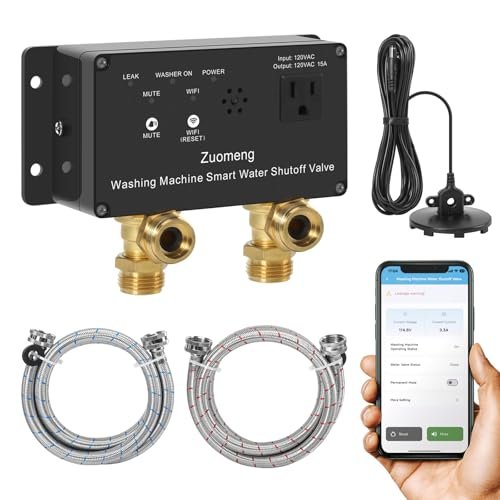
Its design combines a floor-level leak sensor, motorized solid-brass hot- and cold-water valves, WiFi-based remote monitoring, app controls, and washing-machine-compatible fittings. The supplied product information also emphasizes improved sensor sensitivity, remote alarm silencing, and straightforward installation without cutting or welding existing plumbing.
That makes it a more proactive solution than a basic leak detector, but automatic shutoff systems also deserve closer scrutiny before installation. Valve quality, connection size, water pressure, WiFi dependence, sensor placement, and long-term maintenance all affect how useful the system will be.
What Is the Zuomeng Leak Detection and Shutoff Kit 2.0?
The Zuomeng system is a smart washing machine water leak detector with automatic hot- and cold-water shutoff valves.
Its purpose is straightforward: monitor the area around a washing machine for escaping water and interrupt the water supply if a leak is detected.
A standard water alarm merely tells you that water has reached the sensor. This system adds a mechanical response by controlling the supply valves.
That distinction is particularly relevant for washing machines because both hot and cold lines may remain pressurized even when the appliance is not actively filling.
The kit is designed around standard washing machine hose connections and includes components intended to simplify installation without permanently altering the home's plumbing.
Why Washing Machines Benefit From Automatic Shutoff Protection
A washing machine normally has two supply hoses connected to household plumbing: one hot and one cold.
Those hoses, their fittings, the appliance inlet connections, and nearby valves are all potential leak points.
If a small leak develops while someone is home, it may be noticed fairly quickly.
If a hose or connection fails while the appliance is operating unattended, however, water can continue flowing until someone manually closes the supply.
An automatic shutoff system is designed to shorten that interval.
When the floor sensor detects water, the controller can close both water valves without waiting for someone to physically reach the laundry room.
Leak Detection vs. Automatic Shutoff
This is the most important distinction when comparing water protection products.
A leak detector identifies water and alerts you.
An automatic shutoff system identifies water and can take action.
Both approaches have value, but they address different parts of the problem.
A detector is simpler and usually less expensive. It is useful when someone can respond quickly.
A shutoff system is more complex, but it can reduce continued water flow after detection.
For appliances supplied by pressurized plumbing, that additional layer can be worthwhile.
Two-Valve Protection for Hot and Cold Water Lines
The Zuomeng system uses separate valves for the washing machine's hot and cold supply lines.
That is appropriate because a leak can originate from either side.
Closing only one line would provide incomplete protection.
The supplied specifications describe 3/4-inch 90-degree full-port valves, which corresponds to the type of connection commonly associated with washing machine supply hoses.
Always verify the actual fittings in your laundry area before ordering, because plumbing configurations can vary.
Solid Brass Valve Construction
One of the major product claims is the use of solid brass valves rather than plastic valve bodies.
For a component installed directly in a pressurized water line, construction material matters.
Brass is commonly used in residential plumbing because it provides mechanical strength and good suitability for water-service applications.
The manufacturer lists a maximum operating pressure of 150 PSI for the valves.
That is substantially above the normal pressure found in many residential plumbing systems, but compatibility should still be confirmed against the specific installation and manufacturer instructions.
Full-Port Valve Design
The valves are described as full-port, meaning the internal opening is intended to minimize restriction when the valve is fully open.
This matters because adding a shutoff device should ideally not significantly reduce the flow available to the washing machine.
The manufacturer lists a maximum flow rate of 8 gallons per minute.
Actual flow at the appliance will depend on household water pressure, plumbing diameter, hose condition, valve configuration, and the washing machine itself.
The practical goal is simply to allow normal appliance filling while still providing automatic shutoff capability.
90-Degree Valve Configuration
The 90-degree valve design may also help with installation in tight laundry areas.
Washing machines are often installed close to walls, where straight fittings can consume valuable space or force hoses into awkward bends.
An angled configuration can make hose routing easier depending on the existing plumbing layout.
Before installation, however, check the available clearance behind the washing machine.
The valve body, actuator, hose fittings, and cables all require space.
WiFi-Based Remote Monitoring
The Leak Detection and Shutoff Kit 2.0 adds WiFi connectivity through the GeniLife app.
This allows the user to monitor valve status and receive leak notifications remotely.
Remote awareness is useful because automatic shutoff solves only part of the problem.
Even if the system closes the valves successfully, you still need to know that a leak occurred so the appliance and plumbing can be inspected.
A smartphone notification can provide that information while you are away from home.
What You Can Do Through the GeniLife App
According to the supplied product information, the app can be used to monitor the system and manage valve-related actions.
Two dedicated controls are highlighted.
One allows the user to silence the alarm remotely after a leak has been detected.
The other allows the water valve to be reopened after the problem has been addressed.
That can make recovery more convenient because users do not necessarily need to operate the controller manually every time the system trips.
Remote Alarm Silencing
An alarm is useful when the leak first occurs, but it can become distracting once someone is actively dealing with the problem.
The app's remote mute function allows the audible warning to be silenced while leaving the system in a controlled state.
This is a practical feature, particularly if the leak occurs when someone else is at home and the primary user is managing the situation remotely.
The alarm should only be muted after the cause has been investigated.
Silencing an active leak warning without checking the source defeats the purpose of the system.
Remote Valve Reopening
Once the leak has been repaired or the sensor area has dried, the app can be used to reopen the water valves.
That can restore normal washing-machine operation without manually manipulating both valve controls.
This feature should be used carefully.
The valve should not be reopened simply because the alarm has stopped.
First verify that the source of the leak has genuinely been corrected and that all hose connections are secure.
Automatic Shutoff After Leak Detection
Automatic valve closure is the core safety feature.
When the sensor detects water above its triggering threshold, the system is intended to close the hot- and cold-water supply.
This can help limit the amount of additional water entering the affected area.
The effectiveness of any shutoff system depends on response speed, valve reliability, sensor placement, and whether the leak occurs downstream of the shutoff valves.
For example, closing the supply can stop a leaking inlet hose from continuing to receive water.
It cannot remove water that is already inside the washing machine, drain hose, or plumbing beyond the valve.
Sensor Design Intended to Reduce False Alarms
The product uses a disc-shaped sensor base that slightly elevates the detection tip.
According to the supplied specifications, the sensor is designed to trigger when water reaches approximately 1 millimeter above the floor surface.
The purpose is to avoid reacting to tiny amounts of incidental moisture while still detecting a meaningful leak.
This can be useful in laundry areas where minor dampness or occasional cleaning water might otherwise create nuisance alarms.
Why False-Alarm Resistance Matters
An overly sensitive leak sensor can become frustrating.
If it activates every time a few droplets reach the laundry-room floor, users may begin ignoring warnings or disabling the system.
On the other hand, a sensor that requires too much standing water before triggering may react later than desired.
The elevated probe design attempts to strike a balance by requiring a shallow but measurable amount of water before activating.
Whether that threshold is ideal depends on the installation.
Sensor Placement Is Critical
Even a highly sensitive leak sensor cannot detect water that never reaches it.
The detector should be placed where escaping water is most likely to collect first.
For a washing machine, that often means the lowest point behind or beside the appliance, close to the supply hoses and connections.
Floor slope matters.
If the laundry-room floor tilts away from the sensor, water could travel elsewhere before reaching it.
Before final placement, consider pouring a very small controlled amount of water on the floor to understand how it naturally flows, provided doing so is safe for the flooring.
Common Washing Machine Leak Sources
The system is most useful when placed with realistic leak scenarios in mind.
Common potential leak points include the hot- and cold-water supply hoses, hose fittings, appliance inlet connections, drain hose, internal pump components, door seal on front-load machines, and detergent dispenser.
The automatic shutoff valves can stop incoming supply water.
They cannot necessarily stop a leak originating from every internal or drainage-related source.
For that reason, leak detection remains important even when the source is not directly controlled by the valve.
Easy Installation Without Cutting or Welding
The kit is designed to connect inline with washing machine supply hoses.
According to the product description, installation does not require cutting or welding pipes.
That makes it much more accessible than installing a whole-house automatic shutoff valve.
The basic concept is to place the smart valves between the existing household supply and the washing machine hoses.
The supplied kit also includes stainless steel hoses and waterproof sealing tape.
Why Standard Hose Connections Help
Washing machine plumbing is relatively standardized compared with many other household plumbing fixtures.
Using compatible 3/4-inch threaded fittings can allow the system to be added without modifying rigid plumbing.
That makes installation more reversible.
If the system later needs to be removed or replaced, the original appliance connections can generally be restored more easily than if pipes had been cut.
Installation Still Requires Care
"Plug-and-play" does not mean plumbing connections can be assembled casually.
Threaded fittings must be tightened correctly.
Connections should be checked for leaks after pressurization.
Hoses should not be twisted, sharply kinked, or placed under unnecessary tension.
The valves and hoses should also be arranged so the washing machine can be moved for servicing without damaging the connections.
If existing shutoff valves are corroded or difficult to operate, that problem should be addressed before installing additional components.
Using Thread-Sealing Tape Correctly
The kit includes waterproof tape, which is presumably intended for threaded connections where appropriate.
Thread-sealing tape should only be used on fittings designed to seal at the threads.
Many washing machine hose connections seal using rubber washers rather than thread tape.
Applying tape where it is not needed can interfere with proper seating or make future maintenance more difficult.
Follow the installation instructions for each specific connection type rather than assuming every threaded fitting needs tape.
Stainless Steel Supply Hoses
The supplied product information states that stainless steel hoses are included.
Braided stainless steel washing machine hoses are commonly used because they provide additional external reinforcement compared with basic rubber hoses.
However, the hose assembly still includes internal materials, fittings, and seals that can age.
Smart shutoff protection should therefore complement, not replace, periodic inspection of the hoses themselves.
Does the System Protect Against Electrical Problems?
The source material mentions helping prevent electrical short circuits associated with water leaks.
It is reasonable that limiting uncontrolled water can reduce the chance of water reaching nearby electrical equipment.
However, the shutoff system itself should not be treated as an electrical safety device.
If water has reached outlets, plugs, extension cords, appliance wiring, or electrical panels, appropriate electrical safety precautions should be followed.
Do not touch energized equipment while standing in water.
If there is uncertainty, disconnect power safely if possible and contact a qualified professional.
Can It Prevent Wall and Floor Damage?
Automatic shutoff can help limit continued water flow, which may reduce the extent of damage.
But no leak detection system can guarantee that damage will not occur.
Water may already have spread before the sensor activates.
Some leaks can also occur inside walls or other locations where the floor sensor cannot detect them immediately.
The system is best understood as a damage-mitigation tool, not a guarantee against water damage.
Pressure Rating and Household Plumbing
The manufacturer lists a valve pressure rating of up to 150 PSI.
Residential water pressure varies widely.
A higher component rating provides margin, but it does not mean household water pressure should actually be maintained anywhere near that maximum.
Excessive plumbing pressure can stress fixtures, hoses, and valves throughout the property.
If you suspect unusually high water pressure, it is worth checking the system with an appropriate pressure gauge or consulting a plumber.
Manufacturer-Claimed Valve Lifespan
The source material claims a valve lifespan of up to 40 years.
That should be treated as a manufacturer claim rather than a guaranteed service life.
Motorized valves contain mechanical components, seals, actuators, and electronics that may age differently depending on water quality, cycling frequency, environmental conditions, pressure, installation quality, and maintenance.
The more useful question is whether the valve continues to operate reliably when tested.
Periodic functional testing is therefore more important than relying on a theoretical lifespan figure.
How to Test the System After Installation
A shutoff system should never be installed and then assumed to work indefinitely.
After installation, run a controlled test according to the manufacturer's instructions.
Verify that the leak sensor detects water.
Confirm that the alarm activates.
Check that the app receives the alert.
Most importantly, verify that both hot- and cold-water valves actually close.
Then confirm that the system can be reset and the valves reopened correctly.
Periodic Testing Is Essential
Automatic shutoff valves may remain open for long periods without operating.
Mechanical components can become stiff, and electronics can fail.
Periodically testing the shutoff function helps confirm that the system remains ready.
A simple functional test is much more valuable than seeing a "connected" status in an app.
Connectivity confirms communication.
It does not necessarily prove that the physical valve can close.
Smart Shutoff vs. Simple Water Alarm
A standalone water alarm is simpler and cheaper.
It usually requires no plumbing changes and may run entirely on batteries.
Its limitation is that someone must respond after the alarm activates.
The Zuomeng system adds automatic intervention.
That makes it particularly relevant for washing machines because supply hoses remain connected to pressurized plumbing.
The tradeoff is greater cost, more installation work, and additional hardware that must be maintained.
Smart Shutoff vs. Manual Washing Machine Valves
One traditional recommendation is to close the washing machine's manual supply valves whenever the appliance is not in use.
This is effective when done consistently.
The problem is convenience.
Many homeowners rarely close the valves because they are difficult to reach behind the washing machine or simply easy to forget.
A smart automatic system attempts to provide protection without requiring this daily habit.
Manual valves remain important, however, because they provide a physical means of isolating the water supply during maintenance or system failure.
Fixture-Level vs. Whole-House Shutoff
The Zuomeng system protects the washing machine supply lines specifically.
That has advantages.
A washing-machine leak can be isolated without shutting off water to toilets, faucets, showers, and other fixtures.
The limitation is that it cannot protect the rest of the home.
A whole-house smart shutoff valve offers broader coverage but requires installation on the main water line and may be more expensive or technically demanding.
For some properties, both approaches can make sense.
WiFi Dependence and Local Protection
Remote monitoring depends on WiFi and app connectivity.
If the internet connection fails, smartphone notifications and remote controls may become unavailable.
The supplied source emphasizes app-based control but does not provide enough verified detail to assume every automatic shutoff function is cloud-independent.
For that reason, buyers should confirm how the system behaves during WiFi or internet outages before relying on it for unattended protection.
A good safety system should ideally retain local leak-to-valve functionality even when remote connectivity is unavailable.
Common Installation Mistakes
One common mistake is positioning the sensor based on convenience rather than water flow.
Another is overtightening threaded fittings, which can damage components or seals.
Hoses may also be installed with sharp bends that place stress on the fittings.
A further mistake is failing to test the valve after installation.
Seeing the device online in an app is not sufficient.
The actual shutoff action must be verified.
Finally, do not block access to manual valves. In an emergency, you should still be able to isolate the water mechanically if necessary.
Best Practices for a Reliable Setup
Start by inspecting the existing washing machine plumbing.
If hoses are visibly worn, corroded, cracked, or heavily kinked, replace them rather than simply adding a shutoff system around deteriorated components.
Install the smart valves without forcing the plumbing into an unnatural position.
Place the leak sensor at the floor's likely collection point.
Once installed, pressurize the system and inspect every fitting for drips.
Then perform a complete leak simulation and confirm both valves close.
Afterward, label or document the system so other household members know how to reset or manually isolate it.
Who Should Consider This Kit?
This type of system is most useful for homeowners who want automatic washing machine leak protection rather than notification alone.
It can be especially attractive when the laundry area is:
- Upstairs
- Near finished living spaces
- In a condo or apartment
- Above another occupied unit
- Frequently unattended
- Located far from the main living area
- Equipped with older plumbing that is being monitored carefully
The potential consequences of a leak often determine whether automatic shutoff is worth the additional complexity.
Upstairs Laundry Rooms
An upstairs washing machine can create a particularly difficult leak scenario.
Water may damage not only the laundry floor but also ceilings, walls, insulation, and rooms below.
Automatic shutoff cannot eliminate that risk, but it can reduce continued incoming water after detection.
In this setting, placing the sensor at the lowest point around the appliance becomes especially important.
Condos and Apartments
A leak in a multi-unit building may affect neighboring units.
A fixture-specific shutoff system can therefore have value beyond protecting one household's flooring.
Installation rights and plumbing rules may vary in rental or managed properties, however.
Tenants should generally obtain any required approval before modifying appliance water connections.
Vacation Homes and Frequently Empty Properties
Remote monitoring may be attractive for properties that remain empty for extended periods.
However, the benefit depends on whether the automatic shutoff remains functional without internet connectivity.
If unattended protection is the primary reason for purchasing the system, this behavior should be verified directly from current manufacturer documentation.
A whole-house shutoff may also provide broader coverage for an unoccupied property.
Advantages of the Zuomeng Leak Detection and Shutoff Kit 2.0
The biggest advantage is automatic response.
The system does more than send an alert—it can close both washing machine water lines when a leak is detected.
The use of solid-brass full-port valves is also appealing compared with lightweight plastic plumbing components.
Standard washing machine hose connections make installation relatively accessible, while the included stainless steel hoses reduce the number of additional parts required.
WiFi monitoring provides remote status information, alerts, muting, and valve reopening.
The raised sensor design may also help reduce nuisance alarms caused by insignificant moisture.
Potential Drawbacks
The system is more complex than a conventional leak sensor.
Installation requires opening and reconnecting pressurized plumbing connections.
The valves and controller introduce additional components that may eventually require maintenance or replacement.
Remote features depend on WiFi and the GeniLife app.
The sensor only reacts to water that physically reaches its detection point.
Protection is also limited to the washing machine supply rather than the entire home.
Finally, some manufacturer claims—such as long valve lifespan—should be viewed as product specifications rather than guaranteed real-world outcomes.
Frequently Asked Questions
What does the Zuomeng Leak Detection and Shutoff Kit do?
It monitors for water near a washing machine and can automatically close the hot- and cold-water supply valves when a leak is detected.
Does it connect to WiFi?
Yes. The 2.0 version includes WiFi connectivity and uses the GeniLife app for remote monitoring and control.
Can it send leak alerts to my phone?
Yes. The supplied product information states that leak notifications can be received through the app.
Can it shut off both hot and cold water?
Yes. The kit includes separate valves for both washing machine supply lines.
What size are the valves?
The product information specifies 3/4-inch 90-degree full-port valves.
What are the valves made from?
They are described as solid brass.
What pressure are the valves rated for?
The manufacturer lists a maximum pressure of approximately 150 PSI.
What is the stated maximum flow rate?
The supplied specifications list a maximum flow rate of approximately 8 GPM.
Does the system require cutting pipes?
The product is designed around washing machine hose connections and does not require pipe cutting or welding under a typical compatible installation.
Are hoses included?
The supplied product information states that stainless steel hoses are included.
How sensitive is the water sensor?
The manufacturer describes the sensor as being designed to detect water once it reaches roughly 1 millimeter above the floor.
Can I silence the alarm remotely?
Yes. A remote mute function is described as part of the GeniLife app.
Can I reopen the valves through the app?
Yes. Once the leak has been resolved, the valves can be reopened through the app according to the supplied specifications.
Does it automatically prevent all washing machine water damage?
No.
It can detect water and stop incoming supply through the controlled valves, but no system can guarantee prevention of all damage.
Some water may escape before detection, and certain leaks may originate downstream of the shutoff point.
Do I still need to inspect my washing machine hoses?
Yes.
Automatic leak protection supplements normal maintenance rather than replacing it.
Hoses, fittings, shutoff valves, and appliance connections should still be inspected periodically.
Can I install it myself?
The system is designed for relatively straightforward installation using washing machine hose connections.
Anyone uncomfortable working with pressurized plumbing connections should consider professional installation.
Final Verdict
The Zuomeng Leak Detection and Shutoff Kit 2.0 WiFi version offers a more active approach to washing machine leak protection than a conventional water alarm.
Its primary advantage is straightforward: when the floor sensor detects a meaningful amount of water, the system can close both the hot- and cold-water supply valves instead of simply notifying you that a leak exists.
Solid-brass 3/4-inch full-port valves, WiFi monitoring, GeniLife app controls, remote alarm muting, valve reopening, included stainless steel hoses, and a sensor designed to reduce false alarms make the package relatively comprehensive.
The system makes the most sense in situations where a washing machine leak could cause substantial damage—particularly upstairs laundry rooms, finished spaces, apartments, condos, and homes where the appliance frequently runs without someone nearby.
Its limitations should remain clear. It only protects the water lines it controls, it depends on correct sensor placement, and its remote features rely on network connectivity. It should also be periodically tested to verify that the physical valves still close correctly.
For homeowners who want automatic washing machine water shutoff rather than notification alone, this type of system can provide a meaningful additional layer of protection when installed, tested, and maintained properly.