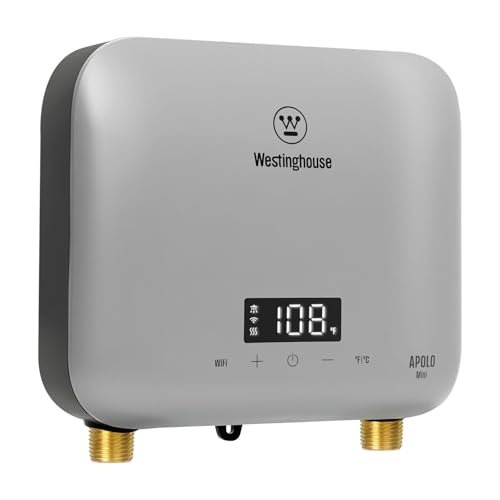
Westinghouse Apolo Mini 3.5kW Tankless Water Heater Review: Compact WiFi Hot Water for Sinks and Vanities
Waiting for hot water at a remote bathroom or kitchen sink can be surprisingly wasteful. Water sitting in long plumbing runs cools between uses, so the faucet may need to run for several seconds—or longer—before warm water arrives from the main water heater.
The Westinghouse Apolo Mini 3.5kW electric tankless water heater is designed to solve that specific problem. Rather than serving an entire house, it functions as a compact point-of-use heater for sinks, vanities, handwashing stations, and other relatively low-flow fixtures. It heats water only when needed, eliminating the need for a small storage tank.
The unit also adds features rarely found on basic under-sink heaters, including WiFi connectivity, app-based temperature adjustment, Alexa and Google Home compatibility, a selectable 80°F to 130°F temperature range, multiple safety protections, and a compact 6.9 × 8.1 × 2.5-inch enclosure.
Its 3.5kW output, however, places clear limits on what it can do. This is a sink-focused heater, not a shower or whole-house system.
What Is the Westinghouse Apolo Mini 3.5kW?
The Apolo Mini is a compact electric tankless water heater intended to provide hot water close to the point of use.
According to the supplied specifications, it offers:
- 3.5kW electric heating
- Point-of-use tankless operation
- WiFi connectivity
- App temperature control
- Alexa compatibility
- Google Home compatibility
- Adjustable temperature from 80°F to 130°F
- 1/2-inch NPT plumbing connections
- 6.9" × 8.1" × 2.5" dimensions
- Dedicated 30A circuit requirement
- IPX4 water-resistance rating
- Dry-fire protection
- Low-flow protection
- Voltage protection
- Anti-scald functionality
- Flame-retardant housing
The manufacturer explicitly positions it for sinks rather than showers.
Why a Point-of-Use Water Heater Can Make Sense
A central water heater may be perfectly adequate while still delivering hot water slowly to fixtures located far away.
The problem is not always heating capacity. Sometimes it is simply pipe distance.
When the heater is dozens of feet from the faucet, cooled water sitting in the hot-water line must be pushed out before heated water reaches the fixture.
A point-of-use heater moves the heat source closer to the faucet.
Typical Applications
The Apolo Mini is best suited to relatively modest hot-water demands such as:
- Bathroom sinks
- Powder-room vanities
- Kitchen handwashing
- Light dish rinsing
- Utility sinks
- Office sinks
- Workshop sinks
It can also be useful in additions or detached spaces where extending a central hot-water system would be inconvenient.
How Tankless Heating Works
Unlike a mini-tank heater, the Apolo Mini does not store several gallons of hot water.
When the faucet opens and sufficient flow is detected, the electric heating element activates.
Water passes through the heater, absorbs heat, and exits toward the faucet.
Once water flow stops, heating stops.
This means there is no tank that needs to remain hot between uses.
What the 3.5kW Rating Means
The heater's 3.5kW output determines how much heat it can add to flowing water.
This is one of the most important specifications.
A tankless heater's practical performance depends on three variables:
- Heater power
- Water-flow rate
- Incoming water temperature
The lower the water flow, the more temperature rise a 3.5kW heater can generally provide.
Flow Rate vs. Temperature Rise
A compact tankless heater cannot provide the same temperature rise at every faucet flow.
If water moves slowly through the unit, each gallon receives more heating energy.
If the faucet is opened fully and flow rises significantly, the heater has less energy available per gallon.
As a result, outlet temperature may decrease.
Why Incoming Water Temperature Matters
Imagine incoming water is already 70°F.
Reaching 105°F requires a temperature rise of only 35°F.
If the inlet water is 45°F, reaching the same outlet temperature requires a 60°F rise.
The heater must work much harder in the second scenario.
This is why small electric tankless heaters tend to perform better in warmer climates or with low-flow faucets.
This Heater Is Not Intended for Showers
The supplied information explicitly states that the Apolo Mini is not designed for shower use.
That distinction is important.
A shower requires sustained flow that is typically much higher than a bathroom sink.
A 3.5kW heater simply does not have enough heating capacity to deliver a large temperature rise at typical shower flow rates.
Why It Works Better for Sinks
Sink use is usually intermittent and lower-flow.
Handwashing, for example, may require only a modest amount of warm water for a short period.
This better matches the heater's power level.
Trying to use it for a shower would likely result in insufficient temperature, insufficient flow, or both.
Adjustable Temperature From 80°F to 130°F
The heater allows temperature adjustment within a stated range of 80°F to 130°F.
That provides flexibility for different applications.
A handwashing sink may need only comfortably warm water, while some kitchen tasks may call for a higher temperature.
Higher Settings Reduce Available Flow
Selecting a hotter outlet temperature increases the amount of heating required.
If incoming water is cold, the heater may need lower flow to reach a high temperature setting.
So the temperature setting and practical flow rate are closely linked.
Anti-Scald Protection
The product includes anti-scald functionality according to the supplied description.
That is particularly relevant because the upper temperature setting reaches 130°F.
Even with built-in safeguards, hot-water temperatures should be selected conservatively, especially in households with children, older adults, or users with limited sensitivity.
WiFi Connectivity
One of the more distinctive features is WiFi-enabled control.
The heater can reportedly be managed through a smartphone app.
This can provide access to functions such as:
- Temperature adjustment
- Heater status
- Restart commands
The exact feature set may depend on the current app and firmware.
Alexa and Google Home Compatibility
The Apolo Mini is also described as compatible with:
- Amazon Alexa
- Google Home
That makes it possible to integrate the heater into a broader smart-home system.
Voice control may be useful for checking or adjusting supported functions without opening the app.
Smart Control Is Convenient, Not More Powerful
WiFi and voice features do not increase the heater's physical performance.
The unit remains limited to 3.5kW of heating capacity.
Smart controls improve usability, not flow rate or temperature-rise capability.
Remote Temperature Adjustment
Being able to adjust the heater remotely can be convenient when the unit is installed beneath a sink or inside a cabinet.
Instead of reaching the physical control panel, users can make supported changes from a phone.
However, remote temperature changes should still be made carefully because someone may be using the fixture without realizing the setting has changed.
Compact Dimensions
The heater measures approximately:
6.9 inches × 8.1 inches × 2.5 inches
That is very compact for a water-heating appliance.
Its shallow profile can make it easier to install inside:
- Vanity cabinets
- Sink cabinets
- Small utility spaces
without sacrificing much storage.
Compact Size Is One of Its Biggest Advantages
A mini storage heater can require several gallons of tank volume.
The Apolo Mini eliminates that tank entirely.
This can make it attractive when cabinet space matters.
1/2-Inch NPT Plumbing Connections
The heater uses standard 1/2-inch NPT connections according to the source.
This is a common size for residential fixture plumbing.
It can simplify integration with compatible:
- Shutoff valves
- Flexible supply lines
- Faucet connections
The actual installation should still follow Westinghouse's approved plumbing layout.
Install It Close to the Fixture
A point-of-use heater works best when installed near the faucet.
Keeping the hot-water run short reduces:
- Wait time
- Pipe heat loss
- Amount of cooled water that must be discharged
This is one of the main reasons to choose a small local heater in the first place.
Dedicated 30A Circuit Requirement
Although physically small, the Apolo Mini requires substantial electrical capacity.
The supplied information calls for a dedicated 30A circuit.
This is a critical requirement.
It should not be treated like a small plug-in appliance.
Why 3.5kW Can Require a Large Circuit
Electric water heating draws substantial current because resistance elements convert a large amount of electrical energy directly into heat.
The exact current depends on voltage.
The manufacturer’s circuit requirements should always take precedence over estimates.
Do Not Share the Circuit
If Westinghouse specifies a dedicated 30A branch circuit, it should not be shared with:
- Lighting
- General outlets
- Kitchen appliances
- Other high-load equipment
A dedicated circuit reduces the risk of overload and voltage drop.
Breaker and Wire Size Must Match
The breaker alone does not determine circuit safety.
The wiring must also be properly sized for:
- Current
- Installation method
- Conductor type
- Local code
Never increase breaker size without confirming the conductors are suitable.
“DIY-Friendly” Needs Context
The supplied marketing description calls installation DIY-friendly.
The plumbing may indeed be relatively straightforward for someone experienced with 1/2-inch NPT fittings.
The electrical work is a different matter.
A dedicated 30A mains circuit generally requires more expertise than replacing a faucet or standard wall switch.
Professional Installation May Be the Better Choice
A licensed electrician can verify:
- Circuit capacity
- Breaker size
- Conductor sizing
- Grounding
- Electrical panel load
A plumber can verify:
- Connection orientation
- Water pressure
- Shutoff valves
- Leak-free fittings
Professional help is particularly worthwhile when a new branch circuit must be installed.
IPX4 Water-Resistance Rating
The heater carries an IPX4 rating according to the source.
IPX4 generally indicates protection against water splashing from multiple directions.
That is appropriate for an appliance installed near plumbing.
IPX4 Does Not Mean Waterproof
The unit should not be:
- Submerged
- Sprayed directly
- Installed where leaks can continuously soak it
The enclosure still needs to be positioned in a reasonably dry and protected location.
Dry-Fire Protection
Dry-fire protection is intended to prevent the heating element from operating when proper water conditions are absent.
This is important because electric heating elements can overheat quickly without water carrying the heat away.
It should be viewed as a backup protection system rather than a reason to operate the unit incorrectly.
Low-Flow Protection
The heater also includes low-flow protection.
Tankless water heaters normally require a minimum flow before the heating element can safely activate.
If flow falls below that threshold, the unit may reduce or stop heating.
Why Very Low Faucet Flow Can Be a Problem
Users sometimes turn a faucet down to a tiny trickle in an attempt to get hotter water.
At some point, flow can become too low for the heater to detect or operate normally.
The manufacturer's minimum activation flow should therefore be checked if ultra-low-flow fixtures are used.
Voltage Protection
The source lists voltage protection among the safety features.
This can help protect the electronics and heating system from abnormal electrical conditions.
However, it does not eliminate the need for correctly installed circuit protection.
Flame-Retardant Housing
The enclosure is described as being made from flame-retardant material.
That adds another layer of design protection around a high-power electric appliance.
As with other safety features, it should complement rather than replace proper electrical installation.
Separated Heating Element Design
Westinghouse describes the heating element as separated in a way intended to reduce scale and corrosion.
This can be beneficial because mineral buildup is one of the major maintenance issues affecting electric tankless heaters.
Why Scale Matters
Hard water contains dissolved minerals such as calcium and magnesium.
When heated repeatedly, those minerals can deposit on internal surfaces.
Over time, scale may:
- Restrict flow
- Reduce heat transfer
- Affect temperature stability
- Increase maintenance needs
Maintenance in Hard-Water Areas
If local water is hard, periodic maintenance may be needed even with a scale-resistant design.
Depending on manufacturer recommendations, this could include:
- Flushing
- Descaling
- Cleaning inlet screens
Water-treatment options may also be worth considering.
Energy Use Compared With a Storage Tank
The Apolo Mini heats only when water is being drawn.
That eliminates the standby heat loss associated with keeping a small tank warm all day.
This can be efficient for intermittent sink use.
Energy Savings Are Usage-Dependent
It would be misleading to promise a specific reduction in utility bills.
Actual energy use depends on:
- How often the sink is used
- Water temperature setting
- Electricity cost
- What system it replaces
The main efficiency advantage is avoiding stored-hot-water standby losses.
Tankless vs. Mini-Tank Water Heater
A mini-tank stores a small reserve of hot water.
The Apolo Mini heats water continuously on demand.
Tankless Advantages
- Smaller footprint
- No tank standby losses
- Continuous output within rated capacity
- Smart connectivity
Mini-Tank Advantages
- Can provide a short burst of higher flow
- Less sensitive to incoming temperature during brief use
- Some models use simpler electrical connections
The best choice depends on how the sink is used.
Tankless vs. Central Hot Water
A central heater may still make more sense when several fixtures need hot water.
The Apolo Mini is most useful when a specific sink has a delivery problem.
For example, if a guest bathroom takes a long time to receive hot water from the central system, a local heater can address that fixture without changing the entire household plumbing layout.
A Good Option for Remote Sinks
Point-of-use heaters are particularly useful in:
- Detached garages
- Workshops
- Basement utility areas
- Additions
- Guest bathrooms
where running a new hot-water line may be expensive or inconvenient.
Not a Whole-House Replacement
At only 3.5kW, this heater should not be viewed as a substitute for a central household water heater.
It is not designed to power:
- Multiple bathrooms
- Washing machines
- Bathtubs
- Several simultaneous fixtures
Its strength is localized hot water.
Common Buying Mistakes
Buying It for a Shower
The manufacturer explicitly says it is not intended for showers.
Ignoring the 30A Circuit Requirement
The unit may be small, but the electrical load is substantial.
Expecting Full-Flow Hot Water in Cold Climates
Lower inlet temperatures reduce practical flow.
Assuming WiFi Improves Heating Capacity
Smart controls do not increase the 3.5kW output.
Ignoring Hard-Water Maintenance
Scale can still affect long-term performance.
Who Is the Apolo Mini Best For?
The Westinghouse Apolo Mini 3.5kW is most suitable for someone who needs:
- Hot water at a single sink
- Compact under-sink installation
- WiFi/app control
- Alexa or Google Home integration
- Adjustable temperature
- No storage tank
It is particularly compelling when the existing central heater is simply too far from the fixture.
Who Should Choose a Larger Heater?
A higher-capacity model is necessary if the intended application includes:
- Showering
- Bathtub filling
- Several fixtures
- High-flow kitchen use
A larger heater will also require greater electrical capacity.
Advantages and Considerations
Advantages
- Compact 6.9" × 8.1" × 2.5" design
- 3.5kW point-of-use heating
- Tankless operation
- WiFi control
- Alexa compatibility
- Google Home compatibility
- Adjustable 80°F–130°F temperature range
- 1/2-inch NPT plumbing
- IPX4 splash protection
- Dry-fire protection
- Low-flow protection
- Voltage protection
- Scale-conscious heating design
Potential Considerations
- Sink use only
- Not designed for showers
- Requires dedicated 30A circuit
- Output varies with water flow and inlet temperature
- May need professional electrical installation
- Hard water can still require maintenance
- 2.4/5 GHz WiFi compatibility is not specified in the supplied information
Frequently Asked Questions
What is the Westinghouse Apolo Mini?
It is a compact 3.5kW electric tankless water heater designed primarily for point-of-use sink applications.
What is the heating power?
3.5kW.
Is it designed for showers?
No. The supplied information explicitly states that it is optimized for sinks and vanities rather than showers.
What can it be used for?
Typical uses include bathroom sinks, kitchen rinsing, handwashing, utility sinks, and other relatively low-flow fixtures.
Does it store hot water?
No. It heats water on demand.
Does it have WiFi?
Yes.
Does it work with Alexa?
Yes, according to the supplied description.
Does it work with Google Home?
Yes.
Can I change the water temperature remotely?
Yes. The source states that app and voice controls support temperature adjustment.
What temperature range is available?
Approximately 80°F to 130°F.
How large is the unit?
Approximately 6.9 × 8.1 × 2.5 inches.
What plumbing connections does it use?
1/2-inch NPT.
What electrical circuit does it require?
The supplied specifications call for a dedicated 30A circuit.
Can I plug it into a normal outlet?
That should not be assumed. A dedicated 30A circuit indicates a purpose-built electrical installation is required.
Is it waterproof?
It has an IPX4 rating, which provides splash resistance but does not mean the appliance can be submerged.
Does it have dry-fire protection?
Yes.
Does it have low-flow protection?
Yes.
Does it protect against voltage problems?
The source states that voltage protection is included.
Does it resist scale?
The separated heating-element design is described as helping reduce scale and corrosion, but hard-water maintenance may still be necessary.
Will it provide unlimited hot water?
It can continue heating while water flows, but only within the limits of its 3.5kW heating capacity.
Why might outlet temperature drop?
The most common reasons are excessive flow or colder incoming water.
Is professional installation recommended?
Yes, particularly if a new dedicated 30A circuit is required.
Final Thoughts
The Westinghouse Apolo Mini 3.5kW electric tankless water heater is a specialized product with a clear purpose: providing convenient hot water at a sink without installing a storage tank or waiting for water to travel from a distant central heater.
Its combination of a compact 6.9 × 8.1 × 2.5-inch body, WiFi-enabled controls, Alexa and Google Home compatibility, adjustable 80°F–130°F temperature range, 1/2-inch NPT connections, and multiple safety protections makes it considerably more sophisticated than a basic under-sink heater.
The main limitation is equally clear. With 3.5kW of heating capacity, this is not a shower or whole-house system. Performance depends on incoming water temperature and faucet flow, and the electrical installation requires a dedicated 30A circuit.
For a bathroom vanity, utility sink, remote kitchen fixture, office, workshop, or another low-flow point of use, the Apolo Mini can provide a practical combination of compact installation, on-demand electric hot water, and modern smart-home control.