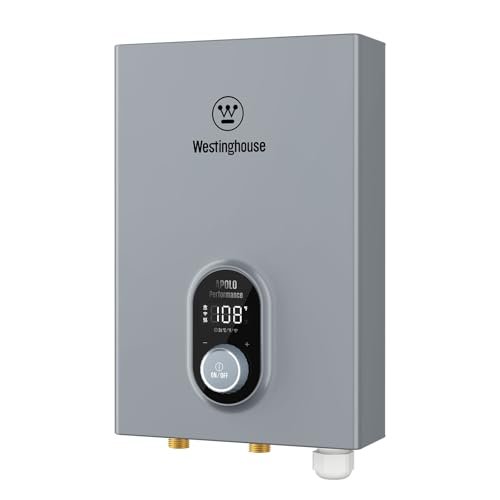
Westinghouse 11kW Electric Tankless Water Heater Review: 2.6 GPM, WiFi Control and Compact 240V Design
An electric tankless water heater can be an excellent fit for apartments, smaller homes, offices, and point-of-use applications where space is limited and hot-water demand is moderate. Instead of storing dozens of gallons in a tank, it heats water only when a fixture is opened.
The Westinghouse 11kW electric tankless water heater is designed around that compact, on-demand approach. According to the supplied specifications, it runs on 240 volts, delivers up to 2.6 gallons per minute, activates at 0.4 GPM, and requires a 50-amp double-pole breaker with 8 AWG wiring. It also adds WiFi connectivity, app control, Alexa and Google Home compatibility, a digital display, and adjustable temperatures from 86°F to 140°F.
The important question is not simply whether 2.6 GPM sounds sufficient. Tankless performance depends heavily on incoming water temperature, desired outlet temperature, and how many fixtures are running at once. An 11kW model can be very practical when correctly sized, but buyers should be cautious about assuming it can always support a shower and two sinks simultaneously under every condition.
This guide explains what the Westinghouse 11kW model can realistically do, how to interpret its flow rating, what the electrical requirements mean, and where this compact electric tankless heater makes the most sense.
What Is the Westinghouse 11kW Tankless Water Heater?
This Westinghouse model is an 11-kilowatt, 240-volt electric tankless water heater.
Rather than maintaining a reservoir of hot water, the unit activates when it detects sufficient water flow. Electricity is then sent to the heating elements, which warm the water as it passes through the appliance.
When the fixture closes, active water heating stops.
This design eliminates the problem of depleting a fixed tank, although it introduces a different limitation: the heater can only warm a certain amount of water per minute.
Key Specifications
The supplied product information lists the following main specifications:
- Power: 11kW
- Voltage: 240V
- Maximum current: approximately 46A
- Breaker: one 50A double-pole breaker
- Wiring: 8 AWG
- Maximum advertised flow: 2.6 GPM
- Minimum activation flow: 0.4 GPM
- Temperature range: 86°F to 140°F
- Temperature adjustment: 1°F increments
- Water connections: 1/2-inch NPT
- Dimensions: approximately 14.2 x 9.5 x 3.5 inches
- Connectivity: WiFi, app, Alexa, and Google Home support
- Certification: ETL, according to the supplied description
These figures make it clear that this is a relatively compact electric heater, but still a substantial electrical appliance.
The 11kW Rating Explained
An 11kW heater can use up to roughly 11,000 watts while operating at full power.
At 240 volts, that corresponds to approximately 46 amps, which matches the supplied current specification.
That is much more electrical demand than a standard receptacle circuit can provide.
The heater must be hardwired to an appropriately sized dedicated 240V circuit.
One 50-Amp Double-Pole Breaker
The supplied specifications call for a 50A double-pole breaker.
That is simpler than larger 18kW, 24kW, or 27kW electric tankless units that may require two or three separate high-current circuits.
Even so, 50 amps is still a major branch-circuit load.
Before purchasing, confirm that the electrical panel has both enough physical breaker space and enough service capacity.
8 AWG Wiring
The source specifies 8 AWG wiring.
The final conductor size and installation method should always follow the current manufacturer instructions and applicable electrical code.
Factors such as conductor material, cable type, run length, ambient temperature, and local requirements can affect proper sizing.
This is not an installation where smaller wiring should be substituted based on guesswork.
Do You Need an Electrician?
For most homeowners, yes.
Installing a 240V, 50A circuit involves high-current electrical work and usually requires access to the main service panel.
Incorrect wiring can create serious risks including overheating, electrical shock, or fire.
Unless you are properly qualified and local rules permit DIY electrical work, the electrical side should be handled by a licensed electrician.
Understanding the 2.6 GPM Rating
The heater is advertised at up to 2.6 gallons per minute.
That number needs context.
Tankless heaters do not have one universal hot-water flow rate. Their ability to maintain a target temperature depends on the amount of heat they must add to the incoming water.
The greater the temperature rise, the lower the sustainable flow.
Temperature Rise Determines Real Capacity
Suppose the incoming water is 75°F and you want 105°F shower water.
That requires a 30°F rise.
An 11kW heater can handle more flow under those conditions than if the inlet water is 45°F and must be heated to 105°F.
In the second case, the required temperature rise is 60°F.
The heater has to add twice as much heat to each gallon.
That reduces the amount of water it can heat per minute.
Why Warm Climates Help
Smaller electric tankless water heaters are much more capable in regions with warm incoming water.
If groundwater enters the home at 70°F or higher, an 11kW heater has a relatively modest temperature rise to achieve for a typical shower.
In a cold northern climate with very cold winter inlet temperatures, performance can be much more limited.
This is why local groundwater temperature should be considered before using maximum GPM as a sizing figure.
Can It Run One Shower?
A single efficient shower is one of the most realistic applications.
Many modern showerheads operate around 1.5 to 2.5 GPM.
If incoming water is reasonably warm and the desired shower temperature is moderate, the Westinghouse 11kW may be able to supply one shower effectively.
If the inlet water is very cold, the maximum comfortable shower flow may need to be lower.
Can It Run One Shower and Two Sinks?
The supplied listing markets the heater for one shower plus two sinks.
That may be possible under favorable conditions, but it should not be interpreted as a guaranteed scenario at all temperatures and flow rates.
For example, a 2.0 GPM shower plus two faucets each using 0.5 GPM would total 3.0 GPM, already above the advertised 2.6 GPM maximum.
If the sinks are barely open and incoming water is warm, the combined demand may be manageable. If all fixtures run at higher flow, the heater may not maintain the selected temperature.
Fixture count is less important than total simultaneous GPM.
A Better Way to Size It
Instead of asking, "How many fixtures can it run?" ask:
- What is the incoming water temperature?
- What outlet temperature do I want?
- What is the flow rate of each fixture?
- Which fixtures will actually operate at the same time?
That produces a much more realistic estimate.
Minimum Activation Flow of 0.4 GPM
The heater requires approximately 0.4 GPM of water flow before it activates.
This matters at low-flow fixtures.
If a faucet is barely opened, the flow may remain below the activation threshold and the heater may not energize.
For normal showers and ordinary faucet use, 0.4 GPM is generally a fairly low threshold.
Still, it is worth knowing if the heater will serve very low-flow handwashing fixtures.
Continuous Hot Water Without a Storage Tank
The main benefit of a tankless design is that there is no tank to empty.
A traditional storage heater can eventually run out of hot water during heavy use and require time to recover.
A tankless heater can continue producing hot water for as long as the demand remains within its heating capacity.
This is often described as "endless hot water."
Endless Does Not Mean Unlimited Flow
This distinction is essential.
The Westinghouse can heat continuously, but only within the capability of its 11kW heating system.
If total demand exceeds what the unit can heat to the selected temperature, outlet temperature may drop.
A tankless heater solves the problem of storage capacity, not the problem of finite heating power.
No Tank Recovery Time
Because water is heated on demand, there is no waiting for a storage tank to reheat after a long shower.
This can be very convenient in smaller households where hot-water demand is moderate but continuous.
However, pipe travel time still exists.
If the bathroom is far from the water heater, cold water already sitting in the plumbing must still clear before heated water reaches the fixture.
WiFi Control
The heater includes WiFi connectivity for remote control through an app.
That allows the user to adjust temperature settings without standing directly in front of the unit.
This can be useful if the heater is installed in a utility closet, basement, cabinet, or another less accessible area.
Voice Control With Alexa and Google Home
The supplied description also lists compatibility with Amazon Alexa and Google Home.
Voice control can add convenience for changing set temperature or checking heater status, depending on the supported commands.
It is best viewed as a secondary feature.
Smart-home integration should not outweigh more important purchasing factors such as heating capacity, electrical compatibility, and water-flow performance.
Precise 1°F Temperature Adjustment
The heater supports adjustment in 1°F increments across an advertised range of 86°F to 140°F.
Fine control can be useful because tankless heaters are often set to a specific outlet temperature rather than relying entirely on mixing large amounts of cold water downstream.
For showering, many users will operate well below the 140°F maximum.
Higher temperatures increase scalding risk.
Be Careful With High Temperature Settings
Water at elevated temperatures can cause burns quickly.
Households with children, older adults, or anyone with reduced temperature sensitivity should be especially cautious.
A high maximum setting is useful for certain applications, but it should not automatically be treated as the ideal everyday setting.
Follow the manufacturer's recommendations and local plumbing requirements.
LED Status Display
The built-in LED display provides real-time operating information.
A clear display can help users monitor selected temperature and other status indicators without opening the mobile app.
This also means the heater remains practical even for household members who do not use smart-home features.
Compact Wall-Mounted Design
The unit measures roughly 14.2 inches high, 9.5 inches wide, and 3.5 inches deep.
That is dramatically smaller than a conventional storage-tank water heater.
Its wall-mounted form can free valuable floor space in apartments, utility closets, small homes, offices, or compact remodels.
Where the Compact Size Helps Most
The small footprint can be particularly attractive for:
- Apartments
- Condominiums
- Tiny homes
- ADUs
- Offices
- Workshops
- Small utility closets
- Point-of-use applications
However, electrical and plumbing access still determine where the heater can realistically be installed.
1/2-Inch NPT Connections
The heater uses 1/2-inch NPT water connections.
That is smaller than the 3/4-inch connections commonly found on larger whole-house tankless heaters.
For moderate-flow applications, 1/2-inch plumbing may be perfectly adequate.
For higher-flow whole-home designs, pipe sizing should be evaluated carefully.
The heater cannot compensate for upstream plumbing that restricts available flow.
ETL Certification
The supplied product information states that the heater is ETL certified.
ETL certification indicates that the product has been evaluated against applicable safety standards by a recognized testing laboratory.
Buyers should verify that the certification applies to the exact model purchased.
Local permitting authorities may also require proof of listing.
Four-Layer Safety Protection
The source identifies four main safety protections:
- Electrical leakage protection
- Overheat protection
- Dry-fire protection
- High-voltage protection
These are appropriate safeguards for an electric tankless water heater.
They supplement correct electrical and plumbing installation rather than replacing it.
Dry-Fire Protection
Dry firing occurs when heating elements energize without sufficient water flow.
That can cause rapid overheating and damage.
A dry-fire protection system is designed to prevent the heater from operating under those conditions.
This is particularly important during initial installation or after plumbing service.
Overheat Protection
Overheat protection helps shut down or limit heating if internal temperatures exceed safe operating conditions.
This is another important safeguard on a high-power electric appliance.
The exact reset procedure should be reviewed in the owner's manual.
Electrical Leakage Protection
Leakage protection is intended to reduce risk from unintended electrical current paths.
It should not be considered a substitute for proper grounding or any GFCI protection required by code.
The entire electrical installation should still follow the manufacturer specifications.
Separate Water and Electrical Pathways
The source also emphasizes separated water and electricity pathways.
Keeping water passages isolated from electrical components is fundamental to safe water-heater design.
The listing additionally associates this construction with reduced corrosion and scaling, although those issues depend on several factors beyond physical separation alone.
Scale Can Still Be a Problem
No tankless water heater should be assumed immune to mineral buildup.
Hard water can deposit scale on internal heating surfaces and narrow water passages.
Over time, this can reduce efficiency and flow.
The unit may require periodic descaling depending on local water hardness and manufacturer recommendations.
Install Service Valves if Recommended
When permitted by the installation instructions, service valves can make future maintenance easier.
They allow the heater to be isolated and flushed with an appropriate descaling solution.
Planning maintenance access during installation can save significant effort later.
Smart Controls Do Not Eliminate Maintenance
WiFi control and digital monitoring can make operation more convenient, but the heater is still a plumbing appliance.
Owners should periodically check for:
- Leaks
- Loose electrical connections
- Scale buildup
- Reduced flow
- Error codes
- Unusual heating behavior
A tankless unit benefits from preventive maintenance just like a storage heater.
Is It Good for an Apartment?
Yes, potentially.
Its compact size and moderate 11kW power level can make it attractive for apartments with appropriate 240V electrical capacity.
The main issue is whether the electrical panel can support a new 50A circuit.
In multifamily buildings, owners may also face restrictions on electrical modifications.
Is It Good for a Small Home?
It can be, particularly in a warm climate or household where only one major hot-water fixture is normally used at a time.
For a small home with one bathroom, the capacity may be a good match.
For a household where several people routinely use showers and sinks simultaneously, it may be undersized.
Is It Good for an Office?
Yes, if the main demand is sinks and light handwashing.
An 11kW heater may actually be more capacity than needed for a small office restroom if no shower is involved.
The 0.4 GPM activation flow is worth checking against low-flow commercial faucets.
Is It Good for Two Bathrooms?
The number of bathrooms is not the correct sizing metric.
A two-bathroom home where only one shower runs at a time may be suitable.
A two-bathroom home where both showers run together could exceed the heater's capability.
Simultaneous flow matters far more than the number of rooms.
Is It Good for a Bathtub?
A bathtub filler can have a much higher flow rate than a shower.
At 2.6 GPM maximum advertised output, filling a large tub with adequately heated water could be slow.
If the filler is allowed to flow faster than the heater can support, outlet temperature may drop.
For frequent large-bathtub use, a higher-output heater may be preferable.
Electric Tankless vs. Storage Tank
A storage water heater keeps a reservoir of hot water ready.
That gives it the ability to handle temporarily high flow by drawing from stored capacity.
An electric tankless heater offers continuous heating but only up to its instantaneous power limit.
The Westinghouse uses less floor space and avoids tank recovery time, but a conventional tank may be more forgiving when several fixtures operate simultaneously.
Electric Tankless vs. Larger Electric Tankless
A larger 18kW or 24kW heater can support more flow at the same temperature rise.
The tradeoff is electrical demand.
Larger units may require multiple breakers and much heavier overall service capacity.
The 11kW model is easier to accommodate electrically, but it must be sized more conservatively.
Electric Tankless vs. Gas Tankless
Gas-fired tankless heaters can often support higher flow rates because their burners can provide much greater heating output.
However, they require a gas supply and proper combustion venting.
An electric unit avoids combustion entirely and can be easier to place when adequate electrical service is already available.
Common Buying Mistakes
The biggest mistake is assuming that 2.6 GPM is guaranteed regardless of incoming water temperature.
Another is taking the "one shower plus two sinks" description literally without adding up real fixture flow.
Buyers also sometimes overlook the 50A electrical requirement.
Another mistake is assuming that tankless means zero maintenance.
Finally, smart controls should not distract from proper sizing.
What to Check Before Buying
Before choosing this heater, verify:
- Incoming groundwater temperature
- Desired hot-water temperature
- Showerhead flow rate
- Sink flow rates
- Simultaneous fixture demand
- Electrical panel capacity
- Availability of a 50A 240V circuit
- 8 AWG wiring requirements
- 1/2-inch plumbing compatibility
- Installation clearances
- Local permits and code
- Water hardness
These details will determine whether the heater actually performs as expected.
Main Advantages
The strongest advantages are compact size and relatively straightforward electrical requirements compared with larger electric tankless units.
The heater provides up to 11kW of on-demand heating, an advertised maximum of 2.6 GPM, and a low 0.4 GPM activation threshold.
Fine temperature control, WiFi connectivity, voice integration, and an LED display add convenience.
The ETL listing and multiple safety systems are also positive features.
Potential Drawbacks
The 2.6 GPM capacity is modest for whole-house use.
Actual hot-water flow may be substantially lower in cold climates.
A dedicated 50A 240V circuit is still a major electrical requirement.
The 1/2-inch connections also reinforce that this is better suited to moderate-flow applications than very high-demand households.
Smart-home features may be useful, but they do not compensate for an undersized heater.
Who Should Consider the Westinghouse 11kW?
This model makes the most sense for buyers with moderate hot-water demand and suitable electrical infrastructure.
It may be particularly appropriate for:
- Apartments
- Small homes
- One-bathroom households
- Warm climates
- Offices
- ADUs
- Point-of-use installations
- Users who want WiFi temperature control
- Homes where space is limited
For larger households or cold climates with simultaneous shower demand, a more powerful heater may be necessary.
Frequently Asked Questions
How powerful is the Westinghouse heater?
It is rated at 11kW.
What voltage does it require?
240V.
How much current does it draw?
The supplied specification is approximately 46 amps.
What breaker is required?
One 50A double-pole breaker.
What wire size is listed?
8 AWG wiring.
What is the maximum flow rate?
The advertised maximum is 2.6 GPM.
Will it always provide 2.6 GPM of hot water?
No. Actual hot-water flow depends on incoming water temperature and required temperature rise.
Can it run a shower?
Yes, under suitable flow and inlet-temperature conditions.
Can it run one shower and two sinks?
Possibly under favorable conditions and low combined flow, but this should not be assumed without calculating total GPM and temperature rise.
What is the minimum activation flow?
Approximately 0.4 GPM.
What temperature range does it support?
The supplied range is 86°F to 140°F.
Can temperature be adjusted in small increments?
Yes. The source states 1°F increments.
Does it have WiFi?
Yes.
Does it work with Alexa?
The supplied description states Alexa compatibility.
Does it work with Google Home?
Yes, according to the supplied information.
Does it have a display?
Yes. An LED display provides operating information.
What size are the water connections?
1/2-inch NPT.
What are the dimensions?
Approximately 14.2 inches high x 9.5 inches wide x 3.5 inches deep.
Is it ETL certified?
The supplied information states that it is ETL certified.
Does it need maintenance?
Yes. Periodic inspection and possible descaling are appropriate, especially in hard-water areas.
Final Verdict
The Westinghouse 11kW electric tankless water heater is a compact on-demand solution best suited to moderate hot-water loads rather than high-demand whole-house use.
Its strongest features are the 11kW heating capacity, advertised 2.6 GPM maximum flow, low 0.4 GPM activation threshold, 86°F to 140°F temperature range, WiFi control, voice-assistant support, ETL certification, and compact wall-mounted design.
The most important limitation is capacity. The claim that it can supply a shower and two sinks may be realistic in a warm climate with low-flow fixtures, but it should not be treated as a universal guarantee. Incoming water temperature and combined flow determine real performance.
Electrical installation is also significant. A dedicated 240V, 50A circuit with 8 AWG wiring is required.
For an apartment, small home, office, or one-bathroom application with moderate simultaneous demand, the Westinghouse 11kW can be a practical alternative to a storage tank. For colder climates or households that routinely run multiple high-flow fixtures at once, a larger system is likely the safer choice.