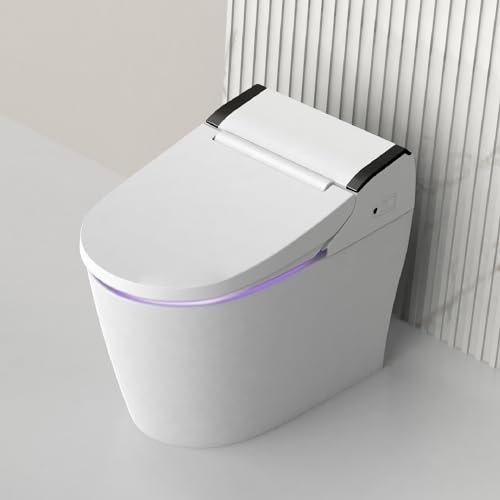
Smart Tankless Toilet With Bidet Review: Automatic Flushing, Heated Comfort, and Integrated Cleaning
Smart toilets have moved well beyond novelty. For homeowners planning a modern bathroom renovation, they can combine several separate fixtures and accessories into a single unit: toilet, bidet, heated seat, warm-air dryer, deodorizing system, remote control, and automatic flushing.
This particular smart tankless toilet with integrated bidet is designed around that all-in-one approach. Its advertised features include automatic dual flushing, a heated seat, warm-water washing, warm-air drying, multiple bidet modes, automatic deodorization, a stainless steel nozzle, wireless remote control, and a tankless tornado-style flushing system.
Those capabilities can make everyday bathroom use more comfortable and reduce reliance on toilet paper, but smart toilets are also more complex than conventional models. Water pressure, electrical access, installation requirements, maintenance, and feature preferences all matter before buying.
This guide examines how the major functions work, what they can realistically add to a bathroom, and what you should check before choosing a tankless smart toilet.
What Is a Smart Tankless Toilet?
A smart toilet combines a conventional flushing toilet with electrically powered comfort and hygiene features.
Instead of installing a separate bidet attachment, heated toilet seat, deodorizer, and other accessories, these functions are built into the toilet itself.
The model described here also uses a tankless flushing system. Rather than storing water in a traditional tank behind the bowl, it draws water directly from the home's supply line when flushing.
This design can create a cleaner, more compact appearance, but it also means adequate water pressure becomes particularly important.
According to the supplied specifications, the toilet's listed flushing performance is approximately 1.12 gallons per flush at 35 PSI. Actual operation will depend on installation conditions and the plumbing system supplying the toilet.
Automatic Dual Flushing
Automatic flushing is one of the most recognizable smart-toilet features.
This model uses a seat sensor intended to determine when the toilet has been used and initiate flushing without requiring the user to operate a handle.
It is also described as having an automatic dual-flush function, allowing the toilet to select between a smaller flush and a fuller flush depending on usage.
Why Dual Flush Matters
Traditional toilets often use essentially the same amount of water regardless of what needs to be removed from the bowl.
A dual-flush system attempts to match the flush to the task. A smaller flush may be sufficient for liquid waste, while a stronger flush can be used when greater bowl-clearing power is needed.
When implemented effectively, this approach can reduce unnecessary water consumption.
Automatic selection adds convenience because users do not need to choose between separate buttons or flush settings manually.
Hands-Free Operation
There is also a practical hygiene advantage to automatic flushing.
Users can leave the toilet without touching a flush handle or button. That reduces one contact point in the bathroom and can be especially convenient in households with children, older users, or anyone who simply prefers automated fixtures.
However, automatic functions depend on electronic sensors, so buyers should understand how manual flushing works in case of a power interruption or sensor issue.
Tankless Flushing System
The absence of a conventional toilet tank changes both the appearance and operation of the fixture.
A tank-style toilet fills a reservoir and stores water until the next flush. A tankless model instead relies directly on the water supply.
This smart toilet uses what the manufacturer describes as a tornado flushing system, designed to move water around the bowl with significant force rather than simply releasing water vertically from a tank.
Advantages of a Tankless Toilet
The most immediately noticeable benefit is appearance.
Without a bulky tank behind the seat, the toilet can have a lower, more streamlined profile that fits particularly well in contemporary bathrooms.
The system also avoids storing water in a tank between flushes.
Direct-feed flushing can deliver strong performance when household water pressure and plumbing are appropriate.
Water Pressure Is Critical
Tankless toilets generally depend more heavily on available supply pressure than traditional gravity-fed toilets.
The source information references operation at 35 PSI, so this should not be overlooked.
Before purchasing, confirm that the plumbing system can meet the manufacturer's pressure and flow requirements.
Low water pressure may reduce flushing performance, while pipe sizing and supply configuration can also influence how well a direct-flush toilet works.
This is one of the most important installation details to verify in advance.
Integrated Bidet Functions
The built-in bidet is arguably the most significant difference between a smart toilet and a conventional model.
Instead of relying entirely on toilet paper, users can activate a controlled stream of water for personal cleaning.
This model includes several washing modes, including posterior wash, feminine wash, and turbo wash.
Each mode is intended for a slightly different cleaning preference.
Posterior Wash
Posterior wash provides water cleaning after normal toilet use.
Depending on the control options available on the unit, users may be able to adjust functions such as water temperature, spray intensity, or nozzle position.
Even when adjustment ranges vary between smart toilets, the core benefit remains the same: water provides the primary cleaning action rather than dry paper alone.
Feminine Wash
A dedicated feminine wash function typically positions the spray differently to provide gentler forward cleaning.
This can be more convenient than relying on a single fixed nozzle position.
Turbo Wash
Turbo or stronger wash modes generally provide a more concentrated or powerful spray.
Some users may prefer stronger water pressure, while others may find a gentler wash more comfortable. A good smart toilet should therefore make controls intuitive rather than forcing one setting on every user.
Self-Cleaning Stainless Steel Nozzle
Because a bidet nozzle operates inside the toilet environment, cleanliness is an important consideration.
This model uses a stainless steel nozzle with a self-cleaning function.
Stainless steel is well suited to this application because it is durable, smooth, and comparatively easy to keep clean.
A self-cleaning cycle typically rinses the nozzle before, after, or around normal use, depending on the toilet's programming.
That does not eliminate the need for regular bathroom cleaning, but it can help keep the bidet system itself more sanitary between routine maintenance sessions.
Heated Toilet Seat
A heated seat may initially sound like a luxury feature, but it is one of the smart-toilet functions users tend to notice every day.
A conventional ceramic toilet can feel particularly cold in cooler weather or air-conditioned homes.
The integrated seat heater maintains a more comfortable surface temperature.
Depending on the model, heating intensity may offer several adjustment levels.
For households where different users have different preferences, accessible temperature controls can be more important than the maximum heating capability itself.
Energy Considerations
A heated seat requires electricity to maintain temperature.
Some smart toilets include energy-saving or standby modes that reduce heating when the toilet is unlikely to be used.
If energy efficiency matters, check whether the specific model allows scheduled, automatic, or reduced-power heating rather than keeping the seat at maximum temperature continuously.
Warm-Water Bidet Washing
Cold-water bidet attachments are simple and effective, but a smart toilet can offer a more comfortable experience by heating the wash water.
This model includes a warm-water cleaning system.
That can be particularly noticeable during longer wash cycles or in cooler environments.
Tankless smart bidets commonly heat water on demand rather than storing a limited reservoir of warm water. If this model uses an instantaneous heating system, that may allow a more consistent supply during use, but the precise heating configuration should be confirmed from the current manufacturer specifications.
Warm-Air Dryer
After washing, the toilet includes a warm-air drying function.
The dryer is intended to reduce the amount of toilet paper required after bidet use.
This is an important distinction because bidet toilets do not necessarily eliminate toilet paper entirely for every user.
Drying performance varies among smart toilets, and some people may still prefer a small amount of paper to finish drying.
Nevertheless, combining water washing with warm-air drying can substantially reduce dependence on conventional paper compared with using toilet paper as the sole cleaning method.
Automatic Deodorization
Odor management is another integrated feature.
The toilet includes an automatic deodorization system, designed to operate without requiring separate aerosol sprays or countertop air fresheners.
Smart-toilet deodorization systems commonly draw air from around the bowl and pass it through a filtering or deodorizing mechanism.
The exact mechanism and replacement requirements should be verified for the specific model.
This feature can be useful in small bathrooms, powder rooms, or ensuite bathrooms where ventilation is limited.
It should not, however, be viewed as a replacement for adequate bathroom ventilation.
Wireless Remote Control
With numerous functions available, control design becomes important.
This model includes a wireless remote controller for functions such as posterior washing, feminine washing, turbo washing, and other smart features.
A remote offers several advantages over controls mounted directly to the side of the toilet.
It can be positioned where the user can reach it comfortably, and the control layout can accommodate more functions without creating a large side panel.
For users with limited mobility, a wall-mounted remote may also be easier to operate than buttons attached close to the bowl.
Remote Placement Matters
When installing the toilet, choose a remote-control location that can be reached comfortably while seated.
Avoid placing it where water from a shower, sink, or cleaning process will regularly contact it unless the manufacturer specifically rates it for that exposure.
If the remote uses replaceable batteries, make sure it can be removed easily when necessary.
A More Integrated Bathroom Design
One attraction of an all-in-one smart toilet is visual simplicity.
A conventional setup may include a toilet, standalone bidet attachment, external controls, deodorizer, toilet paper holder, and various other accessories.
A smart toilet integrates many of those functions into a single fixture.
Tankless construction enhances this effect because there is no traditional rectangular water tank behind the seat.
For minimalist and contemporary bathroom renovations, this can create a cleaner architectural appearance.
Can a Smart Bidet Toilet Reduce Toilet Paper Use?
One of the advertised environmental benefits of smart bidet toilets is reduced toilet paper consumption.
That claim is reasonable in principle because water performs much of the cleaning that would otherwise require paper.
The warm-air dryer can further reduce paper use.
However, the amount saved depends entirely on user habits. Some people may still use toilet paper for drying, checking cleanliness, or personal preference.
It is therefore more accurate to view a bidet toilet as an opportunity to reduce toilet paper consumption rather than guarantee its elimination.
Water Efficiency
The supplied specifications list approximately 1.12 gallons per flush, which places emphasis on water-conscious flushing.
Dual flushing can potentially reduce water use further when the smaller flush is selected appropriately.
The actual efficiency of any toilet depends on how consistently it clears the bowl.
A low-volume toilet that requires frequent repeat flushes can lose part of its theoretical water-saving advantage.
For this reason, flushing performance and plumbing compatibility are just as important as the advertised gallons-per-flush figure.
Certifications and What They Mean
The product information describes the toilet as cUPC and cETLus certified.
Certification information is relevant because smart toilets combine plumbing and electrical systems in a bathroom environment.
Buyers should verify current certification details for the exact model being purchased, especially if local plumbing or electrical codes require specific approvals.
Certification does not mean a product will automatically comply with every local installation requirement.
Building codes and electrical regulations can vary, so installation requirements should be confirmed where necessary.
Electrical Requirements
A smart toilet needs electricity for its heated seat, warm-water system, dryer, sensors, remote-controlled functions, and deodorizer.
That means bathroom electrical infrastructure must be considered before purchase.
Unlike a conventional toilet, which may function with plumbing alone, a smart toilet generally needs an appropriately located electrical outlet.
In many jurisdictions, bathroom receptacles require ground-fault protection or other safety measures.
Electrical installation should comply with applicable local codes and the manufacturer's instructions.
Do not assume that an extension cord is an acceptable permanent solution simply because an outlet is not conveniently located.
Plumbing Requirements
The plumbing side also deserves more attention than it would with a basic gravity toilet.
Before ordering, verify:
- Available water pressure
- Supply-line dimensions
- Shutoff-valve configuration
- Drain location
- Rough-in dimensions
- Required water connections
- Manufacturer clearance specifications
The toilet must physically fit the existing plumbing layout.
A smart toilet with outstanding features is of little value if it requires extensive plumbing reconstruction that was not anticipated in the renovation budget.
Smart Toilet vs. Conventional Toilet
A conventional toilet remains difficult to beat for simplicity.
It requires no electrical power, contains fewer electronic components, is familiar to virtually every plumber, and can be inexpensive to repair.
A smart toilet offers comfort and convenience instead.
Heated seating, automatic flushing, bidet washing, warm-water cleaning, drying, and deodorization provide a fundamentally different user experience.
The tradeoff is complexity.
More components mean more potential maintenance points, and repairs may require specialized replacement parts.
The decision therefore depends on priorities.
If simplicity and low long-term maintenance are paramount, a high-quality conventional toilet may remain preferable. If comfort, hygiene features, and bathroom technology matter more, a smart toilet has a clear advantage.
Smart Toilet vs. Bidet Toilet Seat
Another alternative is installing an electronic bidet seat on an existing toilet.
This can provide many of the same features—including warm water, heated seating, washing, and drying—without replacing the entire toilet.
A bidet seat is often the easier option for an existing bathroom.
An integrated smart toilet, however, can produce a cleaner appearance and may add features such as automatic flushing and tankless bowl design that a replacement seat cannot provide.
For a complete bathroom renovation, the integrated approach may make more sense.
For a modest upgrade to an otherwise functional toilet, an electronic bidet seat can be more practical.
Who Is This Smart Toilet Best For?
This type of fixture is most appropriate for someone who actively wants an integrated bidet experience rather than simply a modern-looking toilet.
It can make particular sense for a new bathroom, major renovation, primary suite, or high-end guest bathroom where the necessary electrical and plumbing infrastructure can be planned from the beginning.
It may also appeal to people who want to reduce toilet paper use or who value automated bathroom features.
However, households that prioritize easy DIY repairs, minimal electronics, or the lowest possible purchase cost may prefer a conventional toilet.
Common Mistakes to Avoid Before Buying
One of the biggest mistakes is choosing a smart toilet purely by its feature list.
Compatibility should come first.
Measure the bathroom carefully and verify the toilet's rough-in requirements. Confirm water pressure. Check for an appropriate electrical outlet. Review service access and maintenance requirements.
Another mistake is assuming every advertised automatic function will work identically for every user. Seat sensors and automatic flushing systems vary in sensitivity and programming.
Remote controls should also be evaluated for usability. A toilet with dozens of functions is not necessarily convenient if basic features are difficult to find.
Finally, consider long-term replacement parts. A conventional toilet uses relatively standardized components, while smart toilets may rely on proprietary electronics, nozzles, control boards, or remotes.
Cleaning a Smart Toilet
Cleaning an electronic toilet requires slightly more care than scrubbing a basic porcelain fixture.
Always follow the manufacturer's recommendations, particularly around electronic components, sensors, nozzle assemblies, and plastic seat surfaces.
Avoid allowing large amounts of water to enter electrical housings.
Harsh abrasive cleaners should generally be avoided on delicate seat materials and control surfaces.
The stainless steel bidet nozzle should also be inspected periodically even if it includes an automatic rinsing function.
Self-cleaning features assist maintenance; they do not eliminate it.
Advantages of This Smart Tankless Toilet
The strongest argument for this model is the number of functions integrated into one fixture.
Automatic dual flushing reduces physical interaction with the toilet. The bidet system provides multiple washing modes, while warm water, a heated seat, and a warm-air dryer focus on comfort.
The tankless design creates a streamlined appearance, and the direct flushing system avoids keeping water stored in a conventional tank.
Automatic deodorization and wireless control add convenience, while the reported 1.12-gallon flush emphasizes water-conscious operation.
For users who genuinely want these features, an integrated design can be more cohesive than assembling several aftermarket accessories.
Potential Drawbacks
Complexity is the largest limitation.
The toilet depends on both plumbing and electricity, meaning installation can require more planning than simply replacing one conventional toilet with another.
Water pressure must be adequate for tankless flushing.
Electronic components also introduce additional potential failure points compared with a mechanical gravity toilet.
The initial purchase cost of smart toilets can be higher, and specialized repairs may be more difficult than replacing an ordinary fill valve or flapper.
Some users may also discover that they rarely use certain functions after the novelty wears off.
That is why it makes sense to identify which features genuinely matter to your household before paying for a premium fixture.
Frequently Asked Questions
What does automatic dual flush mean?
The toilet uses sensors and control logic to initiate flushing automatically and select an appropriate flush level based on use.
The exact sensing behavior should be confirmed in the manufacturer's operating instructions.
Does this toilet have a built-in bidet?
Yes. The supplied specifications describe posterior, feminine, and turbo washing functions with a self-cleaning stainless steel nozzle.
Is the toilet seat heated?
Yes. A heated seat is one of the advertised comfort features.
Does the bidet use warm water?
Yes. The model includes warm-water washing.
Does it have an air dryer?
Yes. A warm-air drying system is included to help reduce the need for toilet paper after washing.
Does it require electricity?
Yes. Features such as heating, drying, automatic sensing, deodorization, and electronic controls require electrical power.
Does it have a traditional water tank?
No. It uses a tankless flushing system that draws water directly from the supply line.
How much water does it use?
The supplied product specifications list approximately 1.12 gallons per flush at 35 PSI.
Actual performance should be evaluated according to the manufacturer's installation requirements and local water pressure.
Why is water pressure important?
Unlike a gravity toilet that releases water from a stored tank, a tankless toilet depends directly on the water supply.
Insufficient pressure or flow can affect flushing performance.
Can it reduce toilet paper use?
Potentially.
The bidet performs much of the cleaning with water, and the warm-air dryer can further reduce the amount of paper needed. Individual habits will determine the actual reduction.
Does automatic deodorization replace bathroom ventilation?
No.
Deodorization can help manage odors around the toilet, but proper bathroom ventilation remains important for controlling humidity and general air quality.
Is a smart toilet difficult to install?
It can be more involved than a conventional toilet because both plumbing and electrical requirements must be satisfied.
Professional installation may be worthwhile when electrical work, plumbing changes, or unfamiliar tankless systems are involved.
Final Verdict
A smart tankless toilet with an integrated bidet can transform one of the most basic bathroom fixtures into a much more capable system.
This model combines automatic dual flushing, approximately 1.12-gallon flushing, a tankless direct-water design, posterior and feminine washing, turbo wash, a heated seat, warm water, warm-air drying, automatic deodorization, a stainless steel self-cleaning nozzle, and wireless remote control.
Those features make it particularly appealing for modern bathroom renovations where comfort, automation, and an integrated appearance are priorities.
Its suitability ultimately depends less on how many features it offers and more on whether the bathroom is prepared to support them. Water pressure, electrical access, rough-in measurements, plumbing configuration, installation requirements, and long-term serviceability should all be checked before purchasing.
For the right bathroom, a smart toilet can replace several separate accessories while providing a cleaner, more automated experience. For buyers who value simplicity above all else, a conventional toilet will remain easier to own.
The best choice is therefore not simply the toilet with the longest feature list. It is the one whose comfort features, plumbing requirements, maintenance expectations, and everyday usability match the household that will actually use it.