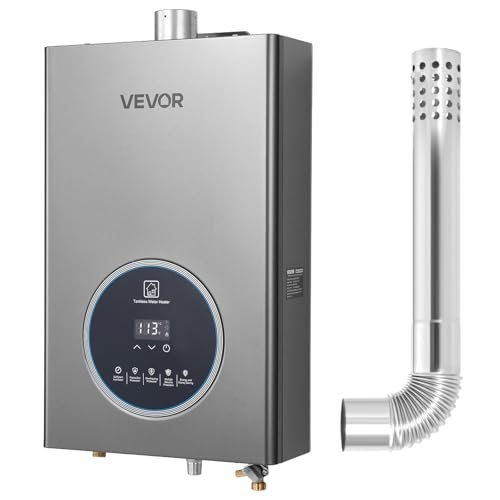
4.3 GPM Propane Tankless Water Heater Review: 100,000 BTU, ±1°F Temperature Control and Indoor Venting
A propane tankless water heater can be a practical alternative to a traditional storage tank when the goal is continuous hot water, compact installation, and strong heating performance without relying on a large electrical supply. Instead of keeping dozens of gallons hot around the clock, it heats water only when a fixture is opened.
This 4.3 GPM propane tankless water heater is rated at up to 100,000 BTU per hour and is designed for indoor installation with a vent connection. Its main features include precise temperature regulation, a digital LED display, touch controls, 1/2-inch NPT plumbing connections, and several built-in safety protections.
The headline 4.3 GPM figure suggests enough capacity for a shower and additional moderate hot-water use under suitable conditions. However, as with any tankless system, actual performance depends on incoming water temperature, flow rate, desired outlet temperature, gas supply, and correct venting.
For homeowners comparing compact propane heaters for bathrooms, small homes, apartments, cabins, or moderate whole-house demand, the unit's combination of 100,000 BTU output and temperature stabilization makes it worth understanding in more detail.
What Is This 4.3 GPM Propane Tankless Water Heater?
This product is an indoor propane-fired tankless water heater.
Unlike a conventional water heater with a storage tank, it heats water while it flows through the heat exchanger. When a hot-water fixture opens, the heater detects demand, ignites the burner, and transfers heat into the water.
When the fixture closes, combustion stops.
This means there is no stored tank to deplete during a long shower. As long as the unit has propane, water, and sufficient capacity for the current flow, it can continue producing hot water.
Key Specifications
The supplied product information highlights several important characteristics:
- Maximum heat input: approximately 100,000 BTU/hr
- Maximum advertised flow: 4.3 GPM
- Fuel: propane
- Installation: indoor
- Water connections: 1/2-inch NPT
- Temperature control: approximately ±1°F around the selected setting
- Display: large LED screen
- Controls: touch panel
- Venting: vent outlet for connection to an approved direct-vent system
- Safety systems: flameout, overheating, dry-burning, anti-freeze, wind-pressure and other protections
Those specifications position it above small portable propane heaters and closer to a fixed residential tankless system.
Understanding the 100,000 BTU Rating
BTU per hour measures the burner's maximum heat input.
A rating of 100,000 BTU/hr gives the unit substantially more heating capacity than compact outdoor camping heaters, many of which operate in the 30,000- to 50,000-BTU range.
That extra output is what allows a residential-style heater to support greater water flow and a larger temperature rise.
However, BTU alone does not tell you exactly how many fixtures the heater can serve. Water temperature and flow have to be considered together.
What Does 4.3 GPM Actually Mean?
The manufacturer lists a maximum flow of approximately 4.3 gallons per minute.
That is potentially enough for a normal shower plus a smaller sink load, or two low-flow fixtures under favorable conditions.
The key word is maximum.
A tankless heater cannot always deliver its maximum rated flow at the maximum desired temperature.
If the incoming water is warm, the heater can raise a larger volume of water to the target temperature.
If the incoming water is very cold, available hot-water flow decreases because every gallon requires more energy.
Temperature Rise Determines Real Capacity
Consider two homes using the same heater.
In the first, incoming water is 70°F and the desired outlet temperature is 105°F. The heater needs a 35°F temperature rise.
In the second, incoming water is 40°F and the desired outlet is also 105°F. The required rise is 65°F.
The second installation asks nearly twice as much heating work from the same 100,000-BTU burner.
That means the maximum sustainable flow will be lower.
This is why local inlet-water temperature matters when deciding whether 4.3 GPM is sufficient.
Is 4.3 GPM Enough for One Shower?
Yes, in most reasonable scenarios.
Many modern showerheads use around 1.5 to 2.5 GPM.
That puts a single shower comfortably below the unit's advertised maximum flow under favorable conditions.
In colder climates, the heater may still support one shower easily because the total demand is moderate relative to its 100,000-BTU output.
Can It Run Two Showers?
Possibly, but the answer depends on the showerheads and temperature rise.
Two 1.5 GPM showers create a combined flow of 3.0 GPM.
Two 2.0 GPM showers require 4.0 GPM.
Both figures sit below the advertised 4.3 GPM maximum, but cold inlet water may reduce available hot-water flow enough that the heater cannot maintain the desired temperature at the full combined demand.
If simultaneous showering is a major priority, sizing should be based on the manufacturer's temperature-rise performance chart rather than the maximum GPM figure alone.
Can It Run a Shower and Sink at the Same Time?
This is a more realistic multi-fixture scenario.
For example, a 2.0 GPM shower plus a bathroom sink using 0.5 GPM creates a total demand of around 2.5 GPM.
That provides more margin for colder incoming water.
For many small households, a shower-plus-sink workload is a better representation of real use than trying to run several high-flow fixtures simultaneously.
Continuous Hot Water Without Tank Depletion
The biggest practical advantage of tankless heating is duration.
A traditional tank may eventually run out of stored hot water during long showers or back-to-back use.
A tankless heater does not have that same storage limit.
As long as demand remains within the heater's capacity, hot water can continue.
That makes the phrase "continuous hot water" reasonable, but it should not be confused with unlimited flow.
Endless Duration, Finite Flow
This distinction is fundamental.
The heater can operate for a long time, but it cannot produce more than its burner and heat exchanger are capable of heating.
If several fixtures push total demand beyond the unit's capacity, outlet temperature may drop or the system may struggle to maintain the setpoint.
Correct sizing matters more than the absence of a tank.
±1°F Temperature Regulation
One of the more compelling features is the claimed ±1°F temperature stability.
The heater uses sensors to monitor operating conditions and adjust burner output in an effort to keep water temperature close to the selected setting.
That can make showers more comfortable by reducing sudden hot and cold swings.
It is especially useful when water pressure changes slightly as another fixture opens or closes.
Why Temperature Stability Matters
A tankless heater that constantly overshoots and undershoots the target temperature can be frustrating even if it technically has enough capacity.
Stable modulation is therefore just as important as raw BTU output.
For normal residential use, consistent temperature often matters more than squeezing every possible fraction of a gallon per minute from the heater.
Real-World Temperature Can Still Shift
A ±1°F regulation claim should be understood as a stated performance target rather than a guarantee in every possible plumbing condition.
Major flow changes, very cold inlet water, insufficient gas pressure, or an undersized system can still affect outlet temperature.
The smart controls help regulate the heater, but they cannot override insufficient heating capacity.
LED Display
The large LED display provides real-time operating information such as water temperature and system status.
That makes the heater easier to monitor and configure.
A visible temperature readout is especially useful during initial setup because users can verify the selected temperature without opening a cover or relying on a mechanical dial.
Touch Control Panel
The heater uses a touch interface for local operation.
This provides a cleaner and more modern control surface than traditional rotary gas-water-heater controls.
The main practical advantage is direct temperature adjustment and clearer system feedback.
For an appliance that may remain installed for many years, simple local controls are generally preferable to relying exclusively on a mobile app.
Indoor Installation Requires Proper Venting
This model is described as an indoor propane tankless water heater.
That means combustion gases must be safely vented outdoors.
Propane combustion produces carbon dioxide and can also produce dangerous carbon monoxide if combustion or venting is improper.
The heater should never be operated indoors without the manufacturer-specified vent system.
Direct Venting Is Not Optional
The source states that the heater includes a vent outlet intended for connection to a direct vent.
That connection must be installed correctly.
A proper vent system helps move combustion exhaust outdoors and, depending on the appliance design, may also provide combustion air.
Improvised venting is unsafe.
Use only vent materials and configurations approved for the heater.
Why Professional Gas Installation Is Often Appropriate
Installing a propane tankless water heater involves more than connecting water lines.
The job may require:
- Correct gas-pipe sizing
- Propane regulator compatibility
- Leak testing
- Vent installation
- Combustion clearances
- Water piping
- Pressure verification
- Local permits
For most homeowners, a licensed plumber or gas technician is the appropriate installer.
Gas Supply Must Be Sized Correctly
A 100,000-BTU burner needs sufficient propane flow.
A gas line that is too small can cause poor combustion, reduced heat output, ignition issues, or shutdowns.
Pipe sizing depends on total BTU demand, pipe length, regulator pressure, and other appliances sharing the system.
Do not assume an existing small gas line is automatically adequate.
Propane Regulator Compatibility
If the home uses a propane tank, the regulator must deliver the pressure specified by the water heater.
Improper gas pressure can lead to unreliable ignition or unsafe combustion.
The gas supply should be verified during installation rather than adjusted by trial and error.
Always Test Gas Connections for Leaks
Every new or disturbed gas connection should be tested with an approved leak-detection method before the appliance is operated.
Never use an open flame to test for propane leaks.
If a leak is detected, shut off the gas supply and correct the issue before proceeding.
1/2-Inch NPT Connections
The heater uses 1/2-inch NPT plumbing connections according to the supplied information.
That can simplify integration into many residential plumbing systems.
However, the gas connection size and water connection size should not be assumed to be interchangeable simply because both may use NPT threads.
Always follow the exact connection diagram in the installation manual.
Water Flow and Pipe Size
Even a heater rated for 4.3 GPM cannot deliver that flow if the supply piping is highly restricted.
Old galvanized pipes, partially closed valves, undersized lines, clogged filters, or poor well pressure can all reduce performance.
Before blaming the heater for low flow, consider the plumbing system feeding it.
Multiple Built-In Safety Protections
The product description lists a broad set of protective features, including:
- Flame-failure protection
- Dry-burning protection
- Overheat protection
- Timeout protection
- High-temperature lock
- Wind-pressure protection
- Anti-freeze protection
- Leak-related safeguards
- Pipe-damage protection
These systems are useful, but they should be understood as backup protections rather than substitutes for correct installation.
Flameout Protection
A flame-failure system detects when the burner has gone out unexpectedly.
If the flame disappears, the appliance should stop supplying gas rather than allowing unburned propane to continue flowing.
This is a fundamental safety feature for gas appliances.
Overheat Protection
Overheat protection helps stop operation if water or internal components exceed safe temperatures.
This can reduce the risk of damage and excessively hot outlet water.
The heater should still be set to an appropriate household temperature.
Dry-Burning Protection
Dry-burning or dry-fire protection prevents the burner from continuing to heat if there is insufficient water moving through the heat exchanger.
That helps protect the exchanger from overheating.
It is particularly important during startup or when water pressure becomes unstable.
High-Temperature Lock
The listed high-temperature lock is intended to reduce the chance of accidental temperature settings beyond a safe threshold.
This may be useful in households with children or guests.
However, the exact lock behavior should be confirmed in the owner's manual.
Timeout Protection
Timeout protection can shut down the burner after prolonged continuous operation.
The exact duration is not given in the source.
This is typically intended as an additional safeguard against abnormal operation.
Wind-Pressure Protection
Wind-pressure protection is generally associated with the combustion and venting system.
Strong wind or abnormal vent pressure can interfere with proper exhaust flow.
A protection mechanism can shut the appliance down rather than continue operating under unsuitable vent conditions.
Anti-Freeze Protection
Anti-freeze protection is a valuable feature, but buyers should interpret it carefully.
Built-in freeze protection often depends on the appliance having power and gas available and may only protect the internal unit under specific conditions.
It does not necessarily mean exposed plumbing can safely remain outdoors in severe freezing weather.
Follow the manufacturer's cold-weather instructions exactly.
Freeze Protection Is Not a Substitute for Insulation
Water lines leading to and from the heater can still freeze.
In cold climates, exposed pipes may require insulation, heat tracing, or another approved freeze-protection method.
If the property will be vacant during winter, winterization procedures may be necessary.
Tankless Water Heater vs. Storage Tank
A storage water heater keeps a reserve of hot water ready.
That provides excellent short-term flow, but the supply can eventually run out.
The propane tankless heater produces water continuously instead.
It also takes up much less physical space.
The tradeoff is greater installation complexity, especially around gas and venting.
Propane Tankless vs. Electric Tankless
A major advantage of propane is heating power.
Producing the equivalent of 100,000 BTU/hr electrically would require a very large electrical service.
Propane allows relatively high water-heating output without demanding huge electrical circuits.
The tradeoff is fuel storage, combustion, venting, and gas-system maintenance.
Propane Tankless vs. Natural Gas Tankless
The two technologies operate similarly, but the fuel systems are different.
A propane heater must be configured specifically for propane.
A natural-gas unit should not be connected to propane unless the manufacturer explicitly allows and provides an approved conversion procedure.
Gas pressures and burner characteristics differ.
Is It Suitable for a Small Whole House?
Potentially, yes.
A 4.3 GPM heater can make sense for a small home where one major hot-water fixture is usually used at a time.
A couple taking showers sequentially while occasionally using sinks is a very different demand pattern from a large family running multiple showers simultaneously.
Household behavior matters.
Is It Suitable for an Apartment?
It can be, provided propane service, approved venting, and local building rules permit the installation.
Multifamily buildings may have stricter requirements for gas appliances and vent penetrations.
A compact appliance does not automatically make installation simple in an apartment.
Is It Suitable for a Cabin?
Yes, potentially.
A propane tankless heater can be especially useful in cabins where electrical capacity is limited.
However, indoor venting, gas storage, freeze protection, and seasonal winterization all need to be considered.
For an unheated seasonal cabin, freeze protection is particularly important.
Is It Suitable for a Tiny Home?
It may be, because the wall-mounted tankless design saves floor space.
The 100,000-BTU output is also substantial for a small building.
However, tiny homes require careful attention to combustion air, vent placement, gas storage, and clearances because the interior volume is limited.
Is It Suitable for a Bathtub?
It can fill a bathtub, but the flow rate matters.
A high-flow tub spout may exceed the heater's capacity at the desired temperature rise.
Reducing flow can maintain hotter water but increases filling time.
Large soaking tubs may benefit from a higher-capacity heater.
Is It Suitable for a Dishwasher?
Yes, potentially.
A dishwasher generally draws hot water intermittently rather than at a continuous shower-like flow.
As long as other fixtures do not push total demand beyond the heater's capacity, dishwasher use should be manageable.
Maintenance and Descaling
Tankless heaters require periodic maintenance.
Hard-water minerals can accumulate inside the heat exchanger and reduce heat transfer or flow.
In areas with hard water, periodic descaling may be especially important.
The maintenance interval should follow the manufacturer's instructions and local water conditions.
Why Hard Water Matters
Scale acts as an insulating layer on heat-transfer surfaces.
That can reduce efficiency and force the burner to work harder.
It can also restrict narrow water passages.
Ignoring scale for years may shorten heater life or degrade temperature stability.
Install Service Valves if Recommended
Isolation and flush valves can make maintenance much easier.
They allow the heater to be disconnected from the household water system and flushed with an appropriate descaling solution.
If the installation manual supports service valves, adding them during installation is usually easier than retrofitting them later.
Combustion Maintenance
The burner and venting system should also be inspected periodically.
Dust, insects, debris, or vent blockage can affect combustion.
Any unusual flame behavior, soot, exhaust smell, repeated shutdown, or error code should be investigated promptly.
Carbon Monoxide Safety
Any indoor fuel-burning appliance carries carbon-monoxide considerations.
A properly installed and vented heater should direct combustion gases outdoors.
Homes with combustion appliances should also follow applicable requirements for carbon-monoxide alarms.
Never operate the unit with damaged or disconnected venting.
Common Buying Mistakes
The first mistake is assuming 4.3 GPM is guaranteed regardless of incoming water temperature.
Another is overlooking the cost and complexity of gas-line and vent installation.
Buyers may also underestimate the importance of propane pressure and pipe sizing.
Another common mistake is assuming anti-freeze protection means no winter preparation is ever required.
Finally, a high BTU rating does not compensate for poorly installed venting or inadequate water flow.
What to Check Before Buying
Before purchasing this heater, verify:
- Propane availability
- Gas-line sizing
- Regulator compatibility
- Installation clearances
- Approved vent route
- Incoming water temperature
- Desired outlet temperature
- Maximum simultaneous GPM
- Water pressure
- Plumbing connection compatibility
- Water hardness
- Local gas and plumbing codes
- Permit requirements
These checks matter far more than appearance or display size.
Main Advantages
The strongest advantage is substantial heating power in a compact tankless format.
A 100,000 BTU/hr burner and advertised 4.3 GPM flow can provide meaningful residential capacity.
Precise temperature regulation, LED monitoring, touch controls, and multiple safety protections add convenience.
Propane operation also avoids the enormous electrical demand associated with similarly powerful electric tankless heaters.
Potential Drawbacks
The heater requires a correctly sized propane supply.
Indoor installation requires approved venting.
Actual flow at comfortable temperature may be lower than 4.3 GPM in cold climates.
Hard-water maintenance may be necessary.
Professional installation may add significantly to total cost.
And although the unit offers several safety systems, those protections cannot compensate for improper gas or vent installation.
Who Should Consider This Propane Tankless Heater?
This type of heater may be a good fit for:
- Small homes
- Cabins
- Tiny homes
- Apartments where propane installation is permitted
- Homes with limited electrical service
- One- or two-bathroom properties
- Buyers who want continuous hot-water duration
- Properties where floor space is limited
Larger households with multiple simultaneous showers may need a higher-flow model.
Frequently Asked Questions
What is the maximum heating output?
Approximately 100,000 BTU per hour.
What is the advertised maximum flow?
Approximately 4.3 GPM.
Is 4.3 GPM guaranteed?
No. Real hot-water flow depends on incoming water temperature and desired temperature rise.
Can it run one shower?
Yes, under normal sizing conditions.
Can it run two showers?
Possibly, depending on showerhead flow and inlet-water temperature.
Can it provide continuous hot water?
Yes, as long as demand stays within the heater's capacity and fuel and water supplies remain available.
How stable is the temperature?
The manufacturer states that the control system maintains the set temperature within approximately ±1°F.
Does it have a digital display?
Yes.
Does it have touch controls?
Yes.
Is it designed for indoor use?
Yes, according to the supplied description.
Does it require venting?
Yes. Indoor propane combustion must be vented according to the manufacturer's instructions.
What size are the water connections?
The source lists 1/2-inch NPT connections.
Does it have flame-failure protection?
Yes.
Does it have overheat protection?
Yes.
Does it have dry-fire protection?
Yes.
Does it have anti-freeze protection?
Yes, according to the supplied information, though cold-weather installation and winterization requirements still need to be followed.
Does it need electricity?
The source does not provide enough electrical detail to state the exact requirement. Indoor tankless gas heaters commonly need some electrical power for controls, ignition, or venting, so the current manual should be checked.
Is professional installation recommended?
For gas supply, venting, and code compliance, professional installation is generally the prudent choice.
Final Verdict
This 4.3 GPM, 100,000 BTU propane tankless water heater offers a useful balance between compact size and relatively strong hot-water output.
Its key strengths are the 100,000 BTU/hr burner, advertised 4.3 GPM flow, ±1°F temperature-control claim, LED display, touch controls, multiple safety systems, and indoor direct-vent design.
The biggest purchasing consideration is proper sizing. A 4.3 GPM rating can comfortably support a shower and lighter additional use under favorable conditions, but colder incoming water reduces available flow.
Installation also needs to be treated seriously. Propane line sizing, regulator pressure, venting, combustion safety, plumbing, and local code all matter.
For a small home, cabin, apartment, or other property that needs continuous propane-powered hot water without sacrificing floor space, this type of heater can be a strong option when professionally sized and correctly installed.