Calcium Chloride Moisture Test Kit Review: Understanding ASTM F1869 Concrete Testing
Installing flooring or protective coatings over a concrete slab before it is sufficiently dry can lead to expensive failures. Excess moisture vapor moving through concrete may weaken adhesives, create bubbles beneath coatings, discolor flooring, contribute to warping, or cause sections of the finished surface to release from the slab.
A calcium chloride moisture test provides a practical way to measure the amount of moisture vapor currently leaving the surface of an uncoated concrete floor. The method is commonly associated with ASTM F1869 and reports the result as a moisture vapor emission rate, or MVER.
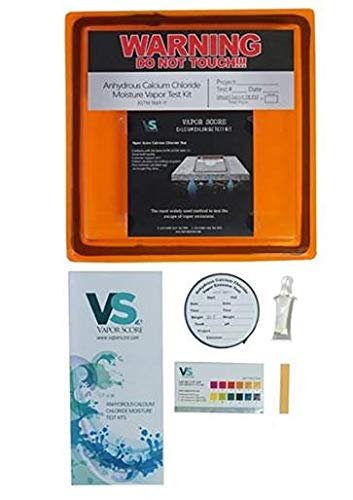
This test kit combines calcium chloride test units with distilled water and pH strips, allowing users to evaluate both moisture emission and surface alkalinity before installing compatible flooring, coatings, or adhesives. Accurate results, however, depend on careful surface preparation, controlled environmental conditions, correct timing, and precise calculations.
What Is the Calcium Chloride Test Method?
The calcium chloride test is a quantitative method used to estimate how much moisture vapor is being emitted from the surface of a concrete slab.
A measured quantity of anhydrous calcium chloride is placed beneath a sealed cover on a prepared section of concrete. Calcium chloride readily absorbs moisture from the surrounding environment. During the test period, the material gains weight as it collects moisture vapor emitted by the slab.
The difference between the starting and final weight is used to calculate the moisture vapor emission rate.
Results are generally expressed as pounds of moisture emitted per 1,000 square feet of concrete over a 24-hour period.
What ASTM F1869 Measures
ASTM F1869 is associated with measuring moisture vapor emission from concrete using anhydrous calcium chloride.
The test evaluates conditions near the slab surface during the testing period. It does not directly measure moisture throughout the full depth of the concrete.
This distinction matters because concrete can contain different moisture levels at different depths. A slab may appear relatively dry at the surface while retaining more moisture deeper inside.
The calcium chloride method therefore provides useful information about current surface emission, but it should not be interpreted as a complete profile of internal slab moisture.
Understanding Moisture Vapor Emission Rate
Moisture vapor emission rate, commonly abbreviated as MVER, estimates the amount of water vapor moving out of the concrete surface.
The result is expressed in:
Pounds of moisture per 1,000 square feet over 24 hours
For example, a result may be recorded as 3 pounds, 5 pounds, or another value per 1,000 square feet per day.
The acceptable result depends on the flooring, adhesive, coating, moisture-mitigation system, and manufacturer requirements. There is no single universal MVER limit that applies to every installation.
Always compare the measured result with the written specifications for the exact products being installed.
Why Concrete Moisture Testing Matters
Concrete may look and feel dry while still releasing significant moisture vapor.
Moisture can enter or remain within a slab because of:
- Water used in the original concrete mixture
- Inadequate curing time
- Missing or damaged vapor retarders
- Ground moisture beneath the slab
- Plumbing leaks
- Poor drainage
- Seasonal humidity
- Wet cleaning
- Environmental changes
- Water intrusion
When impermeable or moisture-sensitive flooring is installed, vapor movement may become trapped beneath the finished surface.
Potential consequences include:
- Adhesive softening
- Flooring delamination
- Blistering
- Bubbles beneath coatings
- Discoloration
- Warping
- Cupping
- Efflorescence
- Alkaline damage
- Unpleasant odors
- Microbial growth where suitable conditions exist
Testing before installation gives contractors and property owners useful information for choosing materials and planning moisture mitigation.
Calcium Chloride Testing and Flooring Warranties
Many flooring and adhesive manufacturers specify acceptable moisture limits for their products.
These requirements may reference:
- ASTM F1869 calcium chloride results
- ASTM F2170 relative humidity testing
- Concrete surface pH
- Approved primers
- Moisture-mitigation systems
- Required documentation
A test result does not automatically approve a slab for every product. The measured value must be evaluated against the current technical data sheet and installation instructions supplied by the flooring or adhesive manufacturer.
Failure to test or document conditions may affect warranty eligibility.
Why Environmental Conditions Matter
The calcium chloride test should be conducted under environmental conditions that represent normal building use.
Temperature and relative humidity influence how moisture moves through concrete. Heating, cooling, dehumidification, open windows, wet weather, or temporary construction conditions can all affect the result.
For meaningful testing, the space should be at or near the conditions expected during occupancy.
Testing under unstable or unrepresentative conditions can produce results that do not accurately reflect how the slab will behave after flooring is installed.
The test should not be marketed as accurate regardless of temperature and humidity. Consistent, documented environmental conditions are essential to reliable interpretation.
Preparing the Building Before Testing
Before conducting a calcium chloride test, the building environment should be stabilized as required by the applicable test method and flooring specifications.
This may involve operating:
- Heating systems
- Air conditioning
- Dehumidification
- Permanent ventilation
- Normal building controls
The slab should not be tested immediately after unusual events such as:
- Wet cleaning
- Heavy rain intrusion
- HVAC shutdown
- Construction heating
- Open-air exposure
- Flooding
- Temporary enclosure changes
Document the ambient temperature and relative humidity during the test.
Surface Preparation Is Critical
The test must be placed on clean, exposed concrete.
Floor coverings, adhesives, sealers, curing compounds, paint, coatings, patching residues, and contaminants may interfere with moisture emission and distort the result.
The selected test area may need mechanical preparation to expose clean concrete.
Potential contaminants include:
- Carpet adhesive
- Tile mortar
- Paint
- Epoxy
- Oil
- Wax
- Drywall compound
- Concrete curing agents
- Surface hardeners
- Dust
- Cleaning residue
Vacuum the prepared surface thoroughly before installing the test unit.
Avoid using water or liquid cleaners immediately before testing, as they may add moisture to the slab.
Selecting Test Locations
Concrete conditions may vary considerably across the same room or building.
Testing should account for:
- Exterior walls
- Columns
- Plumbing locations
- Previously wet areas
- Different slab pours
- Below-grade sections
- Changes in flooring type
- Cracks
- Expansion joints
- Areas near doors
- Variations in ventilation
One test in the center of a large floor may not represent the entire installation area.
The number and placement of tests should follow the applicable standard, project specifications, and flooring manufacturer guidance.
How the Calcium Chloride Test Works
The basic procedure involves weighing a container of anhydrous calcium chloride before exposing it to the slab.
The container is then placed on prepared concrete and sealed beneath a moisture-resistant cover. The cover isolates a known area of the slab so moisture emitted from that area is absorbed by the calcium chloride.
After the specified exposure period, the container is resealed and weighed again.
The weight gain, test duration, and exposed surface area are used to calculate the MVER.
Basic Testing Procedure
Although users should follow the instructions supplied with the kit and the applicable ASTM procedure, a typical workflow includes the following steps.
Prepare the Concrete
Remove coatings and contaminants from the selected area. Vacuum away all dust.
Record Environmental Conditions
Measure and document room temperature and relative humidity.
Record the Starting Weight
Use the documented starting weight of the calcium chloride container, or weigh it using a suitable calibrated scale if required by the kit.
Open the Test Container
Expose the anhydrous calcium chloride only when ready to begin. It begins absorbing moisture from the air immediately.
Position the Test
Place the container on the prepared concrete without spilling or contaminating the material.
Seal the Cover
Install the supplied dome or cover securely so outside air cannot enter the test area.
Record the Start Time
Document the exact date and time.
Leave the Test Undisturbed
Do not move, open, puncture, or disturb the cover during the test period.
End the Test
At the appropriate time, remove and immediately reseal the container according to the instructions.
Record the Final Weight
Determine how much moisture the calcium chloride absorbed.
Calculate the MVER
Use the supplied formula, worksheet, or laboratory service to calculate the final result.
Why Accurate Weighing Matters
The result depends on a relatively small change in weight. An inaccurate scale can therefore produce a misleading MVER calculation.
Important weighing considerations include:
- Appropriate scale resolution
- Calibration
- Stable weighing surface
- Clean containers
- Prompt resealing
- Avoiding fingerprints or contamination
- Recording units correctly
- Protecting samples from room humidity
Some kits use preweighed containers and laboratory analysis, while others require the user to perform the weighing and calculation.
Confirm which process applies before beginning.
Avoiding Outside-Air Contamination
Anhydrous calcium chloride absorbs moisture rapidly from ambient air.
Leaving the container open before or after the test can increase its weight independently of slab moisture.
To minimize error:
- Open the container only when ready
- Install the cover immediately
- Reseal promptly after exposure
- Avoid humid handling areas
- Do not touch the calcium chloride
- Follow the timing instructions carefully
A damaged cover or incomplete seal may invalidate the test.
Testing Duration
The exposure period must follow the test method and kit instructions.
Ending the test too early or leaving it in place too long may make the result unsuitable for valid ASTM-based reporting.
Record both the start and finish times precisely rather than estimating the duration.
The test area should remain undisturbed throughout the entire exposure period.
Interpreting the Result
Once the MVER has been calculated, compare it with the maximum value permitted by the selected flooring or coating system.
A result above the product limit may require:
- Additional drying time
- Improved environmental control
- Moisture-mitigation epoxy
- A different adhesive
- A more moisture-tolerant flooring system
- Further investigation
- Additional testing
A result below the published limit does not remove the need to follow every other installation requirement.
Surface condition, alkalinity, temperature, flatness, porosity, and structural integrity still matter.
Why One Passing Test May Not Be Enough
Moisture conditions can vary across a slab.
A passing result in one location does not guarantee acceptable conditions everywhere else. Large areas, separate rooms, previous water-damage zones, and different concrete placements may need additional tests.
Testing multiple locations helps identify hidden variations that could affect flooring performance.
Calcium Chloride Testing vs. Relative Humidity Testing
Calcium chloride testing and in-situ relative humidity testing evaluate different aspects of concrete moisture.
Calcium Chloride Testing
The calcium chloride method estimates moisture vapor emission near the slab surface.
Its advantages include:
- Familiar reporting units
- Direct comparison with some flooring specifications
- Relatively simple equipment
- Long history of use in flooring work
Its limitations include:
- Surface-oriented measurement
- Sensitivity to environmental conditions
- Dependence on surface preparation
- Limited applicability to certain slab conditions
- No direct measurement of deeper internal moisture
In-Situ Relative Humidity Testing
Relative humidity probes are installed in drilled holes at a specified depth within the slab.
This method evaluates internal concrete humidity rather than only surface emission.
Some flooring manufacturers prefer or require ASTM F2170 results, while others accept either method. The correct test should be determined from project specifications and current manufacturer requirements.
Why Both Tests May Be Useful
On some projects, calcium chloride and relative humidity testing are used together.
The tests measure different conditions, so their results should not be converted directly or expected to match.
Using both methods may provide a broader picture of slab moisture, particularly for high-value flooring systems or complex installations.
Surface pH Testing
The described kit also includes distilled water and pH test strips.
Concrete surfaces are naturally alkaline. Moisture moving through the slab can carry alkaline compounds to the surface, potentially affecting adhesives and coatings.
A pH test helps identify whether the surface alkalinity falls within the acceptable range for the intended installation product.
The flooring or coating manufacturer should specify the maximum permitted pH.
How a Concrete pH Test Is Performed
The exact procedure should follow the kit and product instructions, but a typical surface pH test involves:
- Preparing clean, exposed concrete.
- Applying the specified amount of distilled water.
- Allowing the water to remain for the required period.
- Placing the pH strip into the solution.
- Comparing the strip color with the supplied chart.
- Recording the result.
Tap water should not be substituted for distilled water because its mineral content and existing pH may affect the reading.
Why Moisture and pH Are Related
Moisture moving through concrete can transport alkaline salts toward the surface.
When that moisture becomes trapped beneath flooring or coatings, the resulting high-pH environment may attack certain adhesives, primers, or backing materials.
Testing both MVER and surface pH provides more useful installation information than moisture testing alone.
Who Can Use a Calcium Chloride Test Kit?
The kit may be useful for:
- Flooring contractors
- General contractors
- Renovation professionals
- Property inspectors
- Real estate investors
- Facility managers
- Coating installers
- Homeowners managing DIY flooring projects
Professional interpretation remains important for expensive or warranty-sensitive installations.
A homeowner can perform the procedure, but mistakes in surface preparation, environmental conditioning, timing, sealing, or weighing may make the result unreliable.
New Concrete Slabs
New concrete contains a substantial amount of mixing water and requires time to dry.
Drying speed depends on:
- Slab thickness
- Water-to-cement ratio
- Curing method
- Ambient humidity
- Temperature
- Air movement
- Vapor retarder quality
- Ground conditions
- Building enclosure
- Surface treatments
Rules of thumb based only on slab age are unreliable. Testing provides project-specific information about current conditions.
Existing Concrete Slabs
Older slabs can also experience moisture problems.
Possible sources include:
- Missing vapor barriers
- Damaged vapor retarders
- Groundwater
- Plumbing leaks
- Drainage problems
- Changes in building use
- HVAC modifications
- Previous flooding
- Seasonal moisture movement
Age alone does not guarantee that a slab is dry enough for moisture-sensitive flooring.
Common Testing Mistakes
Testing Over Coatings or Adhesive Residue
The result may not reflect actual concrete emission.
Failing to Stabilize the Environment
Temporary temperature or humidity conditions can distort the test.
Using Too Few Tests
A small sample may miss wet areas.
Disturbing the Cover
Breaking the seal allows room air to affect the calcium chloride.
Mishandling the Container
Leaving it open increases weight independently of the slab.
Using an Inaccurate Scale
Small weighing errors can significantly change the calculated result.
Estimating the Test Time
Start and finish times should be documented precisely.
Ignoring Flooring Manufacturer Limits
The MVER value must be compared with the exact product specification.
Assuming a Passing Result Guarantees Success
Other conditions, including pH and surface contamination, may still cause failure.
Test Kit Storage
Sealed calcium chloride test units can generally remain usable when stored properly, but users should follow the manufacturer’s stated storage and shelf-life guidance.
Store the kit:
- In its original sealed packaging
- In a dry location
- Away from high humidity
- Away from temperature extremes
- Protected from puncture
- Away from water and chemicals
Once exposed to air, anhydrous calcium chloride begins absorbing moisture and should not be treated as unused material.
The statement that a kit has “no expiration date” should only be relied upon when confirmed by the specific manufacturer and when the package remains sealed and undamaged.
Documenting the Test
Good records are important for project decisions and warranty documentation.
Record:
- Project address
- Room or test location
- Slab age if known
- Date and time
- Ambient temperature
- Relative humidity
- Surface preparation method
- Starting weight
- Final weight
- Exposure duration
- Calculated MVER
- Surface pH
- Flooring product
- Adhesive product
- Photographs
- Installer name
Clear documentation makes it easier to evaluate results and investigate any future flooring issue.
What to Do When Results Are Too High
A high moisture result should not be ignored or hidden.
Possible next steps include:
Allow More Drying Time
Maintain appropriate environmental conditions and retest later.
Investigate Moisture Sources
Check plumbing, drainage, vapor barriers, and exterior water management.
Use Approved Mitigation
A compatible moisture-mitigation system may reduce vapor transmission.
Select Different Products
Some flooring materials and adhesives tolerate higher moisture levels than others.
Consult the Manufacturer
Obtain written guidance for the specific test result and installation system.
Seek Professional Evaluation
Complex or persistent moisture problems may require a flooring consultant, engineer, or moisture specialist.
Advantages and Considerations
Advantages
- Quantitative concrete moisture-vapor measurement
- Results expressed as pounds per 1,000 square feet per 24 hours
- Familiar method in the flooring industry
- Useful before installing adhesives, coatings, or floor coverings
- Can help identify elevated surface moisture emission
- Kit may include calcium chloride units, distilled water, and pH strips
- Suitable for new and existing concrete
- Useful for contractors and informed DIY users
- Supports project documentation
- Can help reduce avoidable flooring failures
Potential Considerations
The test measures current surface emission rather than moisture throughout the full slab depth.
Reliable testing requires stable environmental conditions, clean exposed concrete, correct sealing, accurate timing, and precise weighing.
The method may not be appropriate for every slab or every flooring specification. Some manufacturers require in-situ relative humidity testing instead of, or in addition to, calcium chloride testing.
Claims of ASTM compliance apply only when the full procedure is followed correctly.
Frequently Asked Questions
What does a calcium chloride test measure?
It estimates the moisture vapor emission rate from the surface of a concrete slab.
How are results reported?
Results are typically expressed as pounds of moisture per 1,000 square feet over 24 hours.
Does the test measure moisture deep inside the slab?
No. It primarily evaluates moisture emission near the concrete surface.
What is ASTM F1869?
It is the standard test method associated with measuring concrete moisture vapor emission using anhydrous calcium chloride.
Can I test painted or coated concrete?
The test generally requires clean, exposed concrete. Coatings, adhesives, and sealers must be addressed according to the standard and project requirements.
Does temperature affect the result?
Yes. Temperature and relative humidity influence moisture movement and must be controlled and documented.
Can the test be used in an unfinished building?
Testing under conditions that do not represent normal service may produce results that are difficult to apply to the completed space.
How many tests are required?
The number depends on the installation area, applicable standard, and project specifications. One test is rarely sufficient for a large project.
What is an acceptable MVER?
The acceptable limit is determined by the flooring, adhesive, coating, or mitigation-system manufacturer.
Does a low result guarantee the floor will not fail?
No. Surface preparation, pH, internal humidity, adhesive compatibility, and installation quality also affect performance.
Why are pH strips included?
They help evaluate surface alkalinity, which may affect adhesives and coatings.
Why is distilled water included?
Distilled water supports more reliable surface pH testing than ordinary tap water.
Can homeowners use the kit?
Yes, but the test must be performed carefully. Professional testing may be preferable for expensive or warranty-sensitive flooring.
Does sealed calcium chloride expire?
Storage life depends on the manufacturer and package condition. Confirm the specific shelf-life claim rather than assuming every sealed test remains valid indefinitely.
Is calcium chloride testing the same as ASTM F2170?
No. ASTM F2170 uses in-situ probes to measure relative humidity inside the concrete slab.
Final Thoughts
A calcium chloride moisture test kit can provide valuable information before flooring, coatings, or adhesives are installed over concrete. By measuring moisture vapor emission at the slab surface, the ASTM F1869 method helps installers compare current conditions with the limits established by product manufacturers.
The addition of distilled water and pH strips makes the kit more useful by allowing users to evaluate surface alkalinity alongside moisture emission. Both conditions can influence adhesive and coating performance.
The test is only as reliable as the procedure used. Environmental conditions must be stabilized, the concrete must be properly prepared, the cover must remain sealed, the exposure period must be recorded accurately, and the sample must be weighed correctly.
For major projects, calcium chloride testing may be combined with in-situ relative humidity measurements and professional interpretation. When performed and documented properly, it can help prevent avoidable flooring failures and support a more informed installation decision.