Rectangle Undermount Bathroom Sink Review: Modern Ceramic Basin With Built-In Washboard and Overflow
An undermount bathroom sink is one of the cleanest ways to create a modern vanity. Because the basin sits beneath the countertop instead of resting on top of it, the transition from counter to sink remains smooth, uncluttered, and easy to wipe down.
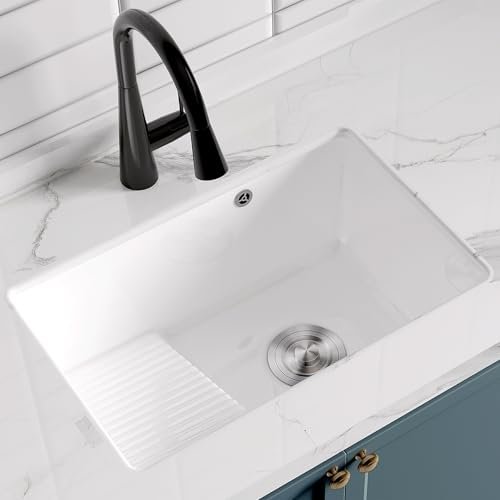
This rectangular ceramic undermount sink adds an unusual practical feature to that familiar design: a built-in sloped washboard area for handwashing small or delicate items. It also includes an overflow channel, a glossy ceramic finish, and a rectangular bowl shape intended to maximize usable basin space.
For homeowners remodeling a contemporary bathroom, guest bath, or utility-oriented vanity, it offers a combination of streamlined appearance and added functionality that goes beyond a conventional undermount basin.
What Is This Rectangle Undermount Bathroom Sink?
This is a ceramic bathroom basin designed to mount underneath a compatible countertop.
Its main supplied features include:
- Rectangular undermount installation
- Integrated washboard surface
- Built-in overflow
- Glossy ceramic construction
- Stain-resistant surface
- Smooth rimless countertop transition
- Customer support for installation and troubleshooting
Unlike a vessel sink, the basin does not sit visibly on top of the counter. Most of its structure is hidden below the vanity surface.
Why Choose an Undermount Sink?
The biggest advantage of an undermount sink is the clean transition between the countertop and basin.
Because there is no raised rim sitting on the counter, water, dust, and bathroom residue can be wiped directly toward the sink.
That makes undermount basins especially attractive for:
- Modern vanities
- Minimalist bathrooms
- Quartz countertops
- Granite countertops
- Solid-surface installations
The result is a visually simpler vanity with less hardware interrupting the countertop.
A Sleek Rectangular Shape
Rectangular sinks have become popular in contemporary bathroom design because their straight lines coordinate naturally with modern vanities, faucets, mirrors, and cabinetry.
Compared with a round bowl, a rectangular basin can also provide more usable space toward the corners.
That can make routine tasks such as:
- Handwashing
- Face washing
- Shaving
- Cleaning small items
feel less confined.
Why Rectangular Basins Work Well With Modern Vanities
Modern bathroom furniture often uses:
- Straight cabinet fronts
- Flat-panel doors
- Geometric mirrors
- Linear faucets
A rectangular sink reinforces that design language.
It can work especially well with finishes such as:
- Matte black
- Brushed nickel
- Chrome
- Brushed gold
because the basin itself remains neutral and understated.
Seamless Countertop Integration
The undermount installation leaves the countertop edge visible around the basin.
This creates a smooth, intentional transition rather than the layered appearance of a drop-in sink.
The result can make even a relatively simple vanity feel more refined.
The Built-In Washboard Is the Standout Feature
The most unusual feature is the integrated washboard surface.
Instead of using a completely smooth basin wall, one section includes a gently sloped textured area intended for manually scrubbing small items.
This may be useful for:
- Delicate clothing
- Small fabric items
- Washcloths
- Stain treatment
- Hand-rinsed garments
That makes the sink more versatile than a conventional bathroom basin.
How the Washboard Works
The idea is simple.
The textured or shaped surface creates resistance while fabric is moved across it, helping loosen residue during handwashing.
The slight slope also encourages water to move back toward the basin instead of remaining trapped on the ledge.
When a Built-In Washboard Is Useful
Most people will not replace a washing machine with a bathroom sink.
However, the feature can be practical for small jobs such as:
- Rinsing a stain immediately
- Washing delicate fabric
- Cleaning reusable cloths
- Handwashing a small item
It may be especially useful in apartments, guest bathrooms, or utility-adjacent spaces where a dedicated laundry sink is unavailable.
Not a Replacement for a Laundry Sink
The washboard adds functionality, but this is still fundamentally a bathroom basin.
Large garments, heavily soiled clothing, or frequent laundry work are better handled by a dedicated utility sink.
Think of the washboard as an added convenience rather than the primary reason to use the basin.
Integrated Overflow Protection
The sink includes a built-in overflow channel.
The overflow provides an additional path for water if the basin fills too high.
This is useful if:
- The faucet is accidentally left running
- The drain becomes partially obstructed
It helps reduce the likelihood of water spilling over the front edge of the vanity.
Overflow Does Not Guarantee Flood Prevention
An overflow is a backup drainage feature, not a perfect safeguard.
If:
- The drain is completely blocked
- Water enters faster than the overflow can remove it
the basin can still overflow.
It should therefore be considered an additional safety feature rather than a substitute for normal attention.
Choose the Correct Drain Assembly
Because the sink has an overflow, the drain assembly should generally be designed for overflow-equipped basins.
This is important.
Drain assemblies are commonly available in:
- Overflow-compatible versions
- Non-overflow versions
Using the wrong type can interfere with proper drainage.
Premium Ceramic Construction
The basin is made from ceramic with a glossy finish.
Ceramic is widely used in bathroom sinks because it provides a hard, smooth surface that handles everyday water exposure well.
A glazed ceramic surface is generally:
- Easy to clean
- Resistant to staining
- Non-absorbent
- Visually bright
- Compatible with common bathroom cleaners
Glossy Finish and Maintenance
The glossy glaze provides a smooth surface that discourages dirt and residue from bonding deeply.
Routine buildup such as:
- Soap
- Toothpaste
- Cosmetics
- Hard-water residue
can usually be removed with mild cleaning products.
Stain Resistance
The supplied description states that the sink resists stains and discoloration.
That is one of the practical benefits of glazed ceramic.
Regular maintenance remains important, especially in homes with hard water or heavily pigmented cosmetic products.
Ceramic Is Durable but Can Still Chip
Ceramic is hard, but it is also brittle.
A heavy metal object dropped into the basin can potentially chip or crack it.
Avoid striking the sink with:
- Tools
- Heavy bottles
- Metal fixtures
especially during installation.
Easy Everyday Cleaning
For regular maintenance, use:
- Warm water
- Mild bathroom cleaner
- Soft cloth
- Non-abrasive sponge
The smooth finish usually does not require aggressive scrubbing.
Avoid Harsh Abrasives
Steel wool and coarse scouring products can potentially dull the glaze.
Gentle cleaning usually provides better long-term results.
If mineral deposits develop, use a cleaner appropriate for glazed ceramic rather than mechanically scraping the surface.
Hard-Water Considerations
Hard water can leave mineral residue around:
- Drain
- Overflow
- Faucet splash area
Wiping the basin regularly helps prevent scale from becoming difficult to remove.
Undermount Installation Requires a Compatible Countertop
An undermount sink cannot be installed appropriately beneath every countertop material.
It is most commonly paired with solid materials such as:
- Granite
- Quartz
- Marble
- Solid-surface composites
These materials expose a finished countertop edge around the sink opening.
Laminate Countertops Require Extra Caution
Traditional laminate countertops may not be ideal for standard undermount installations because exposed substrate around the cutout can be vulnerable to moisture.
Always verify countertop compatibility before choosing this sink.
Accurate Countertop Cutting Is Essential
The opening in the counter must be cut precisely.
An inaccurate cut can produce:
- Uneven reveal
- Poor alignment
- Unsightly edges
For stone or engineered-quartz countertops, fabrication is usually best handled professionally.
Supporting the Sink Properly
An undermount sink should not rely only on adhesive to support its weight indefinitely.
Depending on the installation, proper mounting may involve:
- Mechanical clips
- Support brackets
- Adhesive or sealant
- Structural support beneath the counter
The exact method should follow the sink and countertop manufacturer's recommendations.
Why Professional Installation May Be Worth It
Undermount sinks require more precision than simple drop-in models.
A professional installer can help ensure:
- Proper alignment
- Correct support
- Watertight sealing
- Appropriate drain positioning
This is particularly important when working with expensive stone countertops.
Seal the Countertop Joint Carefully
The joint between the sink and countertop should be properly sealed.
A good seal helps prevent water from entering the interface between the basin and counter.
Over time, inspect the sealant for:
- Gaps
- Separation
- Mold
and replace it if necessary.
Faucet Compatibility
An undermount sink generally does not dictate the faucet configuration directly.
The faucet is often mounted through:
- Countertop
- Vanity deck
- Wall
That gives homeowners significant design flexibility.
Counter-Mounted Faucet
A deck-mounted faucet is the most common choice.
Make sure the spout extends far enough over the basin to direct water comfortably toward the center.
Wall-Mounted Faucet
A wall-mounted faucet can create an especially clean modern appearance.
However, it requires precise rough-in work behind the wall.
This option is usually easiest during a full bathroom renovation.
Avoid Excessive Faucet Reach
A faucet that extends too far can cause water to strike the opposite side of the basin and splash outward.
Conversely, too little reach can send water against the rear wall of the sink.
Measure carefully before buying the faucet.
Who Benefits From the Washboard Feature?
The washboard may appeal particularly to:
- Apartment dwellers
- Parents
- Travelers
- People who handwash delicates
- Households without a utility sink
It is a niche feature, but one that adds genuine practicality rather than simply decorative styling.
Small-Bathroom Applications
Although the source does not provide dimensions, rectangular undermount sinks are often well suited to compact vanities because the bowl sits mostly below the counter.
This allows the countertop itself to remain visually open.
Before buying, always verify the actual:
- Width
- Front-to-back depth
- Bowl depth
- Cabinet clearance
Vanity Cabinet Clearance
The sink occupies space below the countertop.
That can interfere with:
- Drawers
- Shelf placement
- Plumbing
Make sure the vanity cabinet is deep and wide enough for the basin before installation.
Undermount Sink vs. Drop-In Sink
Undermount Advantages
- Cleaner countertop
- Easier wiping
- More modern appearance
Drop-In Advantages
- Easier installation
- Works with more countertop types
- Often lower installation cost
The undermount design is better when aesthetics and cleaning convenience are priorities.
Undermount Sink vs. Vessel Sink
A vessel sink sits on top of the countertop and becomes a visual focal point.
An undermount sink does the opposite.
It keeps the basin visually secondary and emphasizes the vanity surface.
Choose undermount if you prefer:
- Minimalism
- Lower visual profile
- Cleaner counter lines
Undermount Sink vs. Integrated Vanity Sink
An integrated sink is molded or fabricated directly into the countertop.
That creates even fewer seams.
However, integrated solutions typically provide less flexibility for replacing the basin separately.
An undermount sink offers a similar clean look while remaining a separate component.
Common Buying Mistakes
Ignoring Countertop Compatibility
Not every material works well with undermount installation.
Forgetting the Overflow When Choosing a Drain
Use the correct drain type.
Measuring Only the Visible Opening
The full basin extends beneath the countertop.
Choosing a Faucet Without Checking Reach
Poor geometry can cause splashing.
Treating the Washboard Like a Full Laundry Basin
It is useful for small handwashing tasks, not bulk laundry.
Installation Checklist
Before installation, verify:
- Countertop material
- Cabinet dimensions
- Sink cutout
- Drain position
- Faucet placement
- Overflow-compatible drain
- Support hardware
- Sealant requirements
Doing this before the counter is fabricated can prevent costly corrections later.
Who Is This Sink Best For?
This sink may be a strong choice for:
- Modern bathroom renovations
- Minimalist vanities
- Homeowners who prefer undermount sinks
- Buyers who occasionally handwash small garments
- Bathrooms with stone or solid-surface counters
It may be less suitable for:
- Laminate countertops
- Very shallow vanity cabinets
- DIYers who want the easiest possible installation
Advantages and Considerations
Advantages
- Clean undermount appearance
- Rectangular modern design
- Integrated washboard
- Built-in overflow
- Glossy ceramic construction
- Stain-resistant surface
- Easy countertop cleanup
- Useful basin capacity
Potential Considerations
Undermount installation is more demanding.
Countertop compatibility must be verified.
Drain and faucet requirements should be checked separately.
Ceramic can chip under heavy impact.
Washboard is intended for light handwashing rather than full laundry duty.
Frequently Asked Questions
Is this an undermount sink?
Yes. It is designed to mount below the countertop.
What shape is the basin?
Rectangular.
Does it have an overflow?
Yes.
What is the washboard feature for?
It provides a textured or sloped surface for handwashing small or delicate items.
Is the sink made from ceramic?
Yes, according to the supplied description.
Is it stain resistant?
The glossy ceramic surface is described as resistant to staining and discoloration.
Can it be used with a stone countertop?
Undermount sinks are commonly paired with granite, quartz, and similar solid countertop materials, but compatibility should be confirmed with the fabricator.
Can I install it under laminate?
Standard laminate may present moisture-related challenges with undermount installations. Confirm suitability with the countertop manufacturer.
Does it need special support?
Proper mounting support is important. Follow the manufacturer's installation instructions rather than relying on sealant alone.
Does the overflow affect drain selection?
Yes. Choose a drain designed for a sink with an overflow.
Is it easy to clean?
The glossy glazed surface is designed for straightforward routine cleaning.
Is the washboard suitable for full loads of laundry?
No. It is better suited to small items, spot cleaning, and delicate handwashing.
Final Thoughts
This rectangular ceramic undermount bathroom sink with an integrated washboard offers something unusual: a clean modern vanity design combined with a small amount of utility-sink functionality.
Its strongest advantages are the seamless undermount installation, usable rectangular basin, built-in overflow, durable glazed ceramic surface, and sloped washboard section for occasional handwashing. For bathrooms where aesthetics matter but a little extra practicality is welcome, that combination can make the sink more versatile than a standard flat-bottom basin.
The main consideration is installation. Undermount sinks require a compatible countertop, accurate fabrication, reliable support, and proper sealing. Faucet reach and overflow-compatible drain selection should also be planned before the vanity is completed.
For buyers looking for a modern rectangular undermount bathroom sink with ceramic construction, overflow protection, easy maintenance, and a built-in washboard for light handwashing, this model offers a distinctive balance of contemporary design and everyday functionality.