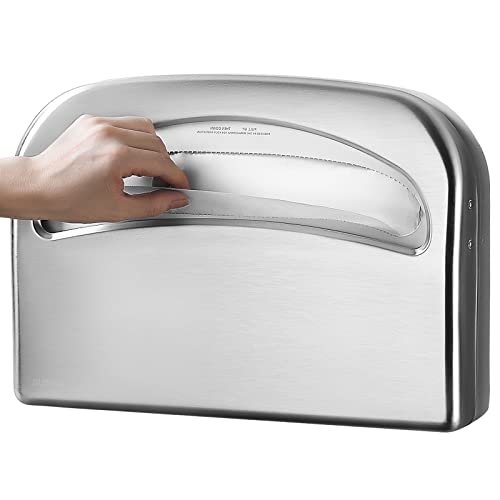
Gorlary Commercial Toilet Seat Cover Dispenser Review: A Practical Choice for High-Traffic Restrooms
Keeping a commercial restroom clean and well stocked involves more than providing soap, toilet paper, and paper towels. Small details can make a noticeable difference in how visitors perceive a facility, and providing disposable toilet seat covers is one of those details.
The Gorlary Commercial Toilet Seat Cover Dispenser is designed to provide a simple, permanent storage solution for disposable single-fold and half-fold toilet seat covers. Made from 304 stainless steel and capable of holding up to 250 covers, it is primarily intended for offices, restaurants, schools, retail facilities, and other shared restrooms.
Rather than using a temporary cardboard box or leaving packages of seat covers on a shelf, a wall-mounted dispenser keeps supplies organized and within easy reach. But is a stainless steel model such as the Gorlary dispenser the right choice for your restroom?
This guide examines its design, capacity, installation, maintenance requirements, advantages, limitations, and the situations where it makes the most sense.
What Is the Gorlary Commercial Toilet Seat Cover Dispenser?
The Gorlary Commercial Toilet Seat Cover Dispenser is a wall-mounted holder designed specifically for disposable toilet seat cover sheets. Its purpose is straightforward: store a large quantity of covers in one accessible location while allowing restroom users to remove individual sheets as needed.
Unlike plastic dispensers commonly found in lower-traffic facilities, this model uses 304 stainless steel. Stainless steel is particularly suitable for commercial restroom fixtures because it offers a combination of durability, moisture resistance, easy cleaning, and a professional appearance.
According to the product specifications, the dispenser can accommodate up to 250 single-fold or half-fold toilet seat covers.
Its approximate dimensions are:
- 16.5 inches wide
- 11.4 inches high
- 2 inches deep
- Approximately 0.92 kg in weight
The relatively shallow profile is useful in restroom stalls where space can be limited. It provides significant storage capacity without protruding excessively from the wall.
Why Use a Toilet Seat Cover Dispenser?
Disposable toilet seat covers are easy to provide without a dedicated dispenser, but loose packages are rarely the most practical solution in a commercial environment.
A wall-mounted dispenser establishes a consistent location where visitors know to find them. It also prevents boxes from being placed on toilet tanks, countertops, shelves, or other surfaces where they can become damaged or exposed to moisture.
For facility managers and cleaning staff, a dispenser can also simplify restocking. Instead of replacing small packages frequently, employees can load a larger quantity of covers at once.
The benefit is therefore less about the complexity of the fixture and more about organization.
In a busy restroom, simple infrastructure matters.
304 Stainless Steel Construction
One of the Gorlary dispenser's most notable features is its 304 stainless steel construction.
This material is commonly used for equipment and fixtures where corrosion resistance and cleanability are important. Restrooms naturally contain moisture, cleaning chemicals, fingerprints, and frequent physical contact, making material selection particularly relevant.
Why Stainless Steel Makes Sense in Commercial Restrooms
Plastic dispensers can work perfectly well in many environments, but stainless steel offers several advantages for permanent commercial installations.
It generally provides better resistance to everyday impacts and tends to maintain its structural integrity longer than lightweight plastic. It also creates the familiar commercial appearance found in many public restroom fixtures, including paper towel dispensers, grab bars, waste receptacles, and toilet paper holders.
The smooth surface is relatively straightforward to wipe down as part of routine restroom maintenance.
That makes the Gorlary dispenser particularly suitable for facilities where durability is more important than obtaining the least expensive dispenser available.
Stainless Steel Still Requires Maintenance
Stainless steel should not be interpreted as maintenance-free.
Fingerprints, water spots, soap residue, dust, and cleaning-product residue can still accumulate on its surface. Regular wiping with an appropriate cleaner and a soft cloth will help maintain its appearance.
Harsh abrasives should generally be avoided because they can scratch the finish.
For commercial installations, including the dispenser in the normal restroom cleaning schedule is usually sufficient.
Large 250-Cover Capacity
Capacity is another important consideration when choosing a commercial toilet seat cover holder.
The Gorlary dispenser is advertised as holding up to 250 single-fold or half-fold covers. That capacity can be particularly useful in high-traffic locations.
A larger dispenser reduces the frequency with which cleaning or maintenance personnel need to replenish supplies. It also decreases the likelihood of the dispenser becoming empty during busy periods.
This can matter in environments such as airports, schools, restaurants, office buildings, shopping facilities, clinics, entertainment venues, and other locations where restroom usage fluctuates throughout the day.
Capacity Should Match Restroom Traffic
A large-capacity dispenser is not automatically necessary for every restroom.
A small private office restroom used by a handful of employees may not need space for hundreds of covers. Conversely, a restroom serving a busy restaurant or public facility can benefit considerably from additional capacity.
Before choosing a dispenser, estimate how frequently the restroom is used and how often maintenance personnel inspect it.
The best dispenser capacity is ultimately one that complements the facility's existing cleaning and restocking schedule.
Bottom-Loading Design for Easier Refilling
Restocking is a routine task, so dispenser design can influence day-to-day convenience more than it initially appears.
The Gorlary model uses a bottom-access refill system. Staff can open the bottom of the dispenser and insert compatible seat cover sheets through the opening.
This eliminates the need to remove the entire dispenser from the wall whenever it needs replenishment.
In a commercial setting, even small reductions in maintenance time can become useful when employees are responsible for servicing multiple stalls or several restrooms.
The loading process should nevertheless be performed carefully. Covers that are compressed, folded incorrectly, or inserted unevenly may not dispense as smoothly.
Compatibility With Toilet Seat Covers
One detail buyers should verify before purchasing any dispenser is refill compatibility.
The Gorlary holder is intended for single-fold and half-fold disposable toilet seat covers. However, toilet seat cover products can vary in dimensions, folding patterns, packaging, and dispensing behavior.
A dispenser's maximum capacity does not necessarily mean every package containing that number of sheets will fit perfectly.
Before purchasing bulk refills, compare their dimensions and fold configuration with the dispenser's requirements.
This is especially important for facilities purchasing restroom consumables by the case. A dispenser is only useful when compatible replacement covers are easy to obtain.
Wall-Mounted Design Saves Space
Commercial restroom stalls rarely have much unused space. A dispenser therefore needs to be accessible without interfering with normal restroom use.
At approximately two inches deep, the Gorlary dispenser maintains a relatively slim wall profile.
Wall mounting also keeps the covers away from floors, toilet tanks, and other surfaces where loose supplies could become wet or contaminated.
Placement is important, however.
The dispenser should be positioned where a seated user can reach it comfortably without excessive twisting or stretching. At the same time, it should not interfere with grab bars, toilet paper dispensers, doors, partitions, or other restroom fixtures.
For commercial installations, accessibility requirements and applicable local building regulations should also be considered when determining mounting position.
Installation Considerations
The installation itself is conceptually simple: the dispenser is attached to a wall or restroom partition so it remains permanently accessible.
The important part is choosing the correct mounting method for the surface.
A solid masonry wall, drywall partition, tile surface, and commercial restroom divider may each require different anchors or fasteners. Using unsuitable hardware can result in a dispenser that gradually loosens under repeated use.
Before drilling, verify the location of plumbing, wiring, and other concealed infrastructure.
The dispenser should sit securely against the mounting surface without rocking or flexing when users pull covers from it.
Choosing the Right Position
Do not choose the mounting location based solely on where the dispenser visually fits.
Think about the person using the stall.
Can the cover be reached comfortably from the toilet? Does the dispenser obstruct another fixture? Will the stall door hit it? Can maintenance staff easily open and refill it?
A few minutes spent checking these details before drilling can prevent an inconvenient installation that later needs to be moved.
Where Does This Dispenser Make the Most Sense?
The Gorlary dispenser is fundamentally a commercial restroom product.
It is most useful in environments where many different people share restroom facilities and where supplies need to remain organized.
Office Buildings
Shared office restrooms benefit from fixtures that are durable, understated, and easy for cleaning personnel to maintain.
The stainless steel design also pairs naturally with many existing commercial restroom fixtures.
Restaurants and Hospitality Businesses
Restroom presentation can influence a customer's overall impression of a restaurant, café, hotel, or hospitality venue.
Providing seat covers in a dedicated dispenser creates a more organized presentation than leaving refill packages exposed.
Schools and Campuses
Schools, colleges, universities, libraries, and similar institutions often have heavily used restrooms. A high-capacity dispenser can reduce the frequency of refilling compared with smaller holders.
Retail and Public Facilities
Shopping centers, supermarkets, entertainment venues, transportation facilities, and other public spaces may see substantial restroom traffic throughout the day.
Durability and refill capacity become especially relevant in these environments.
Healthcare and Professional Facilities
Medical offices, dental practices, clinics, and professional facilities may also choose to provide disposable seat covers as part of their restroom supplies.
The smooth stainless steel exterior can be incorporated into routine surface-cleaning procedures.
Stainless Steel vs. Plastic Toilet Seat Cover Dispensers
The Gorlary dispenser is not necessarily the best choice for every facility. Plastic dispensers remain a viable alternative, particularly where budget and weight are primary concerns.
Plastic models are often inexpensive, lightweight, and easy to install. For low-traffic restrooms, those advantages may be sufficient.
Stainless steel becomes more attractive when the fixture is expected to remain installed for years.
It generally offers greater rigidity and a more substantial feel, while its appearance tends to coordinate better with other commercial-grade restroom hardware.
The tradeoff is usually cost. Stainless steel dispensers commonly require a higher initial investment than basic plastic alternatives.
For a temporary installation or lightly used restroom, that additional expense may not provide much practical benefit. For a permanent, frequently used commercial restroom, the durability advantage can be more meaningful.
What to Look for When Buying a Toilet Seat Cover Dispenser
The material is only one part of choosing the right dispenser.
Capacity should be considered first. Estimate restroom traffic and determine how frequently staff can realistically replenish supplies.
Next, check refill compatibility. Confirm that the seat covers your facility already purchases—or plans to purchase—fit the dispenser.
Construction quality is equally important. A commercial fixture should feel rigid enough to tolerate repeated pulling, refilling, cleaning, and occasional impacts.
The refill mechanism should also be accessible to staff without making the dispenser unnecessarily easy for users to open or damage.
Finally, consider dimensions carefully. Measure the intended mounting area rather than assuming that a standard commercial dispenser will fit every stall.
Advantages of the Gorlary Toilet Seat Cover Dispenser
Several characteristics make this model attractive for commercial applications.
Its stainless steel body is arguably its strongest feature. It provides a more durable alternative to lightweight plastic dispensers while maintaining the familiar appearance of commercial restroom hardware.
The advertised 250-cover capacity is another benefit for busy facilities because it can reduce restocking frequency.
Its shallow profile also allows substantial storage without occupying excessive stall space.
Finally, the simple mechanical design means there are no batteries, sensors, motors, or complicated components to maintain.
For facilities seeking a straightforward fixture, simplicity is an advantage.
Potential Drawbacks to Consider
No dispenser is ideal for every installation.
The stainless steel construction adds weight compared with basic plastic holders, making secure mounting particularly important.
The finish can also show fingerprints, smudges, and water marks, so periodic cleaning is necessary if appearance is important.
Compatibility deserves attention as well. Facilities should verify their preferred disposable covers before ordering large quantities of refills.
There is also the question of whether a 250-cover commercial dispenser is necessary at all. Low-traffic private restrooms may be adequately served by a smaller and less expensive solution.
Common Mistakes to Avoid
One common mistake is purchasing the dispenser before checking the available wall space.
Measure first, especially in compact restroom stalls containing grab bars, sanitary disposal units, toilet paper holders, and other fixtures.
Another mistake is treating installation hardware as interchangeable. The appropriate mounting method depends on the wall or partition material.
Facilities should also avoid purchasing bulk refill cases until compatibility has been confirmed.
Finally, do not overfill the dispenser. Packing too many sheets into a holder can create excessive friction and make individual covers more difficult to remove.
Reliable dispensing is more useful than maximizing the theoretical number of sheets inside.
Cleaning and Maintenance
One advantage of a relatively simple stainless steel dispenser is that maintenance requirements are limited.
Regularly wipe the exterior to remove fingerprints, dust, and restroom residue. Periodically inspect the mounting points to ensure the dispenser remains firmly attached.
During refilling, employees can also check the interior for torn sheets or covers that have shifted out of position.
If covers begin dispensing poorly, the refill stack should be inspected before assuming there is a problem with the dispenser itself. Misaligned or incompatible covers can cause dispensing difficulties.
Routine inspection should be sufficient for most installations.
Is the Gorlary Commercial Toilet Seat Cover Dispenser Worth Considering?
The Gorlary Commercial Toilet Seat Cover Dispenser makes the most sense for businesses and institutions that want a durable, high-capacity, permanently mounted toilet seat cover holder.
Its main strengths are straightforward: 304 stainless steel construction, capacity for up to 250 compatible covers, a slim wall-mounted profile, and a simple refill system.
Those characteristics make it particularly relevant for restaurants, offices, schools, retail facilities, campuses, and other moderately to heavily used commercial restrooms.
It may be more dispenser than necessary for a small private bathroom or extremely low-traffic facility. Buyers should also verify refill compatibility and mounting requirements before purchasing.
For the appropriate environment, however, the combination of stainless steel construction and high capacity makes it a practical alternative to basic plastic dispensers.
Frequently Asked Questions
How many toilet seat covers does the Gorlary dispenser hold?
The dispenser is advertised as holding up to 250 single-fold or half-fold disposable toilet seat covers. Actual usable capacity may depend on the thickness and dimensions of the specific covers being used.
What is the dispenser made from?
The product is specified as being made from 304 stainless steel, a material commonly used for commercial fixtures because of its durability and corrosion resistance.
What are its dimensions?
The dispenser measures approximately 16.5 inches wide, 11.4 inches high, and 2 inches deep.
Always measure the intended installation area before purchasing.
Is it suitable for commercial restrooms?
Yes. Its capacity, stainless steel construction, and wall-mounted design make it particularly suited to offices, restaurants, schools, retail facilities, campuses, and other shared restrooms.
Can it be used in a home bathroom?
It can, but its commercial dimensions and 250-cover capacity may be unnecessary for most residential bathrooms. A smaller dispenser may be more appropriate unless you specifically prefer commercial-style restroom fixtures.
Are toilet seat covers included?
Product bundles and package contents can change, so buyers should verify the current listing before ordering rather than assuming refill covers are included.
Are all half-fold seat covers compatible?
Not necessarily. Dimensions and folding configurations can vary between manufacturers. Check the dimensions of your preferred refills against the dispenser before buying covers in bulk.
Is stainless steel better than plastic?
Neither material is universally better.
Plastic is typically lighter and can be more economical, making it suitable for lower-traffic environments. Stainless steel is generally the better choice when durability, rigidity, long-term use, and a commercial appearance are priorities.
Final Verdict
The Gorlary Commercial Toilet Seat Cover Dispenser addresses a simple problem with an equally straightforward design: keeping disposable seat covers organized, protected, accessible, and easy to replenish.
Its 304 stainless steel body distinguishes it from inexpensive plastic alternatives, while its capacity of up to 250 covers makes it particularly useful for restrooms that receive regular traffic.
The most important considerations are not complicated features but practical details. Make sure the dispenser fits the available space, confirm that your preferred refills are compatible, and use appropriate mounting hardware for the installation surface.
For businesses or facility managers looking for a durable wall-mounted toilet seat cover dispenser without electronic components or unnecessary complexity, the Gorlary model is a practical option worth considering.