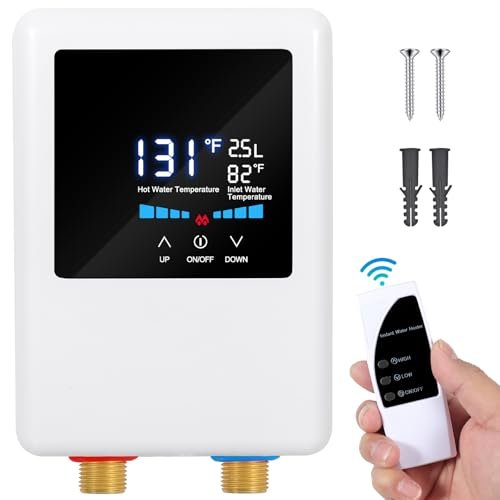
DOYXC Mini 110V Tankless Water Heater Review: Compact Point-of-Use Hot Water With Remote and Touch Controls
Waiting for hot water at a distant sink can be frustrating, especially when the main water heater is located far from the kitchen, bathroom, workshop, or utility area. A compact point-of-use heater addresses that problem by heating water close to the fixture instead of relying on a long run of hot-water piping.
The DOYXC Mini electric tankless water heater is designed as a compact under-sink or wall-mounted solution for relatively modest hot-water needs. According to the supplied product information, it operates on 110V, can heat water up to 131°F (55°C), offers both touch-screen and remote control, and uses 1/2-inch NPT plumbing connections.
The product is aimed primarily at sinks and other point-of-use applications rather than high-flow whole-home demand. Its compact size and tankless design are appealing, but the electrical requirements deserve especially careful attention: the supplied listing calls for 6 mm² wiring and a circuit breaker rated at 60A or higher. Those figures represent a substantial electrical load for a nominal 110V appliance and should be verified against the manufacturer's official installation manual by a qualified electrician before installation.
What Is the DOYXC Mini Tankless Water Heater?
The DOYXC Mini is an electric point-of-use water heater that heats water as it flows through the unit.
Unlike a conventional storage heater, it does not maintain a tank of hot water. When sufficient water flow is detected, the heater activates and begins transferring heat into the moving water.
Once water flow stops, the heater reduces or stops active heating.
According to the supplied specifications, the unit includes:
- 110V electric operation
- Tankless point-of-use heating
- Maximum stated temperature of 131°F
- Digital LCD display
- Touch controls
- Remote control
- Celsius and Fahrenheit display modes
- Variable power modulation
- IPX4 splash resistance
- Dry-heating protection
- Leakage protection
- Automatic shutdown when not operating
- 1/2-inch NPT plumbing connections
- Wall-mounted installation
- 24-month stated warranty
These features make it more sophisticated than a basic mechanical under-sink heater.
How a Point-of-Use Tankless Water Heater Works
A tankless heater activates when water begins flowing through it.
Cold water enters the unit, passes through the heating chamber, and exits toward the faucet at a higher temperature.
Because there is no storage tank, there is no need to wait for a reservoir to reheat after someone uses the available hot water.
The limiting factor is instead the heater's instantaneous power.
If too much water flows through the heater at once, it may not be able to raise the temperature as much as desired.
What “Hot Water in 3–5 Seconds” Really Means
The manufacturer states that the unit can begin producing heated water within approximately 3 to 5 seconds.
That is best interpreted as rapid heater response rather than a guarantee that hot water will reach every faucet in exactly that amount of time.
Actual delivery time also depends on:
- Distance between heater and faucet
- Pipe length
- Pipe diameter
- Water-flow rate
An under-sink installation keeps that distance short, which is one reason point-of-use heaters can feel much faster than a centrally located water heater.
Maximum Temperature of 131°F
The product is described as capable of reaching up to 131°F, or 55°C.
That provides a broad range for handwashing, cleaning, and other sink-related uses.
However, maximum temperature and maximum flow cannot necessarily be achieved simultaneously.
A small electric tankless heater can produce a larger temperature rise when water moves more slowly through the unit.
At higher flow, the outlet temperature may fall.
Why Flow Rate Is So Important
The amount of heat a tankless heater can add to water depends on how quickly that water is moving.
At low flow, each gallon receives more heating energy.
At high flow, the same electrical power has to heat more water every minute.
This means a compact heater may perform very well at a bathroom faucet while struggling if connected to a much higher-flow fixture.
Incoming Water Temperature Matters Too
The heater's performance also depends heavily on how cold the incoming water is.
If water enters at 75°F and the target is 105°F, the unit needs to provide only a 30°F temperature rise.
If inlet water is 45°F, reaching the same 105°F requires a 60°F rise.
That second situation requires roughly twice as much heating per gallon.
For this reason, compact electric tankless heaters often perform better in warmer climates or when paired with lower-flow fixtures.
Best Uses for the DOYXC Mini
The DOYXC is most naturally suited to point-of-use fixtures where hot-water demand is relatively low.
Potential applications include:
- Bathroom sinks
- Kitchen handwashing
- Utility sinks
- Garage sinks
- Workshop sinks
- Small apartments
- RV-related installations where electrical requirements are compatible
- Temporary or supplemental sink applications
The intended use should always be checked against the manufacturer's flow and temperature-rise specifications.
Bathroom Sink Use
A bathroom vanity is one of the strongest applications for a compact electric tankless water heater.
Handwashing typically requires modest flow, so the heater has more opportunity to produce a useful temperature rise.
Installing it directly beneath the vanity can also minimize the amount of cold water that must be discharged before heated water arrives.
Kitchen Sink Use
The heater may also work for light kitchen tasks such as:
- Handwashing
- Food rinsing
- Light dish rinsing
A high-flow kitchen faucet can be more demanding.
If the water does not reach the desired temperature, reducing faucet flow may improve performance.
Is It Suitable for Showers?
The supplied product description emphasizes sinks, washing food, dishes, hands, faces, and similar point-of-use applications.
It does not provide enough verified flow information to recommend the unit as a shower heater.
Showers typically require substantially more continuous flow than sinks.
Unless the manufacturer explicitly provides a shower performance rating at your expected inlet-water temperature, it is safer to treat this model as a sink-oriented heater.
Compact Wall-Mounted Design
One of the product's clearest advantages is its compact form.
Because there is no storage tank, the heater can be mounted on a wall rather than occupying floor or cabinet space with a bulky reservoir.
That can be useful in:
- Small kitchens
- Bathrooms
- Apartments
- Utility rooms
- Workshops
The installation should still leave enough room for electrical access, plumbing connections, and future maintenance.
Why Point-of-Use Placement Can Save Water
When a sink is far from the central water heater, users may run the faucet while waiting for the cooled water inside the hot-water pipe to clear.
A local heater shortens that plumbing run considerably.
This can reduce:
- Waiting time
- Water wasted before hot water arrives
- Heat lost through long pipes
That benefit can be just as important as the heater's compact size.
Touch-Screen Controls
The unit uses a touch-sensitive control panel for temperature adjustment.
This gives it a more modern interface than a simple mechanical dial.
The digital screen also makes it easier to see the selected temperature and operating status.
Remote Control
A separate remote control is included according to the supplied description.
That can be convenient when the heater is:
- Mounted beneath a sink
- Installed inside a cabinet
- Positioned somewhere awkward to reach
The remote allows temperature adjustments without touching the heater directly.
Avoiding Wet-Hand Adjustments
The manufacturer presents remote control as a way to reduce the need to touch the heater with wet hands.
That is sensible for convenience, but it does not change the fundamental installation requirement that the electrical appliance be mounted and wired safely away from uncontrolled water exposure.
Celsius and Fahrenheit Display
The heater can reportedly switch between Celsius and Fahrenheit.
The supplied instructions state that holding the on/off control for several seconds changes the display unit.
This is a small feature, but it makes the heater easier to use in regions accustomed to different temperature scales.
Variable-Power Operation
The DOYXC is described as using a variable-frequency or self-adjusting power design.
Rather than consuming maximum electrical power whenever water flows, it adjusts input according to:
- Flow rate
- Selected temperature
- Heating demand
This is similar in principle to self-modulating control used in many modern electric tankless heaters.
Why Power Modulation Matters
Imagine washing your hands with relatively warm inlet water.
The heater may not need its maximum output to reach a comfortable temperature.
If colder water begins flowing or the target temperature is increased, the control system can demand more heating power.
This helps match energy use to actual demand.
The 99% Thermal-Efficiency Claim
The source claims thermal efficiency of up to 99%.
Electric resistance heating can convert most electrical input into heat at the appliance, so high point-of-use conversion efficiency is plausible.
However, that figure should not be confused with guaranteed whole-home energy savings.
Real-world energy consumption also depends on:
- How much hot water is used
- Plumbing heat loss
- Electricity pricing
- Temperature settings
- User habits
Tankless Does Not Automatically Mean Lower Bills
A tankless heater eliminates most storage-tank standby losses because it does not keep a reservoir hot continuously.
That can reduce wasted energy in some applications.
But electricity is still required to heat every gallon of water.
The actual cost advantage depends on what the heater replaces and how often it operates.
IPX4 Splash Protection
The heater is listed as having an IPX4 rating.
IPX4 generally indicates resistance to splashing water from multiple directions.
That is useful for equipment installed near sinks and plumbing.
However, IPX4 does not mean waterproof or submersible.
Keep the Heater Away From Direct Water Exposure
The unit should not be positioned where it can be:
- Submerged
- Continuously sprayed
- Soaked by an active plumbing leak
Electrical and plumbing connections should remain accessible and properly protected.
Leakage Protection
The source states that the heater includes electrical leakage protection.
That is an important safety feature for an appliance combining water and mains electricity.
Built-in protection should complement—not replace—proper:
- Grounding
- Circuit protection
- Wiring
- Installation practices
Dry-Burning Protection
Tankless heating components depend on water flow to carry away heat.
If heating occurs without sufficient water, internal temperatures can rise rapidly.
Dry-heating or dry-burning protection is designed to help prevent that condition.
The heater should still be filled and commissioned according to the manufacturer's instructions before it is energized.
Automatic Shutdown
The listing states that the heater automatically powers down when not actively operating.
This is consistent with tankless design.
The heater should not continue drawing full heating power when there is no hot-water demand.
LCD Status Monitoring
The LCD screen is intended to display temperature and operating information.
This can help users identify whether the heater is:
- Powered
- Heating
- At the selected temperature
More detailed diagnostic capabilities should be verified in the product manual.
The Electrical Requirements Need Special Attention
The most important issue in the supplied listing is the stated electrical specification.
The product is described as operating on 110V, while the installation instructions call for:
- 6 mm² conductors
- A circuit breaker rated 60A or higher
That represents a very high-current circuit.
Why the Electrical Numbers Matter
At 110V, a 60A circuit represents several kilowatts of available power.
That is far beyond the demand of an ordinary plug-in appliance.
The heater should therefore be treated as a dedicated, high-current fixed electrical load.
Do Not Use a Standard Household Outlet
Nothing in the supplied electrical requirements suggests that this heater should be connected to an ordinary 15A or 20A household receptacle.
The actual connection method should be verified in the official installation documentation.
Improvised adapters, extension cords, or undersized wiring should not be used.
Verify the 6 mm² / 9 AWG Claim
The source describes 6 mm² wiring as approximately 9 AWG.
Wire sizing and equivalence should not be determined solely from marketplace copy.
More importantly, correct conductor size depends on:
- Actual heater current
- Breaker rating
- Conductor material
- Temperature rating
- Wiring method
- Local electrical code
A licensed electrician should verify the required wire size from the manufacturer documentation.
Breaker Size Should Not Be Guessed
The stated requirement of 60A or greater also deserves professional verification.
In electrical installations, simply choosing a larger breaker is not safer.
A breaker must be matched correctly to:
- Appliance
- Conductors
- Circuit design
Oversizing a breaker relative to the wiring can create an overheating hazard.
Professional Installation Is Strongly Recommended
Despite the source describing installation as straightforward, the electrical requirements make professional installation the safer approach for most users.
A qualified electrician can verify:
- Actual voltage
- Maximum current
- Correct breaker
- Wire size
- Grounding
- Electrical-panel capacity
- Local code compliance
A plumber can ensure that the water connections are installed correctly and leak-free.
1/2-Inch NPT Connections
The heater uses 1/2-inch NPT plumbing connections according to the supplied description.
This is a common residential plumbing size.
It can make integration easier with compatible:
- Supply lines
- Shutoff valves
- Faucet plumbing
The connections should be installed according to the manufacturer's orientation and sealing instructions.
Add Accessible Shutoff Valves
Isolation valves near the heater can make maintenance much easier.
They allow the appliance to be serviced without shutting down the property's entire water supply.
This is especially useful if the heater later needs flushing, inspection, or replacement.
Hard Water and Scale
Tankless heaters can be affected by mineral-rich water.
Calcium and magnesium may form deposits when water is heated repeatedly.
Over time, scale can reduce:
- Flow
- Heat transfer
- Temperature consistency
If the local water supply is hard, follow the manufacturer's maintenance recommendations.
Tankless vs. Mini-Tank Water Heater
For under-sink hot water, buyers often choose between a small tankless unit and a mini storage tank.
Tankless Heater
A tankless model offers:
- Very compact size
- No stored reservoir
- Continuous heating within capacity
- Reduced standby losses
Mini-Tank Heater
A mini-tank offers:
- Stored hot water ready for immediate use
- Potentially higher short-term flow
- Less sensitivity to instantaneous heating capacity
The better option depends on how much water the fixture needs and what electrical service is available.
Tankless vs. Central Hot Water
A point-of-use tankless heater does not necessarily need to replace the home's central water heater.
It can instead supplement it.
For example, if one remote bathroom takes a long time to receive hot water, a small under-sink heater may solve that problem while the main water heater continues serving showers and other high-demand fixtures.
RV and Camping Claims Need Careful Interpretation
The source mentions RVs and camping among potential uses.
The heater's substantial electrical requirements make compatibility highly dependent on the available power source.
Many RV or portable electrical systems cannot provide a dedicated 60A, 110V circuit.
Do not assume portability means it can run from:
- Standard campsite outlets
- Small generators
- Ordinary RV receptacles
Electrical compatibility needs to be calculated first.
Common Buying Mistakes
Buying Before Checking Electrical Requirements
The claimed 60A circuit requirement is substantial and may require new wiring.
Assuming 110V Means a Normal Outlet
Voltage alone does not determine circuit capacity.
Buying It for a Shower Without Flow Data
The product is primarily presented as a point-of-use sink heater.
Expecting 131°F at Any Flow Rate
Higher flow generally reduces achievable temperature rise.
Ignoring Winter Inlet-Water Temperature
Colder incoming water reduces practical hot-water output.
Assuming IPX4 Means Waterproof
It provides splash resistance, not submersion protection.
Who Is the DOYXC Mini Best For?
This heater may make sense for users who need:
- Fast hot water at one sink
- Compact wall-mounted installation
- Remote temperature adjustment
- Digital controls
- No storage tank
- Supplemental point-of-use heating
It is most compelling where the electrical system has already been verified as compatible.
Who Should Consider a Different Heater?
Another solution may be preferable if:
- Only a standard household outlet is available
- High-flow shower water is required
- Several fixtures need hot water simultaneously
- Electrical upgrades would be expensive
- A mini-tank could meet the demand more simply
The smallest physical heater is not always the easiest system to install.
Advantages and Considerations
Advantages
The DOYXC Mini combines rapid on-demand heating, a maximum stated temperature of 131°F, compact wall mounting, remote and touch-screen controls, Celsius/Fahrenheit selection, self-adjusting power, 1/2-inch NPT connections, and several built-in protection features.
Its point-of-use design can reduce the wait for hot water at distant sinks while avoiding the space requirements of a storage tank.
Considerations
The largest concern is the stated electrical requirement. A 110V heater calling for 6 mm² wiring and a 60A-or-greater breaker requires careful verification and professional electrical planning.
The listing also does not provide enough detailed flow-versus-temperature-rise information to treat the heater as suitable for high-flow applications such as showers.
Frequently Asked Questions
What type of water heater is the DOYXC Mini?
It is a compact electric tankless point-of-use water heater.
What voltage does it use?
The supplied description states 110V.
How quickly does it heat water?
The manufacturer claims approximately 3–5 seconds for heating response.
What is the maximum stated temperature?
Approximately 131°F, or 55°C.
Does it need to preheat a tank?
No. It is tankless.
Can it be installed under a sink?
Yes, that is one of the primary intended applications.
Does it use standard plumbing connections?
The source states 1/2-inch NPT connections.
Does it have a digital display?
Yes.
Can it be controlled remotely?
A remote control is included according to the source.
Does it also have touch controls?
Yes.
Can it display both Fahrenheit and Celsius?
Yes.
Is it waterproof?
It is described as IPX4, which means splash resistance rather than full waterproofing.
Does it include dry-heating protection?
Yes.
Does it include electrical leakage protection?
Yes, according to the supplied information.
Does it automatically adjust power?
The source states that it uses variable power based on flow and temperature demand.
Is it energy efficient?
The manufacturer claims thermal efficiency of up to 99%, but actual energy savings depend on usage and installation.
What breaker is required?
The supplied listing states 60A or greater, but this should be verified against the official installation manual and local electrical requirements.
What wire size is required?
The source states 6 mm², but final conductor sizing should be confirmed by a qualified electrician.
Can I plug it into a normal wall outlet?
The stated electrical requirements indicate that it should not be assumed compatible with a standard household receptacle.
Is it suitable for showers?
The source focuses on sink and point-of-use applications and does not provide enough verified flow data to recommend it confidently for shower use.
Can I use it in an RV?
Only if the RV electrical system can safely supply the heater's actual circuit requirements. Many cannot.
Is professional installation recommended?
Yes, especially because of the unusually high stated current requirement for a 110V appliance.
Final Thoughts
The DOYXC Mini 110V electric tankless water heater is aimed at a practical problem: providing hot water quickly at a sink without installing a storage tank or waiting for hot water to travel through long plumbing runs.
Its combination of compact wall mounting, rapid heating, up to 131°F temperature capability, remote control, touch-screen operation, self-modulating power, IPX4 protection, and 1/2-inch NPT plumbing makes it an appealing point-of-use concept for kitchens, bathrooms, utility sinks, workshops, and similar spaces.
The electrical side, however, should be treated as the deciding factor. The listing's stated 60A-or-higher breaker and 6 mm² conductor requirement at 110V is substantial and should be verified through official manufacturer documentation before installation. A licensed electrician should confirm that the appliance, breaker, wiring, and electrical service are correctly matched.
For a compatible sink installation, the DOYXC Mini can provide a useful combination of space-saving tankless heating, fast local hot-water delivery, precise digital controls, and on-demand energy use—but buyers should size it for realistic flow and verify the high-current electrical requirements before purchasing.