SwitchBot WiFi Water Leak Detector Review: Real-Time Alerts, 100 dB Alarm, and No Hub Required
A smart water leak detector can be one of the simplest ways to add an early-warning layer to a home. Small leaks often begin in hidden places—under a washing machine, beneath a sink, around a water heater, or behind an appliance—and may go unnoticed until moisture has already spread.
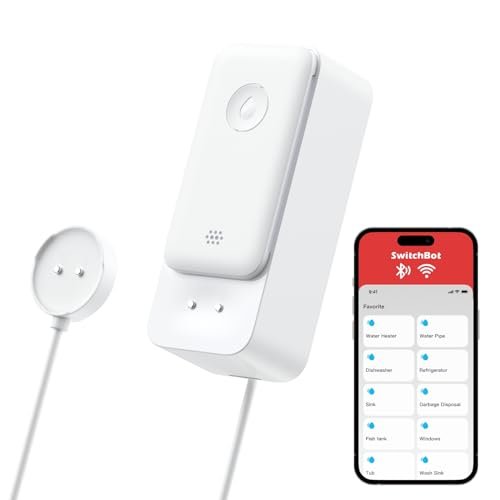
The SwitchBot WiFi Water Leak Detector is designed to monitor those high-risk areas without requiring a separate hub. It connects directly to a 2.4 GHz WiFi network and can send app and email notifications when it detects dripping, standing water, or flooding. It also includes a loud local alarm, top-and-bottom sensing probes, a one-meter extended probe for specialized monitoring, and an IP67-rated enclosure.
For users who want direct WiFi connectivity rather than another smart-home gateway, it offers a relatively straightforward way to add leak monitoring around the home.
What Is the SwitchBot WiFi Water Leak Detector?
This is a battery-powered smart leak sensor designed for indoor water monitoring.
Its key supplied features include:
- Direct 2.4 GHz WiFi connection
- No separate hub required
- App notifications
- Email alerts
- Device sharing with family members
- Top and bottom water-sensing probes
- Detection down to a stated 0.5 mm water level
- One-meter extended water probe
- 100 dB local alarm
- IP67-rated enclosure
- Two AAA batteries included
- Claimed battery life up to two years
- Low-battery app notifications
- SwitchBot ecosystem integration
- Support for selected third-party smart-home services
The sensor is primarily an alerting device. It detects water and can trigger compatible smart-home actions, but it does not contain a plumbing shutoff valve.
No Hub Required
One of the most important advantages is direct WiFi connectivity.
Many smart leak sensors require a proprietary hub or Zigbee gateway before remote notifications work. This model connects directly to the home network.
That can reduce:
- Initial cost
- Number of devices to install
- Smart-home complexity
For someone who wants one or two connected leak sensors without building a larger hub-based system, this is appealing.
2.4 GHz WiFi Only
The detector supports 2.4 GHz WiFi, according to the supplied description.
It does not connect directly to a 5 GHz-only network.
In practice, many modern routers broadcast both frequencies, but setup can still fail if:
- 2.4 GHz is disabled
- Band steering interferes with pairing
- The sensor is too far from the router
Confirm network compatibility before installation.
Why 2.4 GHz Makes Sense for Sensors
2.4 GHz generally offers better range and wall penetration than higher-frequency WiFi.
That can be useful in places such as:
- Basements
- Laundry rooms
- Utility closets
- Under-sink cabinets
These are exactly the locations where leak detectors are often needed.
Real-Time App Notifications
Once connected, the sensor can send remote app notifications when water is detected.
That is one of the main reasons to choose a smart detector over a basic audible alarm.
If a leak happens while you are:
- At work
- Traveling
- Shopping
- Away overnight
you can still learn that something has happened.
Email Alerts
The supplied description also lists email notifications.
Using more than one alert channel can reduce the chance of missing an event.
For example, a phone notification may disappear quickly, while an email provides a more persistent record.
Share the Device With Family Members
The device can be shared with other users.
That means more than one person can monitor the home's status.
This can be useful for:
- Couples
- Families
- Shared homes
- Property managers
If one person misses an alert, another may still see it.
High-Sensitivity Water Detection
The sensor uses probes positioned on both the top and bottom.
The source states that it can react to water levels as low as approximately 0.5 mm.
That is designed to help detect very shallow water before a large puddle develops.
Real-world response still depends on whether the water physically reaches the sensing contacts.
Bottom Probe Detection
The lower probes are useful for detecting water spreading across a floor or cabinet surface.
Common situations include:
- Supply-line leak
- Washing-machine leak
- Dishwasher leak
- Water-heater leak
The sensor should be placed where water is most likely to collect first.
Top Probe Detection
Upper probes add another detection direction.
They may help detect water dripping down onto the device rather than only accumulating underneath it.
That can be useful beneath exposed plumbing or appliance connections.
Detecting Drips and Flooding
The combination of top and bottom sensing makes the detector relevant to both:
- Small localized leaks
- Larger water accumulation
This is more flexible than a device that only detects floor contact.
One-Meter Extended Probe
Another useful feature is the included one-meter extended probe.
This allows the sensing point to be separated from the main detector body.
That can be valuable in narrow or awkward areas where the full device would not fit easily.
Where the Extended Probe Can Help
Potential applications include:
- Behind washing machines
- Inside appliance gaps
- Near refrigerators
- Tight plumbing spaces
- Water-level monitoring locations
The cable lets the main electronics remain in a more accessible area.
Water-Level Monitoring
The supplied description also suggests using the extended probe to monitor changing water levels in areas such as:
- Bathtubs
- Pools
- Fish tanks
That makes the detector more versatile than a simple floor leak sensor.
However, placement should follow the manufacturer's instructions so the device is not used outside its intended environmental limits.
Water-Level Detection Is Different From Leak Detection
These are related but distinct uses.
Leak detection asks:
"Has water appeared where it should not be?"
Water-level monitoring asks:
"Has water reached this specific height?"
The extended probe can potentially serve both purposes depending on how it is positioned.
100 dB Local Alarm
The sensor includes an audible alarm rated at approximately 100 dB according to the source.
That gives people inside the home a strong local warning.
This is especially useful in:
- Basements
- Utility rooms
- Laundry areas
where a quieter alarm might go unnoticed.
Why Local and Remote Alerts Should Work Together
A local siren is useful when someone is home.
Remote notifications are useful when the property is empty.
The strongest leak-detection setup uses both.
Neither method is perfect on its own.
Manual Mute Function
Once the leak has been found, the alarm can be muted.
That is useful during cleanup because the device does not need to keep sounding while the problem is being addressed.
Always make sure the sensor is fully dry before returning it to normal monitoring.
IP67 Waterproof Rating
The detector is described as IP67 rated.
That is appropriate for a device intended to come into direct contact with water.
The rating helps protect the electronics against:
- Moisture
- Splashes
- Dust
under the conditions defined by the rating.
IP67 Does Not Mean Permanent Submersion
An IP67 rating should not be interpreted as unlimited underwater use.
The detector should still be installed and maintained according to the manufacturer's instructions.
It is designed to survive leak-related exposure, not function indefinitely as a submerged sensor body.
Up to Two Years of Battery Life
The detector uses two AAA batteries, which are included.
The source states battery life of up to two years.
Actual runtime can vary depending on:
- Alarm events
- WiFi signal quality
- Temperature
- Battery quality
- Notification activity
As with most battery-life claims, treat this as an estimate rather than a guarantee.
Low-Battery Notifications
The app can notify users when battery power becomes low.
That is especially important because leak sensors often sit quietly for months at a time.
Without a low-battery warning, it would be easy to forget the device until a leak occurs.
Best Places to Install the Sensor
Under a Kitchen Sink
Monitor around:
- Supply hoses
- Shutoff valves
- Drain fittings
- Dishwasher connections
Near a Water Heater
Place the sensor near the lowest likely water path.
Behind a Washing Machine
Monitor supply hoses and drain connections.
Near a Dishwasher
Position it where water escaping beneath cabinetry is likely to emerge.
Near a Refrigerator
Useful for models with water or ice-maker lines.
In a Basement
Place sensors near known plumbing or appliance risk points.
Placement Strategy Is Critical
A leak detector cannot sense water that never reaches it.
Think about:
- Floor slope
- Cabinet layout
- Pipe position
- Appliance feet
- Low spots
The best location is usually where water would naturally flow first.
Avoid Routine Wet Areas
Do not place the sensor where normal use constantly gets it wet.
Examples include:
- Directly beside an open shower
- Areas frequently soaked during cleaning
- Locations with regular condensation
Frequent nuisance alarms reduce confidence in the system.
SwitchBot Ecosystem Integration
The detector can work with other SwitchBot devices.
The supplied description specifically mentions combinations with devices such as:
- SwitchBot Plug Mini
- SwitchBot Indoor Cam
This can make leak events more actionable.
Turning Off Electrical Equipment
A leak event can potentially trigger compatible smart plugs or other supported devices.
For example, a smart plug might be switched off when water is detected.
This can be useful in certain scenarios, but electrical safety should not depend solely on consumer smart-home automation.
Proper circuit protection remains essential.
Checking the Home With a Camera
If a compatible SwitchBot indoor camera is available, a leak alert may prompt you to visually inspect the area remotely.
That can help distinguish between:
- Minor drip
- Major flooding
- False trigger
It is especially useful when nobody is home.
Third-Party Smart-Home Compatibility
The supplied description lists support for services such as:
- Alexa
- Google Assistant
- Siri
- IFTTT
- SmartThings
The exact features available through each platform can vary.
Some integrations may provide only basic automation or voice-control functionality rather than full leak-management capabilities.
Leak Detector vs. Automatic Shutoff Valve
This distinction is important.
The SwitchBot detector identifies water.
It does not physically stop the home's water supply by itself.
If automatic plumbing shutoff is required, a separate compatible valve or actuator must be added.
When Automatic Shutoff Is Worth Considering
Automatic shutoff may be particularly useful for:
- Vacation homes
- Upstairs laundry rooms
- Finished basements
- Frequently unoccupied properties
A point sensor like this can still be valuable as the trigger or early-warning layer.
SwitchBot Sensor vs. Hub-Based Leak Detectors
Direct WiFi Advantages
- No extra hub
- Simpler initial setup
- Fewer devices to buy
Hub-Based Advantages
- Often lower sensor power use
- Larger smart-home device networks
- Local automation options in some ecosystems
The better choice depends on how many devices you plan to deploy and which smart-home platform you already use.
SwitchBot Sensor vs. Basic Audible Alarm
A basic water alarm is inexpensive and easy to use.
The SwitchBot model adds:
- Remote notifications
- Email alerts
- Device sharing
- Smart-home integrations
- Extended probe
If you only need a local alarm under one sink, a simpler detector may be enough.
If you want remote monitoring, this model offers substantially more functionality.
Common Setup Mistakes
Trying to Connect to 5 GHz Only
The sensor requires 2.4 GHz WiFi.
Installing It Where WiFi Is Weak
Remote alerts depend on network reliability.
Failing to Test Notifications
Always verify app and email alerts after setup.
Positioning the Sensor Away From Water Paths
Place it where water will actually collect.
Forgetting Battery Maintenance
Pay attention to low-battery warnings.
Common Buying Mistakes
Assuming No Hub Means No Network Dependency
Remote alerts still depend on WiFi and internet access.
Assuming It Automatically Stops Water
It does not contain a shutoff valve.
Ignoring Extended-Probe Use Cases
The probe can make the device much more useful in tight locations.
Assuming All Third-Party Integrations Offer the Same Features
Compatibility varies by platform.
Who Is This Detector Best For?
The SwitchBot WiFi Water Leak Detector may be a strong choice for:
- Homeowners who do not want a separate hub
- Apartments
- Laundry rooms
- Basements
- Kitchens
- Utility rooms
- Existing SwitchBot users
- Buyers who want both point sensing and an extended probe
It may be less attractive for large installations with dozens of sensors where a hub-based low-power network could be more efficient.
Advantages and Considerations
Advantages
- No separate hub required
- Direct 2.4 GHz WiFi
- App notifications
- Email alerts
- Family device sharing
- Top and bottom probes
- Detection down to the stated 0.5 mm
- One-meter extended probe
- Water-level monitoring capability
- 100 dB alarm
- IP67 rating
- Up to two years claimed battery life
- Low-battery alerts
- SwitchBot ecosystem integration
- Third-party smart-home support
Potential Considerations
2.4 GHz WiFi only.
Does not automatically shut off water.
Remote alerts depend on internet connectivity.
Battery life varies with real-world conditions.
Third-party automation capabilities vary.
Frequently Asked Questions
Does the SwitchBot water leak detector require a hub?
No. The supplied description states that it connects directly to WiFi.
Which WiFi frequency does it use?
2.4 GHz only.
Does it send phone notifications?
Yes.
Does it send email alerts?
Yes.
Can multiple family members monitor the device?
Yes, the device can be shared.
Does it detect very shallow water?
The source states detection at approximately 0.5 mm water level.
Does it detect drips?
Yes, it uses probes on both the top and bottom.
Does it include an extended probe?
Yes. A one-meter extended probe is listed.
Can it monitor water levels?
Yes, according to the supplied product description.
How loud is the alarm?
Approximately 100 dB according to the source.
Is it waterproof?
It is described as IP67 rated.
What batteries does it use?
Two AAA batteries.
Are batteries included?
Yes.
How long do the batteries last?
The supplied description claims up to two years.
Does the app warn about low battery?
Yes.
Does it work with Alexa or Google Assistant?
The source lists compatibility with Alexa, Google Assistant, Siri, IFTTT, and SmartThings, though supported features may vary.
Can it automatically shut off water?
Not by itself. A separate compatible water-control device would be required.
Final Thoughts
The SwitchBot WiFi Water Leak Detector is most compelling for users who want smart leak monitoring without purchasing another hub.
Its direct 2.4 GHz WiFi connection simplifies the basic architecture, while app and email notifications provide awareness when nobody is home. The combination of top-and-bottom sensing probes, a one-meter extended probe, a 100 dB local alarm, and an IP67-rated enclosure also gives it more flexibility than a basic floor alarm.
The extended probe is particularly useful because it allows monitoring in narrow spaces and can be used for water-level detection in addition to conventional leak monitoring.
Its main limitation is that it alerts rather than physically stops water. For higher-risk properties, pairing smart leak detection with an appropriate automatic shutoff system may provide stronger protection.
For buyers looking for a hub-free WiFi water leak detector with real-time notifications, a loud local alarm, IP67 protection, extended probe sensing, and SwitchBot smart-home integration, this model offers a practical balance of simplicity and connected functionality.