Insoma Water Hose Timer Review: Brass Fittings, Flexible Scheduling, Rain Delay and Manual Watering
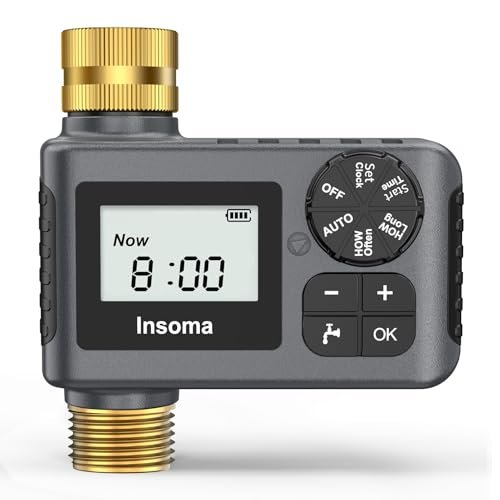
A programmable hose timer can make garden irrigation far easier to manage, especially when watering needs to continue while you are at work, traveling, or simply trying to avoid manually opening and closing the outdoor faucet every day. The Insoma water hose timer is designed for that kind of straightforward automation, with a focus on durable fittings, flexible scheduling, local controls, and weather-resistant construction.
This model combines brass inlet and outlet threads, adjustable watering frequency and duration, automatic and manual modes, a 1-to-7-day rain delay, a large LCD display, child lock, low-maintenance battery operation, and an IP55-rated housing. It is intended for common outdoor applications such as lawn sprinklers, drip irrigation, greenhouse misting, garden beds, and other hose-fed watering systems.
Its strongest advantage is how much scheduling flexibility it provides without requiring WiFi or a smartphone app. Users can program watering intervals ranging from minutes to days and leave the timer to operate locally.
For homeowners who want a single-zone timer with metal plumbing connections and broad programming options, the Insoma is a practical alternative to both basic mechanical timers and more complicated smart irrigation controllers.
What Is the Insoma Water Hose Timer?
The Insoma is a battery-powered programmable valve that installs between an outdoor faucet and a hose or irrigation system.
When a programmed watering cycle begins, the internal valve opens. Once the selected duration ends, it closes automatically.
That allows lawn sprinklers, drip lines, soaker hoses, and other watering equipment to operate without someone standing at the faucet.
The timer is programmed locally using a rotating dial and buttons.
Why a Hose Timer Is Useful
Manual watering works well until schedules become inconsistent.
You may forget to water on a hot day, leave a sprinkler running too long, or struggle to maintain plants while traveling.
A programmable timer creates a repeatable routine.
Once the schedule is configured, the system can automatically provide water according to the selected frequency and duration.
That does not guarantee perfect irrigation, but it removes much of the repetitive work.
Brass Inlet and Outlet Connections
One of this model's most notable features is the use of brass threads on both the inlet and outlet.
That is an upgrade from timers that rely entirely on plastic hose connections.
The faucet connection is exposed to mechanical stress, outdoor heat, water pressure, and repeated installation or removal. Brass generally offers better thread durability and greater resistance to deformation than basic plastic fittings.
Why Brass Threads Can Be Beneficial
Plastic hose threads can work perfectly well, but they may become damaged if overtightened, cross-threaded, exposed to excessive mechanical stress, or left outdoors for years.
Brass provides a more rigid connection.
It can be especially useful if the timer is removed each winter and reinstalled every spring.
That said, brass does not make the whole timer indestructible. Internal valves, seals, and the plastic housing still need reasonable care.
Leak Resistance Depends on More Than Material
The manufacturer describes brass connections as more leak resistant, but the connection material alone does not guarantee a watertight joint.
Garden hose fittings usually seal through a rubber washer.
A missing, damaged, or misaligned washer can cause a brass fitting to leak just as easily as a plastic one.
Always inspect the sealing gasket during installation.
Flexible Watering Frequency
The Insoma offers unusually broad frequency settings.
According to the supplied information, watering frequency can be configured from 1 minute to 23 hours and 59 minutes, or from 1 to 7 days.
This means the timer can support both frequent short-interval watering and widely spaced schedules.
That flexibility is useful because different irrigation applications need very different routines.
When Minute- or Hour-Based Frequency Is Useful
Very frequent watering may make sense for:
- Seed germination
- Small containers
- Greenhouse plants
- Fresh transplants
- Misting systems
- Very fast-draining growing media
These situations may require small amounts of water several times per day.
For established lawns and shrubs, however, hourly irrigation is usually unnecessary.
Daily and Multi-Day Scheduling
The 1-to-7-day range is more relevant for established landscaping.
A lawn might be watered every two or three days rather than daily.
Mature shrubs may need even longer intervals depending on rainfall, soil, and climate.
The timer provides the scheduling range, but plant requirements should determine the actual program.
Watering Duration From 1 Minute to Nearly 24 Hours
Each watering cycle can reportedly run from 1 minute up to 23 hours and 59 minutes.
That is an extremely wide range.
Most lawn sprinklers will never need a cycle anywhere near 24 hours, but long durations may be useful for low-flow applications such as:
- Gravity-fed drip irrigation
- Soaker hoses
- Slow greenhouse systems
- Specialized filling applications
For ordinary residential watering, shorter durations will generally be more appropriate.
Long Runtime Does Not Mean You Should Use It
A feature being available does not mean it is agronomically sensible.
Running a high-flow sprinkler for several hours could waste enormous amounts of water and cause runoff or flooding.
Watering duration should be based on:
- Plant type
- Soil type
- Irrigation output
- Weather
- Root depth
- Drainage
The timer is simply the control mechanism.
Automatic Watering Mode
In Auto mode, the timer follows the programmed schedule.
Once start time, frequency, and duration are set, it opens and closes the valve automatically.
This is the main mode for routine irrigation.
It is especially useful during vacations or busy periods when manual watering would be inconsistent.
Manual Watering Mode
Manual mode allows the faucet to be used temporarily without deleting or disrupting the automatic schedule.
The source states that manual watering can run from 1 minute to 23 hours and 59 minutes.
This can be useful when you need extra water outside the normal program.
For example, you might use it to water newly planted shrubs or run the hose for another garden task.
Manual Mode Preserves the Existing Schedule
This is one of the most useful aspects of a good electronic hose timer.
Without a dedicated manual function, you may need to turn the timer off, use the hose, and then remember to rebuild or reactivate the schedule.
Manual mode lets you handle a temporary task and then return to normal automation.
Rain Delay From 1 to 7 Days
The timer includes a rain-delay function lasting from 1 to 7 days.
This temporarily suspends scheduled watering.
Once the selected delay expires, the programmed routine resumes automatically.
That makes it much easier to respond to wet weather without deleting schedules.
Rain Delay Is Manual, Not Automatic Weather Detection
The supplied description does not mention a rain sensor, WiFi connection, or weather service.
That means the delay should be treated as a manual feature.
You observe that rain has fallen or is expected, then activate the pause yourself.
This is different from a smart weather-based controller that automatically checks forecasts.
Why Rain Delay Can Be Valuable
Continuing irrigation immediately after heavy rainfall can waste water and oversaturate soil.
A temporary pause helps avoid unnecessary watering.
The correct delay depends on the situation.
A brief rain shower may justify only one day, while a long soaking storm could make several days appropriate.
Large LCD Display
The Insoma includes a larger LCD screen designed to make readings easier.
That is useful because the timer provides many settings.
The display can help users review:
- Clock time
- Start time
- Watering duration
- Frequency
- Operating mode
- Battery status
Larger text and clearer information can make outdoor programming much less frustrating.
Child Lock
A child-lock mode is included to prevent accidental changes.
This is useful if the timer is mounted low on an outdoor faucet where children can easily reach it.
It may also help prevent unintended operation caused by pets brushing against the controls.
Once the schedule is configured, locking the interface can reduce accidental changes.
Two AA Batteries
The timer is powered by two 1.5V AA alkaline batteries, which are not included according to the listing.
The manufacturer claims operation for more than six months under expected use.
Actual battery life can vary depending on valve activity, environmental temperature, battery quality, and frequency of watering.
A timer running several times every day may consume power faster than one running twice a week.
Battery-Powered Means No Outdoor Outlet
One of the main benefits is installation simplicity.
There is no wiring.
No extension cord is required.
No outdoor electrical receptacle is needed.
That allows the timer to be attached directly to a conventional garden faucet.
Check Battery Status Regularly
Even if the claimed battery life exceeds six months, inspect the display periodically.
If the timer is responsible for keeping plants alive while you travel, battery condition becomes critical.
Installing fresh batteries before a long trip is a sensible precaution.
IP55 Weather Resistance
The Insoma is described as IP55 rated.
This means the housing is designed to resist dust and water jets under specified testing conditions.
That level of protection is suitable for ordinary outdoor exposure such as rainfall and garden splashing.
However, IP55 does not mean the timer can be submerged.
Weather Resistant Does Not Mean Freeze Resistant
Freezing weather requires separate consideration.
Water trapped inside the timer can freeze and expand, damaging the valve body or housing.
If your area experiences freezing temperatures, disconnect the timer, drain it, and store it indoors unless Insoma explicitly approves year-round cold-weather use.
Sealed Battery Cover
The battery compartment includes an additional sealing ring to help keep moisture out.
When replacing the batteries, inspect this seal.
Make sure it is:
- Clean
- Properly seated
- Free from cracks
- Not twisted
A damaged seal can allow moisture into the electronics.
Fiber-Reinforced Connector
The connector material reportedly includes 35% fiber reinforcement.
This is intended to strengthen the inlet structure and help it tolerate outdoor pressure and mechanical loading.
The timer is rated for a broad water-pressure range of approximately 7.25 to 116 PSI.
That covers many common residential supplies.
High Pressure Is Not Necessarily Better
Although the timer can reportedly tolerate high pressure, excessive household water pressure can still be problematic.
High pressure may contribute to:
- Hose failures
- Leaking fittings
- Sprinkler misting
- Drip-system damage
- Higher water consumption
If household pressure is unusually high, a pressure regulator may still be appropriate.
Additional Reducing Bushing
The kit includes a 3/4-inch male NPT to 1/2-inch female NPT reducing hex bushing.
This adds installation flexibility where the available plumbing does not match the primary connection size.
Adapters should be used carefully because garden hose threads and pipe threads are not identical.
Follow the supplied instructions to avoid cross-threading or leaks.
Thread Seal Tape Included
The package also includes thread seal tape.
Thread seal tape is appropriate for certain tapered pipe-thread connections.
It is generally not required on ordinary garden hose threads, which typically seal using a flat washer.
Use the tape only where the connection type calls for it.
Quick Connector Included
A quick connector is also listed in the package.
This can make hose attachment and removal easier depending on the irrigation setup.
Quick-connect systems are useful when hoses need to be removed frequently.
Make sure the seals remain clean and replace worn O-rings if leaks develop.
Easy Dial-and-Button Programming
The timer uses a rotating dial combined with buttons.
Users can select settings such as:
- Clock
- Frequency
- Duration
- Start time
- Auto
- Off
A dial-based interface can be easier to understand than repeatedly cycling through settings with a single button.
No WiFi Required
No WiFi or smartphone application is mentioned.
That means the timer appears to operate completely locally.
This has several benefits:
- No router setup
- No app registration
- No cloud dependence
- No internet outages affecting schedules
- No 2.4GHz compatibility issues
For straightforward irrigation, local programming can be more reliable.
The Tradeoff: No Remote Control
The limitation is that schedules cannot be changed remotely based on the supplied description.
If a storm starts while you are away from home, you cannot activate rain delay through an app.
People who travel frequently may prefer a WiFi-connected irrigation timer.
Lawn Watering
The timer is well suited to portable lawn sprinklers.
Program the start time, frequency, and duration, leave the outdoor faucet open, and the timer manages water flow automatically.
This can be particularly useful for homes without underground irrigation systems.
Garden Irrigation
Vegetable gardens and raised beds can be paired with:
- Drip tubing
- Soaker hoses
- Micro-sprinklers
The broad frequency range allows irrigation to be adapted as plants mature.
New seedlings may need frequent moisture, while established plants can often transition to deeper, less frequent watering.
Greenhouse Misting
The listing specifically mentions greenhouse mist systems.
Short, repeated watering intervals can be useful in greenhouse environments where temperature and evaporation are high.
However, misting needs differ substantially from root-zone irrigation.
Programming should reflect the actual growing system.
Gravity Drip Irrigation
The manufacturer also mentions gravity-fed drip systems.
These systems may operate at much lower pressure and flow than standard household sprinklers.
The timer's stated minimum pressure is approximately 7.25 PSI, so verify that a gravity system actually produces enough pressure for reliable valve operation.
Not every elevated water tank will meet that threshold.
Pool-Related Use
The listing mentions pool applications.
The long manual and automatic duration ranges can certainly keep a hose operating for extended periods.
However, a hose timer should not be the only protection against pool overflow.
If overfilling could cause property damage, active supervision or an appropriate level-control system is safer.
Soaker Hoses
Soaker hoses are an excellent match for programmable watering.
They release water slowly over a broad area.
Longer watering sessions can deliver moisture deeper into the root zone.
The timer prevents the common problem of forgetting that the hose is running.
Choosing the Right Watering Frequency
The correct schedule depends heavily on soil.
Sandy Soil
Sandy soil drains quickly and may benefit from shorter, more frequent irrigation.
Clay Soil
Clay holds water well but absorbs it slowly. Long high-flow watering can produce runoff.
Loamy Soil
Loam generally balances drainage and moisture retention.
Observe the soil rather than relying entirely on a preset schedule.
Seasonal Schedule Changes
Do not program the timer once and forget about it for the entire year.
Plants usually need more water during hot, dry periods and less during cooler or rainy seasons.
Adjust watering duration and frequency as conditions change.
Check Local Watering Restrictions
Some communities limit irrigation to certain days or hours.
The timer's flexible scheduling can make compliance easier.
Check local rules before programming automatic watering.
Installation Tips
A typical installation should be straightforward.
Install the batteries, attach the timer to the faucet, connect the hose or irrigation line, open the faucet, and check carefully for leaks.
Then program the schedule and run a manual test.
Do Not Cross-Thread the Brass Fittings
Brass is durable, but damaged threads can still leak.
Start every connection by hand.
If the fitting does not turn smoothly, stop and realign it.
Do not force a connection with tools.
Avoid Overtightening
A garden hose fitting usually relies on a washer to seal.
Tightening excessively can damage the gasket or other components.
If water leaks, inspect the seal before applying more force.
Support the Hose
A heavy garden hose can pull downward or sideways on the timer.
Route the hose so its weight rests on the ground.
This reduces stress on the faucet and timer inlet.
Test Before Going Away
If the timer will water plants while you are traveling, test it for several complete cycles beforehand.
Confirm that:
- The timer opens correctly.
- Flow is sufficient.
- The valve closes completely.
- The schedule repeats correctly.
- Connections remain dry.
- Batteries are healthy.
This simple test can prevent unpleasant surprises.
Common Mistakes to Avoid
One common mistake is assuming rain delay works automatically.
Another is using an unnecessarily long watering duration simply because the timer permits it.
Users may also apply thread tape to the wrong type of fitting.
Other mistakes include leaving the timer outside during freezes, ignoring battery condition, and placing too much hose weight on the faucet connection.
Insoma Timer vs. Basic Mechanical Timer
A mechanical timer typically requires you to turn a dial each time you water.
It shuts the water off after a set interval but usually cannot start itself on a recurring schedule.
The Insoma adds fully automatic recurring irrigation.
That makes it far more useful during vacations or for daily garden maintenance.
Insoma Timer vs. WiFi Hose Timer
A smart WiFi timer adds remote control, app alerts, and potentially weather integration.
The Insoma offers a simpler approach.
It avoids connectivity problems and subscription or cloud dependence but lacks remote access.
The better choice depends on whether simplicity or remote control matters more.
Insoma Timer vs. Multi-Zone Controller
This is a single-zone timer.
If one faucet needs to control several areas independently, a two-, three-, or four-zone model may be more suitable.
For one sprinkler or irrigation line, however, a single-zone controller is simpler to program and maintain.
Main Advantages
The strongest feature is the combination of brass inlet and outlet connections with highly flexible programming.
Watering frequency can range from minutes to days, while each cycle can run from 1 minute to nearly 24 hours.
Automatic operation, manual watering, 1-to-7-day rain delay, child lock, a large display, IP55 protection, fiber-reinforced connections, adapters, and a broad pressure rating add meaningful versatility.
The timer also works without WiFi or external electricity.
Potential Drawbacks
It only controls one irrigation zone.
No automatic rain sensor or remote app access is described.
The long maximum duration could encourage overwatering if programs are not configured thoughtfully.
Batteries are not included.
And despite its IP55 rating, the device should still be protected from submersion and freezing temperatures.
Who Should Consider the Insoma Water Hose Timer?
This timer is particularly suitable for users who want a straightforward single-zone controller for:
- Lawn sprinklers
- Vegetable gardens
- Raised beds
- Flower beds
- Drip irrigation
- Soaker hoses
- Greenhouses
- Misting systems
- Vacation watering
It is especially appealing to buyers who prefer metal hose connections and local controls over app-based smart-home features.
Frequently Asked Questions
Does the Insoma timer have brass connections?
Yes. The supplied information describes brass inlet and outlet threads.
What is the watering frequency range?
From approximately every 1 minute to 23 hours 59 minutes, or every 1 to 7 days.
How long can each automatic watering cycle run?
From 1 minute to 23 hours and 59 minutes.
Does it have automatic watering?
Yes.
Does it have manual watering?
Yes.
Does manual watering affect the programmed schedule?
It is designed to allow temporary use without interrupting the saved routine.
Does it include rain delay?
Yes.
How long can rain delay last?
From 1 to 7 days.
Does it automatically detect rainfall?
No automatic rain detection is described, so the delay should be treated as manually activated.
Does it have child lock?
Yes.
What batteries does it use?
Two AA 1.5V alkaline batteries.
Are batteries included?
No, according to the supplied information.
How long can the batteries last?
The manufacturer claims more than six months, though actual life will vary.
Is it waterproof?
The housing is listed as IP55 water resistant, not submersible.
What pressure range is listed?
Approximately 7.25 PSI to 116 PSI.
Does it include an adapter?
Yes. A 3/4-inch male NPT to 1/2-inch female NPT reducing bushing is listed.
Does it include thread seal tape?
Yes.
Can it be used with a sprinkler?
Yes.
Can it be used with drip irrigation?
Yes, provided the system meets the timer's pressure and flow requirements.
Can it be used with a greenhouse misting system?
Yes, according to the supplied application list.
Does it require WiFi?
No WiFi requirement is stated.
Final Verdict
The Insoma programmable water hose timer is a strong single-zone option for users who want flexible automatic watering without the complexity of a connected smart-home system.
Its standout features are the brass inlet and outlet threads, very broad watering frequency and duration settings, automatic and manual modes, 1-to-7-day rain delay, child lock, large LCD display, IP55 construction, reinforced connector, and included plumbing adapters.
The biggest tradeoffs are the lack of confirmed remote control and automatic weather sensing. It also requires users to program responsibly, since its extremely long possible watering durations could waste substantial water if configured poorly.
For a lawn sprinkler, garden, greenhouse, soaker hose, drip system, or other single hose-fed irrigation zone, the Insoma offers a durable and highly configurable way to automate watering while remaining simple enough to operate directly at the faucet.