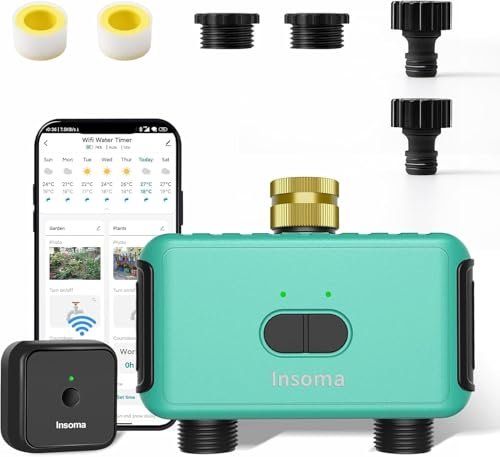
Dual-Zone WiFi Sprinkler Timer Review: Two Independent Outlets for Smarter Lawn and Garden Watering
Managing more than one watering area from a single outdoor faucet can quickly become inconvenient. A lawn may need a longer watering cycle than a vegetable bed, while container plants, drip lines, or a greenhouse may require completely different timing. A basic single-outlet hose timer cannot handle those differences without additional splitters or manual adjustments.
This dual-zone WiFi sprinkler timer is designed to solve that problem by dividing one water source into two independently controlled outlets. Each zone can operate separately, allowing you to create different watering schedules for different parts of the yard rather than treating the entire irrigation setup as one system.
The timer also adds app-based control and Alexa compatibility, making it more flexible than a traditional mechanical hose timer. Its brass inlet is intended to provide a stronger connection to the outdoor faucet, while the two plastic outlets keep the overall unit relatively lightweight.
What Is a Dual-Zone WiFi Sprinkler Timer?
A dual-zone sprinkler timer connects to a single outdoor faucet or hose bib and provides two separate water outlets.
Instead of using one watering schedule for everything, each outlet can be managed independently.
For example, you might connect:
- Zone 1 to a lawn sprinkler
- Zone 2 to a drip irrigation line
Each area can then receive a schedule suited to its own watering requirements.
Why Two Independent Zones Matter
Different plants and irrigation systems rarely need exactly the same amount of water.
Grass may require longer, deeper watering sessions, while herbs or raised beds may perform better with shorter, more frequent cycles.
Independent zones let you manage those differences without repeatedly disconnecting hoses or changing timer settings.
One Faucet, Two Watering Areas
The main practical advantage is that one outdoor water source can support two separate irrigation circuits.
That can simplify watering for:
- Front and back garden areas
- Lawn and flower beds
- Vegetable gardens
- Greenhouses
- Drip irrigation
- Container plants
It can also reduce the need for an additional faucet or manual hose splitter.
Independent Scheduling
The source states that the two outlets work separately.
That means each zone should be treated as its own watering channel rather than both turning on together every time.
This is particularly useful when the two areas have different:
- Soil types
- Plant varieties
- Sun exposure
- Watering durations
Sequential Watering May Be Preferable
In many home irrigation systems, running two zones at once can reduce water pressure.
Independent scheduling allows you to stagger watering times.
For example, Zone 1 can run early in the morning and Zone 2 immediately afterward.
This can help maintain stronger flow at each outlet.
Smart WiFi Control
Unlike a purely mechanical timer, a WiFi sprinkler controller can typically be managed through a smartphone app.
That makes it possible to adjust watering without walking outside to the faucet.
Remote control can be particularly useful when:
- Traveling
- Changing seasonal schedules
- Responding to unexpected weather
- Testing irrigation lines
The exact app and feature set should be confirmed for the current model.
Why Remote Watering Is Useful
Traditional hose timers work well once they are programmed, but any change usually requires physical access to the device.
WiFi control makes the system easier to adjust when conditions change.
For example, if plants need an extra watering cycle during a hot spell, the schedule can potentially be modified from the app rather than at the faucet.
Alexa Compatibility
The timer is described as compatible with Alexa.
Voice control can add convenience for simple tasks such as turning a watering zone on or off.
Depending on the integration, you may be able to use commands for:
- Starting watering
- Stopping watering
- Activating a specific zone
The exact supported commands can vary, so verify the current smart-home integration before purchase.
Voice Control Is Best as a Convenience Feature
Alexa integration is useful, but it should not replace a properly configured schedule.
Automated irrigation works best when the timer handles routine watering on its own.
Voice commands are more useful for:
- Quick manual watering
- Testing a zone
- Temporarily stopping irrigation
Brass Inlet for a Stronger Faucet Connection
The timer uses a brass inlet where it connects to the outdoor faucet.
This is an important detail because the inlet is one of the most stressed parts of a hose timer.
It must support:
- Device weight
- Hose tension
- Repeated tightening and removal
- Outdoor exposure
Brass generally offers better thread durability than lightweight plastic.
Brass vs. Plastic Inlet
Plastic fittings can work well, but repeated cross-threading or overtightening can damage them.
A brass inlet is typically more resistant to mechanical wear.
That can be especially useful if the timer is:
- Removed seasonally
- Reinstalled frequently
- Used with heavier hoses
Plastic Outlets
The source states that the outlets are plastic.
This helps reduce weight and cost but requires more careful handling than metal connections.
Avoid:
- Overtightening hose fittings
- Pulling sideways on connected hoses
- Allowing heavy hoses to hang unsupported
Proper strain relief can help protect the outlet threads.
Is Plastic a Problem Outdoors?
Not necessarily.
Outdoor irrigation products commonly use weather-resistant plastics because they are:
- Lightweight
- Corrosion resistant
- Affordable
The main issue is mechanical stress rather than rust.
A plastic outlet should perform well when hoses are attached correctly and not forced.
Installation
A dual-zone hose timer is generally designed to mount directly onto a standard outdoor faucet.
Installation typically involves:
- Attaching the timer to the faucet
- Connecting hoses or irrigation lines to the two outlets
- Adding power or batteries
- Connecting the controller to WiFi
- Configuring each zone in the app
Exact setup steps depend on the model.
Support the Hoses
One frequently overlooked detail is hose weight.
A heavy garden hose can place considerable leverage on a timer mounted several inches away from the wall.
If possible, arrange the hoses so they rest on the ground or use a hose guide instead of letting their full weight hang from the outlets.
Check for Leaks After Installation
Once everything is connected, turn the faucet on slowly and inspect:
- Faucet connection
- Inlet washer
- Zone 1 outlet
- Zone 2 outlet
Small leaks often come from:
- Misaligned threads
- Missing washers
- Overtightened fittings
Correct those issues before leaving the system unattended.
Leave the Faucet Open During Automatic Use
A hose timer can only control water if the upstream faucet remains open.
After confirming that all connections are secure, the faucet normally stays on while the timer valves control when water flows to each zone.
This makes leak-free connections especially important.
Best Uses for Zone 1 and Zone 2
The two outlets can be assigned based on watering style.
A practical setup might be:
Zone 1: Lawn Sprinkler
Grass often benefits from longer irrigation sessions that soak deeper into the soil.
Zone 2: Drip Irrigation
Flower beds or vegetables may use lower-flow drip lines with different durations.
The independent timer allows both systems to share one faucet without sharing one schedule.
Vegetable Garden and Lawn Combination
This is one of the best use cases for a two-zone timer.
A vegetable garden may need more frequent watering than established turf.
Separate control prevents you from overwatering one area simply because another area needs more moisture.
Containers and Hanging Baskets
A second zone can also serve micro-irrigation tubing for pots or hanging baskets.
These can dry more quickly than garden soil and may benefit from shorter but more frequent watering.
Greenhouse Use
A WiFi timer can be useful for greenhouse irrigation because schedules can be adjusted remotely.
However, confirm that the timer's operating environment and wireless range are suitable for the greenhouse location.
Water Pressure Considerations
Connecting two zones does not create more water pressure.
The available flow still depends on:
- Household supply pressure
- Faucet size
- Hose diameter
- Irrigation equipment
If both zones are allowed to run simultaneously, pressure may drop.
Sequential schedules are often more reliable.
Check Flow Requirements
Before connecting a large sprinkler system, compare its water-flow requirements with the faucet's available output.
A timer can control water, but it cannot compensate for an undersized supply.
This matters especially with:
- Impact sprinklers
- Multiple sprinkler heads
- Long hose runs
WiFi Range
Smart outdoor timers need a reliable wireless connection to their gateway or router, depending on the model.
The outside wall, masonry, metal siding, and distance from the router can all affect signal strength.
Before finalizing the installation, verify that the timer remains connected where the faucet is located.
2.4 GHz WiFi
Many smart irrigation products use 2.4 GHz WiFi because it typically offers better range than 5 GHz.
The supplied description does not specify the network requirement, so check the current product documentation before purchase.
Weather-Based Features
The source does not mention rain delays or automatic weather skipping.
Do not assume those features are included simply because the timer uses WiFi.
If weather-responsive irrigation is important, verify whether the app supports:
- Manual rain delay
- Forecast-based skipping
- Local weather automation
Watering History
Likewise, watering logs are not stated in the source.
Some smart timers track completed irrigation sessions, while others provide only basic scheduling.
Confirm this feature if you want detailed monitoring.
Manual Watering
Most smart hose timers provide some way to start irrigation manually.
This is useful for:
- Testing sprinklers
- Filling a watering can
- Giving plants an extra cycle
However, because the source does not specify manual controls, buyers should confirm whether activation is available through the app, physical buttons, or both.
Dual-Zone Timer vs. Two Separate Timers
You could install a hose splitter and two individual timers instead.
A single dual-zone unit offers several advantages:
- Fewer devices
- Cleaner installation
- One smart-home interface
- Potentially easier scheduling
Two individual timers may provide more flexibility if the watering areas are physically separated.
Dual-Zone Timer vs. Irrigation Controller
A hose timer is intended primarily for above-ground watering systems connected to a faucet.
A traditional irrigation controller manages wired underground sprinkler valves.
Choose a hose timer when using:
- Garden hoses
- Portable sprinklers
- Drip kits connected to a faucet
Choose an irrigation controller for built-in multi-zone sprinkler systems.
Common Mistakes
Running Both Zones When Pressure Is Low
Schedule them separately if flow drops.
Overtightening Plastic Outlets
Plastic threads can be damaged by excessive force.
Letting Heavy Hoses Pull on the Timer
Support hoses to reduce stress.
Assuming All Smart Features Are Included
Verify rain delay, history, and remote functions.
Ignoring WiFi Coverage
Test the outdoor connection before relying on remote control.
Who Is This Timer Best For?
This two-zone WiFi sprinkler timer makes the most sense for homeowners who:
- Have one faucet but two watering areas
- Need separate schedules
- Want app-based irrigation control
- Use Alexa smart-home devices
- Prefer a brass faucet connection
It can be particularly useful for yards combining lawn sprinklers with drip irrigation.
Who Might Need Something More Advanced?
A larger irrigation controller may be better if you need:
- More than two zones
- Underground sprinkler valves
- Soil-moisture integration
- Advanced weather intelligence
- Commercial-scale irrigation
This product is aimed at relatively simple residential hose-based watering setups.
Pros and Considerations
Advantages
- Two independent watering outlets
- Separate control for different garden areas
- WiFi-enabled smart irrigation
- Alexa compatibility
- Brass faucet inlet
- Convenient single-faucet design
- Suitable for lawns, gardens, and drip systems
Potential Considerations
- Plastic outlet fittings need careful handling
- Exact app functions are not provided
- Simultaneous watering may reduce pressure
- WiFi range should be checked
- Weather automation is not confirmed
Frequently Asked Questions
How many watering zones does it support?
Two.
Can both zones have different schedules?
The source states that the two outlets work separately, so independent control is a key feature.
Does it work with Alexa?
Yes, according to the supplied description.
Is the inlet metal?
Yes. The faucet inlet is described as brass.
Are the outlets brass?
No. The supplied description identifies them as plastic.
Can I connect two garden hoses?
Yes, provided the hose fittings are compatible with the timer outlets.
Can I use one outlet for a sprinkler and the other for drip irrigation?
Yes. That is one of the most practical uses for a dual-zone timer.
Do both zones run at the same time?
The source does not specify. Even if simultaneous operation is supported, running them sequentially may provide better water pressure.
Does it automatically skip watering when it rains?
The source does not state this feature. Verify the app capabilities before purchasing.
Can it be controlled remotely?
As a WiFi timer, remote app control is part of the intended smart functionality, although exact app features should be confirmed.
Is it suitable for an underground sprinkler system?
Generally, hose timers are intended for faucet-connected irrigation rather than conventional wired underground sprinkler valves.
Final Thoughts
This two-outlet WiFi sprinkler timer provides a straightforward way to convert a single outdoor faucet into two independently managed irrigation zones.
Its strongest feature is flexibility. A lawn sprinkler, drip irrigation line, vegetable garden, or container system can each receive a different schedule without requiring separate faucets. Smart control and Alexa compatibility add convenience, while the brass inlet provides a more durable connection at the faucet.
The main practical considerations are water pressure, WiFi coverage, and the plastic outlet fittings. Heavy hoses should be supported, connections should be checked carefully for leaks, and the two zones may perform best when scheduled sequentially rather than simultaneously.
For a homeowner who wants a simple dual-zone smart watering system with independent outlets, WiFi control, Alexa integration, and a brass faucet connection, this type of sprinkler timer can be a useful upgrade over a conventional single-zone hose timer.