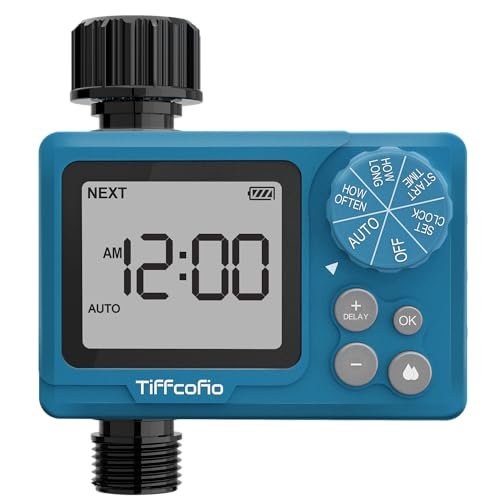
Tiffcofio Water Timer Review: Simple Automatic Irrigation With Rain Delay and Weather-Resistant Design
A hose timer is one of the simplest ways to make garden watering more consistent. Instead of relying on memory to turn a faucet on and off every day, a programmable timer can automate the process and keep irrigation running according to a repeatable schedule.
The Tiffcofio Water Timer is designed for straightforward outdoor watering control. It lets you set the current time, watering start time, duration, and frequency, then automatically operates the connected hose or irrigation system according to that program. It also includes a 24-, 48-, or 72-hour rain delay so scheduled watering can be paused after wet weather.
This type of timer is particularly useful for lawns, vegetable gardens, flower beds, drip irrigation, and other hose-fed watering systems where full smart-home connectivity is unnecessary. Its value comes from simplicity: set a schedule, leave the faucet open, and let the timer manage the watering cycle.
For homeowners who want basic automatic irrigation without complicated menus or app setup, the Tiffcofio offers the essential controls most gardens need.
What Is the Tiffcofio Water Timer?
The Tiffcofio is a programmable outdoor faucet timer designed to control water flow automatically.
It installs between an outdoor faucet and the hose or irrigation equipment.
Once a watering schedule is programmed, the internal valve opens at the selected start time and closes when the watering duration is complete.
Unlike a basic mechanical countdown timer, this model can repeat the watering schedule automatically according to the selected frequency.
That makes it much more useful for unattended watering.
Why an Automatic Hose Timer Is Useful
Consistent irrigation can be difficult when watering depends entirely on someone remembering to do it.
Busy schedules, travel, changing weather, or simple forgetfulness can result in plants receiving too little or too much water.
A programmable water timer reduces that workload by handling the routine automatically.
You still decide how often and how long the garden should be watered, but the timer performs the repetitive opening and closing of the faucet.
Simple Dial-Based Programming
The supplied description emphasizes straightforward programming through a rotating knob.
The setup process focuses on four main parameters:
- Current time
- Watering start time
- Watering duration
- Watering frequency
That is essentially everything needed for a basic automatic irrigation schedule.
By limiting setup to the core watering controls, the timer should be easier to understand than controllers with numerous advanced modes.
Why Simple Controls Matter Outdoors
Garden timers are often programmed while standing outside in bright sunlight, sometimes with wet or dirty hands.
Complicated interfaces can become frustrating quickly.
A dial-based controller can make it easier to move between settings and confirm the program without navigating deeply nested menus.
For users who mainly want dependable automatic watering, simpler controls can be a real advantage.
Set the Current Time First
The current clock time forms the foundation of the schedule.
If the timer's clock is incorrect, the programmed start time will also occur at the wrong time.
Before configuring watering, verify that the timer shows the correct local time.
This sounds obvious, but incorrect clock settings are one of the easiest ways to end up with sprinklers operating unexpectedly.
Choose a Start Time
The watering start time determines when the irrigation cycle begins.
For many lawns and garden beds, early morning is a practical period because temperatures tend to be cooler and evaporation may be lower than during the middle of the day.
However, the best start time depends on climate, local water restrictions, plant type, and irrigation method.
The timer simply provides consistency once you choose the appropriate time.
Set the Watering Duration
Watering duration determines how long the valve remains open during each cycle.
The supplied product description does not provide the exact minimum or maximum duration range, so buyers should verify the current manual or product listing if precise runtime limits matter.
The important point is to match duration to actual water output.
A sprinkler, drip line, and soaker hose can deliver dramatically different quantities of water during the same amount of time.
Avoid Choosing Duration by Guesswork
A 20-minute sprinkler cycle may be plenty for one lawn and insufficient for another.
Similarly, a drip system may need to run much longer because it releases water slowly.
Consider:
- Sprinkler flow rate
- Soil type
- Plant type
- Weather
- Root depth
- Coverage area
The timer controls time, but you still need to determine what that time means in terms of actual irrigation.
Set the Watering Frequency
Watering frequency determines how often the programmed cycle repeats.
The source does not specify the exact available frequency options, so these should be checked in the timer's documentation.
In general, frequency should be based on plant needs rather than convenience.
Established landscaping often benefits from less frequent, deeper watering, while seedlings or small containers may need more regular moisture.
Automatic Watering for Lawns
A hose timer can turn a portable lawn sprinkler into a basic automatic irrigation system.
Once the sprinkler is positioned correctly and the schedule is set, the timer can start and stop watering without daily intervention.
This is particularly useful for homes without an underground sprinkler system.
Lawn Watering Should Match Soil and Grass Type
Avoid automatically watering grass every day unless conditions genuinely require it.
Frequent shallow watering can keep moisture near the surface rather than reaching deeper roots.
Many established lawns respond better to deeper irrigation at longer intervals, although the correct approach depends on grass species, temperature, rainfall, and soil.
Use the timer for consistency, not as a substitute for observing the lawn.
Vegetable Garden Irrigation
The Tiffcofio timer can also work well with vegetable gardens.
A hose, soaker line, or drip system can be left connected and operated automatically.
This helps maintain more consistent soil moisture, which can be especially useful during warm weather when vegetable beds dry quickly.
Adjust the schedule as plants grow and seasonal conditions change.
Flower Beds and Landscaping
Flower beds may need a completely different watering routine from the lawn.
If the timer controls a dedicated irrigation line for ornamental beds, you can program the system specifically for those plants.
Drip irrigation or a soaker hose can be especially useful because water is delivered closer to the root zone.
Drip Irrigation
A programmable hose timer is a common control point for drip irrigation systems.
The timer determines when water flows, while downstream components regulate how that water reaches individual plants.
A complete drip setup may also require:
- Pressure regulation
- Filtration
- Mainline tubing
- Emitters
- Backflow protection
The timer does not replace those components.
Soaker Hose Applications
Soaker hoses slowly release water along their length and can be useful for garden rows, hedges, and flower borders.
Because they apply water relatively slowly, they may need longer watering sessions than conventional sprinklers.
A timer allows the hose to operate without someone needing to remember when to return and shut it off.
Rain Delay for 24, 48 or 72 Hours
One of the Tiffcofio timer's most useful features is its rain-delay mode.
You can temporarily suspend the normal watering program for:
- 24 hours
- 48 hours
- 72 hours
After the selected delay expires, the normal schedule resumes automatically.
This lets you respond to rainfall without deleting or reprogramming the irrigation routine.
Rain Delay Is Not the Same as a Rain Sensor
The source describes a delay that can be activated after rainy weather, but it does not state that the timer includes an automatic rain sensor or internet weather connection.
The safest interpretation is that the delay is manually activated.
You observe that sufficient rain has fallen and select the appropriate pause.
That distinction is important if you are expecting fully automatic weather-based irrigation.
How Long Should You Delay After Rain?
The right delay depends on how much water the soil actually received.
A brief shower may justify only a short pause.
A prolonged storm may leave the soil wet for several days.
Other factors include:
- Soil texture
- Temperature
- Drainage
- Plant type
- Sun exposure
Clay soil generally remains moist longer than sandy soil.
Use the delay function as a flexible tool rather than always selecting the same setting.
Rain Delay Can Help Reduce Overwatering
Running irrigation immediately after meaningful rainfall wastes water and can oversaturate the soil.
Too much moisture may contribute to poor root-zone conditions or runoff.
Temporarily pausing the schedule helps prevent unnecessary watering.
This is one of the easiest ways to make a basic automatic timer more responsive to changing weather.
Useful for Travel
The supplied description highlights unattended watering while traveling.
This is one of the strongest reasons to use an electronic timer.
Once configured correctly, the system can continue operating while nobody is home.
That can help protect plants from missed watering during short trips or vacations.
Test the System Before Leaving Home
Do not set up a timer immediately before a trip and assume everything will work perfectly.
Run several complete automatic cycles first.
Confirm that:
- The timer starts at the expected time.
- Water flow is sufficient.
- The valve closes completely.
- Hose connections do not leak.
- The schedule repeats correctly.
Testing is particularly important when the timer will be responsible for valuable plants.
Inspect the Hose Too
A timer can work perfectly while the connected hose fails.
Cracked hoses, weak fittings, or poorly seated washers can leak once the outdoor faucet remains pressurized.
Before relying on automated irrigation, inspect the entire downstream system.
Replace worn hoses and fittings rather than leaving questionable components under pressure while away.
Weather-Resistant Construction
The timer is described as having a weatherproof, dust-resistant structure suitable for outdoor use.
That is important because faucet timers are routinely exposed to sun, rain, splashing, and humidity.
The source does not provide a specific IP rating, so it is better to describe the timer as weather resistant rather than assume a particular level of certified water protection.
Outdoor Does Not Mean Submersible
Even equipment designed for outdoor use should not be installed where it sits in standing water.
Mount the timer in its normal faucet position and allow rainwater to drain away.
Keeping the battery compartment and controls out of pooled water can improve reliability.
Protect the Timer From Freezing
Water trapped inside an irrigation timer can freeze and expand.
That can damage the valve body, fittings, or seals even if the exterior housing is weather resistant.
In climates with freezing temperatures, remove the timer at the end of the watering season, drain it, and store it somewhere dry unless the manufacturer explicitly approves winter installation.
Durable Materials for Outdoor Use
The source states that the timer is built with weather-resistant materials intended for long-term outdoor operation.
This should help it tolerate routine use during the gardening season.
Actual service life will depend on several factors, including:
- Water quality
- Water pressure
- UV exposure
- Temperature
- Mechanical stress
- Storage
- Maintenance
A durable housing is only one part of long-term reliability.
Installation Should Be Straightforward
A typical installation involves attaching the timer directly to a compatible outdoor faucet and then connecting a garden hose or irrigation line to the outlet.
No permanent plumbing changes should be required.
Once installed, open the faucet so the timer can control the water automatically.
Then check every connection for leaks before programming the schedule.
Check the Hose Washer
Most garden-hose threads seal with a rubber washer.
If that washer is missing, cracked, or misaligned, water may leak from the connection.
Before tightening the timer, inspect the gasket.
This simple step often solves leaks without requiring tools or additional sealing materials.
Do Not Overtighten
Garden hose connections generally do not need extreme force.
Overtightening can damage the washer, threads, or faucet.
Start by hand-tightening the connection.
If water still leaks, inspect the seal and alignment before tightening further.
Support the Hose
A heavy hose can pull downward on the timer.
Route the hose toward the ground so its weight is not hanging directly from the faucet connection.
This reduces mechanical stress on both the timer and the outdoor spigot.
Water Pressure Still Matters
A timer controls water flow but does not create pressure.
If the household supply is weak, adding the timer will not make the sprinkler stronger.
Likewise, a very long or narrow hose can reduce flow because of friction losses.
Consider the entire irrigation system when evaluating performance.
Measure Faucet Flow if Needed
A simple bucket test can help estimate available flow.
Fill a container of known volume and measure how long it takes.
For example, if a 5-gallon bucket fills in one minute, the faucet is supplying roughly 5 gallons per minute under those conditions.
That can help determine whether the connected sprinkler or drip system is appropriately sized.
Soil Type Should Influence the Schedule
The same watering program will not work equally well everywhere.
Sandy Soil
Sandy soil drains rapidly and may dry more quickly.
Shorter but somewhat more frequent watering may be appropriate in some conditions.
Clay Soil
Clay absorbs water slowly and retains it for longer.
Long high-flow sprinkler cycles may create runoff before water penetrates deeply.
Loamy Soil
Loam usually offers a better balance between drainage and moisture retention.
Adjust the timer according to what the soil actually does after watering.
Observe Soil Moisture
Automation should not replace observation.
Check the soil periodically.
If it stays wet for days, reduce watering.
If it dries completely before the next scheduled cycle, increase duration or frequency where appropriate.
A timer repeats instructions accurately, even when those instructions are poorly chosen.
Adjust the Schedule Seasonally
Irrigation needs change throughout the year.
Hot, dry summer conditions may require more supplemental watering.
Cooler months, increased rainfall, or slower plant growth may require significantly less.
Review the timer settings periodically rather than using one schedule indefinitely.
Consider Local Water Restrictions
Some municipalities restrict lawn irrigation to specific days or time windows.
A programmable timer can make compliance easier by automating watering only during permitted periods.
Check current local requirements before setting recurring programs.
Manual Watering Capability
The supplied description does not explicitly mention a dedicated manual-watering mode.
If temporary manual operation is important, verify whether the current Tiffcofio model supports it before purchase.
Many electronic timers do, but it should not be assumed unless stated.
Without a manual mode, you may need to adjust the timer or temporarily remove it when you want unrestricted hose use.
Tiffcofio Timer vs. Mechanical Hose Timer
A mechanical timer generally works like an egg timer.
You turn the dial manually and it shuts the water off after a selected period.
It does not start watering automatically later.
The Tiffcofio is more useful when you need recurring automatic irrigation because it can use programmed start times and frequency.
Tiffcofio Timer vs. WiFi Smart Timer
A WiFi timer may allow remote control, smartphone notifications, and automatic weather integration.
The Tiffcofio appears to focus on local programming instead.
That keeps setup simpler and eliminates dependence on internet connectivity.
The tradeoff is that remote control and automatic weather updates are not described.
Tiffcofio Timer vs. Multi-Zone Controller
This listing does not state that the timer has multiple independently controlled outlets.
It should therefore be treated as a single-zone timer unless the exact product documentation says otherwise.
For one lawn sprinkler or irrigation line, that is often enough.
If you need separate schedules for lawn, garden, and greenhouse zones, a dual- or multi-zone timer would be more appropriate.
Best Applications
The Tiffcofio timer is a good match for straightforward hose-fed irrigation such as:
- Lawns
- Vegetable gardens
- Flower beds
- Raised beds
- Soaker hoses
- Drip irrigation
- Greenhouses
- General landscape watering
Its main role is to automate one watering routine consistently.
Common Setup Mistakes
One mistake is setting the wrong clock time and then wondering why watering starts at the wrong hour.
Another is choosing an irrigation duration without checking soil moisture or system output.
Users may also assume rain delay is automatic weather detection when the description only supports a manual pause.
Other mistakes include leaving damaged hoses under constant pressure or failing to winterize the timer.
Main Advantages
The main strength of the Tiffcofio Water Timer is simplicity.
It provides the essential controls needed for recurring automatic irrigation: current time, start time, watering duration, frequency, and rain delay.
The 24-, 48-, and 72-hour pause options make it easier to adapt watering after rainfall, while the weather-resistant construction is intended for regular outdoor use.
It can be particularly useful for maintaining lawns and gardens during periods when manual watering would be inconvenient or inconsistent.
Potential Drawbacks
The source does not provide detailed specifications for watering duration or frequency ranges.
It also does not confirm WiFi, smartphone control, an automatic rain sensor, or multiple independent watering zones.
A dedicated manual watering mode is not stated either.
That makes this timer better suited to users who prioritize straightforward basic irrigation rather than advanced smart-home features.
Who Should Consider the Tiffcofio Water Timer?
This timer is most appropriate for users who want:
- Automatic hose watering
- Straightforward programming
- Scheduled irrigation
- Rain-delay functionality
- Outdoor weather resistance
- No requirement for complex smart-home setup
It is particularly useful for one lawn, garden, flower bed, or irrigation line that needs a consistent recurring schedule.
Frequently Asked Questions
What is the Tiffcofio Water Timer?
It is a programmable faucet timer designed to automate hose-fed irrigation.
What settings need to be programmed?
The source lists current time, start time, watering duration, and watering frequency.
Does it automatically start watering?
Yes, once an automatic schedule has been configured.
Does it automatically stop watering?
Yes, according to the programmed duration.
Does it have rain delay?
Yes.
What rain-delay options are available?
24, 48, or 72 hours.
Does it automatically detect rain?
Automatic rain sensing is not stated. The delay should therefore be treated as manually activated unless the current manual says otherwise.
Does the normal schedule return after rain delay?
Yes. The source indicates that irrigation is delayed rather than permanently deleted.
Can it be used while traveling?
Yes. Automatic scheduling is intended to maintain watering without daily manual operation.
Is it suitable for lawn sprinklers?
Yes, provided the sprinkler works with the connected hose and available water supply.
Can it be used with a garden?
Yes.
Can it operate drip irrigation?
Yes, provided the downstream system is properly configured.
Can it be used with a soaker hose?
Yes.
Is it weather resistant?
The supplied description says the timer has a weatherproof and dust-resistant outdoor structure.
What is its IP rating?
No specific IP rating is provided in the supplied information.
Does it require WiFi?
No WiFi requirement is mentioned.
Does it include automatic weather forecasting?
No such feature is stated.
Can it control multiple independent zones?
Multiple zones are not mentioned in the supplied description, so this should not be assumed.
Does it have manual watering mode?
A dedicated manual mode is not stated in the supplied information and should be verified if important.
Final Verdict
The Tiffcofio Water Timer is a straightforward automatic irrigation controller for homeowners who want to move beyond manual faucet operation without adopting a complicated smart watering system.
Its most useful features are the simple dial-based setup, programmable start time, watering duration and frequency, 24/48/72-hour rain delay, automatic operation, and weather-resistant outdoor construction.
Its simplicity is also its main limitation. The source does not establish advanced capabilities such as WiFi control, automatic rain detection, multiple independent zones, or app-based monitoring.
For a lawn, vegetable garden, flower bed, drip line, soaker hose, or other single hose-fed irrigation system, the Tiffcofio provides the essential functionality needed to create a repeatable watering routine and reduce the need for daily manual irrigation.