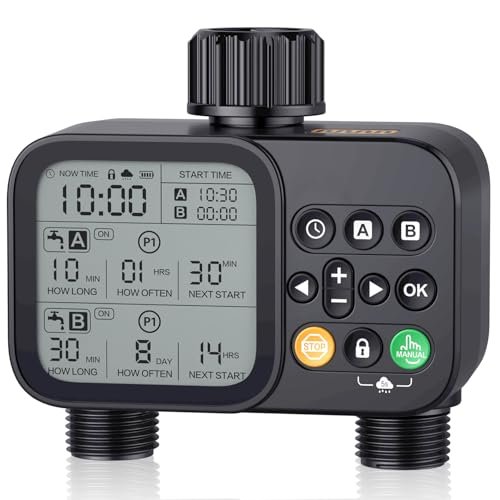
2-Zone Sprinkler Timer Review: Independent Programs, Rain Sensing, Manual Watering and Second-Level Scheduling
A dual-zone hose timer can be a major upgrade for anyone trying to water two different parts of a yard from a single outdoor faucet. Instead of forcing a lawn, vegetable garden, flower bed, or drip system to share one schedule, a two-zone timer allows each outlet to follow its own watering routine.
This 2-zone programmable sprinkler timer is especially flexible because its scheduling range extends from extremely short one-second cycles to watering sessions lasting as long as 24 hours. Each zone can also operate on frequencies ranging from hourly intervals to schedules separated by as many as 32 days. With a total of eight available programs, the timer is designed for irrigation systems that need considerably more control than a basic single-program hose timer can provide.
It also includes several practical outdoor features: three manual watering modes, an integrated rain-sensing function, a large LCD display, child lock, low-battery protection, reinforced hose connections, a stainless steel inlet filter, IP54-rated construction, and automatic valve closure when battery power becomes too low.
For homeowners who want to automate two independent watering areas without installing a permanent irrigation controller, this type of timer offers an unusually broad range of scheduling options.
What Is a 2-Zone Sprinkler Timer?
A two-zone sprinkler timer attaches to an outdoor water source and divides that supply between two independently controlled outlets.
Each outlet can be connected to a different hose or irrigation system.
For example, one zone might control a lawn sprinkler while the second operates drip irrigation for a vegetable garden.
Because each zone can have a separate watering program, you do not have to give both areas the same start time, runtime, or frequency.
Why Independent Zones Matter
Different parts of a landscape rarely require identical watering.
Grass may benefit from longer, less frequent watering, while containers or vegetables may need shorter and more regular irrigation. Shrubs, raised beds, flower borders, and greenhouse plants can all have different moisture requirements.
A dual-zone timer allows those differences to be reflected directly in the irrigation schedule.
Instead of compromising with one universal program, you can configure each outlet for the plants it actually serves.
Up to Eight Watering Programs
The timer supports a total of eight programs across its two zones.
That provides considerable flexibility.
Multiple programs can be useful when the same zone needs watering at different times during the day. For example, newly germinated seed or small containers may need short cycles in the morning and later in the day.
Established landscaping may use only one or two programs, but having additional capacity allows the system to adapt as seasonal conditions change.
Watering Duration From 1 Second to 24 Hours
One of the most unusual features is the extremely broad watering-duration range.
The source states that each watering session can be programmed from 1 second to 24 hours.
That allows the timer to control applications far beyond standard lawn sprinklers.
Very short cycles may be useful for misting or specialized irrigation, while extended runtimes can serve low-flow drip or gravity-fed systems.
Why One-Second Control Can Be Useful
Most garden timers begin at one minute.
Second-level control is valuable when only a tiny amount of water is needed.
Potential examples include:
- Greenhouse misting
- Seed propagation
- Small irrigation emitters
- Short flushing cycles
- Very small container systems
Whether such short cycles work effectively will still depend on how quickly the valve opens and how much water the connected system delivers.
Long Watering Sessions Require Care
A maximum runtime of 24 hours gives the timer tremendous flexibility, but it also creates the possibility of serious overwatering if settings are entered incorrectly.
A conventional lawn sprinkler should almost never need to run anywhere near that long.
Long durations make more sense for extremely low-flow irrigation.
Always consider actual system output before using multi-hour schedules.
Watering Frequency From Hourly to Every 32 Days
The frequency range is similarly broad.
The source states that watering can repeat:
- Every 1 to 24 hours
- Daily through approximately every 32 days
That makes the timer suitable for everything from frequent seedling irrigation to infrequent deep watering.
Few basic hose timers provide this much interval flexibility.
Hourly Irrigation
Hourly cycles are useful mainly for situations where small amounts of moisture must be delivered frequently.
Examples include:
- Seedlings
- Propagation beds
- Containers
- Greenhouse systems
- Fast-drying growing media
For mature lawns and established shrubs, hourly watering would generally be unnecessary.
Long-Interval Watering
At the other end of the range, a schedule extending to 32 days can be useful for low-water landscapes or certain established plants.
However, very long intervals should be chosen based on plant requirements and climate.
The timer provides the capability; it does not determine whether a 20- or 30-day interval is appropriate.
Three Manual Watering Modes
The timer includes three manual modes accessible through the Zone control.
Manual watering allows you to open one or more zones temporarily without changing the automatic irrigation program.
This is useful for everyday outdoor tasks and for giving one area additional water outside its normal schedule.
Manual Watering From 1 Second to 24 Hours
Manual watering reportedly uses the same broad timing range, from 1 second to 24 hours.
That means you can run a quick valve test, water a small area briefly, or operate a low-flow irrigation system for an extended period.
Manual mode can also be helpful when testing installation before relying on automatic schedules.
Why Manual Mode Matters
Automatic timers should not make the outdoor faucet harder to use.
Manual mode lets you temporarily operate a zone for tasks such as:
- Supplemental garden watering
- Testing sprinklers
- Washing outdoor surfaces
- Running a hose
- Checking drip emitters
Once the manual cycle is finished, the programmed schedule remains in place.
Built-In Rain-Sensing Function
Unlike timers that only provide a manually selected rain delay, this model is described as having a rain-sensing chip located on top of the unit.
According to the supplied information, the timer can skip scheduled watering on rainy days while preserving the original irrigation program.
That can reduce unnecessary watering without requiring the user to delete schedules.
Why Automatic Rain Skipping Is Useful
Automatic watering is convenient until rainfall occurs.
Without weather awareness, a timer may run a sprinkler immediately after a storm.
A rain-sensing function can help avoid unnecessary irrigation and reduce the risk of overwatering.
Because the source does not provide technical details on sensor thresholds or calibration, users should verify how the rain-sensing behavior works in the manual.
Rain Sensing Does Not Replace Soil Monitoring
Even when a timer detects rainfall, it may not know how much moisture actually reached the root zone.
A brief shower could trigger a sensor without providing enough water for deep-rooted plants.
Conversely, a major storm could leave the soil wet for days.
Continue checking actual soil conditions rather than relying entirely on automation.
Large LCD Display
The timer includes a large LCD screen that displays important program information.
According to the source, this includes details such as watering time and frequency.
A large display is particularly helpful on a timer with two zones and multiple programs because there is more information to manage than on a basic single-zone model.
Easier Schedule Verification
Before leaving the system unattended, use the display to confirm:
- Correct zone
- Start time
- Watering duration
- Frequency
- Battery condition
- Manual or automatic mode
A quick visual check can prevent programming mistakes.
Child Lock
A child-lock mode is built in.
This helps prevent accidental schedule changes if the timer is mounted low on an outdoor faucet where children can reach it.
It can also reduce unintended adjustments caused by someone pressing controls while using the hose.
For outdoor electronics, a lock function is a useful safeguard.
Low-Battery Warning
The timer provides a visual warning when battery power is becoming low.
This gives you time to replace the batteries before automatic watering becomes unreliable.
Battery monitoring is especially important if the timer is responsible for irrigation while you are traveling.
Automatic Valve Closure on Low Battery
The source states that the valve closes automatically when battery power becomes too low.
This is an important fail-safe.
A timer that fails with an open valve could allow water to continue running indefinitely.
Closing the valve reduces the risk of flooding or excessive water use.
Reinforced Nylon Connector
The timer's connector is described as being made from 30% reinforced nylon.
Reinforced engineering plastic can provide more structural strength than ordinary plastic while remaining lightweight and corrosion resistant.
The connection is rated for water pressure up to 116 PSI according to the supplied specifications.
116 PSI Maximum Pressure
A 116 PSI pressure rating covers a wide range of residential water supplies.
However, this should be understood as a maximum supported pressure rather than an ideal operating target.
Many downstream components, especially drip irrigation equipment, work better at much lower pressures.
Excessive Pressure Can Still Cause Problems
Even when the timer itself can handle high pressure, hoses and irrigation devices may not.
Excessive pressure can contribute to:
- Leaking connections
- Sprinkler misting
- Damaged drip emitters
- Premature fitting wear
A pressure regulator may be necessary depending on the downstream system.
Stainless Steel Inlet Filter
The timer includes a built-in stainless steel filter designed to catch debris before it reaches the valve or hose.
This can help prevent dirt, rust, sand, or sediment from interfering with operation.
A clean filter is especially important for small irrigation emitters.
Clean the Filter Periodically
If flow becomes weak, inspect the inlet filter before assuming the timer is defective.
Sediment can accumulate over time and restrict water supply.
Cleaning the filter is a simple maintenance step that can help preserve consistent flow.
Sealing Gasket for Leak Prevention
The product includes a sealing gasket at the connection point.
Garden hose fittings generally rely on washers or gaskets rather than thread sealant alone.
Make sure the gasket is properly seated before tightening the connection.
A damaged or misaligned seal can cause leakage even when the timer housing is intact.
IP54 Weather Resistance
The timer is listed as IP54 rated.
IP54 provides protection against limited dust intrusion and water splashing under defined conditions.
That makes the device appropriate for normal outdoor faucet use.
It should tolerate ordinary rain and garden splashes, but it should not be submerged.
Sealed Battery Compartment
The battery cover uses both a rubber sealing ring and a latch.
This helps keep moisture away from the electronics.
Whenever you replace the batteries, inspect the seal carefully and make sure the cover closes securely.
Thread-Sealing Tape Included
The package includes thread-sealing tape.
Use it only where the connection type requires it.
Standard garden hose threads usually seal with a washer, so applying thread tape unnecessarily may not improve the connection.
Follow the included installation instructions.
Universal Outdoor Applications
The timer is intended for a broad range of watering applications.
Suitable examples include gardens, lawns, vegetable beds, yards, shrubs, patios, and drip irrigation.
The dual-zone layout is particularly useful when two different irrigation methods need to share one faucet.
Lawn and Garden Combination
One of the most practical setups would be:
Zone 1: Lawn Sprinkler
Run a deeper irrigation cycle every several days.
Zone 2: Vegetable Garden
Run shorter or more frequent drip-irrigation cycles.
Because the zones are independent, both systems can remain connected without sharing the same schedule.
Vegetable Garden Irrigation
Vegetable plants often benefit from more consistent moisture than established turf.
Connecting a dedicated drip line or soaker hose to one zone allows watering to be tailored specifically to the garden.
The broad frequency range makes it easy to adjust irrigation as plants mature.
Shrub and Landscape Watering
Established shrubs can often tolerate longer intervals between watering sessions.
One zone can therefore be programmed for deeper and less frequent irrigation.
The other zone can remain dedicated to plants that need more regular watering.
Gravity Drip Irrigation
The source states that the timer can be used with outdoor gravity-fed drip systems.
However, gravity irrigation provides much lower pressure than a normal faucet.
Because minimum operating pressure is not supplied here, verify that the specific gravity system produces enough pressure for reliable valve operation before depending on it.
Greenhouse and Misting Applications
The one-second minimum watering duration makes this timer potentially interesting for misting systems.
Short cycles can help avoid excessive water application in environments where frequent moisture is required.
However, verify actual valve response and system output during testing.
Manual Valve Closure Procedure
The source includes specific troubleshooting instructions if water continues flowing unexpectedly.
If the valve has been accidentally left open, the recommended sequence is:
- Press OK
- Press MANUAL
- Press OK
- Press STOP
This is intended to manually close the valve.
What to Do If Water Does Not Flow
If no water flows, the source recommends activating manual mode.
If water flows correctly in manual mode, the automatic program may need to be cleared and configured again.
This troubleshooting sequence can help distinguish a scheduling issue from a valve or supply problem.
Program Carefully Before Leaving Home
Because this timer offers an unusually wide scheduling range, small programming errors can have large consequences.
Entering 12 hours instead of 12 minutes could result in substantial water use.
Always review the display after programming each zone.
Test Every Zone
Before relying on automatic operation, manually test both outlets.
Check that:
- The correct zone opens
- Water flows normally
- The valve closes
- Connections do not leak
- The program appears correctly on the display
Then run short automatic schedules to confirm timing.
Check for Schedule Conflicts
With eight programs available, it is possible to create overlapping or confusing schedules.
The source does not clearly state how the timer handles simultaneous programs across both zones.
Staggering start times is a sensible approach if both connected systems require substantial flow.
Why Simultaneous Watering Can Reduce Performance
Both outlets ultimately share the same faucet.
If both run at the same time, available flow may be divided.
A sprinkler that normally works well may lose coverage.
Staggering zones can help each irrigation system receive the full available supply.
Soil Type Should Influence Programming
Sandy Soil
Sandy soil drains quickly and may require more frequent irrigation.
Clay Soil
Clay holds moisture longer but absorbs water slowly. Long high-flow sessions can produce runoff.
Loam
Loam generally balances moisture retention and drainage.
Use each zone's flexibility to adapt watering to the actual soil conditions.
Adjust Programs Seasonally
A schedule that works during peak summer heat may be excessive during cooler months.
Review both zones regularly and adjust frequency or duration as weather changes.
Rain sensing helps, but seasonal programming is still important.
Check Local Watering Restrictions
Many areas limit lawn irrigation to specific days or hours.
The broad scheduling capabilities make compliance possible, but it is still your responsibility to configure the timer accordingly.
Check local rules before activating automatic schedules.
Protect the Timer During Freezing Weather
IP54 weather resistance does not make the timer freeze-proof.
Water trapped inside the valve can expand when frozen and damage internal components.
Disconnect, drain, and store the timer before freezing temperatures unless the manufacturer explicitly states otherwise.
Support Attached Hoses
Heavy hoses can pull downward on the timer and faucet.
Route hoses toward the ground so their weight is supported.
Reducing mechanical stress can help protect the reinforced connector and outdoor spigot.
2-Zone Timer vs. Single-Zone Timer
A single-zone timer is simpler and often less expensive.
It works well when only one sprinkler or irrigation system needs automation.
The dual-zone model becomes much more useful when two areas need different schedules.
For mixed landscaping, the additional outlet can significantly reduce hose switching.
2-Zone Timer vs. Mechanical Hose Timer
A mechanical timer generally requires manual activation every time.
This model provides recurring automatic schedules.
That makes it more appropriate for unattended watering and vacations.
The tradeoff is battery dependence and more complicated programming.
2-Zone Timer vs. WiFi Smart Timer
A WiFi timer can offer remote control and online weather information.
This timer appears to rely on local controls but adds an onboard rain-sensing feature.
That reduces dependence on internet connectivity while still providing some weather-responsive behavior.
Remote smartphone control is not described.
Main Advantages
The strongest feature is the extremely wide programming range.
Each of the two zones can use multiple programs, watering durations from 1 second to 24 hours, and frequencies ranging from hourly intervals to approximately every 32 days.
The three manual modes, rain-sensing function, large LCD, child lock, low-battery warning, automatic valve closure, reinforced connector, stainless steel filter, IP54 construction, and included accessories add practical value.
Potential Drawbacks
The broad programming range also creates more opportunity for user error.
No WiFi or remote app control is described.
The exact behavior of the rain-sensing chip, including its threshold and sensitivity, is not specified.
IP54 construction is weather resistant but not submersible.
And although the source mentions gravity-fed irrigation, minimum operating pressure should be verified before using the timer in a very low-pressure system.
Who Should Consider This 2-Zone Water Timer?
This timer is particularly suitable for users who need independent automatic control of two watering areas, such as:
- Lawn + vegetable garden
- Front yard + backyard
- Drip irrigation + sprinkler
- Flower beds + shrubs
- Greenhouse + garden
- Patio containers + landscape beds
It is especially attractive when very short or very long irrigation cycles are needed.
Frequently Asked Questions
How many zones does the timer control?
Two independent zones.
How many programs are available?
The source states a total of eight programs.
What is the watering duration range?
From 1 second to 24 hours.
What watering frequencies are available?
From every 1 to 24 hours, or approximately daily through every 32 days.
Does each zone have its own program?
Yes.
Does it support manual watering?
Yes.
How long can manual watering run?
From 1 second to 24 hours.
How many manual modes are provided?
Three, according to the supplied information.
Does it include rain sensing?
Yes. The source states that a rain-sensing chip can skip scheduled watering on rainy days.
Does rain sensing erase the normal program?
No. The preset irrigation schedule is retained.
Does it have a large display?
Yes.
Does it include child lock?
Yes.
Does it provide a low-battery warning?
Yes.
What happens when the batteries become too weak?
The valve is designed to shut automatically.
What is the maximum listed pressure?
Up to 116 PSI.
What is the connector made from?
The source describes 30% reinforced nylon.
Does it include an inlet filter?
Yes, a stainless steel filter.
What is the waterproof rating?
IP54.
Does the package include thread-sealing tape?
Yes.
How many hose connectors are included?
Two nipple connectors are listed.
What should I do if water keeps flowing?
According to the supplied instructions: press OK, MANUAL, OK, then STOP.
What if water does not flow?
Activate manual mode. If water flows manually, clear and reconfigure the automatic program.
Can it be used with sprinklers?
Yes.
Can it be used with drip irrigation?
Yes.
Can it work with gravity-fed irrigation?
The source lists gravity drip irrigation as an application, but available pressure should be verified.
Does it require WiFi?
No WiFi requirement is mentioned.
Final Verdict
This 2-zone programmable sprinkler timer stands out because of how much control it provides over watering duration and frequency.
Its most significant features are the two independently controlled zones, eight available programs, 1-second-to-24-hour watering duration, hourly-to-32-day scheduling range, three manual modes, onboard rain-sensing capability, large LCD display, child lock, low-battery fail-safe, reinforced fittings, stainless steel filter, and IP54 outdoor construction.
The main consideration is complexity. With such broad scheduling flexibility, it is important to double-check every program before leaving the system unattended.
For users managing two different irrigation areas that genuinely need different watering routines, particularly drip systems, lawns, gardens, greenhouses, or specialized short-cycle watering applications, this timer offers considerably more precision than a typical basic hose controller.