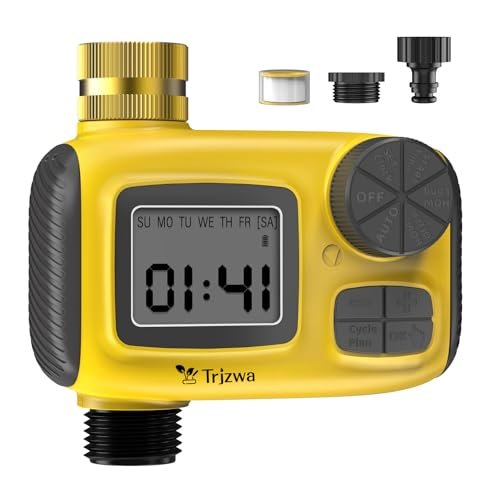
TRJZWA Water Timer Review: Flexible Scheduling, Brass Inlet, Rain Delay and Manual Watering
A programmable hose timer can make outdoor watering far more consistent without requiring a permanent irrigation system. Instead of manually opening and closing a faucet every day, you can set the watering schedule once and let the timer handle the routine.
The TRJZWA Water Timer is designed for this kind of automated garden and lawn irrigation. It supports daily or weekly schedules, up to three watering programs per day, manual watering, rain delay, a large LCD display, child lock, low-battery monitoring, and a 360-degree rotating brass inlet. It also uses an IP55-rated housing for outdoor use.
Its biggest strength is flexibility. You can create multiple watering periods in the same day, assign irrigation to specific days of the week, temporarily pause watering after rain, or manually run the hose without deleting the automatic schedule.
For lawns, vegetable gardens, greenhouses, drip systems, sprinklers, and other hose-fed irrigation setups, the TRJZWA offers a broad feature set without requiring WiFi or a smartphone app.
What Is the TRJZWA Water Timer?
The TRJZWA is a programmable faucet-mounted irrigation timer that installs between an outdoor tap and a garden hose.
Once the schedule is configured, the timer automatically opens the internal valve at the selected start time and closes it when the programmed watering period ends.
That means a conventional garden hose, lawn sprinkler, drip system, or greenhouse irrigation line can operate automatically without someone being present.
Unlike a basic mechanical timer, the TRJZWA supports recurring schedules and multiple watering cycles.
Up to Three Watering Schedules Per Day
One of the more useful features is the ability to create up to three separate watering schedules within a single day.
This provides more flexibility than timers that allow only one start time.
For example, a greenhouse or container garden could be watered briefly in the morning, again in the afternoon, and once more in the evening.
A lawn would usually require less frequent irrigation, but the same functionality can be useful during seed establishment or unusually hot conditions.
Why Multiple Daily Programs Matter
Some plants benefit from one deep watering session.
Others, especially seedlings or small containers, may dry rapidly and need smaller amounts of water more frequently.
The timer allows you to tailor watering to the application rather than forcing every system into one daily cycle.
That can be particularly useful for greenhouse misting or young plants.
Daily and Weekly Scheduling
The timer supports both daily and weekly watering programs.
You can set the current day of the week and choose specific watering days from Sunday through Saturday.
This gives you more control than a simple repeating interval.
For example, you might choose Monday, Wednesday, and Saturday rather than watering every third day.
That can also make it easier to comply with local watering restrictions that specify particular days of the week.
Custom Watering Days for Different Conditions
Weekly programming is helpful because irrigation needs rarely remain identical throughout the season.
A lawn might need water only a few mornings per week, while vegetables may need more frequent attention.
If this timer is controlling one dedicated irrigation line, you can design the schedule around the specific plants connected to it.
Dial-and-Button Programming
The TRJZWA uses a rotating dial combined with buttons for setup.
The main settings include:
- Clock
- Watering frequency
- Watering duration
- Start time
- Automatic mode
- Off
This style of interface is usually easier to understand than repeatedly cycling through settings with a single button.
It also eliminates the need for an app or wireless setup.
No WiFi Required
No WiFi or smartphone connectivity is mentioned in the supplied information.
The timer therefore appears to operate entirely locally.
That means there is no dependency on:
- Router coverage
- Internet connectivity
- Mobile apps
- Cloud accounts
- Smartphone compatibility
For homeowners who prefer straightforward irrigation automation, that simplicity can be beneficial.
The Tradeoff of Local Control
The main limitation is that remote changes are not described.
If heavy rain begins while you are away, you cannot appear to pause the timer from your phone.
Users who want remote control or automatic forecast integration may prefer a WiFi-enabled irrigation timer.
360-Degree Rotating Brass Inlet
The timer uses a 360-degree rotating brass inlet.
This is one of the strongest physical-design features.
Brass provides greater rigidity and thread durability than many basic plastic inlet fittings, while the rotating connection can make installation easier.
Instead of twisting the entire timer against the faucet, the connector can rotate independently.
Why Brass Is Useful on a Hose Timer
The inlet connection supports the timer and the attached hose.
It is repeatedly exposed to water pressure, outdoor temperatures, hose weight, and installation stress.
A brass fitting can help resist:
- Thread wear
- Deformation
- Cracking
- Mechanical stress
It can also make repeated seasonal installation and removal easier.
Leak Resistance Still Depends on Proper Installation
The manufacturer describes the brass inlet as leak resistant, but fitting material alone cannot guarantee a leak-free installation.
Most garden-hose connections depend on a rubber washer.
If that gasket is missing, cracked, or misaligned, the joint can still leak.
Inspect the washer before tightening the timer.
Maximum Water Pressure of 116 PSI
The source lists support for water pressure up to 116 PSI.
That is more than enough for many residential irrigation systems.
However, maximum supported pressure should not be confused with ideal pressure.
Very high household pressure can still stress hoses, sprinklers, fittings, and drip emitters.
High Pressure Is Not Always Better
Excessive water pressure may cause:
- Hose leaks
- Sprinkler misting
- Damaged irrigation fittings
- Increased water use
- Uneven drip performance
If the household supply is unusually high, a pressure regulator may still be useful.
Built-In Metal Filter
The inlet includes a metal filter designed to catch debris before it reaches the internal valve or downstream irrigation system.
This can be helpful when water contains:
- Rust
- Sand
- Sediment
- Pipe debris
- Mineral particles
Foreign material can interfere with valve sealing or reduce flow.
A filter helps reduce that risk.
Clean the Filter Periodically
A dirty filter can become restrictive.
If sprinkler performance weakens over time, inspect the inlet screen before assuming the timer itself has failed.
Cleaning accumulated sediment may restore normal flow.
This is especially important for homes using well water or older plumbing.
IP55 Outdoor Protection
The TRJZWA timer is listed as IP55 rated.
That means its enclosure is designed to resist dust and water jets under specified conditions.
For equipment mounted outdoors beneath a faucet, that is a useful level of protection.
It should tolerate normal rainfall and garden splashing.
Sealed Battery Compartment
The battery cover includes a sealing ring intended to keep moisture away from the electronics.
Whenever the batteries are replaced, inspect that seal carefully.
Make sure it is:
- Clean
- Properly seated
- Not pinched
- Free from cracks
A damaged gasket can reduce the timer's weather resistance.
IP55 Does Not Mean Submersible
The timer should not be installed where it can sit in standing water.
IP55 equipment is designed for outdoor exposure, not continuous submersion.
Good drainage around the outdoor faucet remains important.
Protect the Timer From Freezing
Water trapped inside the timer can freeze and expand.
That can crack the valve body or damage internal seals even if the exterior is weather resistant.
In freezing climates, disconnect and drain the timer before winter unless the manufacturer explicitly approves year-round cold-weather use.
Rain Delay From 1 to 15 Days
The timer includes a particularly wide rain-delay range of 1 to 15 days.
This allows automatic watering to be paused without deleting the underlying irrigation program.
Once the selected delay ends, the previous schedule resumes automatically.
That is useful after rainfall because there is no need to rebuild your watering settings from scratch.
Rain Delay Is Not Automatic Rain Detection
The source does not mention an integrated rain sensor or online weather service.
The rain delay should therefore be treated as a manually activated feature.
You decide when rain or wet conditions justify pausing irrigation and select the appropriate delay.
Why a 15-Day Delay Can Be Useful
Most rain delays are shorter, but an extended range can be useful after prolonged wet weather or during cooler seasons.
That said, a 15-day pause may be excessive for many gardens.
Use actual soil moisture and plant needs to determine the delay rather than choosing the maximum automatically.
Manual Watering From 1 to 120 Minutes
Manual mode allows watering sessions from 1 minute to 120 minutes without changing the saved automatic schedule.
This is useful when the hose needs to be used outside the normal irrigation program.
Examples include:
- Testing a sprinkler
- Watering new plants
- Washing a patio
- Rinsing garden tools
- Giving a dry area extra water
After manual watering, the automatic schedule remains available.
Manual Mode Is Important for Everyday Use
A faucet timer should not make the outdoor water source inconvenient.
Without manual mode, users may need to remove the timer whenever they want to use the hose.
The TRJZWA avoids that problem by allowing temporary watering while preserving the automatic program.
Large LCD Display
The timer includes a large LCD screen designed to display information such as:
- Watering duration
- Watering frequency
- Watering date
- Current settings
- Battery status
A larger screen can make programming much easier outdoors.
It is especially useful when the timer supports several daily schedules and weekly programming.
Battery Indicator
The LCD includes a battery-level indicator.
This lets you check remaining power before the batteries become too weak to operate the valve reliably.
Low-battery monitoring is especially important when the timer is responsible for watering plants during travel.
Check the battery status before leaving home for several days.
Child Lock
A child-lock mode is included to prevent accidental changes.
This is useful if the outdoor faucet is accessible to children or pets.
Once the irrigation schedule is programmed, locking the controls helps prevent unintended adjustments.
Powered by Two AA Batteries
The timer uses two AA alkaline batteries, which are not included according to the supplied information.
Battery-powered operation means there is no need for an outdoor electrical outlet.
Installation remains simple and portable.
Use good-quality batteries and inspect the battery compartment periodically for moisture or corrosion.
Replace Batteries Before Vacation
If the timer will operate unattended while you travel, replacing questionable batteries beforehand is sensible.
Also test the complete automatic schedule for several days before leaving.
Automation should be verified under normal conditions before it is trusted without supervision.
Reset Procedure
The source provides a reset procedure for situations where the timer does not operate correctly.
To reset it:
- Turn the dial to OFF.
- Press and hold the "+" and Cycle/Plan buttons simultaneously.
- Hold them for approximately 5 to 6 seconds.
- Wait for the display to begin flashing.
This clears or resets the timer according to the supplied instructions.
When a Reset May Help
A reset can be useful if:
- The display behaves unexpectedly
- Programs appear corrupted
- The timer does not respond correctly
- Scheduling becomes inconsistent
Before resetting, remember that saved programs may need to be configured again.
Lawn Sprinkler Applications
The TRJZWA can automate a portable lawn sprinkler connected to a standard garden hose.
Once the schedule is programmed, the timer can start and stop irrigation without daily intervention.
This can provide much of the convenience of a basic sprinkler system without underground piping.
How Often Should a Lawn Be Watered?
There is no universal schedule.
The right frequency depends on:
- Grass type
- Soil
- Weather
- Shade
- Rainfall
- Sprinkler output
Established lawns often benefit from deeper, less frequent irrigation rather than constant shallow watering.
The timer provides control, but observation should determine the program.
Vegetable Garden Watering
Vegetable gardens can be paired with drip irrigation or soaker hoses.
These systems often benefit from consistent scheduling, especially during hot weather.
The timer's multiple daily programs can also be useful for seedlings or shallow-rooted plants where smaller, more frequent sessions are appropriate.
Flower Beds and Landscaping
Flower beds may have different moisture needs from lawns.
A dedicated hose or drip line connected to the timer can follow its own watering routine.
Mulched or shaded beds may require less frequent irrigation than exposed sunny areas.
Greenhouse Misting
The manufacturer lists greenhouse misting as a supported application.
The ability to run up to three schedules per day can be useful in greenhouse environments.
However, some misting applications require very short or very frequent cycles.
Verify that the timer's minimum timing settings match the specific system.
Pool-Related Use
The source also lists pools among possible applications.
Manual watering can be useful for filling or topping off water.
However, a standard irrigation timer should not be relied on as the only safeguard against pool overflow.
If overfilling could cause property damage, active supervision or a dedicated level-control system is safer.
Drip Irrigation
The timer can serve as the upstream controller for a drip irrigation system.
A typical drip installation may also require:
- Filter
- Pressure regulator
- Distribution tubing
- Emitters
The timer handles scheduling, while these components control distribution and pressure.
Soaker Hoses
Soaker hoses can also be automated effectively.
They apply water slowly along their length and work well for vegetable rows, shrubs, and flower beds.
The timer removes the need to remember when to return and shut the water off.
Weekly Watering for Large Gardens
The day-of-week scheduling system can be especially useful for larger landscapes.
You can align watering with maintenance routines or local restrictions.
For example, you might water on Tuesday and Saturday mornings and reserve other days for mowing or garden work.
Multiple Daily Cycles for Seedlings
The three-program capability is most useful when soil needs to remain consistently moist.
New grass seed, propagation trays, and shallow containers are common examples.
As plants mature, the schedule can be reduced to fewer, deeper watering sessions.
Avoid Overwatering
A sophisticated timer will accurately repeat whatever schedule you give it, even if the program is excessive.
Signs that watering may be too frequent include persistently saturated soil and runoff.
Check soil moisture regularly and adjust frequency or duration as needed.
Soil Type Should Shape the Schedule
Sandy Soil
Sandy soil drains quickly and may require more frequent irrigation.
Clay Soil
Clay holds moisture longer but absorbs water slowly.
Long high-flow watering can create runoff.
Loamy Soil
Loam generally offers a better balance of drainage and moisture retention.
The timer should be programmed according to actual soil behavior rather than a generic schedule.
Adjust Irrigation With the Seasons
A summer program may be excessive in spring or fall.
As temperatures cool or rainfall increases, reduce watering frequency or duration.
The 1-to-15-day rain delay can be particularly useful during wetter periods.
Check Local Water Restrictions
Some municipalities allow outdoor irrigation only on designated days.
The timer's day-of-week scheduling can make compliance straightforward.
Set the program around local rules rather than leaving irrigation to run whenever convenient.
Installation Tips
Installation should be simple on a compatible outdoor faucet.
Attach the rotating brass inlet, make sure the sealing washer is properly seated, connect the garden hose or quick connector, and turn on the faucet.
Then run a manual cycle to check flow and leaks before programming the automatic schedule.
NH 3/4-Inch Quick Connector
The product package includes an NH 3/4-inch quick connector.
This can make hose attachment and removal easier.
Quick connectors are especially convenient if the same faucet is used for both irrigation and ordinary outdoor chores.
Inspect O-rings and seals periodically because worn quick-connect components can begin to leak.
Thread Seal Tape Included
Thread seal tape is also listed in the package.
Use it only on connections where it is appropriate.
Standard garden-hose threads generally seal with a washer rather than tape.
Using tape incorrectly can sometimes make fittings harder to seat properly.
Support the Hose
A heavy garden hose can pull downward on the timer.
Route the hose toward the ground so the faucet and timer are not carrying unnecessary weight.
This can help protect the rotating brass inlet and reduce long-term stress on the outdoor spigot.
Test All Three Daily Programs
If you plan to use multiple daily schedules, test them before relying on the timer.
Confirm that:
- Each start time occurs correctly
- Water runs for the intended duration
- The valve closes fully
- Programs repeat on the expected days
- Rain delay resumes correctly afterward
Testing is especially important before vacations.
Common Setup Mistakes
One common mistake is programming the wrong day or clock time.
Another is assuming rain delay automatically monitors weather conditions.
Users may also forget to check battery status, leave worn hoses permanently pressurized, or overlook the inlet filter.
A reset may help with electronic problems, but correct programming and maintenance remain essential.
TRJZWA Timer vs. Mechanical Timer
A mechanical hose timer usually starts only when you manually turn a countdown dial.
The TRJZWA offers recurring schedules and automatic start times.
That makes it significantly more useful for unattended irrigation.
The tradeoff is battery dependence and more programming.
TRJZWA Timer vs. WiFi Smart Timer
A WiFi timer can be adjusted remotely and may integrate with weather data.
The TRJZWA appears to remain local.
Its strengths are simplicity and independence from internet connectivity.
Its limitation is the absence of confirmed remote control.
TRJZWA Timer vs. Multi-Zone Timer
The supplied information describes one timer outlet rather than multiple independently controlled zones.
It should therefore be treated as a single-zone controller unless current product documentation states otherwise.
For several watering areas with different schedules, a dual- or multi-zone timer would be more suitable.
Main Advantages
The TRJZWA's strongest feature is its flexible scheduling system.
It supports daily or weekly programming, up to three watering schedules per day, manual watering from 1 to 120 minutes, and rain delay from 1 to 15 days.
The 360-degree brass inlet, built-in metal filter, IP55 housing, large LCD screen, battery indicator, child lock, and quick connector add practical value for outdoor use.
Potential Drawbacks
No WiFi or remote smartphone control is described.
The rain-delay function appears to require manual activation.
The exact automatic watering-duration range is not provided in the source.
Batteries are not included.
It also appears to be a single-zone timer, which may be limiting for larger landscapes.
Who Should Consider the TRJZWA Water Timer?
This timer is a good fit for users who want automatic watering for:
- Lawn sprinklers
- Vegetable gardens
- Flower beds
- Greenhouses
- Drip irrigation
- Soaker hoses
- Courtyards
- General landscape watering
- Vacation irrigation
It is especially useful for situations where several watering periods may be needed during the same day.
Frequently Asked Questions
How many watering schedules can be set per day?
Up to three.
Can you select specific days of the week?
Yes.
Does it support weekly watering programs?
Yes.
Does it have manual watering?
Yes.
How long can manual watering run?
From 1 to 120 minutes.
Does manual watering erase the automatic schedule?
No. It is designed to run without interrupting the existing program.
Does it include rain delay?
Yes.
How long can watering be delayed?
From 1 to 15 days.
Does it automatically detect rain?
No automatic rain sensor is described, so the delay should be treated as manually activated.
Does the previous schedule resume after the delay?
Yes.
Is the inlet made of brass?
Yes.
Does the inlet rotate?
Yes, 360 degrees.
What is the maximum listed pressure?
Up to 116 PSI.
Does it include a filter?
Yes, a built-in metal inlet filter.
What is its weather-resistance rating?
IP55, according to the supplied information.
Does it have a large display?
Yes.
Does the display show battery status?
Yes.
Does it have a child lock?
Yes.
What batteries does it use?
Two AA alkaline batteries.
Are batteries included?
No.
Is a quick connector included?
Yes, an NH 3/4-inch quick connector.
Is thread seal tape included?
Yes.
Can the timer be reset?
Yes. Turn the dial to OFF and hold the "+" and Cycle/Plan buttons for approximately 5 to 6 seconds until the screen flashes.
Can it be used with sprinklers?
Yes.
Can it be used with drip irrigation?
Yes.
Can it be used for greenhouse misting?
Yes, according to the supplied application list.
Does it require WiFi?
No WiFi requirement is mentioned.
Final Verdict
The TRJZWA programmable water timer offers a strong combination of flexible irrigation scheduling and durable outdoor hardware.
Its most useful features are the up-to-three daily watering schedules, day-of-week programming, 1-to-15-day rain delay, 1-to-120-minute manual watering mode, 360-degree brass inlet, metal filter, IP55 construction, large LCD display, battery indicator, and child lock.
Its main limitations are the lack of confirmed smart connectivity, automatic rain sensing, and multiple independent zones.
For a lawn sprinkler, vegetable garden, greenhouse, flower bed, drip system, or other single hose-fed irrigation setup, the TRJZWA provides considerably more automation than a mechanical timer while remaining simple enough to program directly at the faucet.