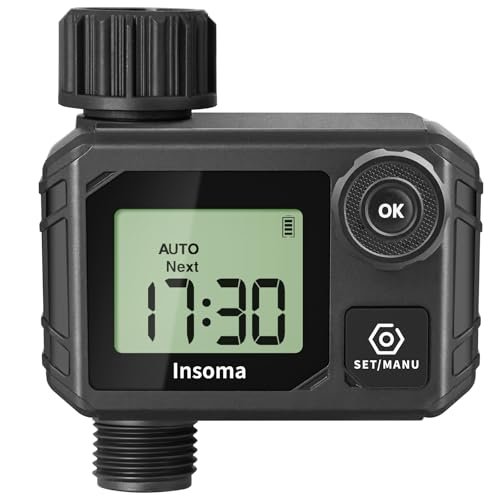
Programmable Water Hose Timer Review: Flexible Scheduling, Rain Delay, Manual Watering and Low-Battery Protection
Automating a garden hose is one of the easiest ways to make outdoor watering more consistent. Instead of remembering to turn the faucet on every morning or worrying that a sprinkler has been left running too long, a programmable hose timer can handle the routine automatically.
This battery-powered water hose timer is designed for lawns, gardens, flower beds, yards, and other hose-fed irrigation setups. It combines flexible scheduling, manual watering, a 1-to-7-day rain delay, low-battery protection, weather-resistant construction, and a simple two-button interface.
Its biggest strength is that it covers the core functions most homeowners actually need without requiring WiFi, a smartphone app, or a separate irrigation controller. You can set a start time, choose how long watering lasts, decide how often it repeats, and temporarily pause the schedule when rain is expected.
For users who want simple and dependable irrigation automation from a standard outdoor faucet, this type of timer can be a practical middle ground between manual watering and a permanent sprinkler system.
What Is a Programmable Hose Timer?
A programmable hose timer is an automatic valve that installs between an outdoor faucet and a garden hose.
Once the schedule is configured, the timer opens the valve at the programmed time and closes it after the selected duration.
That means your irrigation system can operate without anyone being present.
It can be used with equipment such as sprinklers, drip irrigation, soaker hoses, and ordinary garden hoses.
Unlike a WiFi smart timer, this model appears to operate locally through its physical controls and display.
Simple Two-Button Programming
The timer is designed around a simplified two-button interface.
That can be an advantage for users who do not want to navigate complicated menus or connect another device to an app.
The core settings include:
- Watering start time
- Watering duration
- Watering frequency
- Rain delay
- Manual watering
Once those parameters are entered, the timer handles the irrigation cycle automatically.
Why Simple Controls Matter
Outdoor timers are often programmed while standing next to a faucet in bright sunlight.
Small buttons, confusing abbreviations, or complicated nested menus can make setup frustrating.
A simplified control system is especially useful for people who want the timer to do one job well: open and close the water reliably on a schedule.
Adjustable Start Time
The watering start time can be set according to your preferred irrigation routine.
For many lawns and gardens, early morning is a practical watering period because temperatures are generally lower and evaporation may be reduced compared with midday.
However, the best start time depends on climate, plant type, local restrictions, and irrigation method.
The timer gives you the flexibility to match those conditions.
Watering Duration From 1 Minute to 5 Hours 59 Minutes
Automatic watering duration can be programmed from 1 minute up to 5 hours and 59 minutes.
That is a wide enough range for most residential irrigation applications.
Short watering cycles can be useful for:
- Patio containers
- Seedlings
- Small flower beds
- High-flow sprinklers
Longer sessions can work well for:
- Soaker hoses
- Drip irrigation
- Large garden beds
- Slow-emitting irrigation systems
The correct duration depends on how much water your equipment actually delivers.
Duration Alone Does Not Tell You How Much Water Is Applied
A sprinkler running for 20 minutes may deliver much more water than a drip line running for an hour.
For better irrigation planning, consider actual flow rate.
If a hose or sprinkler delivers 4 gallons per minute, a 30-minute cycle uses about 120 gallons.
A low-flow drip system may use only a fraction of that over the same period.
This is why watering schedules should be based on plant needs and system output rather than simply copying someone else's runtime.
Flexible Frequency From Every Hour to Every Seven Days
The timer supports watering intervals from every 1 to 24 hours or every 1 to 7 days.
That provides a broad range of scheduling options.
For example, you might use hourly intervals for certain greenhouse or seed-starting applications, while established landscaping may only need irrigation every few days.
This flexibility makes the timer useful across very different plant types.
When Frequent Watering Makes Sense
Frequent watering can be appropriate for:
- Newly seeded lawns
- Seedlings
- Small containers
- Greenhouse plants
- Fresh transplants
- Extremely fast-draining soil
However, established lawns and shrubs often benefit from deeper, less frequent watering.
The timer provides the capability, but the schedule still needs to be agronomically sensible.
Daily and Multi-Day Irrigation
For mature landscaping, intervals of two, three, or more days may be more appropriate.
Longer gaps encourage water to penetrate deeper into the soil rather than keeping only the surface moist.
That can support deeper root development in many plant types.
Climate and soil should always guide the final schedule.
Rain Delay From 1 to 7 Days
The timer includes a rain-delay function ranging from 1 to 7 days.
This allows you to pause automatic watering temporarily without deleting the normal program.
Once the selected delay expires, the original watering schedule resumes.
That is much more convenient than rebuilding the schedule after every storm.
Rain Delay Is Most Likely Manual
The supplied description says the timer can delay irrigation when rain is in the forecast, but it does not mention an integrated rain sensor, WiFi weather service, or automatic forecast connection.
So the rain delay should be understood as a manual feature unless the product manual states otherwise.
You check the weather and activate the delay yourself.
Why Rain Delay Is Useful
Watering during or immediately after a significant rainstorm can waste water and oversaturate soil.
A temporary delay can help avoid:
- Unnecessary irrigation
- Surface runoff
- Waterlogged soil
- Root stress
- Higher water bills
The appropriate delay depends on rainfall amount and soil conditions.
Manual Watering Mode
Manual Mode allows temporary watering without changing the programmed schedule.
The source states that manual sessions can run from 1 to 59 minutes.
This is useful when you want to provide extra water outside the normal routine.
For example, you might manually water after planting new flowers or during an unusually hot afternoon.
Why Manual Mode Is Better Than Reprogramming
Without a manual function, users may change the entire schedule for a one-time watering need.
That can lead to mistakes later.
Manual watering lets you handle the temporary situation while leaving automatic irrigation untouched.
Battery-Powered Operation
The timer runs on two AA alkaline batteries.
That means there is no need for an outdoor electrical outlet.
Battery operation also makes the device easy to install and relocate.
It simply attaches to the faucet and operates independently.
Long Battery Life Depends on Use
The supplied description says the batteries provide long-lasting operation but does not give a specific runtime.
Actual battery life will depend on:
- Number of watering cycles
- Valve actuation frequency
- Temperature
- Battery quality
- Storage conditions
A timer that opens several times per day may use batteries faster than one operating twice per week.
Low-Battery Indicator
The display shows a low-battery warning when power begins to run down.
That is an important safeguard because battery-powered watering devices can otherwise stop operating without much warning.
Check the display periodically, especially before leaving home for an extended period.
Automatic Valve Closure on Low Battery
One of the more useful safety features is that the valve is designed to close automatically when battery power becomes too low.
That helps prevent a failure where water continues running after the batteries are exhausted.
A closed-valve fail-safe is generally preferable because missed irrigation is less damaging than uncontrolled water flow.
Replace Batteries Before Vacation
If the timer will be responsible for watering while you are away, use fresh batteries or confirm the existing batteries are healthy before leaving.
Also run several test cycles first.
A vacation should not be the first time the system operates unattended.
IP55 Weather Resistance
The timer uses IP55-rated construction according to the supplied specifications.
That means the housing is designed to resist dust and water jets under defined test conditions.
For equipment mounted directly on an outdoor faucet, this is a useful level of protection.
It should tolerate ordinary rainfall and garden-water exposure.
IP55 Does Not Mean Submersible
The device should not be left in standing water or submerged.
An IP55 rating is different from IP67 or IP68 protection.
Install the timer where water can drain away naturally.
Sealed Battery Cover
The battery compartment is described as sealed to help keep moisture away from the electronics.
Whenever you replace the batteries, inspect the gasket or sealing surface carefully.
Dirt, grit, or a pinched seal can reduce water resistance.
Reinforced Connector
The connector is described as being reinforced with 35% fiber.
This likely refers to fiber-reinforced engineering plastic intended to improve strength at the faucet connection.
That is useful because the inlet supports both the timer and the weight of the attached hose.
Even with reinforcement, avoid allowing the hose to pull sideways on the unit.
Water Pressure Range
The timer is specified for water pressure from approximately 7.25 PSI to 116 PSI.
That gives it a broad operating range.
However, irrigation quality still depends on appropriate pressure.
A timer will not increase weak supply pressure, and excessively high household pressure can still stress hoses and fittings.
Why More Pressure Is Not Always Better
Very high pressure can cause:
- Hose leaks
- Sprinkler misting
- Damaged drip emitters
- Premature fitting wear
- Water waste
If the supply pressure is excessive, a pressure regulator may be useful.
Reducing Hex Bushing Included
The product includes a reducing hex bushing.
This can help adapt the timer to plumbing or hose fittings of different sizes.
That can be convenient when the outdoor faucet does not match the expected connection exactly.
Always make sure the adapter is correctly threaded and sealed.
Thread Seal Tape Included
Thread seal tape is also included.
This can help seal compatible tapered pipe-thread connections.
However, garden hose threads usually seal through a rubber washer rather than tape.
Use thread seal tape only where appropriate for the actual fitting type and according to the instructions.
Applying tape unnecessarily can sometimes make hose connections harder to seal correctly.
Installation Is Straightforward
A typical setup involves:
- Insert the batteries.
- Confirm the inlet gasket is seated properly.
- Attach the timer to the outdoor faucet.
- Connect the hose or irrigation line.
- Turn on the faucet.
- Check for leaks.
- Program the schedule.
- Run a manual test.
No special wiring or permanent plumbing work should be required for a standard installation.
Check for Leaks Before Leaving It Pressurized
Once installed, the outdoor faucet normally remains open so the timer can control water flow.
That means the connection stays under pressure.
Inspect the inlet and hose fittings carefully.
A slow drip may waste substantial water over time.
Avoid Overtightening
Most hose connections seal with washers.
Excessive tightening can damage the seal or threads.
If a joint leaks, inspect the gasket and alignment first rather than simply applying more force.
Garden Watering
The timer is well suited to a conventional garden hose.
It can automate watering for vegetable rows, raised beds, or mixed garden areas.
For more uniform irrigation, pairing it with a soaker hose or drip system may work better than hand-spraying with a hose nozzle.
Lawn Sprinklers
The timer can control a portable sprinkler connected to a garden hose.
This is useful for homeowners who do not have an underground irrigation system.
Set the sprinkler in position, program the timer, and the watering cycle can run automatically.
Flower Beds
Flower beds often need a different watering schedule from turfgrass.
A simple timer makes it easier to maintain consistent moisture without manually opening the faucet.
A drip line can be especially effective for flower beds because it applies water close to the root zone.
Raised Beds
Raised garden beds can dry faster than surrounding soil.
Automated irrigation can help maintain more consistent moisture.
The wide scheduling range makes it possible to adjust watering during different seasons.
Greenhouses
Greenhouse plants may need more frequent watering due to higher temperatures and limited rainfall.
The timer's hourly scheduling capability can be useful in this setting.
However, frequent irrigation should still be based on actual plant and soil requirements.
Drip Irrigation
The timer can be used as the control valve for a drip irrigation system.
Drip systems may also require:
- Pressure regulator
- Filter
- Appropriate tubing
- Correctly sized emitters
The timer controls when water flows, but it does not replace those components.
Soaker Hoses
Soaker hoses are another natural match.
Because they deliver water slowly, they often need longer operating periods.
The timer's maximum automatic duration of nearly six hours provides ample flexibility.
Soil Type Should Guide the Schedule
Different soils behave differently.
Sandy Soil
Sandy soil drains quickly and may require more frequent watering.
Clay Soil
Clay absorbs water slowly but retains it for longer. Long continuous watering can produce runoff.
Loam
Loamy soil generally provides a more balanced combination of drainage and moisture retention.
Use the timer as a scheduling tool, but adjust the program based on what the soil is actually doing.
Avoid Overwatering
Automation can make overwatering easier if the schedule is poorly configured.
The timer will repeat whatever program you give it.
Check soil moisture periodically rather than assuming that more water means healthier plants.
Signs of excessive watering may include persistently saturated soil or poor plant vigor.
Adjust the Schedule Seasonally
A schedule that works during the hottest part of summer may be excessive in spring or fall.
As temperature, rainfall, and daylight change, update the watering frequency and duration.
A good timer should reduce work, not eliminate observation.
Use Rain Delay After Significant Rainfall
After a meaningful rainfall event, pause irrigation instead of letting the normal program continue automatically.
The 1-to-7-day range provides enough flexibility for different weather events.
Short delays can follow light rain, while a major storm may justify several days.
Local Water Restrictions
Some cities and municipalities limit outdoor watering to certain days or times.
A programmable timer makes compliance much easier.
Before setting the schedule, check whether local restrictions apply.
Hose Timer vs. Mechanical Timer
A basic mechanical timer usually operates like a kitchen timer: turn the dial and water stops after a fixed period.
It does not generally support recurring schedules.
This electronic timer offers much more flexibility, including start times, recurring intervals, rain delay, and manual watering.
Hose Timer vs. WiFi Smart Timer
A smart WiFi timer can usually be controlled remotely from a phone.
This model appears to emphasize local operation.
The benefit is simplicity and independence from internet connectivity.
The tradeoff is that you cannot appear to change the program remotely.
Hose Timer vs. Underground Irrigation Controller
A permanent irrigation controller can manage many electrically operated zones.
It is appropriate for larger lawns and professionally installed sprinkler systems.
A hose timer is far simpler and less expensive.
It is best suited to one faucet and one hose-fed irrigation line.
Is It Good for Renters?
Yes, potentially.
The timer installs without permanent changes to the plumbing and can be removed later.
That makes it suitable for renters who have permission to use the outdoor faucet.
Is It Good for Vacation Watering?
Yes.
This is one of the best reasons to use a hose timer.
Before leaving, verify:
- Battery condition
- Programmed schedule
- Hose condition
- Connection seals
- Sprinkler or drip placement
- Manual and automatic valve operation
If any component leaks during testing, fix it before leaving the property unattended.
Is It Good for New Plants?
Yes.
New plants often require more consistent moisture while roots establish.
The timer can provide short, regular watering sessions without forcing you to remember them manually.
As plants mature, reduce the frequency when appropriate.
Is It Good for Large Lawns?
It can control one hose-fed sprinkler system, but large lawns may need multiple sprinkler positions or zones.
If you constantly need to move the hose, a multi-zone controller or permanent irrigation system may be more convenient.
Common Setup Mistakes
One common mistake is setting the frequency too aggressively.
Another is assuming rain delay operates automatically.
Users may also overlook low battery warnings.
Other mistakes include overtightening hose fittings, using thread tape where a washer should create the seal, and leaving the timer installed during freezing weather.
Winterization
The device should generally be removed before freezing weather unless the manufacturer specifically approves cold-weather operation.
Disconnect it from the faucet and drain all trapped water.
Freezing water expands and can crack internal valves or the housing.
An IP55 rating does not make a timer freeze-proof.
Routine Maintenance
Periodic maintenance can help extend service life.
Inspect:
- Inlet washer
- Faucet threads
- Hose connector
- Battery compartment seal
- Valve shutoff behavior
- Display condition
If the timer includes an inlet filter, clean it periodically as well.
Main Advantages
The biggest advantage is flexible scheduling without unnecessary complexity.
The 1-minute-to-5-hour-59-minute watering duration, hourly-to-weekly frequency options, 1-to-7-day rain delay, 1-to-59-minute manual mode, low-battery indicator, automatic low-power valve closure, IP55 construction, reinforced connector, broad pressure range, and included adapters make the timer versatile for common residential irrigation.
It is also completely battery powered, so no outlet or wiring is required.
Potential Drawbacks
No WiFi or smartphone control is mentioned.
Rain delay appears to be manually activated rather than based on automatic weather detection.
The timer controls only one irrigation line.
Battery replacement is still required.
And although the enclosure is weather resistant, the timer should not be submerged or exposed to freezing water.
Who Should Consider This Water Hose Timer?
This timer makes sense for users who want simple automatic watering for:
- Lawns
- Vegetable gardens
- Flower beds
- Raised beds
- Greenhouses
- Drip irrigation
- Soaker hoses
- Rental properties
- Vacation watering
It is especially suitable when one outdoor faucet serves one main irrigation area and remote smart-home controls are unnecessary.
Frequently Asked Questions
What is the automatic watering duration range?
From 1 minute to 5 hours and 59 minutes.
How often can it water?
From every 1 to 24 hours or every 1 to 7 days.
Does it have manual watering?
Yes.
How long can manual watering run?
From approximately 1 to 59 minutes.
Does it have rain delay?
Yes.
How long can watering be delayed?
From 1 to 7 days.
Does it automatically detect rain?
Automatic rain sensing is not described, so rain delay should be treated as manual unless the product manual states otherwise.
What batteries does it use?
Two AA alkaline batteries.
Does it show a low-battery warning?
Yes.
What happens if the batteries become too weak?
The valve is designed to close automatically to reduce the risk of water waste.
Is it waterproof?
It is listed as IP55 weather resistant, not submersible.
What water pressure does it support?
Approximately 7.25 to 116 PSI according to the supplied information.
Is the connector reinforced?
Yes. It is described as using 35% fiber reinforcement.
Does it include an adapter?
Yes. A reducing hex bushing is included.
Does it include thread seal tape?
Yes.
Can it be used with a sprinkler?
Yes.
Can it be used with a drip irrigation system?
Yes, with appropriate pressure regulation and filtration where needed.
Can it be used with a soaker hose?
Yes.
Does it require WiFi?
No WiFi requirement is mentioned.
Does it require an electrical outlet?
No. It is battery powered.
Final Verdict
This programmable water hose timer is a strong option for homeowners who want reliable irrigation automation without moving into WiFi-connected smart-home territory.
Its most useful features are the broad watering duration range, hourly or multi-day scheduling, 1-to-7-day rain delay, manual watering, low-battery warning, automatic valve closure when power becomes too low, IP55 outdoor construction, reinforced connector, and support for a wide water-pressure range.
The tradeoff is that it appears to be a single-zone, locally controlled timer. There is no confirmed automatic rain sensing or remote app control.
For a garden, lawn, flower bed, greenhouse, drip system, or soaker hose, it provides a straightforward way to automate watering while reducing the risk of leaving a faucet running longer than intended.