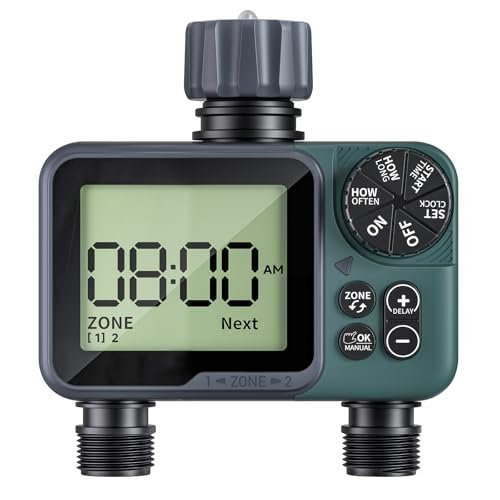
Rvwsx 2-Zone Sprinkler Timer Review: Independent Watering, Rain Delay and Low-Battery Protection
Keeping two parts of a yard on different watering schedules can be awkward when both depend on the same outdoor faucet. A lawn may need longer, less frequent watering, while a vegetable bed or flower garden may need shorter, more regular irrigation. A dual-zone hose timer is designed to solve exactly that problem.
The Rvwsx 2-zone sprinkler timer uses two independently programmable outlets so each area can have its own start time, frequency, and watering duration. It also includes manual watering, a rain-delay function, a large display, a built-in metal filter, low-battery protection, and an IP54-rated housing for outdoor use.
Unlike a smart WiFi controller, this model is designed around local programming rather than app connectivity. That can actually be an advantage for users who want straightforward automation without relying on internet access, cloud services, or another smartphone app.
For lawns, raised beds, greenhouse lines, drip irrigation, and hose-fed sprinklers, the Rvwsx timer offers a useful balance between simplicity and flexibility.
What Is the Rvwsx 2-Zone Sprinkler Timer?
The Rvwsx is a dual-outlet programmable faucet timer.
It attaches to a single outdoor water source and splits that supply into two controlled zones. Each outlet can be scheduled independently.
That means Zone 1 can water one part of the yard while Zone 2 follows a completely different program.
For example, you could use one outlet for a lawn sprinkler and the second for a drip line serving vegetables or flowers.
Why Two Independent Zones Matter
Different plants rarely need identical irrigation.
Grass, shrubs, vegetables, flowers, and container plants all have different root systems and moisture requirements.
A single-zone timer forces everything onto the same schedule.
The Rvwsx allows each area to receive water based on its own needs, which can help reduce both overwatering and underwatering.
Independent Start Times
Each zone can be assigned its own start time.
This is useful because watering both areas simultaneously may reduce water pressure.
If one sprinkler requires strong flow, you can schedule Zone 1 first and Zone 2 afterward.
Staggering the programs often produces better pressure and more consistent sprinkler coverage.
Independent Frequency
The two outlets can also use different watering frequencies.
A vegetable garden might run daily during warm weather while an established lawn runs every few days.
That flexibility makes the timer much more useful than a simple Y-shaped hose splitter.
Independent Watering Duration
Each zone can run for a different length of time.
A high-flow sprinkler may only need a relatively short session, while a low-flow drip system may need much longer.
The right duration depends on the irrigation equipment, soil, plants, and climate rather than the timer alone.
A Practical Two-Zone Setup
A common configuration might look like this:
Zone 1: Lawn
Connect a conventional sprinkler to the first outlet.
The lawn can be programmed for deeper watering at longer intervals.
Zone 2: Vegetable Garden
Connect a soaker hose or drip irrigation system to the second outlet.
This zone can run more frequently and at a different duration.
Because each program is independent, changing the garden schedule does not affect the lawn.
Rain Delay From 1 to 7 Days
The timer includes a rain-delay mode lasting from 1 to 7 days.
This allows scheduled irrigation to be temporarily paused without deleting the underlying programs.
Once the selected delay expires, normal watering resumes.
That is much easier than manually changing every setting after rainfall.
Important: It Does Not Have a Rain Sensor
The manufacturer explicitly states that this timer does not include automatic rain detection.
The user must activate rain delay manually.
That distinction is important.
A rain-delay button is not the same as a weather-aware irrigation controller.
You monitor the local forecast or actual rainfall and decide when to pause watering.
Why Manual Rain Delay Is Still Useful
Even without automatic weather sensing, the feature can help reduce unnecessary watering.
If a heavy storm moves through the area, you can postpone irrigation for several days instead of letting the timer water already-saturated soil.
This can help reduce runoff and avoid excessive soil moisture.
How Long Should You Delay Watering?
There is no single correct answer.
The appropriate delay depends on:
- Amount of rainfall
- Soil type
- Temperature
- Plant type
- Sun exposure
- Drainage
Sandy soil may dry quickly, while clay can remain moist much longer.
Use the timer's 1-to-7-day range as a flexible tool rather than always selecting the same delay.
Manual Watering Without Changing the Schedule
The Manual Watering mode lets you temporarily run one of the zones without changing the programmed irrigation routine.
This is useful for situations such as:
- Newly planted flowers
- Extra watering during hot weather
- Testing a sprinkler
- Rinsing garden areas
- Supplemental watering after transplanting
Once manual watering finishes, the automatic schedule remains intact.
Why Manual Override Is Important
Without a manual mode, users may be tempted to modify the programmed schedule for a one-time task.
That can create confusion later.
A manual override keeps temporary watering separate from normal automation.
Built-In Metal Filter
The inlet includes a metal filter intended to capture sediment and debris before they reach the internal valve system.
Outdoor water supplies can contain small particles such as:
- Rust
- Sand
- Pipe sediment
- Mineral debris
Those materials can interfere with valve sealing or reduce flow.
A filter helps protect the timer's internal mechanism.
Clean the Filter Periodically
A filter only works well if it is maintained.
If flow begins to weaken, inspect the inlet screen.
A partially blocked filter can reduce sprinkler pressure even when the timer itself is functioning normally.
Cleaning it periodically is especially important when using well water or older plumbing.
Maximum Listed Water Pressure
The source lists a maximum pressure of 116 PSI.
That is much higher than the operating pressure of many typical residential irrigation systems.
The listing also states that internal components are designed to withstand substantial pressure.
However, running household plumbing at unnecessarily high pressure can stress hoses, fittings, appliances, and valves.
If your water pressure is unusually high, a regulator may still be appropriate.
Why High Water Pressure Is Not Always Better
More pressure does not automatically mean better irrigation.
Excessive pressure can cause:
- Hose failures
- Leaking fittings
- Misting instead of proper sprinkler droplets
- Premature valve wear
- Water waste
The goal is stable, appropriate pressure rather than maximum possible pressure.
IP54 Outdoor Protection
The timer is rated IP54 according to the supplied information.
That means the housing is designed to resist limited dust ingress and splashing water.
This is appropriate for ordinary outdoor faucet installation.
However, IP54 does not mean the timer should be submerged or left sitting in standing water.
Weather-Resistant Does Not Mean Freeze-Proof
One of the most important maintenance points with any hose timer is winterization.
Water trapped inside the valve can freeze, expand, and crack the housing.
If freezing weather occurs in your area, disconnect the timer, drain it, and store it indoors unless the manufacturer explicitly states otherwise.
An IP rating does not provide protection against ice expansion.
Impact-Resistant Housing
The timer is also described as using impact-resistant materials.
That can help protect it from ordinary knocks around outdoor faucets.
Still, the device should not be allowed to hang under heavy hose tension.
Two hoses can create considerable leverage on the faucet connection.
Route hoses so their weight rests on the ground.
Sealed Battery Compartment
The battery cover uses a rubber gasket intended to reduce water intrusion.
That is important because the timer operates in an environment exposed to rain, splashing, and humidity.
Whenever the batteries are replaced, make sure the gasket remains clean and properly seated.
A twisted or dirty seal can reduce weather resistance.
Low-Battery Warning
The timer provides a low-battery warning on its display.
That is more important than it may sound.
A battery-powered irrigation timer can stop operating correctly if voltage falls too low.
Without a warning, plants may miss watering for days before anyone notices.
Automatic Valve Shutoff on Low Battery
The Rvwsx also includes a useful fail-safe behavior: when battery power becomes too low, the valve automatically closes.
This is preferable to failing in the open position.
An open valve during a battery failure could waste large amounts of water.
A closed-valve fail-safe protects against that scenario, although it also means plants will stop receiving scheduled irrigation until the batteries are replaced.
Replace Batteries Before Long Trips
If the timer will handle irrigation while you are away, do not leave with nearly depleted batteries.
Fresh or well-charged batteries are cheap insurance.
Run a complete test of both zones before traveling.
3.3-Inch Display
The timer includes a 3.3-inch display designed to show important information such as:
- Current watering time
- Upcoming irrigation schedule
- Battery status
- Program settings
A larger display can make setup easier, especially compared with compact hose timers that use tiny screens and abbreviated symbols.
Dial-and-Button Controls
The timer uses a combination of a dial and buttons.
This is usually easier to program than systems that rely on repeated presses of only two or three buttons.
The white labeling is intended to improve readability outdoors.
For users who prefer physical controls over apps, this is a practical design.
No WiFi or App Required
The supplied description does not mention WiFi, Bluetooth, or app connectivity.
The timer therefore appears to operate entirely through local controls.
That means there is no dependency on:
- Router coverage
- Cloud services
- Smartphone compatibility
- Internet outages
- Account creation
For straightforward irrigation automation, that simplicity can improve reliability.
The Tradeoff of No Smart Connectivity
The downside is that you cannot appear to change schedules remotely.
If rain starts while you are away from home, you cannot activate the rain delay from your phone unless a connected feature exists that is not mentioned in the supplied information.
Users who travel frequently may prefer a WiFi-enabled timer.
Long-Lasting Valve Design
The source claims the valve is rated for up to 600,000 cycles.
That is a manufacturer durability claim rather than a guarantee of actual service life.
Real-world longevity will also depend on:
- Water quality
- Pressure
- Weather exposure
- Battery condition
- Freeze protection
- Mechanical stress
- Maintenance
Still, a high stated cycle rating suggests the product is intended for repeated long-term operation.
Dual-Zone Timer vs. Single-Zone Timer
A single-zone timer works well when one faucet controls one irrigation line.
The Rvwsx becomes more useful when two separate areas need different schedules.
Instead of installing two independent timers or manually switching hoses, one controller manages both outlets.
Dual-Zone Timer vs. Basic Hose Splitter
A hose splitter gives you two outlets but requires manual valve control.
The Rvwsx adds scheduling.
That means each outlet can automatically start and stop even when nobody is home.
For regular irrigation, that is a major convenience upgrade.
Dual-Zone Timer vs. WiFi Smart Timer
A WiFi timer offers remote control and may integrate with weather services.
The Rvwsx appears simpler and more self-contained.
Its advantages are fewer connectivity issues and no app dependency.
Its disadvantage is less remote flexibility.
Dual-Zone Timer vs. Underground Irrigation Controller
A full irrigation controller manages permanent electric valves buried around a property.
It may support many zones, rain sensors, soil sensors, and sophisticated scheduling.
The Rvwsx is much simpler.
It is designed for two hose-fed zones connected directly to one outdoor faucet.
That makes it ideal for homes without built-in irrigation infrastructure.
Lawn Irrigation
The first outlet can easily handle a hose-connected lawn sprinkler.
A programmable schedule removes the need to remember when to turn the water on and off.
For established lawns, longer and less frequent watering is often more useful than constant shallow irrigation, though local grass type and climate matter.
Vegetable Gardens
The second zone can be used for vegetables.
A soaker hose or drip line can provide targeted irrigation at the root zone.
The separate schedule is helpful because vegetables often need different watering frequency from lawn grass.
Flower Beds
A dedicated zone can also serve flower beds or shrubs.
This prevents decorative landscaping from being forced onto the same watering schedule as turf.
Greenhouses
The timer can work well for greenhouse watering if a suitable hose or drip system is used.
Greenhouse plants may dry faster than outdoor beds due to higher temperatures.
Independent programming allows more frequent irrigation without affecting the rest of the yard.
Drip Irrigation
The Rvwsx timer can be useful as the control point for drip irrigation.
However, many drip systems need their own pressure regulator and filter downstream.
The timer determines when water flows; it does not automatically regulate pressure to the lower levels many drip emitters require.
Soaker Hoses
Soaker hoses work especially well with timed watering.
Because they release water slowly along their length, they can often run longer than conventional sprinklers.
A timer eliminates the risk of forgetting to shut them off.
Avoid Running Both Zones Simultaneously if Pressure Drops
Even if the programming system permits overlapping schedules, it may be better to stagger them.
One faucet has a finite flow capacity.
If both zones demand large volumes simultaneously, sprinkler performance can decline.
For example, two lawn sprinklers each needing strong pressure may perform poorly if run together.
Sequential schedules usually produce more predictable results.
Measure Your Faucet's Flow
You can estimate available flow with a simple bucket test.
Measure how long the outdoor faucet takes to fill a container of known volume.
That gives you a rough gallons-per-minute figure.
Compare that with the combined needs of your connected sprinklers.
If demand exceeds supply, stagger the zones.
Soil Type Should Influence Programming
The timer provides flexibility, but plant and soil conditions should dictate the schedule.
Sandy Soil
Water drains quickly, so shorter and somewhat more frequent irrigation may be appropriate.
Clay Soil
Water infiltrates slowly and stays wet longer.
Long continuous watering can cause runoff.
Loamy Soil
Loam generally absorbs and retains moisture more evenly.
No timer can automatically compensate for poor scheduling unless the user adjusts it based on these conditions.
Seasonal Adjustments Matter
A schedule that works in midsummer may be excessive in spring or fall.
As temperatures drop and daylight decreases, plants often use less water.
Adjusting irrigation seasonally can prevent waste.
Local Water Restrictions
Many communities restrict outdoor irrigation during droughts.
Because each zone is programmable, the timer can help comply with permitted watering days and times.
Check local rules rather than assuming unrestricted watering is allowed.
Installation Tips
Installation should be straightforward on a compatible outdoor faucet.
First make sure the faucet threads are clean.
Check that the sealing washer is seated properly in the inlet.
Attach the timer by hand without forcing the threads.
Then connect hoses to the two outlets.
Avoid Overtightening
Garden hose connections normally seal with rubber washers.
Excessive tightening can damage threads or deform seals.
If a connection drips, inspect the washer first.
More force is not always the solution.
Check for Leaks After Installation
Turn the faucet on slowly and inspect:
- Timer inlet
- Both outlet fittings
- Hose connectors
- Battery cover area
The faucet normally remains open so the timer can control water automatically.
That means all upstream connections remain pressurized and should be completely leak-free.
Test Both Zones
Before leaving the timer unattended, manually activate each zone.
Confirm that:
- Water starts
- Water flow is adequate
- The correct outlet opens
- The valve shuts off completely
- The programmed schedule remains saved
Then test the rain-delay feature.
Common Mistakes to Avoid
One common mistake is assuming rain delay works automatically.
Another is scheduling both zones simultaneously without checking available flow.
Users may also forget to replace low batteries until watering stops.
Other mistakes include leaving the device installed during freezing weather and overtightening hose connections.
Main Advantages
The Rvwsx timer's strongest feature is independent two-zone programming.
Each outlet can follow its own start time, frequency, and watering duration.
The manual watering mode, 1-to-7-day rain delay, built-in metal filter, 3.3-inch display, low-battery warning, automatic low-power valve shutoff, IP54 housing, and maximum listed pressure of 116 PSI add practical value.
The lack of WiFi also keeps operation simple for users who prefer local controls.
Potential Drawbacks
The timer does not include automatic rain sensing.
Remote control is not described.
Its weather protection is IP54 rather than a higher submersion-resistant rating.
Battery replacement is required.
And because both zones share one faucet, available water flow may limit simultaneous operation.
For complex landscapes or homeowners who want weather-based automation, a smart multi-zone controller may be more suitable.
Who Should Consider the Rvwsx 2-Zone Timer?
This model is a good fit for homeowners who need to automate two hose-fed watering areas from one faucet.
It may be particularly useful for:
- Lawn plus vegetable garden
- Lawn plus flower beds
- Two separate lawn areas
- Greenhouse plus garden
- Drip irrigation
- Soaker hoses
- Rental properties
- Vacation watering
- Homes without underground irrigation
Frequently Asked Questions
How many outlets does the Rvwsx timer have?
Two independently programmable outlets.
Can each outlet use a different schedule?
Yes.
Does it support separate start times?
Yes.
Can watering frequency differ between zones?
Yes.
Does it have manual watering?
Yes.
Does manual watering erase the normal schedule?
No. It is designed to operate temporarily without changing the preset program.
Does it have rain delay?
Yes.
How long can watering be delayed?
From 1 to 7 days.
Does it automatically detect rain?
No. The manufacturer explicitly states that it does not include a rain sensor.
Is it WiFi enabled?
WiFi connectivity is not listed in the supplied information.
Does it have a filter?
Yes. A built-in metal filter is included.
What is the maximum listed water pressure?
116 PSI.
Is it waterproof?
It is rated IP54, meaning it is weather resistant but not designed for submersion.
How large is the display?
Approximately 3.3 inches.
Does it show battery status?
Yes.
What happens when the batteries are nearly empty?
The timer provides a low-battery warning and is designed to close the valve to reduce the risk of water waste.
How durable is the valve?
The manufacturer claims up to 600,000 cycles, although actual life will depend on operating conditions.
Can I use it with lawn sprinklers?
Yes.
Can I use it with drip irrigation?
Yes, with appropriate downstream pressure regulation and filtration when required.
Can both zones run at once?
Possibly depending on programming, but staggering them may be preferable if water pressure or flow drops.
Final Verdict
The Rvwsx 2-zone sprinkler timer is a practical choice for homeowners who want to automate two separate irrigation areas without moving to a WiFi-connected or professionally installed sprinkler controller.
Its best features are the two independently programmable outlets, manual watering, 1-to-7-day rain delay, built-in metal filter, large 3.3-inch display, low-battery warning, automatic low-power valve shutoff, weather-resistant IP54 construction, and high listed pressure tolerance.
The absence of a rain sensor is worth understanding before purchase. Rain delay must be activated manually based on weather conditions, and there is no stated remote app control.
For a lawn, vegetable garden, flower bed, greenhouse, drip line, or pair of hose-fed sprinkler zones, the Rvwsx provides straightforward scheduling and useful safeguards without adding unnecessary smart-home complexity.