Programmable Water Timer Review: Brass Construction, Flexible Scheduling, Rain Delay and Manual Watering
Automatic irrigation can remove one of the most repetitive parts of lawn and garden care: remembering when to turn the water on and, just as importantly, when to turn it off. A programmable faucet timer can handle that routine automatically while still giving you enough control to adapt watering to different plants, soil conditions, and seasons.
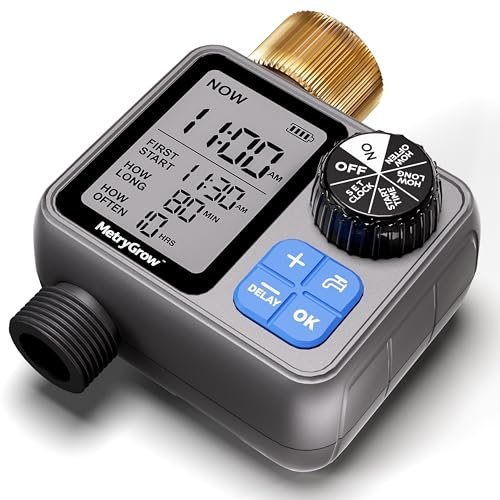
This programmable water timer is designed for hose-fed irrigation systems such as lawn sprinklers, drip lines, greenhouse misting, flower beds, vegetable gardens, and potted plants. Its main features include adjustable watering intervals, sessions lasting from 1 to 360 minutes, manual watering for up to six hours, rain delay, a brass inlet, IPX5-rated weather resistance, a 2.5-inch LCD display, low-battery protection, and memory retention.
The broad scheduling range is especially useful. Frequent watering can be programmed for seedlings or containers, while longer intervals are available for established landscaping and drought-tolerant plants. The manual mode also lets you temporarily use the hose without disrupting the automatic schedule.
For homeowners who want more control than a basic mechanical timer but do not necessarily need WiFi or app-based irrigation, this model offers a comprehensive set of local watering controls.
What Is a Programmable Water Timer?
A programmable water timer is an automatic valve installed between an outdoor faucet and a garden hose or irrigation system.
Once configured, the timer opens the valve according to the selected schedule, keeps water flowing for the programmed duration, and then closes automatically.
This creates a basic automated irrigation system without requiring permanent underground plumbing, electrical wiring, or a conventional sprinkler controller.
It can be particularly useful for properties that rely on ordinary garden hoses, portable sprinklers, drip irrigation, or soaker hoses.
Flexible Watering Intervals From Hours to Days
One of this timer's strongest features is its broad scheduling flexibility.
According to the supplied specifications, watering frequency can be set in two general ways:
- Every 1 to 24 hours
- Every 1 to 15 days
This allows the same timer to serve plants with very different watering requirements.
A container garden might require frequent irrigation, while mature shrubs or drought-tolerant landscaping may need water only every several days.
When Hourly Watering Is Useful
Very frequent cycles are not necessary for most established landscapes, but they can be helpful in specialized situations.
Examples include newly germinated seeds, small containers, greenhouse plants, propagation systems, and fast-draining growing media.
During hot weather, small pots can lose moisture much faster than an in-ground garden.
The ability to water several times per day provides flexibility for these situations.
When Multi-Day Scheduling Makes More Sense
Established lawns, trees, shrubs, and many perennial beds often benefit from deeper irrigation at longer intervals rather than constant shallow watering.
The timer's 1-to-15-day range gives you room to create those less frequent schedules.
The correct frequency still depends on weather, soil, root depth, plant type, and local watering restrictions.
Watering Duration From 1 to 360 Minutes
Each automatic watering session can reportedly last from 1 minute to 360 minutes, or up to six hours.
That is a useful range because different irrigation systems can have dramatically different flow rates.
A conventional sprinkler might deliver enough water in 20 or 30 minutes, while a slow drip system could need an hour or more.
The timer gives you the runtime flexibility, but the correct duration should be determined by how much water the system actually delivers.
Why Runtime Alone Can Be Misleading
A 30-minute irrigation cycle does not tell you how much water reaches the plants.
A high-flow sprinkler and a low-flow drip line can use very different quantities of water over the same period.
For better irrigation planning, consider both runtime and flow rate.
If your irrigation system delivers 5 gallons per minute, a one-hour cycle could use around 300 gallons. A small drip system may use far less.
Understanding that difference can prevent accidental overwatering.
Manual Watering From 1 Minute to 6 Hours
The timer includes a manual watering mode that can reportedly run from 1 minute to six hours.
This allows you to temporarily open the valve without modifying the automatic program.
That can be useful for tasks such as:
- Deep soaking newly planted shrubs
- Washing a car
- Rinsing garden tools
- Cleaning a patio
- Testing a sprinkler
- Giving one area extra water
Once the manual session ends, the automatic schedule remains available.
Why Manual Mode Is Important
Automatic irrigation should not make the outdoor faucet inconvenient for other uses.
Without a manual override, you may need to remove the timer or change the programmed schedule whenever you want to use the hose.
Manual mode avoids that problem.
It lets the timer remain installed while still functioning like a normal faucet when needed.
Brass Inlet Construction
The timer uses a brass inlet connection, which is one of the more useful durability features for a device mounted directly on an outdoor faucet.
The inlet experiences mechanical stress from hose weight, repeated installation, water pressure, and outdoor exposure.
Brass generally provides greater rigidity and thread durability than lightweight plastic connections.
The source also describes the brass as lead-free and BPA-free.
Why the Inlet Matters
The faucet connection supports the timer and the attached hose.
If the inlet flexes excessively or threads become damaged, leaks can develop.
A brass connection can reduce that risk, especially when the timer is installed and removed repeatedly through the watering season.
It is still important to avoid overtightening.
360-Degree Rotatable Connector
The brass connector is described as 360-degree rotatable.
That can make installation easier because the timer body can be positioned without forcing the entire device to rotate against the faucet threads.
A swivel-style connection is particularly helpful when the faucet is close to a wall or when the display needs to face a specific direction.
Leak Prevention
The manufacturer describes the unit as having a 360-degree leak-resistant sealing design.
Regardless of product claims, leak prevention still depends on correct installation.
Always check:
- Faucet washer
- Thread alignment
- Hose gasket
- Connector tightness
- Downstream fittings
A damaged washer can cause leaks even when the timer body itself is in perfect condition.
Avoid Overtightening
Garden hose connections typically rely on a rubber washer to seal.
Excessive tightening can deform that washer or damage threads.
Hand-tighten the connection first.
If water appears, inspect the gasket and thread alignment before using more force.
Maximum Pressure Up to 150 PSI
The timer is listed as supporting water pressure up to 150 PSI.
That is a high maximum rating for residential irrigation equipment.
However, maximum tolerated pressure is not the same as recommended operating pressure.
Very high household pressure can still stress hoses, sprinklers, connectors, and drip components.
Why Excessive Pressure Can Be a Problem
Too much pressure may cause:
- Hose leaks
- Sprinkler misting
- Damaged emitters
- Premature fitting wear
- Excessive water consumption
A pressure regulator may be appropriate if your irrigation system operates above the recommended range of its downstream components.
Listed Flow Rate of 30 Liters per Minute
The source states a maximum flow rate of 30 liters per minute, which is roughly 7.9 gallons per minute.
Actual flow in a real installation will depend on:
- Supply pressure
- Faucet size
- Hose diameter
- Hose length
- Timer restriction
- Downstream equipment
The listed capacity indicates that the timer is designed for more than extremely low-flow applications.
Sprinkler Performance and Flow
Portable lawn sprinklers can be sensitive to flow restriction.
If water volume is too low, spray distance and coverage can decline.
A timer with a relatively high stated flow capacity may be beneficial for conventional sprinklers, but the home's plumbing still needs to provide enough water.
The timer cannot increase available supply.
Rain Delay for Water Conservation
The timer includes a rain-delay function designed to pause automatic watering temporarily.
The supplied information lists delay options of 24 hours, 48 hours, or up to seven days.
After the delay expires, the saved irrigation schedule resumes automatically.
This is useful because you do not need to delete or rebuild the program after rainfall.
Rain Delay Is Not Necessarily Automatic Weather Detection
The product description does not mention a rain sensor, WiFi weather feed, or automatic forecast integration.
The rain delay should therefore be understood as a manually activated feature unless the product manual states otherwise.
You observe that rainfall has occurred or is expected and choose how long to pause irrigation.
Choosing the Right Rain Delay
A light shower may not justify a full week without irrigation.
A soaking storm might.
The appropriate delay depends on:
- Rainfall amount
- Soil type
- Temperature
- Sun exposure
- Drainage
- Plant requirements
Use the timer's range to match actual conditions rather than selecting the same delay every time.
Why Rain Delay Can Reduce Water Waste
Automatic timers will follow their schedule whether the soil is dry or already saturated unless the user intervenes.
Rain delay provides that intervention.
Skipping irrigation after meaningful rainfall can help reduce:
- Runoff
- Overwatering
- Waterlogged soil
- Unnecessary utility costs
This feature is especially valuable during wet periods when a fixed watering program would otherwise continue unchanged.
Low-Battery Alert
The timer includes an LED battery indicator designed to warn when battery power becomes low.
This is important because electronic irrigation timers depend on battery power to operate their valves.
If batteries die unexpectedly, plants may miss scheduled watering or the device may stop functioning correctly.
A visible warning gives you time to replace them.
Automatic Shutoff During Power Loss
The source describes an automatic shutoff function designed to prevent uncontrolled water flow during battery failure.
That is an important safety feature.
A timer that fails closed is generally preferable to one that could remain open when power disappears.
It reduces the risk of water running indefinitely.
Memory Retention
The timer is also described as retaining programmed schedules when power is interrupted.
This can save considerable frustration.
Instead of rebuilding all watering settings after replacing the batteries, the program can remain stored.
The exact behavior should still be confirmed in the user manual, especially if the timer is being relied on during extended travel.
AAA Batteries
The source states that AAA batteries are required and are not included.
Before installation, check the exact number and battery specification listed in the current manual.
Use good-quality alkaline batteries unless the manufacturer recommends something else.
Rechargeable batteries sometimes operate at a lower nominal voltage and may not be appropriate for every irrigation timer.
Replace Batteries Before a Long Trip
If the timer will be responsible for keeping plants watered during a vacation, install fresh batteries or confirm the current batteries are in strong condition.
Also test the system for several days before leaving.
Automation is useful only when the complete irrigation system has been verified.
2.5-Inch LCD Display
The timer includes a 2.5-inch LCD screen.
The display is intended to show information such as:
- Watering schedule
- Rain delay
- Battery status
- Current settings
A clear display is useful because programmable timers can become confusing when several parameters are being changed.
Being able to verify the full program at a glance can reduce setup mistakes.
Good for Beginners
The combination of a display, physical controls, and straightforward schedule parameters makes this kind of timer approachable for first-time users.
There is no stated requirement for smartphone pairing or account creation.
You can configure watering directly at the faucet.
That simplicity can be preferable if you do not need remote access.
Quick-Connect Hose Adapter
The package includes a quick-connect hose adapter according to the source.
Quick connectors can make it easier to attach and remove a garden hose without repeatedly threading the fitting.
This is useful if the same faucet serves both irrigation and ordinary hose use.
Check the O-ring periodically because quick-connect fittings can begin leaking when seals become worn or dirty.
IPX5 Water Resistance
The timer is listed as IPX5 rated.
IPX5 indicates resistance to water jets under specified test conditions.
That is appropriate for equipment exposed to rain and garden splashing.
However, it does not mean the timer is designed for continuous submersion.
IPX5 Does Not Mean Freeze-Proof
Waterproof ratings describe resistance to water entering the enclosure, not damage caused by water freezing inside plumbing components.
Before freezing weather, disconnect and drain the timer unless the manufacturer explicitly allows winter installation.
Frozen water can expand and damage valves, fittings, or the housing.
UV-Resistant ABS Housing
The outer body is described as high-strength, UV-resistant ABS resin.
Outdoor timers spend long periods exposed to sunlight, which can degrade some plastics over time.
UV-resistant materials are intended to slow that deterioration.
Actual lifespan will still depend on climate and exposure.
Rust Resistance
The combination of brass plumbing connections and a polymer outer housing reduces the amount of exposed steel that could corrode.
That can be useful in damp outdoor environments.
However, brass and plastic components should still be inspected periodically for mineral buildup, cracking, or damaged seals.
Lawn Irrigation
The timer can automate a hose-connected lawn sprinkler.
Set the start time, frequency, and duration, then leave the faucet open so the timer can manage the watering cycles.
This is a practical solution for homeowners who want basic irrigation automation without installing underground valves.
Deep Watering vs. Frequent Shallow Watering
Established lawns often benefit from deeper watering at wider intervals rather than constant shallow irrigation, depending on grass type and soil.
The timer's 1-to-15-day frequency range supports that approach.
Do not assume daily watering is automatically better.
Vegetable Gardens
Vegetables may require more frequent moisture than mature landscape plants, especially during hot growing periods.
A dedicated drip line or soaker hose connected to the timer can maintain a more consistent root-zone environment.
Adjust the schedule as plants mature and weather changes.
Flower Beds
Flower beds often contain plants with different needs than the surrounding lawn.
A timer controlling a soaker hose or drip line can keep these areas on their own watering routine.
Mulched beds may retain moisture longer and therefore require less frequent irrigation.
Potted Plants
Containers dry much faster than in-ground beds.
The hourly scheduling options may be especially useful for potted plants in hot, sunny locations.
However, watering duration should be kept appropriate for the container size to prevent waterlogging.
Greenhouse Misting
The source lists greenhouse misting as a supported application.
Greenhouse environments can dry quickly and may require repeated watering cycles.
A programmable timer can automate those sessions, although the one-minute minimum should be checked against the needs of very fine misting systems.
Drip Irrigation
The timer can be used at the start of a drip system.
A typical setup may also include:
- Filter
- Pressure regulator
- Mainline tubing
- Emitters
The timer controls timing, while these components control distribution and pressure.
Do not assume the timer alone is a complete drip-irrigation system.
Soaker Hoses
Soaker hoses work particularly well with long programmable watering durations.
They release water gradually along their length and can be used around hedges, garden rows, or flower beds.
A multi-hour timer reduces the need to manually monitor the hose.
Car Washing and Outdoor Chores
Manual mode makes the timer useful beyond irrigation.
You can temporarily run water for:
- Car washing
- Patio cleaning
- Tool rinsing
- Filling containers
- General outdoor maintenance
When finished, the automatic irrigation program remains available.
Soil Type Should Influence the Schedule
Sandy Soil
Sandy soil drains rapidly and often dries quickly.
It may need shorter or more frequent watering.
Clay Soil
Clay retains moisture longer but absorbs water slowly.
Long high-flow sessions can cause runoff.
Loam
Loamy soil generally provides a more balanced combination of drainage and moisture retention.
Program the timer according to how the actual soil behaves.
Adjust Watering Seasonally
Irrigation needs change throughout the year.
Hot weather increases evaporation and plant water use.
Cooler periods usually reduce demand.
Rainfall can temporarily eliminate the need for supplemental watering.
Review the schedule regularly rather than leaving the same program active all year.
Check Local Watering Restrictions
Some areas restrict irrigation to certain days or times.
A programmable timer can make compliance easier, but only if the schedule is configured correctly.
Check local rules before setting recurring watering cycles.
Installation Tips
Installation should generally be straightforward.
Attach the brass inlet to the outdoor faucet, confirm that the sealing washer is correctly positioned, connect the hose or quick adapter, and open the faucet.
Then program the timer and run a manual test.
Check every connection carefully for leaks before leaving the faucet pressurized.
Support the Hose
A heavy hose can create sideways force on the timer.
Let the hose rest on the ground rather than hanging from the timer's outlet.
Reducing mechanical stress helps protect both the faucet and the timer inlet.
Test Before Relying on Automation
Before going on vacation or leaving the system unattended, run several complete automatic cycles.
Verify that:
- Water starts at the expected time.
- Flow is adequate.
- The valve closes completely.
- The schedule repeats correctly.
- Rain delay behaves as expected.
- Battery status is healthy.
- Connections remain leak-free.
Testing is one of the most important steps in any automated irrigation setup.
Common Mistakes to Avoid
A common mistake is using an unnecessarily long runtime because the timer supports up to six hours.
Another is assuming rain delay automatically monitors the weather.
Users may also forget to check the battery indicator, leave weak hoses permanently pressurized, or ignore freezing temperatures.
Good programming and maintenance matter as much as the timer's specifications.
Programmable Timer vs. Mechanical Hose Timer
A mechanical timer usually starts only when you manually turn the dial and then shuts water off after a countdown.
This programmable timer can repeat watering according to a schedule.
That makes it better for unattended irrigation and vacation use.
Programmable Timer vs. WiFi Smart Timer
A WiFi timer adds remote control and may offer weather integration.
This model appears to operate locally.
The advantage is reduced complexity and no reliance on internet connectivity.
The tradeoff is that remote control from a phone is not described.
Programmable Timer vs. Multi-Zone Controller
The supplied information does not mention multiple independent outlets, so this should be treated as a single-zone timer unless the exact product documentation states otherwise.
For one lawn sprinkler, drip line, greenhouse system, or garden hose, that may be sufficient.
If several areas require different programs from one faucet, a multi-zone timer would be more appropriate.
Main Advantages
The timer's strongest features are its combination of wide scheduling flexibility and durable outdoor construction.
Notable capabilities include a 1-to-24-hour or 1-to-15-day frequency range, 1-to-360-minute automatic cycles, manual watering up to six hours, rain delay, brass connections, IPX5 water resistance, UV-resistant ABS construction, a 2.5-inch LCD, low-battery warning, automatic shutoff, memory retention, and a quick-connect adapter.
It can handle everything from frequent container watering to relatively infrequent landscape irrigation.
Potential Drawbacks
No WiFi or remote app functionality is described.
Rain delay appears to require manual activation rather than automatic weather detection.
Batteries are not included.
A single-zone design may be limiting for large yards.
The manufacturer's "100% leak-proof" language should also be treated as a product claim rather than a guarantee, since installation quality and gasket condition always affect real-world leakage.
Who Should Consider This Programmable Water Timer?
This model is particularly suitable for users who want automatic watering for:
- Lawns
- Flower beds
- Vegetable gardens
- Raised beds
- Potted plants
- Greenhouses
- Drip irrigation
- Soaker hoses
- Misting systems
- Vacation watering
It offers more control than a basic mechanical timer without requiring a permanent irrigation installation.
Frequently Asked Questions
What is the watering frequency range?
According to the supplied information, watering can repeat every 1 to 24 hours or every 1 to 15 days.
How long can an automatic watering cycle run?
From 1 minute to 360 minutes.
Does it support manual watering?
Yes.
How long can manual watering run?
From approximately 1 minute to 6 hours.
Does manual mode erase the automatic schedule?
No. It is designed to operate without changing the preset program.
Does the timer have rain delay?
Yes.
What rain-delay periods are available?
The source lists 24 hours, 48 hours, and delays up to 7 days.
Does it automatically detect rain?
Automatic rain detection is not described, so rain delay should be treated as manually activated unless the manual states otherwise.
Does the normal schedule resume afterward?
Yes, according to the supplied description.
Is the inlet made from brass?
Yes.
Is the timer BPA-free and lead-free?
The source describes the brass components as lead-free and BPA-free.
What is the water resistance rating?
IPX5, according to the supplied information.
What is the maximum listed pressure?
Up to 150 PSI.
What is the listed maximum flow rate?
Approximately 30 liters per minute.
How large is the display?
Approximately 2.5 inches.
Does it provide a low-battery warning?
Yes.
Does the valve close if battery power becomes too low?
The source describes an automatic shutoff feature intended to prevent uncontrolled water flow.
Are batteries included?
No.
Does it retain schedules after battery interruption?
The source states that memory retention preserves programmed schedules.
Does it have a rotating connector?
Yes. The brass connector is described as 360-degree rotatable.
Is a hose adapter included?
Yes, a quick-connect adapter is listed.
Can it be used with sprinklers?
Yes.
Can it control drip irrigation?
Yes, provided the downstream system is configured correctly.
Can it be used for greenhouse misting?
Yes, according to the source.
Does it require WiFi?
No WiFi requirement is mentioned.
Final Verdict
This programmable water timer is a versatile option for gardeners who want extensive scheduling control without moving to a WiFi-connected irrigation system.
Its standout features are the brass inlet, 1-to-360-minute automatic watering range, hourly-to-15-day frequency settings, six-hour manual mode, extended rain delay, IPX5 water resistance, UV-resistant housing, low-battery protection, schedule memory, and 2.5-inch LCD display.
Its greatest strength is flexibility. The same timer can handle frequent watering for containers or greenhouse plants, longer drip-irrigation sessions, or widely spaced cycles for established landscaping.
The main limitations are the lack of confirmed remote connectivity and automatic weather sensing, while the "leak-proof" claims still depend on correct installation and sound seals.
For a lawn, vegetable garden, flower bed, greenhouse, potted plants, drip system, or other single hose-fed irrigation setup, it provides a capable combination of automatic scheduling, manual control, weather adjustment, and outdoor durability.