SONOFF SNZB-05P Water Leak Sensor Review: Zigbee Leak Detection With Long Battery Life
Water leaks are easy to underestimate because many of them begin quietly. A loose fitting under a sink, a dripping washing machine hose, moisture around a water heater, or water entering a basement may remain unnoticed until the damage becomes obvious.
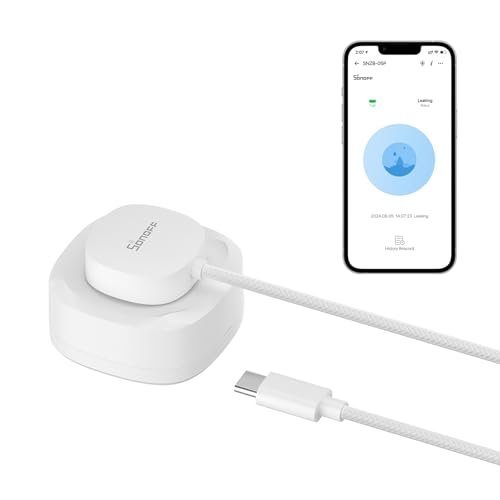
The SONOFF SNZB-05P water leak sensor is designed to catch those problems earlier. It uses Zigbee 3.0 connectivity, supports several detection methods, can work with an extension cable for broader coverage, and is powered by a CR2477 battery advertised to provide up to five years of monitoring.
Unlike a simple standalone alarm, the SNZB-05P can also participate in smart-home automations. When water is detected, it can trigger notifications, gateway alarms, and other connected actions through a compatible Zigbee ecosystem.
That makes it especially interesting for homeowners already using SONOFF or another compatible Zigbee platform. However, the need for a Zigbee hub, the difference between local and cloud-dependent alerts, battery-life expectations, and sensor placement all deserve attention before relying on it for leak monitoring.
What Is the SONOFF SNZB-05P?
The SONOFF SNZB-05P is a Zigbee 3.0 smart water leak detector designed to identify unwanted moisture and report the event through a connected smart-home system.
It is intended for use around areas such as kitchens, bathrooms, laundry rooms, basements, utility spaces, and appliances where leaks may develop.
The device can detect water directly and can also be paired with an extension cable to cover larger or less accessible areas.
Because it communicates using Zigbee rather than connecting directly to Wi-Fi, it requires a compatible Zigbee hub or gateway.
This architecture can be advantageous in a smart home containing many low-power sensors because Zigbee is specifically designed for efficient device-to-device and device-to-hub communication.
Why a Smart Water Leak Sensor Is Useful
A basic water alarm usually makes noise when its contacts get wet.
That can be effective if someone is nearby.
The problem is that many leaks happen when nobody is close enough to hear the alarm.
A smart water leak detector adds remote awareness. When the SNZB-05P detects moisture, it can report the event through the connected Zigbee gateway, which can then trigger an app notification or other automation.
This means a leak in a basement or laundry room can potentially alert you even if you are somewhere else in the home—or away from the property, depending on your hub and app configuration.
The value of a smart sensor therefore comes from both detection and communication.
Zigbee 3.0 Connectivity
The SNZB-05P uses Zigbee 3.0.
Zigbee is widely used in smart-home sensors because it consumes relatively little power and allows multiple devices to operate through a central hub.
Instead of every sensor connecting directly to your Wi-Fi router, Zigbee devices communicate with the Zigbee network.
This can reduce network congestion and extend battery life.
For a leak detector, low-power operation is especially important because the device may sit untouched for years while waiting for a problem.
A Zigbee Hub Is Required
One of the most important purchasing considerations is that the SNZB-05P is not a standalone Wi-Fi sensor.
It needs a compatible Zigbee gateway to access smart features such as app notifications, automations, and gateway alarms.
If you already have a suitable Zigbee hub, adding the sensor may be straightforward.
If you do not, the hub becomes part of the total system cost.
This matters because a low-cost sensor can become a more significant investment when purchased solely to start a new smart-home ecosystem.
Up to Five Years of Battery Life
SONOFF states that the SNZB-05P uses a CR2477 battery and can provide up to approximately five years of continuous monitoring.
That is a major convenience advantage.
Leak sensors are often placed in locations that are awkward to access, such as behind appliances, underneath cabinets, or near plumbing in utility areas.
A long-life battery reduces how frequently those devices need attention.
However, "up to five years" should be viewed as an expected maximum under appropriate conditions rather than a guaranteed lifespan.
Actual runtime can vary according to signal quality, temperature, alarm frequency, communication activity, and battery characteristics.
Why Battery Life Matters for Leak Detection
A leak sensor is different from a frequently handled smart-home device.
Ideally, you install it, test it, and then rarely touch it.
Frequent battery replacement undermines that convenience and increases the risk that a dead sensor will go unnoticed.
A large CR2477 coin-cell battery gives the SNZB-05P more energy capacity than devices using smaller coin cells.
That makes it appropriate for long-term passive monitoring.
Even so, battery status should be checked periodically through the connected smart-home system when supported.
Multiple Water Detection Methods
One of the more useful aspects of the SNZB-05P is that it is not limited to one narrow detection scenario.
The supplied product information describes support for:
- General water leakage detection
- Drip detection
- Extension-cable detection for larger or narrow areas
This flexibility allows the same sensor family to be adapted to several parts of a home.
A single compact sensor may be enough beneath a sink, while an extension cable may make more sense around a water heater or along an appliance edge.
Detecting Standing Water
For many household leaks, the most common scenario is water spreading across a flat surface.
A sensor placed at the lowest point where water is likely to collect can trigger when moisture reaches its contacts.
This approach works well in cabinets, basements, laundry rooms, and near appliances.
Placement matters enormously.
A detector can only respond to water that physically reaches the sensing area.
Drip Detection
Drip detection is useful in locations where water may fall directly onto the sensor before pooling on the floor.
This can happen beneath supply fittings, valves, drain connections, filter housings, or exposed pipe joints.
Early drip detection may provide warning before enough water has accumulated to spread across the surrounding surface.
For slow plumbing leaks, this can be especially valuable.
Extension Cable for Broader Coverage
An extension sensing cable can expand the effective detection area.
Instead of monitoring one small point, the cable can be routed along a broader path where escaping water might travel.
This may be useful:
- Around water heaters
- Beneath long appliance edges
- Along basement walls
- Under kitchen cabinets
- Around HVAC or condensate equipment
- Through narrow gaps where the sensor body cannot fit
The cable should be positioned strategically rather than simply stretched across the largest possible area.
The goal is to place it where water is likely to appear first.
Best Places to Install the SNZB-05P
Water leak sensors are most useful in areas where plumbing or water-using appliances could fail without being noticed immediately.
Good locations include beneath kitchen sinks, under bathroom vanities, beside washing machines, near dishwashers, around water heaters, in basements, near sump pumps, and underneath refrigerators with water lines.
The sensor may also be useful near aquariums or utility sinks.
The right locations depend on the property.
Rather than placing sensors evenly around the home, prioritize areas where a leak is both plausible and capable of causing significant damage.
Under Kitchen Sinks
The cabinet beneath a kitchen sink contains several possible leak sources.
Faucet supply lines, shutoff valves, drain fittings, garbage disposal connections, and water-filtration systems can all drip.
Because the cabinet hides these components, a leak can continue for some time before becoming visible.
Placing the sensor directly beneath the plumbing can provide earlier warning.
Laundry Rooms
Washing machines have multiple water-related failure points, including supply hoses, drain connections, pumps, and door seals.
A sensor positioned behind or beside the machine can detect escaping water before it spreads across the room.
If there is little space under the appliance, an extension cable may be easier to position than the full sensor body.
Water Heaters
Water heaters are another strong candidate.
Leaks may develop around fittings, valves, drain points, or the tank itself.
An extension cable can be useful here because it can monitor a wider perimeter around the base.
The sensor should be positioned where water would naturally collect first.
Basements
Basements are especially suitable for remote leak detection because they may not be visited frequently.
Water from plumbing, groundwater intrusion, sump pump problems, or HVAC systems can accumulate without immediate notice.
A Zigbee leak sensor can provide another layer of monitoring in these areas.
Gateway Alarm Integration
When the SNZB-05P detects water, it can trigger a connected gateway to sound an alarm through smart-home scene linkage.
This adds a local audible warning even though the sensor itself is primarily part of a connected system.
The gateway alarm can be useful if the leak occurs while someone is home but not close to the sensor.
For example, a sensor in the basement could trigger an audible gateway elsewhere in the house.
App Notifications
The sensor can also generate an app alert through the connected smart-home system.
Remote notifications are one of the most important reasons to choose a smart leak detector.
They make it possible to learn about a leak without physically hearing an alarm.
This can be particularly valuable when traveling or when the affected area is isolated from the main living space.
Actual remote notification behavior depends on the gateway, app, network, and configuration being used.
Local Automation Can Work Without Wi-Fi
An important feature described in the product information is that local scene linkage between the Zigbee sensor and gateway can continue independently of Wi-Fi.
This means a properly configured gateway alarm may still activate even if the internet connection becomes unstable.
That is useful because a safety-related sensor should ideally not depend entirely on cloud connectivity for every action.
The distinction is important:
Local Zigbee automation can continue through the gateway.
Remote smartphone notifications generally still require network connectivity.
Why Local Automation Matters
Cloud-connected smart devices are convenient, but cloud dependence can become a weakness during outages.
If a leak occurs at the same time the internet connection fails, a cloud-only alerting system may be unable to notify anyone remotely.
Local Zigbee automation provides a second layer.
The sensor can still communicate with the gateway over the local Zigbee network, allowing the gateway to activate an alarm or other local device.
This redundancy makes the system more resilient.
Repeated Alerts Every 10 Minutes
The SNZB-05P is described as reporting again every 10 minutes during continuous water detection.
This repeated-alert behavior is designed to reduce the chance that a leak is overlooked.
A single notification can easily be dismissed or missed.
Repeated reporting keeps the condition active in the smart-home system until the sensor is no longer detecting water.
This is particularly useful for serious leaks that remain unresolved.
The Tradeoff of Repeated Notifications
Repeated alerts can be valuable, but they can also become irritating if the sensor is triggered accidentally.
That is why placement and testing matter.
A sensor exposed to routine splashes, condensation, or frequent cleaning water may produce unnecessary alarms.
The goal is to install it where unexpected water indicates a genuine problem.
A correctly placed leak detector should rarely trigger during normal household activity.
Smart-Home Automation Possibilities
Because the SNZB-05P uses Zigbee 3.0, it can participate in broader smart-home routines through a compatible hub.
For example, a detected leak could potentially trigger:
- A gateway siren
- Smart lights turning on
- A phone notification
- Another smart-home alarm
- A compatible water shutoff device
- A home automation routine
The exact integrations depend on the hub and platform.
The most important advantage is that leak detection can become part of a larger response rather than simply creating one notification.
Pairing With an Automatic Water Shutoff
The SNZB-05P itself is a sensor, not a valve.
It detects water but does not physically stop the supply.
However, in a compatible smart-home ecosystem, leak detection could potentially be used as a trigger for a separate smart shutoff device.
That distinction matters.
The sensor provides awareness.
An automatic valve provides intervention.
For higher-risk properties, combining both can offer stronger protection than relying on detection alone.
Zigbee Leak Sensor vs. Wi-Fi Leak Sensor
Wi-Fi sensors connect directly to the home's wireless network.
They can be convenient because they may not require a dedicated smart-home hub.
However, Wi-Fi generally uses more power than Zigbee, which can be a disadvantage for battery-operated devices.
Zigbee sensors tend to be more efficient and are well suited to larger networks containing many low-power devices.
The tradeoff is that Zigbee requires a compatible gateway.
For someone already using a Zigbee ecosystem, the SNZB-05P can therefore make more sense than adding independent Wi-Fi leak detectors.
Zigbee Leak Sensor vs. Standalone Audible Alarm
A standalone alarm is simpler.
There is no app, gateway, pairing process, or network dependency.
If it gets wet, it sounds.
That simplicity can be attractive for a single location.
The SNZB-05P is more useful when you want remote notifications, automation, multiple sensors, or integration with other smart-home devices.
The tradeoff is additional setup complexity.
What the SNZB-05P Does Not Do
The sensor does not repair leaks and does not physically stop the water by itself.
It is an early-warning device.
It also depends on a compatible Zigbee gateway for its smart functionality.
Remote alerts depend on the larger network and app environment.
Users should therefore treat it as one component in a broader leak-response plan rather than a complete water-damage prevention system.
Common Setup Mistakes
One common mistake is purchasing the sensor without realizing that a Zigbee hub is required.
Another is installing it too far from the likely path of escaping water.
A sensor can be only a few feet from a leaking pipe and still fail to trigger if the water flows in another direction.
Poor Zigbee mesh coverage can also affect reliability.
If the sensor is installed at the far edge of the Zigbee network, adding compatible powered Zigbee routing devices may help extend coverage depending on the ecosystem.
Finally, do not assume that a five-year battery estimate eliminates the need for periodic testing.
Best Practices for Installation
Pair the sensor with the gateway before placing it permanently.
Once paired, move it to the intended location and confirm that communication remains reliable.
Then perform a controlled water test according to SONOFF's instructions.
Verify every expected response:
Does the sensor report water?
Does the gateway alarm activate?
Does the app receive a notification?
Does the system report normal status after the sensor dries?
Testing the complete workflow is more important than simply confirming that the device appears in the app.
Name Sensors Clearly
If you install several leak sensors, use location-specific names.
Good examples include:
Kitchen Sink
Laundry Washer
Basement Water Heater
Upstairs Vanity
Dishwasher
A notification that clearly identifies the affected location allows you to respond faster.
Generic device names become increasingly confusing as the smart home grows.
Test the System Periodically
A safety sensor should not be installed and forgotten permanently.
Periodically check the battery status and device connectivity.
Test the sensor with a small controlled amount of water when appropriate.
Confirm that the app, gateway alarm, and any linked automations still respond correctly.
This is especially important after changing hubs, routers, smart-home software, or automation settings.
Advantages of the SONOFF SNZB-05P
The SNZB-05P has several strengths.
Its advertised up-to-five-year CR2477 battery life reduces maintenance.
Support for several detection methods makes the sensor flexible enough for compact leak points, direct drips, and broader areas using an extension cable.
Zigbee 3.0 allows integration into a larger smart-home system while maintaining low power consumption.
Local gateway alarm linkage can continue independently of Wi-Fi under supported configurations, which adds resilience.
Repeated reporting during continuous water detection also reduces the chance that a persistent leak will be missed.
Potential Drawbacks
The biggest limitation is the requirement for a Zigbee hub.
For someone without an existing compatible gateway, this adds cost and setup complexity.
The sensor detects leaks but cannot stop the water by itself.
Remote notifications still depend on the connected gateway, app, and internet service.
The advertised five-year battery life may also be shorter in real-world conditions.
Finally, smart-home compatibility should always be verified before purchasing if you intend to use the sensor with a specific third-party Zigbee platform.
Who Should Consider the SNZB-05P?
This sensor is particularly well suited to homeowners already using Zigbee smart-home devices.
It can also make sense for anyone building a larger sensor network around multiple rooms.
Potential use cases include:
- Kitchens
- Bathrooms
- Laundry rooms
- Basements
- Utility rooms
- Water heaters
- Sump pump areas
- Refrigerators with water lines
- Dishwashers
- Aquariums
For a single isolated location where remote notification is unnecessary, a basic standalone water alarm may be simpler.
Is It Suitable for a Large Home?
Potentially.
Zigbee networks can be extended through compatible powered routing devices, allowing sensors to operate beyond the immediate range of the gateway.
The actual performance depends on the smart-home network, building materials, gateway location, and available routers.
For a large home, planning the Zigbee mesh is just as important as choosing the sensors.
Is It Good for a Vacation Property?
It can be useful because app notifications allow remote awareness when internet connectivity is available.
However, detection alone may not be sufficient for a property that remains unoccupied for long periods.
A vacation home may benefit from pairing leak sensors with a compatible automatic shutoff system so that water can be stopped even when nobody is nearby.
Frequently Asked Questions
What is the SONOFF SNZB-05P?
It is a Zigbee 3.0 smart water leak detector designed to detect unwanted moisture and trigger connected alerts or automations.
Does it connect directly to Wi-Fi?
No. It uses Zigbee and requires a compatible Zigbee gateway.
Is a hub required?
Yes. A compatible Zigbee hub or gateway is needed for smart functionality.
What battery does it use?
The sensor uses a CR2477 battery.
How long does the battery last?
SONOFF advertises up to approximately five years of operation.
Actual battery life can vary according to usage and environmental conditions.
Can it detect drips?
Yes. The product is designed to support both leak and drip detection.
Can it monitor a larger area?
Yes. It can be paired with an extension sensing cable for wider or narrow-area coverage.
Where can I install it?
Typical locations include kitchens, bathrooms, basements, laundry rooms, water heaters, appliances, and utility areas.
Does it send phone notifications?
Yes, through a compatible connected gateway and app configuration.
Will the gateway alarm work if Wi-Fi goes down?
The product information states that local scene linkage between the Zigbee sensor and gateway can operate independently of Wi-Fi under supported conditions.
Remote notifications would still generally require network connectivity.
Does the sensor keep sending alerts if water remains present?
Yes. The supplied information states that it can report every 10 minutes during continuous water detection.
Can it automatically shut off my water?
Not by itself.
It is a leak detector, although it may potentially trigger a separate compatible smart shutoff device through automation.
Is it better than a Wi-Fi leak sensor?
Neither is universally better.
Zigbee generally offers lower power consumption and works well in larger smart-home sensor networks, while Wi-Fi models may be simpler for users who do not want a separate hub.
Final Verdict
The SONOFF SNZB-05P is a capable smart water leak detector for users who want more than a simple audible alarm.
Its most attractive features are the advertised long CR2477 battery life, multiple detection methods, optional extension-cable coverage, Zigbee 3.0 connectivity, repeated leak reporting, and the ability to trigger local gateway alarms even when Wi-Fi connectivity is unstable.
It is especially compelling for homeowners who already operate a Zigbee smart-home system because the sensor can become part of broader automations rather than functioning as an isolated device.
The main limitation is straightforward: a compatible Zigbee hub is required, and the SNZB-05P detects water but does not physically shut off the supply by itself.
For kitchens, laundry rooms, basements, bathrooms, and other leak-prone areas, it can provide a useful early-warning layer. Its effectiveness, however, still depends heavily on correct placement, reliable Zigbee connectivity, periodic testing, and having a clear plan for what happens after an alert is received.