2-Zone WiFi Water Timer Review: Smart Life App Control, Rain Delay, Misting Mode, and Independent Irrigation Scheduling
Automating outdoor watering does not necessarily require a buried sprinkler network or a professionally installed irrigation controller. For many homes, a smart hose timer connected directly to an outdoor faucet can provide enough scheduling flexibility to manage lawns, flower beds, vegetable gardens, patio plants, and misting systems from a phone.
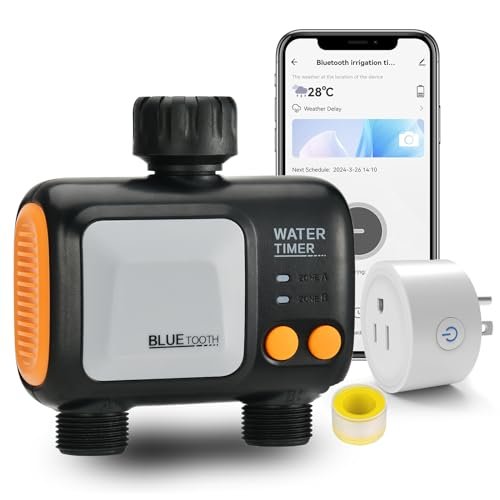
This 2-zone WiFi water timer is designed for that type of setup. According to the supplied product information, it combines two independently controlled outlets with Smart Life app management, 2.4 GHz WiFi connectivity, Alexa and Google voice control, multiple irrigation programs, weather-based rain delay, watering history, manual operation, and an IP55-rated outdoor enclosure.
The timer also supports both standard timed irrigation and a spray or misting mode, which makes it more versatile than a conventional hose timer that simply opens once at a scheduled time. For homeowners who need to automate two different watering areas from one faucet, it offers a practical middle ground between a basic mechanical timer and a permanent multi-zone sprinkler system.
What Is This 2-Zone WiFi Water Timer?
This product is a smart garden-hose irrigation controller with two separately controlled water outlets.
The timer communicates through a WiFi hub and is managed using the Smart Life app on compatible Android or iOS devices. The hub requires a 2.4 GHz WiFi network.
Its main advertised features include:
- Two independently controlled outlets
- Smart Life app management
- Remote watering control
- Timed irrigation mode
- Spray or misting mode
- Up to five watering programs per outlet
- Weekly scheduling
- 24-, 48-, or 72-hour rain delay
- Weather-aware schedule adjustment
- Irrigation history
- Manual watering
- Alexa compatibility
- Google voice-control support
- Shared family access
- Multi-timer expansion
- IP55 water resistance
For a hose-based garden setup, that is a broad range of functionality.
Why Two Independent Watering Outlets Matter
The two outlets are the core practical advantage of this timer.
Instead of attaching two hoses to a simple splitter and operating them manually, each outlet can follow its own watering program.
For example, you could connect:
Zone 1: a lawn sprinkler
Zone 2: drip irrigation for a vegetable garden
The lawn may need longer watering sessions several times per week, while vegetables may require a shorter but more frequent routine.
Independent control lets each area follow the schedule that makes the most sense.
Two Zones Are Better Than One Shared Schedule
Different parts of a landscape rarely use water at the same rate.
A sunny lawn can dry much faster than a shaded flower bed. Container plants may require more frequent irrigation than established shrubs. A misting line has completely different operating requirements from a rotary lawn sprinkler.
Using separate zones helps avoid the common mistake of applying one watering schedule to everything.
Smart Life App Remote Control
The timer is managed through the Smart Life app.
After pairing the timer with the WiFi hub, users can adjust watering without walking outside to the faucet.
The supplied product description indicates that the app can manage:
- Watering frequency
- Watering duration
- Irrigation schedules
- Rain delays
- Manual operation
- Watering history
Remote control can be particularly useful while traveling or when weather conditions change unexpectedly.
Why Remote Irrigation Control Is Useful
A traditional digital timer may automate watering, but schedule changes still have to be made at the device.
A WiFi-connected timer lets users make those adjustments from a smartphone.
That means you can potentially:
- Delay watering after rainfall
- Run a temporary irrigation cycle
- Check previous watering sessions
- Stop watering early
- Modify a schedule while away from home
The convenience becomes more valuable when the garden contains several plants with different watering needs.
2.4 GHz WiFi Requirement
The WiFi hub requires 2.4 GHz WiFi according to the supplied information.
This is common for smart-home devices because 2.4 GHz generally provides better range through walls than 5 GHz.
Before purchasing, confirm that your router or mesh WiFi system provides a 2.4 GHz network.
Also consider signal quality near the area where the hub will be installed.
WiFi Strength Can Affect Reliability
Smart irrigation depends on a stable connection.
Wireless performance can be reduced by:
- Thick exterior walls
- Concrete
- Metal siding
- Long distances
- Utility equipment
- Other radio interference
If the faucet is far from the home, positioning the hub closer to the garden may improve reliability.
Timed Irrigation Mode
The timer includes a standard timed irrigation mode.
In this mode, users create watering programs that start automatically according to a schedule.
The supplied information states that each outlet can support up to five watering procedures, giving the two-zone system up to ten individual timed programs in total.
That is more than enough for many residential gardens.
Why Multiple Watering Programs Are Useful
A single zone may occasionally need more than one watering session.
For example, a vegetable garden might run:
- Early in the morning
- Again briefly during an unusually hot period
A newly seeded lawn may also require a different schedule from established grass.
Multiple programs make these situations easier to manage without constantly changing the main irrigation routine.
Weekly Scheduling
Both irrigation modes support weekly scheduling according to the source.
This allows users to choose which days watering occurs.
For example:
- Monday, Wednesday, and Saturday for a lawn
- Daily watering for seedlings
- Tuesday and Friday for established shrubs
The best frequency depends on plant type, soil, climate, and local watering regulations.
Spray and Misting Mode
The second major operating mode is spray mode.
Instead of leaving the valve continuously open for a long period, this mode can alternate between watering and pause intervals.
Users can adjust:
- Runtime
- Interval time
- Weekly frequency
This type of repetitive operation can be useful for misting and certain specialized irrigation applications.
Where Spray Mode Can Be Useful
Intermittent watering may work well for:
- Greenhouse misting
- Patio cooling
- Seedling beds
- Light irrigation
- Dust suppression
It can also be useful when the soil benefits from shorter watering periods separated by soak time.
Spray Mode and Cycle-and-Soak Watering
Although marketed as spray mode, repeated on/off intervals can resemble cycle-and-soak irrigation.
This approach can be helpful when soil absorbs water slowly.
Instead of running a sprinkler continuously until water begins flowing across the surface, the system can irrigate for a shorter period, pause, and then resume.
That may improve infiltration on:
- Clay soil
- Slopes
- Compacted ground
Timed Irrigation vs. Spray Mode
The best mode depends on the application.
Timed irrigation is generally better for straightforward lawn sprinklers, soaker hoses, and ordinary garden watering.
Spray or cyclic operation is more suitable when water needs to be applied intermittently.
Neither mode is automatically better. The goal is to match the irrigation pattern to the plant and soil conditions.
Weather-Based Rain Delay
The timer includes a weather-aware rain-delay feature.
According to the supplied description, the Smart Life app can use local weather conditions to modify watering, while users can choose delay periods of:
- 24 hours
- 48 hours
- 72 hours
This helps avoid unnecessary watering when meaningful rainfall is expected or has recently occurred.
Why Rain Delay Matters
Without weather awareness, a fixed timer may run even when the soil is already wet.
That can contribute to:
- Water waste
- Runoff
- Oversaturated soil
- Poor root-zone aeration
Rain delay gives the system a way to temporarily suspend watering without deleting the underlying schedules.
Weather Forecasts Are Not Perfect
Weather-based automation is useful, but it should not be treated as a direct soil-moisture measurement.
Forecast rain may miss your property entirely, while a short local storm can deliver more rain than the forecast suggests.
Occasional visual inspection of soil and plant conditions remains useful even with smart irrigation.
Irrigation History and Watering Logs
The app includes a dedicated watering-record page according to the supplied information.
Each watering event can include details such as:
- Start time
- Duration
- End time
This can be particularly useful for troubleshooting.
If plants look unexpectedly dry, you can review whether the scheduled irrigation actually ran.
Why Watering History Is Valuable
A schedule only tells you what should happen.
A watering log helps show what actually happened.
That is useful when checking for:
- Missed irrigation
- Unexpected manual watering
- Excessive runtime
- Schedule conflicts
This level of visibility is something most mechanical timers cannot provide.
Manual Watering Mode
The controller also includes manual watering.
This allows a zone to be activated temporarily without permanently changing the programmed schedule.
Manual operation is useful for:
- Newly planted flowers
- Testing sprinklers
- Extra watering during hot weather
- Filling containers
- Temporary garden tasks
Once the manual cycle ends, the normal automated schedule can continue.
Why Manual Override Is Important
Smart automation should make irrigation easier, not make simple tasks more complicated.
There will always be occasional situations where a homeowner needs water immediately.
Manual mode provides that flexibility while preserving the automatic schedule.
Expandable Irrigation System
The supplied description states that additional WiFi water timers can be added to the same irrigation ecosystem.
For system stability, the manufacturer recommends using no more than four smart water timers.
That potentially allows several hose-fed watering areas to be managed from the same app.
Expanding Beyond Two Zones
A single two-zone timer may be enough for a modest yard.
Larger gardens might eventually require separate watering for:
- Front lawn
- Back lawn
- Raised beds
- Greenhouse
- Flower beds
- Patio plants
Adding additional timers can create a broader smart irrigation network without installing underground wiring.
Why the Four-Timer Recommendation Matters
Manufacturers sometimes advertise large device limits, but practical wireless systems perform best when kept within recommended configurations.
If four timers are recommended for reliable operation, that limit should be taken seriously.
Adding excessive devices could potentially affect:
- Connection stability
- App management
- Hub communication
Design the system around actual needs rather than maximum theoretical expansion.
Family Sharing
The Smart Life platform also allows users to share irrigation control with household members according to the supplied information.
This can be convenient when several people take care of the garden.
Shared users may be able to help:
- Start or stop watering
- Monitor schedules
- Review irrigation activity
For larger households, that can make garden maintenance more collaborative.
Alexa and Google Voice Control
The timer is described as compatible with Amazon Alexa and Google voice-control platforms.
Voice commands can offer hands-free control for supported functions.
For example, a user may be able to start or stop watering without opening the Smart Life app.
Voice control is convenient, although automatic scheduling and weather awareness are likely to provide more practical day-to-day value.
IP55 Water Resistance
The timer carries an IP55 rating according to the supplied product information.
That indicates protection against dust ingress at a level suitable for many outdoor applications and resistance to water jets under defined test conditions.
For a garden timer, this is useful protection against:
- Rain
- Sprinkler spray
- General outdoor moisture
However, IP55 does not mean the timer is designed for immersion in water.
Outdoor Durability
The listing describes the device as being made from durable materials intended for long outdoor use.
Even so, outdoor irrigation equipment should be inspected periodically.
Look for:
- Cracked housings
- Damaged seals
- Loose fittings
- Corrosion
- Water ingress
Weather-resistant does not mean maintenance-free.
Protect It From Freezing
The source does not explicitly establish freeze-proof operation.
Any hose timer containing residual water can potentially be damaged when temperatures fall below freezing.
When cold weather approaches, a sensible routine is to:
- Shut off the faucet.
- Disconnect the timer.
- Drain residual water.
- Remove connected hoses if necessary.
- Store the timer in a protected location.
Water resistance and freeze resistance are completely different properties.
The Timer Does Not Create Water Pressure
The product description correctly notes that the controller does not produce pressure.
It only controls water already supplied by the faucet.
This is important because sprinkler performance depends on:
- Available water pressure
- Flow rate
- Hose diameter
- Hose length
- Elevation
- Downstream irrigation equipment
A smart timer cannot improve a weak water supply.
Two Zones Must Share the Available Water Supply
If both outlets are used simultaneously, they ultimately depend on the same source faucet.
That means available pressure and flow may be divided between them.
For two high-demand lawn sprinklers, this can reduce coverage.
Running demanding zones one after another is often more effective than operating both at once.
Using the Timer for Lawn Irrigation
One outlet can be connected to a conventional lawn sprinkler.
The app can then automate when that sprinkler operates.
This is useful for homeowners who want scheduled lawn watering without installing underground pipes and electric valves.
Using It With Drip Irrigation
The second zone could feed a drip system for:
- Vegetables
- Raised beds
- Shrubs
- Flower beds
Drip systems often require lower pressure and longer runtimes than lawn sprinklers.
A pressure regulator may be required depending on the equipment.
Using It for Patio Plants
Container plants often dry out faster than garden soil.
A dedicated zone can automate patio or balcony irrigation without forcing those plants to follow the lawn schedule.
This is one example where independent outlets provide meaningful value.
Pool Filling
The product description mentions pool applications.
A timer may be used to control a hose during pool filling, but this should still be supervised.
The timer should not be considered a replacement for a dedicated automatic pool-level controller or overflow protection system.
Misting Applications
Spray mode can potentially be useful for misting systems.
Short repeated watering intervals may help with:
- Patio cooling
- Greenhouse humidity
- Plant propagation
The connected misting hardware must still be compatible with the available pressure and flow.
Soil Type Should Guide Scheduling
Smart controls automate irrigation, but users still need to choose appropriate watering durations.
Sandy Soil
Sandy soil accepts water quickly but also drains quickly.
Clay Soil
Clay absorbs water slowly and is prone to runoff.
Loamy Soil
Loam typically offers a good balance between drainage and moisture retention.
Cyclical watering can be particularly useful for clay or compacted soils.
Plant Type Matters
A lawn, vegetable garden, flower bed, and mature shrub area may all require different watering patterns.
The two-zone design works best when each outlet serves plants with similar needs.
Avoid mixing very different vegetation into one zone if separate control is possible.
Common Mistakes
Connecting the Hub to a 5 GHz-Only Network
The system requires 2.4 GHz WiFi.
Giving Both Zones the Same Schedule
Independent control exists so each area can be managed appropriately.
Running Two High-Flow Sprinklers Simultaneously
Available faucet pressure may be divided.
Using Spray Mode Without a Clear Reason
More complicated scheduling is not automatically better.
Trusting Weather Data Completely
Local rainfall can differ from forecast conditions.
Ignoring Watering History
The irrigation log is useful for spotting missed or unusual cycles.
Assuming IP55 Means Freeze-Proof
It does not.
Best Practices for Installation
Start with a simple setup.
Connect the timer securely to the faucet, then attach one irrigation device to each outlet.
Before programming schedules:
- Open the water supply
- Check every connection for leaks
- Test each outlet manually
- Confirm adequate pressure
- Verify Smart Life connectivity
Only after both zones operate correctly should automatic scheduling be enabled.
Start With Simple Watering Programs
Although the system allows several programs, there is little benefit in making irrigation unnecessarily complicated.
Begin with one primary schedule for each zone.
Observe plant and soil conditions for several days.
Then adjust:
- Frequency
- Runtime
- Spray intervals
based on real results.
Monitor for Runoff
If water begins flowing across sidewalks, driveways, or slopes, irrigation may be running longer than the soil can absorb.
Consider:
- Shorter runtimes
- Cyclic spray mode
- Lower flow
- Longer intervals between watering periods
The goal is to move water into the root zone rather than across the surface.
Smart Hose Timer vs. Mechanical Timer
A mechanical timer is inexpensive and simple.
A smart WiFi timer adds:
- Remote control
- Two independent zones
- Multiple programs
- Weather-based delay
- Watering history
- Voice control
- Expandability
Those features are most valuable for more complex gardens.
Smart Hose Timer vs. Permanent Sprinkler Controller
A permanent sprinkler controller operates wired electric valves connected to underground irrigation pipes.
This WiFi hose timer attaches directly to a faucet.
That makes it more suitable for:
- Renters
- Smaller gardens
- Temporary irrigation
- Portable sprinklers
- Drip lines
- Patio watering
A conventional multi-zone controller remains the better solution for larger permanent landscapes.
Who Is This 2-Zone WiFi Timer Best For?
The timer may be a strong fit for homeowners who want:
- Two independent hose irrigation zones
- Remote Smart Life app control
- Weather-based rain delays
- Timed and cyclical watering
- Watering history
- Manual operation
- Voice-assistant integration
- The ability to expand later
It is especially practical when one faucet needs to serve two very different garden areas.
Who May Prefer Something Simpler?
A basic timer may be enough when:
- Only one hose needs automation
- The watering schedule rarely changes
- Remote access is unnecessary
- Weather-based features are not important
The smart features provide the most value when they solve an actual irrigation-management problem.
Advantages and Considerations
The main advantages are the dual independent outlets, Smart Life app control, five watering programs per outlet, timed and spray modes, 24/48/72-hour weather-based rain delay, irrigation history, manual control, Alexa and Google compatibility, multi-timer expansion, family sharing, and IP55 outdoor protection.
The main considerations are that the hub requires 2.4 GHz WiFi, available faucet pressure is shared between outlets, and weather-based adjustments should not replace occasional inspection of actual soil conditions.
Users should also protect the timer from freezing unless the manufacturer explicitly confirms freeze-safe operation.
Frequently Asked Questions
How many watering zones does the timer have?
Two independent outlets.
Can each outlet have its own schedule?
Yes.
Which app does it use?
The Smart Life app.
Does it work with Android?
Yes, according to the supplied information.
Does it work with iOS?
Yes.
What WiFi frequency is required?
2.4 GHz.
Does it support remote control?
Yes.
How many watering programs can each outlet have?
Up to five, according to the supplied description.
How many total programs does that provide?
Potentially up to ten across both outlets.
What irrigation modes are available?
Timed irrigation and spray mode.
What is timed irrigation?
The valve opens for a programmed duration according to a schedule.
What is spray mode?
The timer alternates watering and pause periods based on configured runtime and interval settings.
Can both modes use weekly schedules?
Yes.
Does it have rain delay?
Yes.
What delay periods are available?
The listing specifies 24, 48, or 72 hours.
Does it use local weather information?
The supplied description says the app can automatically detect local weather conditions for rain-delay operation.
Can I see previous watering sessions?
Yes.
What information is included in the watering log?
The source lists start time, duration, and end time.
Does it support manual watering?
Yes.
Does it work with Alexa?
Yes.
Does it work with Google?
Yes, according to the supplied information.
Can I share control with family members?
Yes.
Can more timers be added?
Yes.
How many timers are recommended?
The manufacturer recommends no more than four smart water timers for system stability.
Is it waterproof?
The listing specifies an IP55 rating.
Can it be submerged?
No. IP55 should not be interpreted as a submersible rating.
Does the timer increase water pressure?
No.
Can I use it with lawn sprinklers?
Yes, provided sufficient pressure and flow are available.
Can I connect drip irrigation?
Yes.
Can I use it for misting?
Yes, spray mode may be useful for compatible misting systems.
Can it control pool filling?
It can control hose flow, but pool filling should still be monitored.
Can both zones run together?
Possibly, but available water pressure and flow will be shared.
Should it remain outside during freezing weather?
Freeze-safe operation is not established in the supplied description. Disconnecting and draining the timer before freezing conditions is the safer approach.
Final Thoughts
This 2-zone WiFi water timer offers a practical way to add smart irrigation to an ordinary outdoor faucet without installing a permanent sprinkler controller.
Its strongest features are the combination of two independently controlled watering outlets, Smart Life remote management, multiple schedules, standard and spray irrigation modes, weather-aware rain delay, detailed watering logs, manual operation, voice control, and expansion to additional timers.
The system is especially useful for properties where two garden areas have very different requirements—for example, a lawn sprinkler on one outlet and drip irrigation on the other.
Its smart capabilities still depend on basic irrigation fundamentals. The faucet must provide adequate pressure and flow, the WiFi connection must remain reliable, and schedules should be matched to the soil and plants rather than simply programmed for convenience.
For homeowners who want a flexible two-zone smart hose timer with remote control, weather-based watering adjustments, misting support, and detailed irrigation tracking, this type of controller can provide substantially more control than a conventional faucet timer while remaining much simpler than a permanent underground irrigation system.