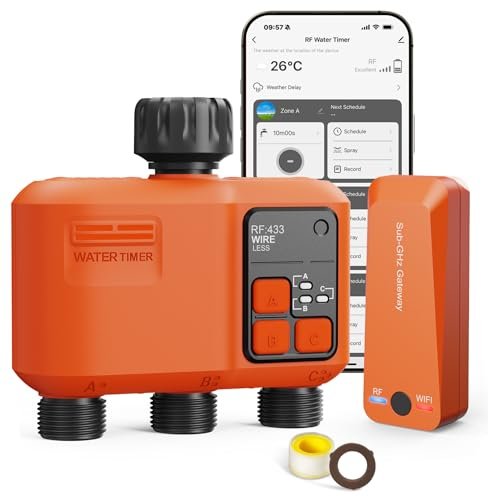
Xinfuture 3-Zone WiFi Sprinkler Timer Review: Long-Range Smart Irrigation With App, Voice, Rain Delay, and 300-Meter RF Connectivity
Smart irrigation becomes much more useful when the controller can maintain a reliable connection across a large yard. Many hose timers work well close to the home but become less dependable when the faucet, greenhouse, garden bed, or irrigation zone sits far from the router.
The Xinfuture WiFi sprinkler timer is designed to address that problem with a separate gateway and long-range RF communication. According to the supplied specifications, the timer-to-gateway connection can reach up to 984 feet, or approximately 300 meters, under suitable conditions. The gateway then connects to a 2.4 GHz WiFi network, allowing the watering system to be managed remotely through the Smart Life or Tuya Smart app.
The system also supports three independently programmable watering zones, rain-delay functions, irrigation history, manual watering, recurring schedules, misting or cycling modes, multiple connected devices, and voice-control integration. For homeowners trying to automate lawns, raised beds, flower gardens, vegetable patches, greenhouses, or several outdoor watering areas from one platform, it offers considerably more flexibility than a basic mechanical hose timer.
What Is the Xinfuture WiFi Sprinkler Timer?
The Xinfuture system is a smart hose-faucet irrigation controller designed to automate several watering zones.
Instead of relying on a direct WiFi connection between the outdoor timer and the home's router, the system uses a gateway as the communication bridge.
The supplied information describes:
- Three independently controlled watering zones
- Long-range RF communication between timer and gateway
- Up to 984 ft / 300 m stated transmission range
- 2.4 GHz WiFi connectivity
- Smart Life app support
- Tuya Smart app support
- Remote watering control
- Voice-control capability
- Separate schedules for each zone
- Standard and cyclical watering modes
- Misting functionality
- Manual watering
- 1–7 day rain delay
- Smart rain detection
- Irrigation history
- Multiple-device support
- Custom zone names
That combination makes it more similar to a small smart irrigation platform than a simple digital faucet timer.
Why Long-Range Connectivity Matters for Irrigation
Outdoor irrigation devices are often installed in awkward locations for wireless networking.
The faucet may be:
- Behind the house
- Across a large yard
- Near a greenhouse
- Inside a shed area
- Behind masonry walls
- Far from the home's WiFi router
A normal WiFi connection can become unreliable as distance and physical obstructions increase.
If the timer loses connectivity frequently, smart scheduling becomes less useful.
Up to 984 Feet of RF Communication
The standout feature is the claimed 984-foot or 300-meter communication range between the timer and the gateway.
That is much greater than the short-range Bluetooth connections commonly used by basic hose timers.
The system appears to use RF communication for the outdoor timer-to-gateway link, while the gateway handles the WiFi connection to the internet.
Maximum Range Is Not Guaranteed in Every Yard
The 300-meter specification should be treated as a best-case transmission figure.
Actual wireless range can be reduced by:
- Concrete walls
- Metal structures
- Dense vegetation
- Buildings
- Terrain
- Electrical interference
- Gateway placement
A clear line of sight generally provides better performance than transmitting through several walls.
Why a Gateway Can Be Better Than Direct WiFi
Direct-WiFi hose timers depend on the router's signal reaching the faucet.
A gateway system changes the architecture.
The timer communicates with the gateway using its dedicated wireless link, and the gateway communicates with the home network.
That lets the gateway be positioned somewhere with a stronger WiFi connection while still maintaining communication with the outdoor timer.
Gateway Placement Is Important
For best results, the gateway should generally be placed:
- Where home WiFi is strong
- As close as practical to the outdoor watering area
- Above large obstructions when possible
- Away from heavy metal shielding
Small changes in placement can make a noticeable difference in wireless performance.
2.4 GHz WiFi Requirement
The gateway connects to 2.4 GHz WiFi according to the product description.
This is common among smart-home devices because 2.4 GHz generally offers better range and wall penetration than 5 GHz.
Before purchase, make sure the home router has a functioning 2.4 GHz network.
Bluetooth Is Only for Setup
The supplied information makes an important distinction:
Bluetooth is used during initial setup, but it cannot be used as the primary standalone control method.
After configuration, the system depends on its normal gateway and WiFi connection for smart remote operation.
This means Bluetooth should not be considered a fallback remote-control system if the home network goes offline.
Smart Life and Tuya Smart App Control
The controller works through the Smart Life or Tuya Smart ecosystem.
These apps can provide a centralized interface for configuring watering schedules and operating the timer remotely.
Once connected, users can potentially manage irrigation while:
- At work
- Traveling
- Indoors
- Away from the property
Remote access is especially useful for gardens that need regular watering during vacations or periods of hot weather.
What Can You Control From the App?
According to the supplied information, app-based functions include:
- Starting or stopping watering
- Configuring individual zones
- Setting watering duration
- Choosing frequency
- Applying rain delays
- Reviewing watering records
- Naming zones
- Managing several devices
This gives users much more flexibility than a timer programmed only with physical buttons.
Three Independently Controlled Zones
The Xinfuture timer is designed around three watering zones.
Each outlet can be programmed separately.
That matters because different parts of a garden rarely need exactly the same watering schedule.
For example:
- Lawn may need longer watering
- Raised vegetables may need more frequent irrigation
- Established shrubs may need deeper but less frequent watering
Independent zones let each area follow its own program.
Why Independent Zones Are Better Than a Splitter
A simple three-way hose splitter creates several outlets, but all of them still depend on manual valves or one common timer.
A true multi-zone timer can control each outlet electronically.
That allows the system to decide:
- Which zone opens
- At what time
- For how long
- On which days
This is much more useful for automated irrigation.
Example Three-Zone Garden Setup
A practical configuration might be:
Zone 1: Front lawn
Zone 2: Vegetable garden
Zone 3: Flower beds
The lawn could receive longer watering two or three times per week.
The vegetables could receive shorter, more frequent irrigation.
The flowers could operate on another schedule entirely.
All three can be managed from the same application.
Watering Duration From 1 Minute to 24 Hours
For zone-based schedules, the source states watering durations can be set from approximately 1 minute up to 24 hours.
That is an extremely broad range.
Most residential watering events will require only a fraction of that maximum, but the flexibility can support specialized uses such as:
- Slow drip irrigation
- Large garden areas
- Pool filling
- Long-duration low-flow systems
Watering time should always be matched to actual soil and plant conditions rather than simply using longer schedules.
Standard Irrigation Mode
The standard mode provides straightforward continuous watering.
For example, you could configure a lawn zone to open at 6:00 a.m. and water continuously for 25 minutes.
This is appropriate where soil absorbs water readily and runoff is not a major problem.
Cycle or Recirculating Watering Mode
The system also supports a cyclical or recirculating irrigation mode.
Instead of running continuously for one long period, watering can be divided into shorter sessions.
This can be useful where water needs time to soak into the soil.
Why Cycle-and-Soak Style Watering Can Help
Some soils absorb water slowly.
If a sprinkler runs continuously, water may begin flowing across the surface before it penetrates deeply.
Breaking irrigation into cycles allows the soil to absorb water between applications.
This can be particularly helpful for:
- Clay soils
- Sloped lawns
- Compacted ground
It can reduce runoff without necessarily reducing total irrigation time.
Misting Mode
The description also mentions a misting function.
Misting or short-cycle watering can be useful for certain specialized applications such as:
- Seed starting
- Seedling beds
- Greenhouse environments
- Cooling applications
- Delicate plants
It should not automatically replace deeper watering for established plants, where root-zone moisture is more important.
Up to Five Schedules Plus Misting
The source states support for five watering schedules plus misting.
That allows multiple watering events to be configured rather than forcing everything into a single daily schedule.
Multiple schedules can be useful when plants need different watering periods during the day.
Monday-to-Sunday Scheduling
Recurring scheduling can be configured across the week.
This allows irrigation on selected days rather than automatically watering every day.
For example, a zone might run:
- Monday
- Wednesday
- Saturday
while another runs every second day according to a different program.
Avoid Watering by Calendar Alone
Automated scheduling is convenient, but soil conditions should still guide irrigation.
A fixed schedule may overwater during a rainy period or underwater during unusually hot weather.
That is why rain-delay and weather-aware functions are useful.
Smart Rain Delay
The timer supports a 1- to 7-day rain delay.
When rain is expected or the garden has already received sufficient water, scheduled irrigation can be temporarily paused.
Once the delay expires, normal programming resumes.
This avoids deleting and rebuilding schedules each time the weather changes.
Smart Rain Detection
The product description also references smart rain detection.
Depending on how the Tuya/Smart Life implementation works, this may use weather-related automation rather than a physical rain sensor.
Users should verify whether rain detection is based on:
- Weather-service data
- External sensor integration
- Another automation source
The source does not provide enough technical detail to assume a dedicated physical rain sensor is included.
Rain Delay Can Reduce Unnecessary Watering
Skipping irrigation after meaningful rainfall can help reduce:
- Water waste
- Saturated soil
- Runoff
- Unnecessary irrigation cycles
However, local rainfall can differ from online weather reports.
Garden conditions should still be checked periodically.
Irrigation History
The controller records watering activity according to the supplied description.
Records can include:
- Start time
- Duration
- End time
That historical information is useful for understanding what the irrigation system has actually done rather than relying only on scheduled intentions.
Why Watering Records Are Useful
Suppose plants begin looking dry.
The irrigation history can help answer:
- Did the timer actually run?
- Which zone ran?
- How long did it operate?
- Was a scheduled session skipped?
This can make troubleshooting much easier.
Irrigation Records Can Also Reveal Overwatering
History is equally useful when soil remains too wet.
You may discover that several schedules overlap or that a zone is watering more frequently than expected.
The solution may simply be adjusting the schedule rather than changing irrigation hardware.
Manual Watering Mode
The timer can also be activated manually with a physical button.
That means users do not have to open the app every time they want temporary water.
Manual mode can be useful for:
- Filling a pool
- Washing a car
- Filling buckets
- Testing sprinklers
- Watering newly planted areas
The exact manual duration behavior should be confirmed in the product instructions.
Manual Operation Should Not Destroy Existing Schedules
A useful smart irrigation controller allows temporary manual watering without forcing the programmed schedule to be recreated afterward.
That is one reason manual override is preferable to physically disconnecting hoses.
Custom Zone Names
The app allows custom names for different watering zones.
Instead of seeing generic labels such as "Zone 1," "Zone 2," and "Zone 3," users can name them:
- Front Lawn
- Tomatoes
- Greenhouse
This becomes especially useful when multiple controllers are installed around a property.
Multi-Device Management
The system supports multiple device connections according to the source.
That makes it possible to expand beyond three zones by adding additional compatible timers.
For larger properties, this can create a distributed irrigation system without installing a traditional underground valve controller.
Potential Use in Larger Gardens
A long-range gateway plus multiple timers could be particularly useful for:
- Large yards
- Separate garden areas
- Greenhouses
- Orchard sections
- Raised-bed groups
The practical limit will depend on the number of devices supported by the gateway and application.
The supplied information does not specify a maximum, so that should be verified before planning a large deployment.
Voice Control
The product is described as supporting voice commands.
Because it integrates with Smart Life and Tuya Smart, voice capability may be available through compatible smart-home platforms.
Typical uses could include commands to:
- Start watering
- Stop watering
- Operate a named zone
Exact command support depends on the current integration and should be verified.
Voice Control Is Convenient but Secondary
For irrigation, schedules and weather controls generally provide more value than voice commands.
A well-configured system should mostly operate automatically.
Voice control is most useful for temporary overrides.
Smart Irrigation vs. Traditional Mechanical Timer
A mechanical timer is inexpensive and simple.
However, it typically offers much less flexibility.
A smart controller can provide:
- Remote access
- Several schedules
- Independent zones
- Rain delay
- Watering records
- Voice integration
- Manual remote overrides
The tradeoff is increased reliance on electronics, networking, and batteries or power.
Smart Timer vs. In-Ground Irrigation Controller
An in-ground sprinkler controller operates permanently installed electric valves.
The Xinfuture system is more oriented toward faucet- and hose-based irrigation.
That makes it useful for homes where owners do not want to install:
- Buried valve boxes
- Irrigation wiring
- Permanent underground piping
It can provide many smart-controller features while retaining flexible garden hoses and drip lines.
Good Applications for This Timer
The system may work well for:
- Residential lawns
- Flower gardens
- Raised beds
- Vegetable gardens
- Greenhouses
- Drip irrigation
- Multiple hose-connected sprinklers
Its long-range communication is particularly relevant for large or difficult properties.
Water Pressure Still Matters
A three-zone timer does not create additional water pressure.
The available flow and pressure still depend on the home's faucet and supply plumbing.
If several zones operate simultaneously, pressure may fall unless the system is designed for concurrent operation.
The supplied text does not clearly state whether all three zones can run simultaneously, so buyers should verify this if simultaneous irrigation is important.
Hose and Sprinkler Flow Must Be Compatible
Every irrigation device has its own flow requirement.
Examples include:
- Oscillating sprinkler
- Impact sprinkler
- Drip tubing
- Soaker hose
- Misting system
The faucet must supply enough flow and pressure for the chosen equipment.
Battery Maintenance
Outdoor hose timers are typically battery-powered even when a gateway is plugged indoors.
The supplied description does not provide battery type or expected runtime.
That information should be confirmed before purchase.
If the app provides low-battery alerts, replacing batteries before they are fully depleted can help avoid missed watering sessions.
Outdoor Durability
Because the timer connects directly to a garden faucet, it will be exposed to outdoor conditions.
Buyers should confirm the manufacturer's:
- Waterproof rating
- Operating-temperature range
- Freeze limitations
These details are not included in the supplied description.
Remove or Protect Timers in Freezing Weather
Water trapped inside a faucet timer can freeze and expand.
Unless the manufacturer specifically rates the unit for freezing conditions, disconnecting and draining it before winter is a sensible precaution.
Freeze damage is different from normal rain resistance.
Installation Strategy
A reliable smart watering system begins with thoughtful placement.
A good setup typically involves:
- Positioning the gateway where both WiFi and RF connections are strong.
- Installing the timer securely on the faucet.
- Testing every zone manually.
- Checking for leaks.
- Creating simple schedules first.
- Reviewing watering history before adding complex automations.
This makes troubleshooting easier.
Start With Conservative Schedules
It is easy to overcomplicate a smart irrigation system immediately.
Start with basic watering schedules based on actual plant needs.
After observing soil moisture and plant response, refine:
- Duration
- Frequency
- Cycle timing
Automation works best when built around real conditions.
Common Mistakes
Assuming 984 Feet Is Guaranteed
Buildings and obstacles can reduce RF range significantly.
Expecting Bluetooth to Control the Timer Normally
Bluetooth is described as setup-only.
Using 5 GHz WiFi Without 2.4 GHz Support
The gateway requires 2.4 GHz.
Giving Every Zone the Same Schedule
Different plantings often need different watering strategies.
Ignoring Rain Because a Schedule Exists
Use rain delay when appropriate.
Setting Long Watering Times Without Checking Runoff
More watering time does not always mean deeper irrigation.
Forgetting About Winter Protection
Outdoor irrigation equipment should be protected against freezing unless explicitly rated otherwise.
Who Is the Xinfuture Timer Best For?
This timer is particularly interesting for people who need:
- Three independently controlled hose zones
- Long-range timer-to-gateway communication
- Remote app access
- Flexible watering schedules
- Rain delays
- Irrigation history
- Multi-device expansion
It is especially useful when the faucet is too far from the router for a normal direct-WiFi timer.
Who May Prefer a Simpler Timer?
A basic timer may be more appropriate if:
- Only one faucet is used
- Remote access is unnecessary
- The watering schedule rarely changes
- The garden is very small
A smart gateway system adds value mainly when automation, distance, or multiple zones matter.
Who May Need a Full Irrigation Controller?
A conventional wired sprinkler controller may be better for properties with:
- Existing underground irrigation
- Many permanent valves
- Large commercial landscapes
- Complex hydraulic requirements
The Xinfuture solution is better suited to flexible hose-based irrigation.
Advantages and Considerations
Advantages
The Xinfuture timer combines three-zone irrigation, up to 984 ft / 300 m stated RF communication, Smart Life and Tuya app control, independent scheduling, rain delay, irrigation history, manual watering, misting, multi-device support, and custom zone naming.
The long-range gateway design is particularly valuable for gardens where ordinary WiFi hose timers struggle to remain connected.
Considerations
The maximum wireless range will vary with obstacles and placement. The system requires 2.4 GHz WiFi, and Bluetooth is only used during setup. The supplied information also does not fully specify waterproof rating, battery life, simultaneous-zone behavior, or how smart rain detection obtains its weather information.
Those details should be confirmed before designing a large irrigation system around the timer.
Frequently Asked Questions
How many watering zones does the Xinfuture timer control?
The supplied description identifies a three-zone design.
Can each zone have its own schedule?
Yes.
How far can the timer communicate with the gateway?
The manufacturer states up to approximately 984 feet or 300 meters under suitable conditions.
Will I always get 300 meters of range?
No. Walls, metal structures, vegetation, and interference can reduce practical range.
Does the outdoor timer connect directly to WiFi?
The system uses a gateway architecture according to the supplied description.
What WiFi frequency does it use?
2.4 GHz.
Does it support 5 GHz WiFi?
The supplied information specifies 2.4 GHz, so 5 GHz-only networks should not be assumed compatible.
Can I control it using Bluetooth?
Bluetooth is described as being used only during initial setup, not as a standalone control method.
Which apps work with it?
The source identifies Smart Life and Tuya Smart.
Can I operate it remotely?
Yes, when the gateway and internet connection are functioning.
Does it support voice control?
The product is described as voice-control compatible.
How long can a watering session run?
The source mentions zone durations from approximately 1 minute to 24 hours and a separate single-irrigation range of 1 second to 11 hours, 59 minutes, 59 seconds.
Does it support cycle watering?
Yes.
Does it have a misting mode?
Yes, according to the supplied description.
How many schedules can be created?
The source mentions support for five schedules plus misting.
Does it have rain delay?
Yes, from 1 to 7 days.
Does it automatically detect rain?
The listing describes smart rain detection, but the exact mechanism should be verified.
Does it store irrigation history?
Yes.
What information is recorded?
The source mentions start time, duration, and end time.
Can I water manually?
Yes.
Can I name each zone?
Yes.
Can I connect more than one timer?
The system supports multiple devices according to the supplied information.
Is it suitable for a greenhouse?
Yes, provided the water-flow and connectivity requirements are suitable.
Is it useful for large yards?
Potentially, especially because of the extended RF communication range.
Is it freeze-proof?
The supplied description does not confirm freeze resistance. Outdoor water timers should generally be drained and protected during freezing conditions unless specifically rated otherwise.
Final Thoughts
The Xinfuture 3-zone WiFi sprinkler timer stands out primarily because it addresses one of the most common weaknesses of smart outdoor irrigation equipment: wireless range.
By using a gateway and a claimed 300-meter / 984-foot RF connection, the system is designed to maintain communication with hose timers located far beyond the reach of many direct-WiFi or Bluetooth products. Combined with Smart Life and Tuya control, independent three-zone scheduling, cycle irrigation, misting, 1–7 day rain delay, watering history, manual overrides, and multi-device management, it offers a broad set of tools for automating a garden.
Its best use case is not simply a single flower bed next to the house. The system becomes more compelling for properties with separate lawns, vegetable beds, greenhouses, distant faucets, or multiple watering areas where reliable connectivity and independent schedules matter.
The 984-foot range should still be treated as a best-case specification, and buyers should verify details such as weather resistance, battery requirements, and simultaneous-zone operation. But for a hose-based irrigation system where ordinary smart timers struggle with distance, the Xinfuture platform provides an appealing combination of long-range connectivity, multi-zone control, flexible scheduling, and remote garden management.