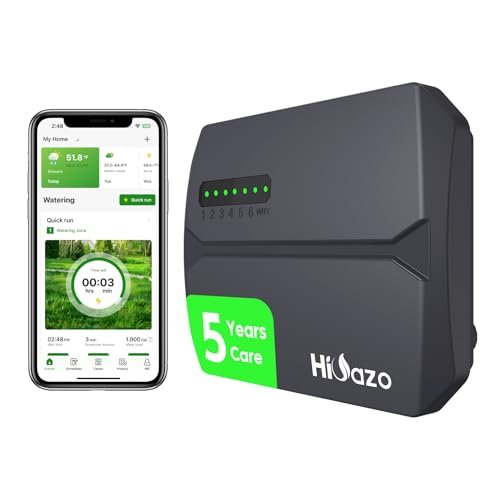
Hioazo 6-Zone Smart Sprinkler Controller Review: App Control, Weather Skips, 16 Watering Plans, and Soak Irrigation
A traditional sprinkler controller can keep a lawn watered on a basic schedule, but it often requires frequent manual adjustments as weather, seasons, and plant needs change. A smart irrigation controller aims to make that process more flexible by combining automated schedules with remote access and weather-aware watering decisions.
The Hioazo 6-Zone Smart Sprinkler Controller is designed as an upgrade for existing residential irrigation systems. According to the supplied product information, it supports up to six independently managed watering zones, as many as 16 irrigation plans, app-based remote control, weather-related watering skips, and two different irrigation strategies: continuous watering and soak-style watering.
For homeowners who already have an installed sprinkler system and want more control without rebuilding the irrigation infrastructure, the Hioazo controller offers a relatively straightforward path to smart watering. Its appeal lies less in any single feature than in the combination of remote management, multi-zone scheduling, weather awareness, and cycle-based irrigation for soils that cannot absorb water quickly.
What Is the Hioazo Smart Sprinkler Controller?
The Hioazo controller is a smart replacement for a conventional multi-zone irrigation timer.
Rather than attaching directly to a hose faucet, it is intended to operate an existing sprinkler system with wired irrigation valves. Once installed, users can manage watering through the Hioazo app instead of relying only on buttons or dials at the controller.
The supplied description highlights:
- Six irrigation zones
- Up to 16 watering plans
- Remote app control
- Real-time irrigation monitoring
- Rain skip
- Frost skip
- Wind skip
- Standard irrigation
- Soak irrigation
- DIY-oriented installation
- Broad compatibility with existing sprinkler systems
- Five-year care or support claim
This combination makes the unit suitable for homeowners who want to modernize an existing irrigation system rather than install one from scratch.
Why Six Irrigation Zones Matter
A six-zone controller allows a property to divide landscaping into multiple independently controlled areas.
For example, a typical setup might use:
Zone 1: front lawn
Zone 2: backyard lawn
Zone 3: side yard
Zone 4: flower beds
Zone 5: shrubs
Zone 6: vegetable garden
Each zone can then receive a schedule appropriate to its own irrigation needs.
That is much more efficient than forcing several different landscape types to follow one watering routine.
Different Zones Need Different Watering
Even within the same yard, water demand can vary substantially.
A sunny lawn may dry much faster than a shaded garden bed. Vegetable plants may require more frequent irrigation than established shrubs. Clay soil may need shorter watering cycles than sandy soil.
The ability to configure multiple schedules makes the controller more useful than a simple timer that treats the entire landscape as one system.
Up to 16 Watering Plans
The Hioazo controller supports as many as 16 watering plans according to the supplied information.
That gives users considerable flexibility for creating different irrigation routines across the six available zones.
A watering plan can potentially be used for:
- Daily irrigation
- Several-times-per-week watering
- Longer weekly soaking
- Special seasonal schedules
- Temporary irrigation for new plantings
The exact number of schedules each zone can use should be confirmed in the current app, but the overall capacity is generous for a six-zone residential controller.
Why Multiple Plans Can Be Useful
One schedule is often enough for a simple lawn, but more complicated landscapes may benefit from several programs.
For example, a homeowner may want:
- A normal early-morning lawn program
- A temporary summer schedule
- A separate soak program for clay soil
- A different routine for flower beds
Multiple programs allow this flexibility without repeatedly rebuilding the entire irrigation setup.
Hioazo App Control
The controller is managed through the Hioazo app according to the supplied description.
Remote access means users can monitor and adjust irrigation without walking to the garage, utility room, or outdoor controller.
This is useful when:
- Traveling
- Working away from home
- Testing sprinklers
- Adjusting schedules during changing weather
- Checking whether a zone is currently running
App-based management is one of the main conveniences of replacing a conventional irrigation timer with a smart controller.
Real-Time Irrigation Monitoring
The app is described as providing real-time monitoring.
That can make it easier to understand what the system is doing at any given moment.
Instead of wondering whether a scheduled cycle started, users can potentially confirm zone activity directly through the app.
Real-time visibility is particularly useful when troubleshooting irrigation problems or checking a system while away from home.
Remote Control During Travel
A connected irrigation controller can be particularly valuable while on vacation.
If weather conditions change unexpectedly, a schedule can be adjusted without asking someone to visit the property.
For example, irrigation could be reduced after several days of rain or modified during an unusually hot period.
Remote access does not eliminate the need for occasional system inspection, but it can substantially improve convenience.
Weather-Smart Watering
The controller includes weather-aware skip functions intended to prevent irrigation during unfavorable conditions.
The supplied product information specifically mentions:
- Rain
- Frost
- Wind
When relevant conditions are detected, scheduled watering can be skipped.
This is one of the most useful smart-controller features because fixed irrigation schedules often continue running regardless of what is happening outside.
Rain Skip
Rain skip helps avoid unnecessary irrigation when natural rainfall is already providing moisture.
This can reduce:
- Water waste
- Soil saturation
- Surface runoff
- Irrigation during storms
A traditional controller generally requires a physical rain sensor or manual intervention to accomplish the same thing.
Frost Skip
Watering during freezing or near-freezing conditions can create problems for both plants and property.
Frost-aware skipping can help avoid irrigation when temperatures are unsuitable.
Potential problems from watering in freezing conditions include:
- Ice on walkways
- Frozen sprinkler components
- Unnecessary plant stress
- Hazardous slippery surfaces
Automatically avoiding those periods improves both irrigation efficiency and safety.
Wind Skip
Wind can significantly reduce sprinkler efficiency.
Strong gusts can blow water away from the intended zone and onto:
- Driveways
- Sidewalks
- Buildings
- Adjacent landscaping
Skipping irrigation during windy periods can help improve coverage and reduce overspray.
Weather Skips Are Only as Good as the Data
Weather-aware automation is helpful, but it should not be treated as perfect.
Actual conditions at a property can differ from weather data.
A forecast may indicate rain while one neighborhood receives little or none. Wind conditions can also vary substantially between open and sheltered areas.
Smart weather skips are best used as an additional decision-making tool rather than a replacement for observing the actual landscape.
Standard Irrigation Mode
The first watering option is Standard Irrigation.
This mode keeps water flowing continuously for the programmed duration.
It is the conventional approach used by many sprinkler systems.
Standard irrigation works well when the soil can absorb water at approximately the same rate the sprinklers apply it.
When Continuous Watering Works Well
Standard watering may be appropriate for:
- Sandy soils
- Relatively flat lawns
- Lower precipitation-rate sprinklers
- Zones with good drainage
The key question is whether water infiltrates the soil without producing runoff.
Soak Irrigation Mode
The second mode is Soak Irrigation.
Instead of delivering the entire watering amount continuously, the controller can divide irrigation into shorter periods separated by pauses.
This gives the soil more time to absorb water.
The method is similar to what irrigation professionals often call cycle-and-soak watering.
Why Soak Irrigation Can Be Better for Clay Soil
Clay soils absorb water relatively slowly.
If a high-output sprinkler runs continuously, water may begin flowing across the surface before the deeper soil receives enough moisture.
Cycle-and-soak irrigation breaks the watering period into smaller segments.
For example, instead of watering continuously for 30 minutes, a system might use several shorter watering periods with pauses between them.
The total watering time may remain similar, but infiltration can improve.
Soak Irrigation Can Help on Slopes
Sloped lawns are also prone to runoff.
Water naturally moves downhill if the application rate exceeds the soil's ability to absorb it.
Shorter watering cycles with pauses can reduce this problem.
That makes soak irrigation especially useful for:
- Hills
- Sloped front yards
- Compacted soil
- Heavy clay
Soak Mode Does Not Automatically Mean Less Water
It is important to distinguish between water distribution and total water quantity.
Cycle-and-soak irrigation may improve absorption, but if the total programmed runtime remains the same, the same overall amount of water may still be applied.
The benefit comes from giving the soil more time to absorb each portion.
Tailoring Irrigation to Plant Needs
The supplied description emphasizes flexible watering frequencies.
This is important because different landscape zones should not automatically receive the same irrigation.
For example:
Lawn
Established turf may benefit from deeper, less frequent watering.
Flower Beds
Some flowers require more regular moisture, while drought-tolerant plants may need much less.
Shrubs
Established shrubs often benefit from deeper irrigation at longer intervals.
Vegetable Gardens
Vegetables can require more consistent soil moisture, particularly during fruit production.
A six-zone system can separate these needs more effectively.
Daily Watering Is Not Always Better
The availability of daily scheduling does not mean every zone should run every day.
Frequent shallow watering can encourage roots to remain near the soil surface.
For many established landscapes, deeper and less frequent irrigation may be more appropriate.
The correct schedule depends on:
- Climate
- Soil type
- Plant species
- Irrigation hardware
- Sun exposure
Soil Type Should Influence Runtime
Understanding the soil is one of the simplest ways to improve irrigation.
Sandy Soil
Water enters quickly but drains quickly.
Clay Soil
Water enters slowly and remains available longer.
Loam
Loam generally balances absorption and retention.
A smart controller becomes more effective when users combine scheduling technology with this basic landscape information.
Sprinkler Type Matters
Different sprinklers apply water at very different rates.
Common types include:
- Fixed spray heads
- Rotary nozzles
- Gear-driven rotors
- Drip irrigation
Running each for 20 minutes does not necessarily deliver the same amount of water.
Zone runtime should therefore reflect the actual irrigation equipment being used.
Smart Controllers Cannot Fix Poor Sprinkler Design
A smart controller can decide when to water, but it cannot correct physical irrigation problems.
Examples include:
- Broken sprinkler heads
- Poor head spacing
- Blocked nozzles
- Low pressure
- Underground leaks
- Sprinklers aimed at pavement
Those issues should be corrected before expecting smart scheduling to deliver good results.
Check Coverage Before Fine-Tuning Schedules
One of the best things to do after installing a new controller is test every zone manually.
Look for:
- Dry areas
- Excess overlap
- Water hitting walls
- Runoff
- Damaged heads
If coverage is uneven, adjusting the controller alone may not solve the problem.
Physical sprinkler corrections should come first.
DIY Installation
The product is marketed as DIY friendly.
According to the supplied information, installation may take around 10 minutes under ideal conditions.
That is possible in a very straightforward replacement where:
- The old controller is easy to access
- Zone wires are clearly labeled
- Power connections are compatible
- WiFi setup works immediately
For many real installations, the process may take longer.
A More Realistic Installation Process
Replacing an irrigation controller generally involves:
- Photographing the existing wiring.
- Labeling each zone wire.
- Disconnecting power.
- Removing the old controller.
- Mounting the new controller.
- Reconnecting common and zone wires.
- Restoring power.
- Connecting the app.
- Testing every irrigation zone.
Taking the time to label wires correctly can prevent significant troubleshooting later.
Compatibility With Existing Systems
The source claims compatibility with approximately 99% of existing sprinkler controllers.
This should be understood as a broad marketing claim rather than a guarantee.
Compatibility can depend on:
- Valve voltage
- Number of zones
- Existing wiring
- Pump relays
- Master valves
- Sensor connections
- Power requirements
Check the actual technical specifications before removing an existing controller.
When Professional Installation Makes Sense
DIY installation may not be appropriate if the irrigation system includes:
- A well pump
- Pump-start relay
- Master valve
- Unusual wiring
- Electrical faults
- Unlabeled valve wires
In those situations, an irrigation technician can reduce the risk of incorrect installation.
Five-Year Care or Support
The supplied product description begins with a claim of five-year care.
That may refer to product support, warranty coverage, or another service commitment.
Because the exact terms are not provided in the source material, buyers should verify:
- What is covered
- Whether parts are included
- Whether labor is covered
- When coverage begins
- Whether registration is required
Warranty language is most useful when the actual terms are clearly documented.
Smart Controller vs. Traditional Sprinkler Timer
A conventional controller usually provides:
- Fixed schedules
- Manual zone operation
- Basic seasonal adjustment
The Hioazo system adds:
- App-based control
- Real-time monitoring
- Weather skips
- Soak irrigation
- More flexible scheduling
Those features are particularly useful for people who regularly adjust watering or want remote access.
Smart Controller vs. Hose Timer
The Hioazo controller is designed for installed sprinkler systems.
It is not the same as a smart hose timer attached to an outdoor faucet.
A hose timer is usually better for:
- Portable sprinklers
- Garden hoses
- Small drip systems
The Hioazo controller is more appropriate for:
- Underground sprinklers
- Wired irrigation valves
- Permanent multi-zone landscapes
Example Six-Zone Residential Setup
A homeowner could configure the system like this:
Zone 1: Front Lawn
Standard irrigation several mornings per week.
Zone 2: Rear Lawn
Longer watering because of greater sun exposure.
Zone 3: Side Yard
Shorter cycle because the area remains shaded.
Zone 4: Flower Beds
Separate schedule based on plant requirements.
Zone 5: Shrubs
Longer, less frequent irrigation.
Zone 6: Clay-Soil Slope
Soak irrigation to reduce runoff.
This illustrates why six independently controlled zones can provide much more precision than one general schedule.
Common Mistakes
Using the Same Runtime for All Six Zones
Different sprinklers and plants usually require different schedules.
Ignoring Soil Type
Clay, sand, and loam respond very differently to irrigation.
Assuming Weather Skips Are Always Perfect
Forecast data may differ from actual conditions.
Using Standard Irrigation on a Runoff-Prone Slope
Soak mode may be more appropriate.
Expecting the Controller to Fix Broken Sprinklers
Hardware problems still require physical repairs.
Believing Every Installation Takes 10 Minutes
Older or complicated systems may take considerably longer.
Assuming 99% Compatibility Guarantees Your Setup
Always check wiring and electrical specifications.
Best Practices for Initial Setup
After installation, keep the first schedule relatively simple.
Start by testing every zone and confirming that:
- The correct valve opens
- Sprinkler coverage is acceptable
- There are no obvious leaks
- Water is not running onto pavement
Then create watering plans based on each zone's actual needs.
Avoid programming all 16 schedules simply because the controller supports them.
Complexity should solve a real irrigation problem.
Monitor the Lawn During the First Few Weeks
Smart automation still benefits from observation.
Look for:
- Dry patches
- Mushy soil
- Standing water
- Runoff
- Wilting plants
If problems appear, modify watering duration or frequency rather than assuming the initial schedule is correct.
Who Is the Hioazo 6-Zone Controller Best For?
The Hioazo controller may be a good fit for homeowners who:
- Have an existing multi-zone sprinkler system
- Need six zones or fewer
- Want app-based remote control
- Want weather-related skips
- Need cycle-and-soak functionality
- Prefer DIY installation
It is particularly attractive for yards containing several different plant and soil conditions.
Who May Prefer a Simpler Controller?
A basic timer may be sufficient if:
- The landscape has only a few uniform zones
- Irrigation rarely needs adjustment
- Remote access is unnecessary
- Weather-based automation provides little value
Smart controllers are most useful when their additional capabilities are actively used.
Advantages and Considerations
Advantages
The Hioazo Smart Sprinkler Controller combines six-zone management, up to 16 watering plans, app control, real-time monitoring, rain, frost, and wind skips, and both standard and soak irrigation modes.
For landscapes with clay soil, slopes, or different types of vegetation, the soak function and zone-specific scheduling can be especially useful.
Considerations
The advertised 10-minute installation time and 99% compatibility should be treated as best-case claims rather than guarantees.
Weather-based skips also depend on the quality of the underlying weather information, while smart scheduling cannot correct physical irrigation defects such as broken sprinkler heads or poor water pressure.
The exact terms of the stated five-year care program should be reviewed before purchase.
Frequently Asked Questions
How many zones does the Hioazo controller support?
The supplied information specifies six irrigation zones.
How many watering plans can I create?
Up to 16 plans, according to the source.
Can each zone have a different schedule?
Yes. Independent zone management is one of the main advantages of the controller.
Can I control it from my phone?
Yes, through the Hioazo app.
Can I control it while away from home?
The supplied description indicates remote app management.
Can I monitor watering in real time?
Yes.
Does it skip watering when rain is expected?
Yes, according to the product description.
Does it skip watering during frost?
Yes.
Does it skip watering when conditions are windy?
Yes.
What is Standard Irrigation?
Standard mode waters continuously for the selected runtime.
What is Soak Irrigation?
Soak mode divides watering into cycles with pauses between them, allowing soil more time to absorb water.
Is soak irrigation useful for clay soil?
Yes, it can help reduce surface runoff.
Is soak mode useful on slopes?
Potentially, because the pauses give water more time to infiltrate before additional irrigation is applied.
Does soak irrigation automatically use less water?
Not necessarily. It changes how water is delivered rather than guaranteeing a lower total quantity.
Is this a hose timer?
No. It is designed to control an installed multi-zone sprinkler system.
Can it replace an existing irrigation controller?
That is its intended use, provided the existing system is electrically and functionally compatible.
Is installation really possible in 10 minutes?
Potentially for a very simple replacement, but actual installation time can vary.
Does it work with every sprinkler system?
The source claims broad compatibility, but technical specifications should be checked before purchase.
Does it fix irrigation leaks?
No. It controls watering schedules but does not repair physical plumbing problems.
Does it compensate for broken sprinkler heads?
No.
Does it include weather-smart scheduling?
The supplied description specifically identifies rain, wind, and frost skipping.
Is there a five-year warranty?
The source mentions "5 Year Care," but the exact warranty or support terms should be verified with the manufacturer.
Final Thoughts
The Hioazo 6-Zone Smart Sprinkler Controller is a practical option for homeowners who want to modernize an existing irrigation system without replacing the underlying valves and sprinkler lines.
Its strongest features are six-zone control, up to 16 watering plans, app-based remote management, real-time monitoring, weather-related skips, and the choice between continuous and soak-style irrigation.
The soak mode is particularly valuable for landscapes with clay soil, compacted ground, or slopes where long uninterrupted watering cycles can cause runoff. Meanwhile, rain, frost, and wind skips can help avoid irrigation when conditions are unfavorable.
The controller's smart capabilities work best when the physical irrigation system is already in good condition. Proper sprinkler coverage, adequate water pressure, accurate zone wiring, and schedules matched to actual soil and plant needs remain essential.
For a homeowner with an existing six-zone-or-smaller sprinkler system who wants remote app control, flexible scheduling, weather-aware automation, and cycle-and-soak watering without a complicated professional upgrade, the Hioazo controller offers a well-rounded smart irrigation feature set.