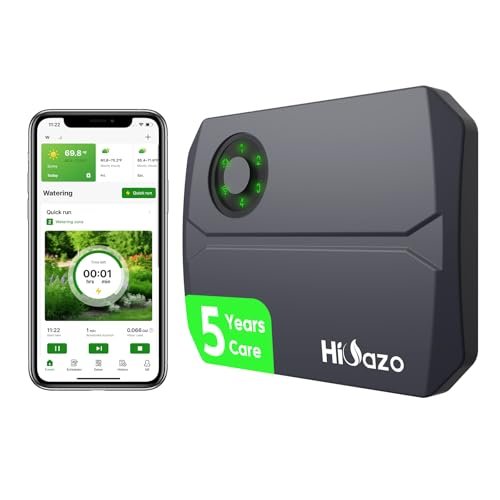
Hioazo 4-Zone Smart Sprinkler Controller Review: App Control, Weather Skips, and Soak Irrigation
A smart sprinkler controller can make a traditional irrigation system much easier to manage. Instead of walking to the garage or outdoor control box every time you need to change a watering schedule, a connected controller lets you make adjustments from your phone and respond more intelligently to changing weather.
The Hioazo 4-zone smart sprinkler controller is designed for residential irrigation systems that need more flexibility than a basic timer provides. It supports app-based remote control, weather-aware watering skips, up to 16 watering plans, and two irrigation modes intended to handle both continuous watering and slower soak-style applications.
For homeowners with several lawn or garden zones, the main attraction is centralized control. Each area can be programmed according to its own watering requirements rather than forcing the entire yard onto one schedule.
What Is the Hioazo Smart Sprinkler Controller?
The Hioazo controller is intended to manage an existing multi-zone sprinkler system through electrically operated irrigation valves.
Based on the supplied product information, its main features include:
- Four irrigation zones
- Up to 16 watering plans
- 2.4 GHz WiFi connectivity
- Hioazo app control
- Remote schedule management
- Real-time monitoring
- Rain-based watering skips
- Frost-based watering skips
- Wind-based watering skips
- Standard irrigation mode
- Soak irrigation mode
- DIY-oriented installation
This makes it better suited to a permanent residential sprinkler system than a simple hose timer attached to an outdoor faucet.
Four Independent Irrigation Zones
The controller supports four watering zones.
A zone typically represents one group of sprinkler heads or drip lines controlled by its own electric valve.
For example, a four-zone yard might be divided into:
- Front lawn
- Backyard
- Flower beds
- Shrub or drip-irrigation zone
Each zone can then be managed according to the needs of that particular landscape area.
Why Irrigation Zones Matter
Different parts of a property rarely require exactly the same amount of water.
A sunny lawn may dry much faster than a shaded flower bed. Drip irrigation may also need a completely different run time from conventional spray heads.
Independent zones help avoid situations where one area is overwatered simply because another needs more irrigation.
Control the System Through the Hioazo App
The Hioazo app provides remote access to the controller.
Instead of standing in front of the irrigation panel, you can manage schedules and monitor watering from a compatible smartphone.
That can be especially useful if the controller is installed:
- In a garage
- In a utility room
- Outside
- In another part of the property
Remote control reduces the need to repeatedly access the physical controller.
2.4 GHz WiFi Requirement
The supplied description specifies 2.4 GHz WiFi.
This is common for smart-home and irrigation devices because 2.4 GHz usually provides better range through walls than 5 GHz.
Before installation, make sure the controller location receives a stable 2.4 GHz signal.
Poor wireless coverage can reduce the usefulness of remote control and real-time monitoring.
Real-Time Monitoring
The app is described as supporting real-time monitoring.
This can make it easier to see what the irrigation system is doing without physically checking the controller.
Depending on the current app implementation, this may help users verify:
- Which zone is operating
- Whether a schedule has started
- Whether watering has been skipped
Exact monitoring features should be confirmed in the latest Hioazo app documentation.
Weather-Smart Irrigation
One of the system's most useful features is weather-aware watering.
The supplied information states that the controller can skip irrigation during unfavorable conditions such as:
- Rain
- Frost
- Strong wind
This helps make irrigation more responsive than a conventional fixed schedule.
Rain Skips
Watering during or immediately around significant rainfall can waste water and oversaturate soil.
A rain-aware controller can temporarily skip a scheduled cycle when natural rainfall is expected to provide sufficient moisture.
This can be especially useful for lawn and garden zones.
Frost Skips
Running irrigation during freezing conditions may create problems for:
- Plants
- Walkways
- Sprinkler components
Water can freeze on surfaces or irrigation hardware.
A frost-based skip can therefore provide both water-saving and practical protective benefits.
Wind Skips
Strong wind can interfere with sprinkler coverage.
Instead of landing evenly on a lawn, spray may drift toward:
- Sidewalks
- Driveways
- Fences
- Neighboring areas
Skipping irrigation during excessive wind can make watering more effective.
This feature is most relevant to spray heads and rotors rather than underground drip irrigation.
Weather Data Is Not the Same as Soil Moisture
Weather-aware scheduling is useful, but it does not directly measure the condition of the soil.
Two zones can react very differently to the same weather.
For example:
- Sandy soil may dry quickly
- Clay soil may stay wet for days
- A covered bed may receive little rainfall
- A shaded area may retain moisture longer
Use weather automation as one input rather than assuming it perfectly represents every zone.
Up to 16 Watering Plans
The Hioazo controller supports up to 16 watering plans across its four zones according to the supplied product information.
This gives users considerable flexibility when building irrigation schedules.
Separate plans may be useful for:
- Different days
- Different seasons
- Different plant groups
- Different irrigation methods
Why Multiple Plans Are Useful
A single program may not be enough for a mixed landscape.
For example, one plan might handle lawn watering while another manages a drip-irrigated planting bed.
The ability to create multiple plans helps tailor irrigation rather than applying one generic schedule to the entire property.
Avoid Creating Too Many Overlapping Schedules
Flexible programming can become counterproductive if too many plans are active at once.
Overlapping programs can result in:
- Duplicate watering
- Excessive runtime
- Difficult troubleshooting
Keep schedules as simple as possible while still meeting the needs of each zone.
Flexible Watering Frequencies
The supplied description indicates that watering can be configured for different frequencies.
This allows users to create routines ranging from frequent watering to less frequent deep irrigation.
That can be useful for different plant types.
For example, a newly planted bed may need more frequent watering than an established landscape zone.
Standard Irrigation Mode
The first watering mode is Standard Irrigation.
In this mode, the selected valve runs continuously for the programmed duration.
This approach works well when:
- Soil absorbs water quickly enough
- Runoff is not a problem
- A single continuous irrigation session is appropriate
It is the familiar operating mode used by most traditional sprinkler controllers.
Soak Irrigation Mode
The second option is Soak Irrigation.
This mode is intended to give soil additional time to absorb water instead of applying the entire irrigation amount continuously.
It can be particularly useful where water tends to run off before penetrating deeply.
Why Soak Irrigation Can Help
Sprinklers sometimes apply water faster than soil can absorb it.
This can result in:
- Surface pooling
- Runoff
- Water flowing onto pavement
- Uneven root-zone moisture
A soak-oriented strategy gives water time to move into the soil before more is applied.
Best Uses for Soak Irrigation
This mode can be especially useful for:
- Clay soils
- Compacted lawns
- Sloped landscapes
- Areas with frequent runoff
Sandy soil may require a different strategy because it absorbs and drains water much more quickly.
Example of a Soak Strategy
Suppose a lawn needs about 24 minutes of total irrigation.
Instead of applying all 24 minutes continuously, a soak-style program may split that requirement into several shorter watering periods with pauses between them.
That can improve infiltration while reducing surface runoff.
The exact cycle length should be based on actual sprinkler output and soil behavior.
Customize Each Zone Separately
One of the best ways to use a multi-zone controller is to program zones according to their actual landscape characteristics.
Consider:
- Plant type
- Soil texture
- Sun exposure
- Sprinkler type
- Slope
when building each schedule.
A spray zone and a drip zone should generally not be treated as though they apply water at the same rate.
Lawn Irrigation
For lawn zones, the controller can be used with conventional:
- Spray heads
- Rotor sprinklers
Weather skips and soak irrigation can be especially useful here.
Lawns are often where runoff and overspray become most noticeable.
Flower Beds
Flower beds may benefit from a separate program with different watering frequency and duration.
Beds in full sun may need more water than shaded areas.
Grouping them into their own zone allows more precise control.
Shrubs and Trees
Established shrubs and trees may require deeper but less frequent watering than turf grass.
A dedicated zone can help accommodate that difference.
Drip Irrigation
Drip zones usually apply water much more slowly than spray sprinklers.
They often require longer runtimes but may need fewer watering days.
Keeping drip irrigation on its own schedule allows the controller to reflect that lower flow rate.
Installation Is Designed for DIY Replacement
The source describes installation as taking approximately 10 minutes in straightforward situations.
That should be treated as a best-case estimate rather than a guarantee.
Actual installation time depends on:
- Existing controller
- Wiring condition
- Number of valves
- Mounting location
- Power configuration
Replacing a clearly labeled controller can be quick. Troubleshooting old or poorly labeled wiring can take considerably longer.
Take a Photo Before Disconnecting the Old Controller
Before removing an existing irrigation controller, photograph all wiring clearly.
This provides a reference for:
- Zone wires
- Common wire
- Power connections
- Any accessory terminals
It is one of the simplest ways to avoid confusion during replacement.
Label Every Zone
Do not depend only on wire colors.
Label wires according to their real landscape function.
For example:
- Zone 1 — Front Lawn
- Zone 2 — Rear Lawn
- Zone 3 — Flowers
- Zone 4 — Drip
This makes both installation and later troubleshooting much easier.
Compatibility Claims Should Be Verified
The supplied product description claims compatibility with 99% of existing sprinkler controllers.
That is a broad marketing claim and should not replace an actual compatibility check.
Before purchasing, verify:
- Number of irrigation zones
- Valve voltage
- Existing power supply
- Master valve requirements
- Pump-start relay requirements
- Sensor connections
Some specialized irrigation systems may require features not provided by this controller.
Test Every Valve After Installation
Once the controller is wired, manually activate each station.
Confirm that:
- The correct zone turns on
- Watering is normal
- The valve shuts off completely
- Zone labels match the actual landscape
Complete this test before relying on automated schedules.
Smart Controller vs. Traditional Irrigation Timer
A traditional controller may still be sufficient for a simple landscape.
Traditional Controller Advantages
- Straightforward operation
- No WiFi dependency
- Fewer connected features
Hioazo Smart Controller Advantages
- App control
- Remote monitoring
- Weather skips
- Multiple schedules
- Soak irrigation
The smart model makes the most sense when remote access and weather-based automation provide meaningful value.
Smart Sprinkler Controller vs. Smart Hose Timer
These products serve different types of irrigation systems.
A smart hose timer mounts directly to an outdoor faucet.
The Hioazo controller manages electrically operated sprinkler valves.
Choose a hose timer for:
- Above-ground hose watering
- Small drip systems
- Portable sprinklers
Choose a controller like Hioazo for:
- Permanent sprinkler zones
- Wired irrigation valves
- Multi-zone landscaping
Common Mistakes to Avoid
Connecting to the Wrong WiFi Band
The controller requires 2.4 GHz connectivity.
Giving Every Zone the Same Schedule
Different landscape areas often need different watering patterns.
Ignoring Soil Type
Clay and sandy soils respond very differently to irrigation.
Overlapping Multiple Plans
Too many programs can accidentally increase watering.
Trusting Weather Skips Completely
Forecast data does not directly measure soil moisture.
Skipping the Manual Zone Test
Always verify every valve after installation.
How to Build a Better Irrigation Schedule
Start by evaluating each zone independently.
Ask:
- What plants are present?
- How much sun does the area receive?
- What sprinkler type is installed?
- Does runoff occur?
- How quickly does the soil dry?
Use those observations to choose the frequency and duration.
If runoff develops before watering is complete, consider Soak Irrigation instead of one uninterrupted session.
Adjust Watering With the Seasons
A schedule that works during summer may provide too much water during cooler months.
Weather skips can help, but they do not replace seasonal review.
Periodically reassess:
- Frequency
- Runtime
- Soil moisture
- Plant condition
and adjust programs as needed.
Advantages and Considerations
Advantages
- Four-zone irrigation control
- Up to 16 watering plans
- Hioazo mobile app
- Remote control
- Real-time monitoring
- Rain skips
- Frost skips
- Wind skips
- Standard irrigation
- Soak irrigation
- DIY-focused installation
Potential Considerations
- Requires 2.4 GHz WiFi
- Weather forecasts do not directly measure soil moisture
- 10-minute installation is likely a best-case scenario
- Broad compatibility claim should be verified against the existing system
- Multiple programs require careful management to prevent overlap
Frequently Asked Questions
How many zones does the Hioazo controller support?
The supplied description specifies four zones.
How many watering plans can be created?
Up to 16, according to the source.
Can I control it from my phone?
Yes, through the Hioazo app.
What WiFi frequency does it use?
2.4 GHz.
Can it automatically skip watering when rain is expected?
Yes, according to the supplied product information.
Does it account for freezing conditions?
Yes, frost-based skips are listed.
Can it skip watering during strong wind?
Yes.
What is Standard Irrigation?
It runs a zone continuously for the scheduled watering period.
What is Soak Irrigation?
It allows watering to be divided in a way that gives soil additional time to absorb moisture and can help reduce runoff.
Can different zones use different schedules?
Yes. That is one of the main benefits of a multi-zone smart controller.
Is it compatible with existing sprinkler systems?
The source claims broad compatibility, but compatibility should be checked against the exact valve, wiring, and power requirements of your system.
Can I install it myself?
It is marketed as DIY-friendly. Installation difficulty depends on the existing system and wiring.
Final Thoughts
The Hioazo 4-zone smart sprinkler controller is designed for homeowners who want to add remote control and weather-aware automation to an existing residential irrigation system.
Its most useful features are the combination of app management, 16 programmable watering plans, weather-based rain, frost, and wind skips, and the choice between Standard and Soak Irrigation. Those tools make it easier to treat different parts of a landscape according to their actual watering requirements rather than relying on one rigid schedule.
The main limitations are the need for stable 2.4 GHz WiFi and the importance of verifying compatibility before replacing an existing controller. The advertised quick installation may be realistic for a simple controller swap, but older or poorly labeled irrigation wiring can make the process more involved.
For homeowners looking for a 4-zone smart sprinkler controller with app control, weather skips, Soak Irrigation, multiple watering schedules, and remote monitoring, the Hioazo system offers a practical way to modernize a conventional lawn and garden irrigation setup.