One-Piece Round Pedestal Bathroom Sink Review: Compact Ceramic Design for Small Bathrooms
A pedestal sink can be a smart choice when you want to preserve floor space without making a bathroom feel unfinished. Unlike a full vanity, it keeps the room visually open while still providing a dedicated basin, faucet connection, drainage, and overflow protection in a compact footprint.
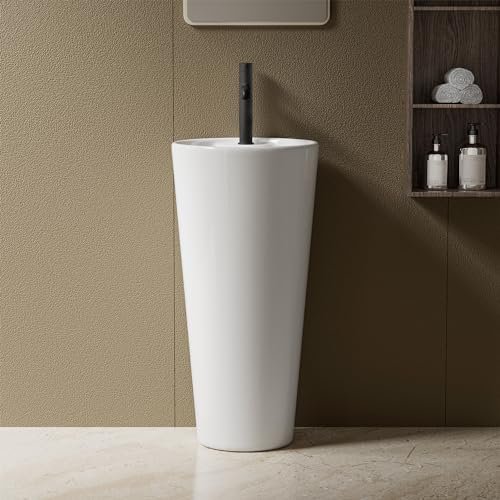
This one-piece round pedestal bathroom sink is designed for small bathrooms, powder rooms, guest baths, laundry rooms, and other spaces where a conventional vanity may feel too bulky. Its ceramic construction, integrated pedestal form, single-hole faucet opening, and approximately 5-1/2-inch basin depth make it a practical option for everyday handwashing while maintaining a clean, modern appearance.
The design is straightforward rather than feature-heavy, which can be an advantage in a small room. There is no cabinet to assemble, no countertop to coordinate, and fewer separate surfaces to maintain.
What Is This One-Piece Pedestal Sink?
This is a freestanding ceramic bathroom basin with the pedestal incorporated into the overall design.
The supplied specifications include:
- One-piece pedestal construction
- Round basin design
- Ceramic material
- Approximately 5-1/2-inch basin depth
- 2-inch drain opening
- Rear pipe opening
- Overflow feature
- Single faucet hole
- Faucet-hole diameter of approximately 1-1/5 inches
- Faucet not included
Its compact format is intended to combine the space efficiency of a pedestal sink with a simple contemporary appearance.
Why Choose a Pedestal Sink?
The biggest reason to choose a pedestal sink is space.
A vanity typically extends farther into the room and visually occupies more area because of the cabinet beneath the basin. A pedestal leaves more of the surrounding floor visible, which can make a small bathroom feel less crowded.
That can be especially useful in:
- Powder rooms
- Half bathrooms
- Small guest bathrooms
- Narrow washrooms
- Compact apartments
- Laundry areas
A pedestal sink also works well when storage is already available elsewhere and you do not need drawers or cabinets directly beneath the basin.
One-Piece Design
The sink uses an integrated one-piece form rather than a separate basin and pedestal column.
That can create a cleaner visual appearance with fewer joints between components.
It may also simplify routine cleaning because there are fewer seams where:
- Dust
- Moisture
- Soap residue
can collect.
The exact installation method should still be confirmed from the supplied hardware and manufacturer instructions.
Ceramic Construction
The sink is made from ceramic.
Ceramic is widely used for bathroom fixtures because it offers a hard, smooth surface that handles regular exposure to water well.
A glazed ceramic basin is generally:
- Easy to wipe clean
- Resistant to ordinary bathroom moisture
- Compatible with common bathroom cleaners
- Visually neutral
It can also maintain a polished appearance for a long time when cleaned with non-abrasive products.
Ceramic Is Durable, but Not Indestructible
Ceramic should not be treated as impact-proof.
A heavy object dropped onto an edge or into the basin can potentially cause:
- Chips
- Cracks
- Glaze damage
Normal use is unlikely to create problems, but care is still appropriate during installation and cleaning.
Round Basin Design
The rounded bowl gives the sink a softer appearance than sharply rectangular basins.
This can work particularly well in:
- Transitional bathrooms
- Contemporary bathrooms
- Small spaces where sharp corners feel intrusive
Rounded edges may also reduce the visual bulk of the fixture in a narrow room.
5-1/2-Inch Basin Depth
The basin depth is listed at approximately 5-1/2 inches.
That provides more usable bowl capacity than many extremely shallow compact sinks.
A deeper basin can help contain:
- Handwashing water
- Faucet splash
- Soap residue
This is especially useful in small bathrooms, where the sink may be positioned close to walls or nearby fixtures.
Why Basin Depth Matters
Very shallow sinks can look attractive but often create more splashing.
A moderately deeper bowl provides more distance between the faucet outlet and surrounding edges.
That can make everyday use more comfortable, particularly if the faucet flow is reasonably controlled.
Overflow Protection
The sink includes an overflow opening.
An overflow provides an additional drainage path if the water level rises high enough.
This can help reduce the chance of the basin spilling over if:
- The drain is partially blocked
- Water is left running
However, an overflow is not a guarantee against flooding. A high-flow faucet or fully blocked drain can still exceed the overflow's capacity.
Drain Compatibility
The supplied information lists a 2-inch drain opening.
Before purchasing a drain assembly, verify the exact measured diameter and required connection type for this model.
Because the sink has an overflow, the drain should generally be compatible with overflow-equipped basins.
Do not automatically buy a non-overflow vessel-sink drain.
Rear Pipe Opening
The sink includes an opening at the rear intended to help accommodate plumbing.
This can simplify routing for:
- Drain pipe
- Water supply connections
A pedestal sink still requires careful plumbing placement because much of the installation remains visible or partially exposed.
Single-Hole Faucet Design
The basin is pre-drilled for one faucet.
The opening is listed at approximately 1-1/5 inches, or roughly 3 cm.
That makes the sink suitable for a single-hole bathroom faucet with an appropriately sized mounting shank.
The faucet itself is not included.
Choosing the Right Faucet
A compact pedestal sink should be paired with a faucet that fits the basin proportionally.
Check:
- Faucet-hole diameter
- Spout height
- Spout reach
- Water-flow direction
A faucet that projects too far can cause water to strike the front wall of the basin and splash outward.
A faucet with too little reach may discharge too close to the rear of the bowl.
Faucet Height Matters
Very tall faucets can overpower a small pedestal sink visually.
They can also increase splash depending on the distance between the aerator and basin floor.
A medium-height bathroom faucet is often a better fit unless the manufacturer specifies otherwise.
Space-Saving Benefits
The pedestal format works particularly well in small spaces because it avoids a full-width cabinet.
That leaves more visible floor around the fixture and can make the bathroom easier to navigate.
It can also provide more flexibility around:
- Toilet clearance
- Door swing
- Narrow walkways
Measure the total projection of the sink before buying, not just its width.
Good Choice for Powder Rooms
Powder rooms usually need only:
- Handwashing
- Soap
- Small towel
Large counter space is often unnecessary.
A pedestal sink can therefore provide enough functionality without consuming valuable floor area.
Suitable Beyond the Main Bathroom
The supplied description also suggests use in areas such as:
- Laundry rooms
- Kitchens
- Balconies
- Commercial washrooms
Whether those applications are appropriate depends on plumbing, local codes, and the intended use.
For most buyers, its strongest role remains as a compact bathroom or washroom fixture.
Residential Applications
In a home, the sink may work well in:
- Guest bathroom
- Half bath
- Secondary bathroom
- Small ensuite
Its simple shape can fit several decorating styles without becoming the dominant visual element.
Commercial Applications
A pedestal sink can also work in some:
- Offices
- Retail spaces
- Hospitality settings
- Public washrooms
Commercial installations should verify:
- Accessibility requirements
- Mounting stability
- Plumbing code
- Fixture durability
before relying solely on residential product specifications.
Cleaning and Maintenance
Routine maintenance should be simple.
Use:
- Mild bathroom cleaner
- Soft cloth
- Non-abrasive sponge
After cleaning, rinsing away residue helps preserve the glazed finish.
Avoid Abrasive Cleaners
Harsh scouring products can dull a glossy ceramic surface over time.
Avoid:
- Steel wool
- Aggressive abrasive powder
- Hard scraping tools
Most normal bathroom residue does not require heavy abrasion.
Hard-Water Care
Hard water can leave mineral deposits around:
- Drain
- Faucet base
- Overflow opening
Regular cleaning before heavy scale develops is usually easier than trying to remove thick deposits later.
Installation Considerations
A pedestal sink may look simple, but correct installation still matters.
The installer should verify:
- Drain alignment
- Water supply location
- Floor level
- Wall support where required
- Faucet clearance
Do not assume the pedestal alone carries every structural load without checking the manufacturer's instructions.
Measure Before Buying
Before ordering, check:
- Available wall width
- Sink projection
- Door clearance
- Toilet clearance
- Drain location
- Supply-line location
A fixture can be compact overall and still interfere with a narrow doorway or toilet.
Pedestal Sink vs. Vanity
A pedestal sink is best when openness matters more than storage.
Pedestal Sink Advantages
It creates a lighter appearance, uses less floor area, and can simplify cleaning around the fixture.
Vanity Advantages
A vanity provides:
- Storage
- Countertop space
- Concealed plumbing
If you need to store toiletries directly beneath the sink, a vanity may be more practical.
Pedestal Sink vs. Wall-Mounted Sink
Both are useful in small bathrooms.
A wall-mounted sink leaves the entire floor open, while a pedestal provides a more traditional freestanding appearance.
A pedestal may appeal to buyers who want:
- More visual substance
- Less exposed support hardware
- A classic or transitional look
A floating sink may be better for an ultra-minimalist design.
Common Buying Mistakes
Assuming the Faucet Is Included
The source states that the faucet must be purchased separately.
Ignoring Faucet Reach
The wrong spout geometry can cause excessive splashing.
Buying the Wrong Drain
The sink includes an overflow, so drain compatibility matters.
Forgetting About Plumbing Placement
A pedestal cannot compensate for badly positioned drain or supply lines.
Choosing Based Only on Width
Projection into the room matters just as much.
Who Is This Pedestal Sink Best For?
This model may be a good fit for:
- Small bathrooms
- Powder rooms
- Guest baths
- Compact residential spaces
- Buyers who prefer a clean one-piece ceramic design
It may be less suitable for people who need:
- Large countertop area
- Under-sink storage
- A wide vanity workspace
Advantages and Considerations
Advantages
- Space-saving pedestal format
- One-piece design
- Ceramic construction
- Smooth glazed surface
- Approximate 5-1/2-inch basin depth
- Overflow included
- Rear plumbing opening
- Single-hole faucet configuration
- Suitable for compact bathrooms
Potential Considerations
Faucet is not included.
Drain compatibility should be verified.
Pedestal sinks provide little or no storage.
Plumbing may remain partially visible.
Exact dimensions should be confirmed before installation.
Frequently Asked Questions
What is the sink made from?
The supplied description states that it is made from ceramic.
Is it a one-piece pedestal sink?
Yes.
How deep is the basin?
Approximately 5-1/2 inches according to the supplied specifications.
Does it have an overflow?
Yes.
What size is the drain opening?
The source lists a 2-inch drain opening.
Does it include a faucet?
No.
What type of faucet does it use?
It is designed for a single-hole faucet.
What size is the faucet opening?
Approximately 1-1/5 inches, or about 3 cm.
Can it work in a small bathroom?
Yes. The compact pedestal design is one of its primary advantages.
Can it be used outside a bathroom?
The supplied description mentions laundry rooms, kitchens, balconies, and commercial spaces, but suitability depends on the specific installation.
Final Thoughts
This one-piece round ceramic pedestal bathroom sink is designed for buyers who want a compact fixture without the visual bulk of a vanity.
Its strongest qualities are straightforward: a space-saving pedestal profile, moderately deep basin, integrated overflow, single-hole faucet configuration, and durable glazed ceramic construction. Those features make it particularly well suited to powder rooms, half baths, and other bathrooms where floor space matters more than storage.
The most important planning considerations are faucet compatibility, drain selection, and existing plumbing position. Because the faucet is not included, buyers also have the freedom to select a finish and style that better matches the rest of the bathroom.
For anyone looking for a compact one-piece pedestal sink with ceramic construction, overflow protection, a single faucet hole, and a space-efficient round design, this model offers a practical foundation for a small or modern bathroom.