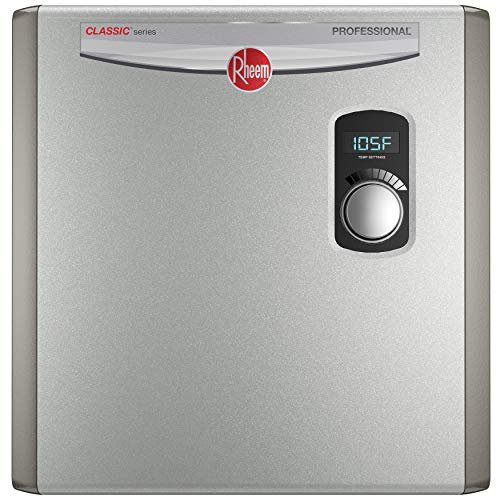
Rheem Professional Classic RTEX-24 Review: 24kW Electric Tankless Water Heater With Up to 5.9 GPM
The Rheem Professional Classic RTEX-24 is a high-output electric tankless water heater designed for homeowners who want continuous hot water without the footprint of a conventional storage tank. Rated at 24kW with a listed maximum flow of up to 5.9 gallons per minute, it sits well above small point-of-use models and is intended for larger hot-water demands.
Its combination of self-modulating power, digital temperature control, 3/4-inch NPT plumbing connections, and compact wall-mounted construction makes it suitable for applications ranging from individual fixtures to multiple simultaneous points of use, provided the heater is correctly sized for the property's incoming water temperature and flow requirements.
The most important thing to understand is that 5.9 GPM is a maximum flow figure, not a guarantee under every condition. As with all electric tankless water heaters, actual hot-water capacity depends heavily on how much the incoming water needs to be heated. In warmer climates, the RTEX-24 can support considerably more flow than it can when incoming groundwater is very cold.
For a home with sufficient electrical infrastructure and moderate-to-high hot-water demand, the RTEX-24 offers an appealing alternative to a bulky tank-style electric water heater.
What Is the Rheem RTEX-24?
The RTEX-24 is a 24kW, 240V electric tankless water heater from Rheem's Professional Classic line.
Instead of storing hot water in a tank, it heats water as it passes through the unit. When a faucet or shower is opened, the heater detects demand and activates its heating elements. When water flow stops, active heating stops.
That means there is no fixed reservoir of hot water to exhaust.
As long as total demand remains within the heater's heating capacity, it can continue producing hot water for an extended period.
Key RTEX-24 Specifications
The supplied product information highlights the following core features:
- Heating output: 24kW
- Voltage: 240V
- Maximum listed flow: up to 5.9 GPM
- Control: on/off dial with digital temperature display
- Power management: self-modulating
- Water connections: bottom-mounted 3/4-inch NPT
- Heating method: electric tankless
- Application: single or multiple points of use
- Design: compact wall-mounted construction
These specifications position the RTEX-24 as a substantially more capable heater than the smaller RTEX models intended primarily for sinks or individual fixtures.
What Does 24kW Mean?
A 24kW electric water heater has substantial heating capacity.
That extra power allows the RTEX-24 to heat more water per minute than smaller point-of-use models while maintaining a useful temperature rise.
This is what makes it potentially suitable for several fixtures rather than only one sink.
However, higher output also means significantly greater electrical demand. The exact circuit, breaker, conductor, panel-capacity, and installation requirements should be taken directly from Rheem's current installation documentation and local electrical code.
Professional electrical evaluation is especially important at this power level.
Understanding the 5.9 GPM Flow Rating
Rheem lists the RTEX-24 at up to 5.9 gallons per minute.
That sounds like a straightforward capacity figure, but tankless water heaters are more complicated than storage tanks.
The unit can only transfer a finite amount of heat into the water each minute.
If incoming water is already relatively warm, the heater can support a higher flow while reaching the desired outlet temperature.
If incoming water is very cold, the heater has to add substantially more heat to every gallon, reducing the maximum sustainable flow.
Temperature Rise Determines Real Performance
Consider a home where incoming water is 70°F and the user wants 105°F water.
The heater needs to create a 35°F temperature rise.
Now compare that with a home where inlet water is 40°F and the desired outlet is still 105°F.
The required rise is 65°F.
The RTEX-24 has the same 24kW of heating power in both scenarios, so it cannot deliver the same flow at both temperature rises.
This is why sizing charts based on groundwater temperature are more useful than looking at the 5.9 GPM number alone.
Why Climate Matters
Electric tankless water heaters generally perform more favorably in warmer climates.
Higher incoming water temperature means less heating is required.
That can allow the RTEX-24 to serve multiple fixtures more comfortably.
In colder regions, particularly during winter, available flow at shower temperature can be substantially lower.
Anyone considering the RTEX-24 for whole-house use should factor local winter groundwater temperature into the decision.
Can the RTEX-24 Run One Shower?
Yes, under normal sizing conditions, a single shower is a relatively modest demand for a 24kW system.
Even a conventional showerhead generally uses much less than the RTEX-24's advertised maximum flow.
The more relevant question is how many additional fixtures will operate at the same time.
Can It Run Two Showers?
Potentially, yes.
For example, two efficient showerheads using around 1.8 GPM each would create a combined flow of approximately 3.6 GPM.
That is below the listed 5.9 GPM maximum.
Whether the heater can maintain the desired temperature at that flow depends on inlet temperature.
In warmer conditions, two showers may be very realistic.
In much colder conditions, available capacity may be reduced.
Can It Run Three Showers?
Possibly under favorable conditions, but this should not be assumed automatically.
Three 1.5 GPM showerheads would total 4.5 GPM.
Three 2.0 GPM showers would require 6.0 GPM, already slightly above the advertised maximum before accounting for temperature rise.
Actual fixture flow matters far more than the number of bathrooms in the house.
Add Up Simultaneous Demand
A better sizing method is to total the flow of fixtures likely to run simultaneously.
For example:
- Shower: 1.8 GPM
- Second shower: 1.8 GPM
- Bathroom faucet: 0.5 GPM
- Kitchen faucet: 1.0 GPM
Total demand would be 5.1 GPM.
The next step is determining whether 24kW can maintain the desired outlet temperature at 5.1 GPM given the home's incoming water temperature.
That is the real sizing question.
Continuous Hot Water Without a Storage Tank
One of the RTEX-24's biggest advantages is continuous heating.
A conventional electric storage tank contains a fixed amount of hot water. Once enough of that water is used, incoming cold water lowers the tank temperature and the heater needs time to recover.
The RTEX-24 does not have that limitation.
It keeps heating water as long as there is demand.
Continuous Does Not Mean Unlimited
"Endless hot water" can be misleading if interpreted too broadly.
The duration may be effectively unlimited, but the flow is not.
If demand exceeds the RTEX-24's heating capacity, it cannot maintain the same outlet temperature indefinitely.
This is why a correctly sized tankless water heater performs very differently from an undersized one.
Self-Modulating Power Control
The RTEX-24 uses self-modulating power control.
Rather than simply operating at maximum output whenever water flows, it can adjust power according to demand.
If only a small faucet is open, the heater does not necessarily need the same electrical input as when several showers are operating.
This can improve temperature control and avoid unnecessary power consumption.
Why Self-Modulation Matters
Hot-water demand varies constantly.
A bathroom sink may use a fraction of the water required by a shower.
A kitchen faucet may fluctuate between a small stream and full flow.
Self-modulating control allows the heater to respond to these changes rather than behaving like a simple all-or-nothing heating appliance.
That helps provide more consistent outlet temperature.
Digital Temperature Display
The RTEX-24 includes an adjustable digital temperature display combined with a physical dial.
This gives users a straightforward way to select and monitor water temperature.
A digital readout is useful because it provides more precise feedback than a generic warm-hot scale.
It also makes day-to-day adjustments easier when household needs change.
Physical Dial Control
The use of a conventional dial alongside the digital display is a practical design choice.
There is no need to rely on a smartphone app, cloud account, or WiFi connection just to change the water temperature.
For a long-lived household appliance, simple local controls are often an advantage.
3/4-Inch NPT Water Connections
The RTEX-24 uses 3/4-inch NPT water connections located at the bottom of the unit.
This larger connection size is appropriate for a heater intended to support higher flow.
Compared with small point-of-use units that use 1/2-inch connections, 3/4-inch plumbing is better suited to supplying multiple fixtures from a central location.
Existing household pipe size still matters, however.
Restricted or undersized plumbing can limit flow regardless of the heater's rated capacity.
Compact Wall-Mounted Design
One of the most obvious differences between the RTEX-24 and a conventional electric tank is physical size.
Rheem describes its tankless design as dramatically smaller than traditional storage heaters.
Because there is no 40-, 50-, or larger gallon tank, the unit mounts directly to a wall.
That can free significant floor space in a utility room, garage, closet, or mechanical area.
Why Space Savings Matter
Removing a traditional tank can free space for storage, appliances, cabinetry, or other mechanical equipment.
This can be particularly valuable in:
- Apartments
- Condominiums
- Small utility rooms
- Compact homes
- Renovations
- Garages
- Mechanical closets
The space savings can be substantial, although electrical infrastructure may still occupy considerable panel capacity.
No Combustion Venting Required
Because the RTEX-24 is electric, it does not burn natural gas or propane.
That means it produces no combustion exhaust and requires no gas flue.
This can simplify placement compared with gas-fired tankless systems.
There is also no gas line or combustion-air requirement.
The tradeoff is the high electrical demand associated with 24kW of heating power.
Electrical Infrastructure Is the Critical Installation Question
Before purchasing a 24kW electric tankless water heater, the home's electrical system should be evaluated carefully.
The heater represents a major electrical load.
The property needs adequate:
- Service capacity
- Panel capacity
- Breaker space
- Correct conductor sizing
- Grounding
- Code-compliant installation
Do not select breaker or wire sizes based on generic online advice. Use Rheem's current model-specific manual and applicable electrical code.
Why a Panel Upgrade May Be Necessary
A home may already have several large electrical loads such as an electric range, dryer, air conditioner, heat pump, EV charger, or electric heating system.
Adding a high-output tankless heater can materially affect total service demand.
Even if the panel contains empty breaker slots, there may not be enough electrical capacity.
A load calculation can determine whether the existing service is adequate.
Tankless vs. Conventional Electric Tank Heater
A traditional electric tank stores a large amount of hot water.
Its advantage is that it can temporarily supply high flow because it draws from stored capacity.
Its disadvantage is that the tank eventually empties and experiences standby heat loss.
The RTEX-24 reverses those tradeoffs.
It avoids tank depletion and occupies far less space, but it needs enough electrical power to heat water instantly as it flows.
Standby Heat Loss
Storage tanks continuously lose some heat through their insulation.
The heating elements periodically switch on to replace that lost energy even when nobody is using hot water.
The RTEX-24 eliminates most storage-related standby heat loss because it does not maintain a hot reservoir.
Active heating occurs when water is demanded.
Control electronics may still consume a small standby amount, but there is no large body of hot water cooling throughout the day.
Does Tankless Automatically Mean Lower Bills?
Not necessarily.
Eliminating standby heat loss can improve efficiency, but actual electricity costs depend on hot-water consumption.
Heating a certain amount of water by a specific number of degrees still requires energy.
If users take much longer showers because hot water no longer runs out, total electricity consumption may rise.
Tankless technology changes how energy is used; household behavior still determines overall consumption.
RTEX-24 vs. Smaller RTEX Models
Smaller Rheem models such as the RTEX-11 are more appropriate for point-of-use or lower-flow applications.
The RTEX-24 offers significantly more heating capacity and higher potential flow.
That makes it more suitable for centralized installations and multiple fixtures.
The tradeoff is much greater electrical demand.
Choosing the smallest model that reliably meets expected hot-water demand can often be more sensible than simply buying the highest-output unit.
RTEX-24 vs. Gas Tankless Water Heater
Gas-fired tankless heaters can often provide very high heating output without placing a huge load on the home's electrical service.
However, they require gas piping, combustion venting, and appropriate combustion air.
The RTEX-24 avoids those complications.
For homes with strong electrical service but no gas supply, electric tankless can be particularly appealing.
RTEX-24 vs. Heat Pump Water Heater
A heat pump water heater approaches efficiency very differently.
It extracts heat from surrounding air and stores hot water in a tank.
That can use substantially less electricity for heating, but the appliance is physically much larger.
The RTEX-24 provides the opposite advantages: minimal physical footprint and no storage tank, but high instantaneous electrical demand.
Can It Supply a Dishwasher?
Potentially, yes.
Dishwashers generally draw hot water intermittently rather than continuously at shower-like flow.
The more important consideration is what other fixtures are running at the same time.
A dishwasher running alone is a modest demand.
A dishwasher operating while two or three showers are running contributes to the home's combined load.
Can It Supply a Washing Machine?
Potentially.
Modern washing machines often use relatively modest water volumes and mix hot and cold water as needed.
Again, simultaneous demand matters.
A washing machine may be insignificant by itself but relevant when several other fixtures are operating.
Can It Fill a Bathtub?
Yes, but bathtub fillers can require relatively high flow.
A high-flow tub spout may exceed the heater's available hot-water capacity at a large temperature rise.
Reducing the faucet flow can allow the heater to maintain hotter water, but filling the tub will take longer.
Large soaking tubs deserve special attention during system sizing.
Good Fit for Smaller Homes
The RTEX-24 can be a strong fit for smaller and medium-size households with sufficient electrical infrastructure.
A home with one or two bathrooms and efficient fixtures may be well matched to a 24kW heater.
The determining factors are usage patterns and climate.
A two-bathroom home in a warm region can present a very different demand profile from the same home in a cold northern climate.
Can It Be Used in an Apartment?
Potentially, provided the electrical system can support it and building rules permit installation.
A compact wall-mounted heater is attractive where floor space is limited.
However, multifamily electrical panels may have limited service capacity.
Electrical feasibility should be confirmed before purchasing the appliance.
Hard Water and Scale
Tankless water heaters can accumulate mineral scale over time.
Hard-water deposits may form inside the heating passages and reduce heat-transfer efficiency.
In severe cases, scale can also restrict flow.
Periodic descaling may therefore be necessary.
Why Maintenance Matters
The RTEX-24's heating system depends on efficient heat transfer between the electrical elements and flowing water.
A mineral layer acts as insulation.
That can make the heater work harder and reduce performance.
Following Rheem's maintenance schedule can help preserve output and service life.
Consider Service Valves
Where Rheem's installation instructions support them, isolation and flushing valves can make future maintenance easier.
They allow the heater to be separated from household plumbing so a manufacturer-approved descaling solution can circulate through the unit.
Planning for maintenance during initial installation is usually easier than retrofitting service access later.
Common Buying Mistakes
One common mistake is assuming the full 5.9 GPM is available regardless of inlet-water temperature.
Another is sizing the heater based on the number of bathrooms rather than actual simultaneous fixture flow.
Buyers also sometimes overlook electrical service requirements until after purchasing the unit.
Another mistake is interpreting continuous hot water as unlimited hot-water capacity.
Finally, tankless units are not maintenance-free, particularly in hard-water areas.
What to Check Before Buying
Before selecting the RTEX-24, determine:
- Winter incoming water temperature
- Desired outlet temperature
- Showerhead flow rates
- Faucet flow rates
- Likely simultaneous use
- Electrical service capacity
- Panel space and condition
- Manufacturer-specified breaker requirements
- Manufacturer-specified wiring requirements
- 3/4-inch plumbing compatibility
- Water hardness
- Installation location
- Local permit and inspection requirements
These details are far more important than the physical size of the unit.
Main Advantages
The RTEX-24's biggest strengths are capacity and compactness.
A 24kW heating system with up to 5.9 GPM flow can support meaningful multi-fixture demand under favorable conditions.
Self-modulating power control helps match energy input to actual need.
The digital temperature display and physical dial are simple to operate.
Bottom-mounted 3/4-inch connections are appropriate for centralized residential plumbing, while the wall-mounted tankless form can free significant floor space.
Potential Drawbacks
The greatest limitation is electrical demand.
A 24kW electric tankless heater may require substantial electrical infrastructure and could trigger panel or service upgrades in some homes.
The advertised 5.9 GPM maximum also depends on temperature rise and should not be treated as guaranteed performance.
Hard-water areas may require periodic descaling.
Finally, a large household that routinely operates several showers and appliances simultaneously may need more capacity, particularly in cold climates.
Who Should Consider the Rheem RTEX-24?
The RTEX-24 may be a good fit for:
- Small to medium-size homes
- Apartments with adequate electrical service
- One- and two-bathroom properties
- Warm or moderate climates
- Homes without natural gas
- Owners replacing a bulky electric tank
- Buyers who value floor-space savings
- Households wanting continuous hot-water duration
- Properties with moderate simultaneous demand
High-demand homes in very cold climates should size the system particularly carefully.
Frequently Asked Questions
How powerful is the Rheem RTEX-24?
It is rated at 24kW.
What voltage does it use?
240V.
What is its maximum listed flow?
Up to approximately 5.9 GPM.
Will it always provide 5.9 GPM of hot water?
No. Actual hot-water flow depends on incoming water temperature and required temperature rise.
Can it run one shower?
Yes, when properly sized.
Can it run two showers?
Potentially, especially with efficient showerheads and favorable inlet-water temperatures.
Can it run three showers?
Possibly under favorable conditions, but total fixture flow and temperature rise need to be calculated.
Can it serve multiple fixtures?
Yes. Rheem describes it as suitable for both single and multiple point-of-use applications.
Does it have a tank?
No. It is fully tankless.
Does it provide continuous hot water?
Yes, provided demand stays within its 24kW heating capacity.
Does it have self-modulating power?
Yes.
Does it have digital temperature control?
Yes.
Is there a physical control?
Yes. It uses an on/off dial along with the digital temperature display.
What size are the water connections?
3/4-inch NPT.
Where are the plumbing connections located?
At the bottom of the unit.
Does it require gas?
No. It is electric.
Does it require combustion venting?
No.
Does it require a dedicated electrical installation?
Yes. A 24kW electric appliance requires substantial dedicated electrical infrastructure. Exact circuit requirements should be taken from Rheem's current manual and applicable electrical code.
Does it require maintenance?
Yes. Inspection and periodic descaling may be necessary, particularly in hard-water areas.
Final Verdict
The Rheem Professional Classic RTEX-24 is a high-output electric tankless water heater aimed at households that need more capacity than a small point-of-use unit but want to avoid the space requirements of a traditional storage tank.
Its strongest features are the 24kW heating capacity, up to 5.9 GPM listed flow, self-modulating power control, adjustable digital temperature display, simple dial interface, and 3/4-inch plumbing connections.
The major caveat is sizing. The 5.9 GPM figure represents maximum potential flow; actual performance depends heavily on incoming water temperature and the temperature rise required. Warm climates and efficient fixtures make it easier to take advantage of the heater's full capacity.
Electrical infrastructure is the other major consideration. A 24kW electric tankless heater is a substantial household load, so panel capacity, service size, breakers, and wiring should be evaluated before purchase.
For a properly equipped home with moderate-to-high hot-water demand, the RTEX-24 offers a compelling combination of continuous hot water, compact installation, precise temperature control, and no storage-tank standby losses.