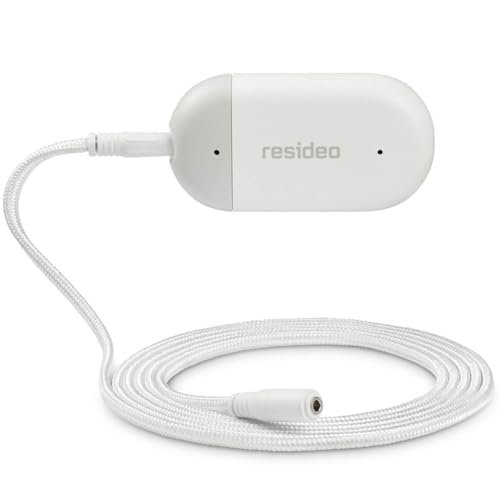
Resideo L1 WiFi Water Leak and Freeze Detector Review: Smart Alerts for Leaks, Temperature, and Humidity
Water leaks are among the most disruptive household problems because they often begin quietly. A slow drip beneath a sink, a failing water-heater connection, or a sump-pump issue may go unnoticed until water spreads beyond the original source. In colder climates, falling temperatures introduce another concern: pipes that approach freezing conditions.
The Resideo L1 WiFi Water Leak and Freeze Detector is designed to monitor both types of risk. It detects water, tracks temperature and humidity, sounds a loud local alarm, and can send mobile push and email notifications when configured thresholds are exceeded. Its included five-foot sensing cable also allows the detector to monitor a much larger area than a small point sensor.
The L1 can operate as a standalone warning device or become part of a broader Resideo water-protection setup. When used with compatible Resideo equipment such as the L5 WiFi Water Leak Shutoff Valve, multiple sensors can contribute to a more comprehensive system capable of responding to detected leaks at the home's water supply.
What Is the Resideo L1?
The Resideo L1 is a battery-powered smart water leak, temperature, and humidity detector.
Its supplied features include:
- WiFi connectivity
- Water leak detection
- Freeze-risk monitoring
- Humidity monitoring
- Mobile push notifications
- Email notifications
- 100 dB local alarm
- LED status indicators
- Five-foot water-sensing cable
- Expandable sensing coverage
- Reusable leak-sensing cable
- Compatibility with Resideo's broader leak-control ecosystem
This makes it more capable than a basic water alarm that only sounds when a puddle reaches the device.
Why Early Water Leak Detection Matters
Leaks are easier to manage when discovered early.
A small leak may initially produce only:
- Damp flooring
- Minor dripping
- Moisture under cabinetry
If nobody notices it, the problem can spread to surrounding materials.
A smart detector adds another layer of monitoring by watching vulnerable areas even when nobody is physically present.
Local and Remote Alerts
The L1 is designed to notify users in several ways.
When a problem is detected, the system can provide:
- Mobile push notifications
- Email alerts
- LED status indication
- Audible alarm
Using multiple alert channels is helpful because no single method is guaranteed to attract attention every time.
If your phone is nearby, the app notification may be most useful.
If you are inside the home but not looking at your phone, the local alarm becomes important.
100 dB Audible Alarm
The source lists the local alarm at 100 decibels.
That is intended to make a leak difficult to ignore when someone is home.
A loud alarm can be especially useful in areas such as:
- Basements
- Utility rooms
- Laundry rooms
where the sensor may be located away from normal living spaces.
WiFi Connectivity for Away-From-Home Monitoring
The L1 uses WiFi connectivity to provide remote alerts.
That means a homeowner may receive notifications while:
- At work
- Traveling
- Shopping
- Away for the weekend
This is one of the major advantages over an inexpensive standalone alarm.
A local-only alarm has limited value if nobody is home to hear it.
Leak Detection Plus Freeze Monitoring
The L1 does more than detect water.
It also monitors temperature and can warn when conditions approach a configured low-temperature threshold.
This can be useful in areas where freezing pipes are a concern.
Potential locations include:
- Basements
- Garages
- Utility spaces
- Seasonal properties
- Rooms near exterior walls
What Freeze Monitoring Actually Does
The detector does not physically heat pipes or prevent freezing by itself.
Its role is to warn you that temperatures have moved into a potentially concerning range.
That gives you an opportunity to investigate and take appropriate action.
It should therefore be viewed as an early-warning tool, not as freeze protection on its own.
Humidity Monitoring
The supplied description also states that the L1 can monitor humidity and notify users when it moves outside configured ranges.
Humidity data can be useful in spaces where excessive moisture may indicate:
- Poor ventilation
- Condensation
- Damp conditions
- Developing moisture issues
However, a humidity reading alone does not identify the exact cause.
It should be interpreted alongside conditions in the room.
Five-Foot Water-Sensing Cable
One of the more useful design features is the included five-foot sensing cable.
Unlike a point sensor that detects water only where its probes touch the floor, the Resideo cable can sense water along its length.
That lets you cover a broader or more irregular area.
Why Cable-Based Leak Detection Is Useful
A cable can be routed:
- Around a water heater
- Behind a washing machine
- Along a basement wall
- Beneath plumbing connections
- Around a sump area
This gives the system more opportunities to detect water before it spreads far enough to reach a single fixed point.
Extendable Coverage
The source states that additional sensor cable can extend total sensing length up to 500 feet.
That is a substantial expansion compared with typical point sensors.
It may be useful in:
- Large basements
- Mechanical rooms
- Utility spaces
- Areas with long runs of leak-prone plumbing
The practical layout should still follow Resideo's installation guidance.
Place the Cable Where Water Will Travel
Good leak-sensor placement is about likely water movement, not just proximity to the appliance.
Think about where water would collect if a connection failed.
Useful factors include:
- Floor slope
- Drain position
- Appliance feet
- Cabinet edges
- Low points
The sensing cable should be positioned along the likely escape path.
Best Places to Use the Resideo L1
The detector can be useful near many common household leak sources.
Water Heaters
Potential failure points include:
- Supply connections
- Drain fittings
- Pressure-relief components
- Tank leaks
Looping sensing cable around the base can provide broad coverage.
Washing Machines
Washing-machine leaks may originate from:
- Supply hoses
- Drain hose
- Internal components
Placing cable behind or beneath the machine can help identify escaping water earlier.
Under Sinks
Kitchen and bathroom sinks contain multiple potential leak points.
These include:
- Faucet supply lines
- Shutoff valves
- Drain traps
- Dishwasher connections
A compact detector with cable coverage can work well inside or near a sink cabinet.
Sump Pumps
A sump-pump failure or overflow can cause significant basement water accumulation.
Monitoring the surrounding area can provide an early alert when water appears outside the intended sump basin.
Reusable After a Leak Event
The sensor cable is reusable.
After the leak has been corrected, the cable must be allowed to dry completely.
Once dry, it can be reconnected to the detector and used again.
This is preferable to disposable leak indicators that must be replaced after activation.
Dry the Cable Thoroughly Before Resetting
Residual moisture may continue to trigger the system.
After a leak:
- Correct the source.
- Remove standing water.
- Dry the sensing cable completely.
- Reconnect or reset according to the manufacturer's instructions.
- Test the system.
Do not assume the detector is ready simply because the floor looks dry.
Standalone Use
The L1 can be used as an independent leak and environmental monitor.
In that role, it provides:
- Leak alerts
- Temperature alerts
- Humidity alerts
- Local alarm
- Remote notifications
For many homes, this may be sufficient if the main goal is early warning.
Integration With the Resideo L5 Shutoff Valve
For stronger water-damage protection, the L1 can be paired with compatible Resideo water-control equipment.
The supplied description specifically references the L5 WiFi Water Leak Shutoff Valve.
In a compatible setup, multiple leak sensors can contribute to a system designed to shut water off at the source when a leak is detected.
Leak Detection vs. Automatic Shutoff
These are two different levels of protection.
Leak Detector Only
A detector:
- Identifies water
- Alerts you
- Requires human response
Detector Plus Shutoff Valve
A connected shutoff system can:
- Detect water
- Send alerts
- Stop incoming water automatically when properly configured
Automatic shutoff can be particularly valuable in an unoccupied home.
Automatic Shutoff Does Not Eliminate All Risk
Even after the main valve closes, water may remain inside:
- Pipes
- Appliances
- Water heater
- Tanks
The system can reduce continued flow, but it cannot guarantee that no damage will occur.
Multiple Sensors for Broader Coverage
A larger home may benefit from several L1 detectors.
Possible locations include:
- Basement
- Laundry room
- Kitchen
- Water heater
- Utility closet
Multiple sensors can monitor independent risk areas rather than relying on a single detector to cover the entire property.
Battery-Powered Installation
The L1 is battery operated.
That provides flexibility because the sensing location does not need a nearby electrical outlet.
This is particularly useful inside:
- Cabinets
- Utility areas
- Appliance spaces
The exact battery type and runtime should be confirmed for the specific product package and current model documentation.
Quick Setup
The source describes setup as straightforward.
In general, the process involves:
- Positioning the detector
- Routing the sensing cable
- Connecting the device to WiFi
- Configuring the app
- Setting environmental thresholds
- Testing notifications
The exact steps should follow the current Resideo instructions.
Test Notifications After Setup
A smart safety device should never simply be installed and forgotten without testing.
Confirm that:
- Water sensing works
- Local alarm sounds
- Mobile notification arrives
- Email notification arrives
- Temperature and humidity settings are correct
If using an L5 shutoff valve, test the complete automation according to manufacturer guidance.
WiFi Dependence
Remote notifications rely on connected infrastructure.
If WiFi or internet service is unavailable, app and email alerts may not function normally.
The local detector still provides value through its physical sensing and audible alarm, but users should understand which connected features depend on the network.
Sensor Placement and WiFi Coverage
A leak detector in a distant basement corner may have weaker wireless coverage than one near the router.
Before final placement, make sure the selected location maintains reliable connectivity.
If WiFi coverage is poor, network improvements may be necessary.
Resideo L1 vs. Basic Water Alarm
A basic alarm may cost less and require less setup.
Basic Alarm Advantages
- Simple
- No app required
- No WiFi setup
Resideo L1 Advantages
- Remote alerts
- Temperature monitoring
- Humidity monitoring
- Long sensing cable
- Expandable coverage
- Smart shutoff ecosystem integration
The L1 is more appropriate when remote awareness and broader monitoring matter.
Resideo L1 vs. Point-Style Smart Sensor
Many smart leak detectors use sensing contacts only on the underside.
The L1's cable-based approach provides broader coverage.
That can be especially useful around larger fixtures such as water heaters where a leak may appear on any side.
A point sensor may still be preferable when monitoring one very specific low spot.
Resideo L1 vs. Whole-Home Flow Monitor
A whole-home flow monitor watches water passing through the main supply line.
The L1 detects actual water where the sensor cable is located.
L1 Strength
It tells you that water has physically reached a specific monitored area.
Flow Monitor Strength
It can identify unusual plumbing flow even if water has not reached a floor sensor.
For comprehensive protection, both approaches can complement each other.
Common Installation Mistakes
Leaving the Cable Coiled
A sensing cable is more useful when routed across the likely leak area.
Placing It Where Normal Cleaning Water Reaches It
This may produce nuisance alarms.
Ignoring WiFi Signal Quality
Remote alerts require reliable connectivity.
Failing to Test the Sensor
Testing confirms that the complete notification chain works.
Resetting Before the Cable Is Dry
Residual moisture can keep triggering alarms.
Common Buying Mistakes
Assuming It Automatically Shuts Off Water by Itself
The L1 is primarily a detector. Automatic shutoff requires compatible additional equipment such as the L5 system described by Resideo.
Assuming One Sensor Protects the Whole House
One unit only monitors its installed area.
Ignoring Freeze and Humidity Features
These can add useful environmental monitoring beyond leak detection.
Forgetting Cable Expansion Possibilities
Large areas can benefit from extended sensing coverage where supported.
Who Is the Resideo L1 Best For?
The L1 may be a strong choice for:
- Homeowners who want remote leak alerts
- Basements
- Utility rooms
- Water-heater areas
- Laundry rooms
- Homes in cold climates
- Existing Resideo smart-home users
- Buyers considering automatic water shutoff later
It may be more functionality than necessary for someone who only wants a cheap audible alarm under one sink.
Advantages and Considerations
Advantages
- WiFi connectivity
- Mobile push alerts
- Email alerts
- 100 dB audible alarm
- Water detection
- Temperature monitoring
- Humidity monitoring
- Freeze-warning capability
- Five-foot sensing cable
- Expandable coverage up to the stated 500 feet
- Reusable sensing cable
- Battery-powered placement flexibility
- Compatibility with Resideo L5 water shutoff solution
Potential Considerations
Remote functions depend on WiFi and connected services.
Automatic shutoff requires additional compatible equipment.
Sensor placement still requires planning.
Multiple units may be needed for whole-home coverage.
The sensing cable must dry fully after activation.
Frequently Asked Questions
Does the Resideo L1 detect water leaks?
Yes. It is designed to detect water through its sensing cable.
How long is the included sensor cable?
Approximately five feet according to the supplied description.
Can the sensing cable be extended?
Yes. The source states that total coverage can be extended up to 500 feet with additional compatible cable.
Does the entire cable detect water?
The supplied description states that water can be detected along its length.
Does it send smartphone alerts?
Yes, when connected and configured properly.
Does it send email notifications?
Yes.
How loud is the alarm?
The supplied information lists a 100 dB audible alarm.
Does it monitor temperature?
Yes.
Can it warn about freezing temperatures?
Yes. Temperature monitoring can provide low-temperature alerts when configured thresholds are reached.
Does it monitor humidity?
Yes.
Can the sensor be reused after detecting a leak?
Yes. Once the leak is resolved and the cable is completely dry, the detector can be reset and returned to service.
Is the L1 battery powered?
Yes, according to the supplied product description.
Can it automatically shut off my home's water?
The L1 can be used with compatible equipment such as the Resideo L5 WiFi Water Leak Shutoff Valve as part of a broader automatic water-control system.
Final Thoughts
The Resideo L1 WiFi Water Leak and Freeze Detector offers more comprehensive monitoring than a basic floor alarm.
Its strongest feature is the cable-based sensing system. The included five-foot cable can monitor a larger area than a small point sensor, and the ability to extend coverage makes the design particularly useful around water heaters, basements, mechanical equipment, and other high-risk locations.
Remote push and email alerts provide awareness when nobody is home, while temperature and humidity monitoring add another layer of environmental protection. The 100 dB local alarm ensures the system still provides a prominent warning when someone is nearby.
Its value increases further for homeowners building a broader Resideo water-protection system, since multiple detectors can be paired with compatible shutoff equipment such as the L5 valve.
For buyers looking for a smart WiFi water leak detector with freeze alerts, humidity monitoring, expandable cable sensing, remote notifications, and optional automatic water-shutoff integration, the Resideo L1 provides a flexible approach to protecting leak-prone areas throughout the home.