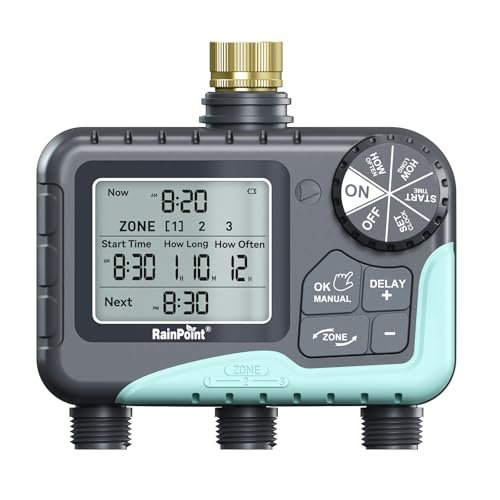
3-Zone Sprinkler Timer Review: Independent Watering Schedules, Brass Inlet and Rain Delay Control
Managing several watering areas from one outdoor faucet can quickly become inconvenient. A lawn may need deep irrigation every few days, while flower beds, raised vegetables, or containers may need shorter and more frequent watering. A 3-zone sprinkler timer solves that problem by splitting one water source into multiple independently programmable outlets.
This model is designed around three separately controlled watering zones, each with its own schedule. It also adds a brass inlet, reinforced connection point, upgraded valve design, manual watering, 24-, 48-, and 72-hour rain delays, an IP65-rated enclosure, and a large LCD display.
The main advantage is flexibility without requiring a permanent irrigation controller or WiFi connection. For homeowners using garden hoses, sprinklers, drip lines, or soaker hoses, the timer can automate three different areas while still allowing temporary manual overrides.
Its value ultimately depends on matching the schedules to actual plant needs and making sure the home's water pressure can support the connected irrigation equipment.
What Is a 3-Zone Sprinkler Timer?
A three-zone hose timer connects to a single outdoor faucet and provides three independently controlled water outlets.
Each outlet functions as its own irrigation zone.
Instead of attaching one hose and manually moving it around the yard, you can connect separate watering systems to all three outlets and program each one differently.
For example:
- Zone 1 can water the lawn.
- Zone 2 can feed a vegetable garden.
- Zone 3 can run a drip line for flower beds.
The timer automatically opens and closes each valve according to the programmed schedule.
Why Three Independent Zones Are Useful
Plants rarely have identical water requirements.
Turfgrass, vegetables, shrubs, flowers, and container plants all respond differently to irrigation frequency and duration.
A one-zone timer forces everything to follow the same routine.
A three-zone controller lets each area receive water based on its own needs.
This is especially helpful when different irrigation methods are used. A lawn sprinkler may deliver a large volume quickly, while a drip system distributes water much more slowly.
Individual Watering Programs for Each Zone
The supplied specifications state that each zone can be programmed independently.
Watering duration can be set from approximately 1 minute to 4 hours, while frequency can range from every hour to every seven days.
That provides enough flexibility for most home irrigation tasks.
A vegetable garden might need short daily watering, while established landscaping could receive a longer session every few days.
Hourly Watering Options
The ability to schedule watering by the hour can be useful for specialized applications.
Seedlings, greenhouse plants, hanging baskets, or very small containers may dry quickly in hot weather.
Short irrigation cycles several times per day can sometimes be more appropriate than one long session.
However, frequent watering should not become the default for all plants. Many established landscape plants benefit from deeper and less frequent irrigation.
Daily and Multi-Day Scheduling
For lawns and mature garden beds, longer intervals may make more sense.
The timer supports schedules up to seven days apart.
That allows routines such as watering every two, three, or seven days rather than running automatically every day.
This flexibility can help reduce overwatering.
Watering Duration From 1 Minute to 4 Hours
Each automatic watering session can reportedly last from 1 minute to 4 hours.
Short durations work well with higher-flow sprinklers.
Longer durations can be useful for:
- Drip irrigation
- Soaker hoses
- Large beds
- Slow-emitting irrigation systems
- Deep watering of trees or shrubs
The correct runtime depends on actual water output rather than the timer itself.
Measure Flow Instead of Guessing
A 30-minute watering session does not tell you how much water the plants receive.
Different sprinklers and drip emitters can deliver dramatically different volumes.
If possible, estimate or measure the output of each zone.
That helps create schedules based on water delivered rather than arbitrary runtime.
Durable Brass Inlet
One of the more notable construction features is the brass inlet connection.
The faucet connection experiences considerable mechanical stress because the entire timer hangs below it while supporting three hoses.
Brass generally provides greater rigidity and thread durability than lightweight plastic.
That can be particularly useful when the timer is installed and removed repeatedly.
Reinforced Inlet Neck
The inlet neck is also described as reinforced.
This area is often a weak point on hose timers because the weight of connected hoses creates leverage against the faucet connection.
A reinforced neck can reduce flexing and help the timer remain securely attached.
Even with stronger construction, hoses should not be allowed to pull sideways on the timer.
Upgraded Coil Valve
The internal valve system has reportedly been redesigned for smoother water flow and reduced "bucking" or vibration.
Valve quality matters more than it may appear.
A poorly designed valve can create abrupt pressure changes when opening or closing.
Smoother operation can reduce noise and stress on fittings.
It may also provide more consistent flow to sprinklers and drip systems.
Water Hammer and Pressure Changes
Any automatically closing valve can create pressure changes in plumbing.
If the home's water pressure is unusually high or pipes already experience water hammer, an irrigation timer may make the issue more noticeable.
A pressure regulator or properly designed plumbing system may be necessary in severe cases.
The upgraded valve can help with smoother operation, but it cannot correct underlying plumbing problems.
IP65 Weather Protection
The timer is listed with an IP65 rating.
That indicates a higher level of water and dust protection than basic splash-resistant outdoor electronics.
For an irrigation controller mounted directly beneath a faucet, that is useful.
It should tolerate ordinary rain and watering exposure under appropriate conditions.
However, IP65 does not mean the timer should be permanently submerged.
Outdoor Durability
The housing is made from ABS plastic according to the source.
ABS is commonly used in outdoor equipment because it is lightweight, impact resistant, and does not rust.
Long-term durability will still depend on sunlight exposure, temperature extremes, water pressure, and seasonal storage.
Protect It From Freezing
Water left inside the valve body can freeze and expand.
That can crack even a weather-resistant housing.
If temperatures in your area drop below freezing, remove the timer, drain it thoroughly, and store it in a protected location unless the manufacturer specifically states that winter exposure is safe.
Freeze damage is different from rain exposure and is not covered simply by an IP rating.
Manual Watering Mode
The timer supports manual watering from approximately 1 minute to 8 hours.
This allows you to temporarily run a zone without changing the normal automatic program.
That is useful when:
- Newly planted flowers need extra water.
- A dry area needs supplemental irrigation.
- You want to wash a patio or garden tool.
- A scheduled cycle was skipped.
Once manual watering ends, the programmed schedule can continue normally.
Why an 8-Hour Manual Range Is Useful
Most lawn watering sessions do not need to run for eight hours.
However, low-flow irrigation systems may operate for much longer periods.
A long manual window also gives users flexibility for non-irrigation tasks such as slowly filling a tank or running a low-output garden line.
The timer should not be left unattended for long manual sessions where overflow could cause damage.
Rain Delay for 24, 48 or 72 Hours
The timer includes selectable 24-, 48-, and 72-hour rain delays.
This temporarily pauses scheduled irrigation without erasing the underlying programs.
After the delay expires, the normal schedule resumes.
That is much easier than reprogramming each of the three zones after every rainfall.
Rain Delay Does Not Necessarily Detect Rain Automatically
The source refers to weather-responsive delays, but it does not establish that the device contains a rain sensor or internet weather connection.
Unless the manual specifically states otherwise, the rain delay should be treated as a manual pause function.
You observe that rain has fallen, activate the delay, and the timer skips irrigation for the selected period.
How to Choose the Right Rain Delay
A light shower may justify only a short pause.
A long soaking rain may eliminate the need for irrigation for several days.
Soil type also matters.
Clay holds moisture much longer than sandy soil.
Rather than always selecting 72 hours automatically, check actual soil moisture.
Large LCD Display
The timer uses a large LCD display intended to make programming easier.
A clear screen is particularly valuable on a three-zone controller because there are more schedules to manage than on a single-outlet timer.
The display should help users review watering duration, timing, zone settings, and battery status without relying on an app.
Local Controls vs. Smart WiFi Timers
This appears to be a standalone programmable timer rather than a WiFi-connected controller.
That has several advantages.
It does not rely on:
- Internet access
- Cloud services
- Smartphone apps
- Account registration
- WiFi signal strength
Once programmed, operation remains local.
For users who simply want reliable irrigation automation, that simplicity can be an advantage.
Low-Battery Warning
The LCD provides a low-battery warning according to the source.
That is an important feature because automatic irrigation depends on the valves having enough power to operate reliably.
A dead battery could cause plants to miss scheduled watering.
Check the display periodically rather than waiting until the irrigation system stops working.
Replace Batteries Before Travel
If the timer will manage the garden while you are away for several weeks, install fresh batteries or confirm the existing batteries are healthy before leaving.
Also test all three zones.
Automated watering is useful during vacations only if the system has been verified beforehand.
One Faucet, Three Irrigation Areas
The main practical benefit is consolidating multiple systems onto a single faucet.
Instead of using several hose bibs or manually moving hoses, one timer can operate three separate lines.
That can simplify irrigation in smaller properties where only one outdoor water connection is conveniently located.
Zone 1: Lawn Sprinkler
A lawn sprinkler usually requires relatively high flow.
This zone might be programmed for longer but less frequent sessions.
Deep watering can encourage roots to grow farther into the soil compared with constant shallow irrigation.
Local climate and grass species still determine the best schedule.
Zone 2: Vegetable Garden
A second outlet can serve a drip line or soaker hose in a vegetable garden.
Because vegetables often have shallower roots and higher seasonal water demand, they may require a different schedule than the lawn.
Independent programming makes this easy.
Zone 3: Flower Beds or Containers
The third outlet can handle flower beds, shrubs, containers, or greenhouse plants.
Container plants often dry much faster than in-ground beds.
A separate zone prevents you from overwatering the lawn just to keep patio plants alive.
Can All Three Zones Run at the Same Time?
The source does not specify whether all outlets can operate simultaneously.
Even if the timer allows overlapping programs, doing so may not be desirable.
Three irrigation systems connected to one faucet can demand far more flow than the plumbing can provide.
If pressure drops significantly, sprinkler coverage can become uneven.
Staggering the schedules is usually safer.
Why Staggering Zones Often Works Better
Suppose each sprinkler requires 3 GPM.
Three operating simultaneously would require 9 GPM.
If the faucet can only provide 5 or 6 GPM at usable pressure, none of the sprinklers may perform correctly.
Running each zone sequentially allows the full available flow to serve one area at a time.
Water Pressure Requirements
The timer does not boost water pressure.
Performance depends on the existing supply.
If a sprinkler works poorly when connected directly to the faucet, adding a timer will not fix the problem.
Likewise, long narrow hoses can reduce pressure through friction.
Use Appropriate Hose Sizes
For higher-flow lawn sprinklers, a larger-diameter garden hose can reduce pressure loss compared with a very narrow hose.
Drip irrigation often requires much less flow and may need its own pressure regulator.
Each zone should be designed around the irrigation equipment connected to it.
Drip Irrigation Compatibility
A three-zone timer can work very well with drip systems.
Each garden section can use a separate drip line and schedule.
However, drip systems commonly require:
- Pressure regulation
- Filtration
- Properly sized emitters
The timer controls when water flows; it does not replace those irrigation components.
Soaker Hose Applications
Soaker hoses release water gradually through porous walls.
They are useful around hedges, garden rows, and foundation plantings.
Because they deliver water slowly, longer watering periods may be necessary.
The timer's multi-hour duration makes that practical.
Greenhouse Watering
Greenhouses can benefit greatly from automation.
Higher temperatures may dry soil and containers quickly.
One dedicated zone can provide frequent short irrigation without changing schedules for the rest of the yard.
Again, actual plant requirements should determine frequency.
Watering Newly Seeded Lawns
New grass seed often requires different irrigation from established turf.
Frequent light watering may be necessary during germination, while mature grass benefits from deeper watering.
A dedicated zone allows one area to follow a temporary schedule without affecting established landscaping.
Avoid Overwatering
More automation does not automatically mean healthier plants.
A timer will repeat whatever program you give it.
If the schedule is excessive, it can create:
- Root problems
- Fungal conditions
- Nutrient loss
- Runoff
- Wasted water
Check soil moisture regularly and adjust schedules seasonally.
Consider Local Watering Restrictions
Some municipalities restrict irrigation to specific days or hours.
A programmable timer can make compliance easier.
Set each zone to run only during permitted periods.
Local restrictions can change during drought conditions, so schedules may need adjustment.
Water Early When Practical
Early morning is often a useful irrigation period because temperatures are cooler and evaporation tends to be lower than during midday.
Wind may also be lighter.
This can help sprinklers deliver more water to the soil rather than losing it to evaporation.
However, local climate and watering restrictions should guide final timing.
Installation Process
Installation should be relatively simple on a standard garden faucet.
Attach the timer to the outdoor spigot, confirm that the sealing washer is properly seated, and connect hoses to the three outlets.
Then install the required batteries and program each zone.
Before relying on the timer, test every valve manually.
Check for Leaks
After turning the faucet on, inspect:
- The brass inlet
- Faucet threads
- Outlet fittings
- Hose washers
- Hose connections
If a joint leaks, first check the gasket.
Overtightening fittings is not always the correct solution.
Avoid Excessive Side Load
Three connected hoses can place significant weight on the timer.
Route the hoses so they rest on the ground rather than pulling downward or sideways on the faucet.
Even a reinforced inlet can eventually be damaged by continuous mechanical stress.
Test the Complete Schedule
After programming, allow the timer to run through each zone at least once.
Verify that each outlet:
- Opens at the expected time.
- Provides adequate flow.
- Stops completely.
- Does not leak when closed.
- Resumes correctly after manual watering.
Testing is especially important before leaving the property unattended.
Common Setup Mistakes
A frequent mistake is setting overlapping schedules that reduce water pressure.
Another is misunderstanding rain delay as automatic rain sensing.
Users may also forget to check battery status.
Other common errors include overtightening hose fittings and leaving the timer outdoors through freezing weather.
Good setup matters as much as the timer's features.
3-Zone Timer vs. Single-Zone Timer
A single-zone timer is sufficient when only one irrigation line needs automation.
A three-zone model becomes worthwhile when one faucet must serve several areas.
The extra outlets reduce the need for multiple timers or constant hose switching.
3-Zone Timer vs. Dual-Zone Timer
A dual-zone timer works well for two watering areas.
The three-zone model adds another independent program.
That can be useful for a lawn, vegetable garden, and flower bed combination.
If you only need two zones, however, a simpler dual-outlet timer may be easier to program and less bulky.
3-Zone Timer vs. WiFi Irrigation Timer
A WiFi timer allows remote adjustment through a phone and may include weather integrations.
This model emphasizes local programming instead.
The advantage is independence from internet services.
The disadvantage is that schedules cannot be changed remotely based on the supplied information.
3-Zone Timer vs. Full Sprinkler Controller
A traditional irrigation controller can manage many electrically actuated underground valves.
It is better suited to large permanent landscapes.
The three-zone hose timer is intended for simpler above-ground irrigation connected directly to a garden faucet.
It requires much less installation work.
Is It Good for Renters?
Yes, potentially.
The timer screws onto a standard faucet and can be removed without permanent plumbing modifications.
That makes it attractive for renters who maintain their own lawn or garden.
Permission should still be obtained if the lease restricts outdoor equipment.
Is It Good for Vacation Watering?
Yes.
A three-zone timer can maintain several areas while you are away.
Before leaving:
- Install fresh batteries if needed.
- Inspect hoses.
- Test all zones.
- Check for leaks.
- Confirm watering schedules.
- Verify sprinkler placement.
A timer can automate irrigation, but damaged hoses or incorrect programs can still create problems.
Is It Suitable for Pool Filling?
The supplied description focuses on irrigation rather than pool filling.
The manual watering duration of up to eight hours could technically support long hose operation, but unattended pool filling carries overflow risk.
Do not rely on a garden timer as the sole protection against flooding.
Maintenance
Routine maintenance is simple but important.
Inspect the inlet washer and hose seals periodically.
Clean any inlet screen if present.
Check for cracks or UV damage.
Verify that valves close completely.
Replace weak batteries.
Remove the timer before freezing conditions.
These steps can substantially extend service life.
Main Advantages
The strongest benefit is three-zone independent scheduling from one faucet.
The brass inlet and reinforced neck add durability where the timer experiences the most mechanical stress.
The adjustable 1-minute-to-4-hour automatic programs, hourly-to-weekly frequency range, manual watering up to eight hours, 24/48/72-hour rain delay, IP65-rated enclosure, large LCD, and low-battery alert provide a comprehensive feature set for non-connected irrigation.
Potential Drawbacks
There is no confirmed WiFi or smartphone control.
Rain delay appears to require manual activation rather than automatic weather sensing.
Three outlets can create pressure issues if operated simultaneously.
The timer also requires battery maintenance and should be removed during freezing weather.
For large permanent sprinkler systems, a dedicated multi-zone irrigation controller would be more appropriate.
Who Should Consider This 3-Zone Sprinkler Timer?
This timer is best suited to users who have one outdoor faucet but three watering areas with different needs.
Typical applications include:
- Lawn plus vegetable garden plus flowers
- Three separate garden beds
- Greenhouse plus lawn plus landscaping
- Drip irrigation zones
- Soaker hoses
- Portable sprinklers
- Rental properties
- Vacation watering
It provides much of the scheduling flexibility of a small irrigation controller without requiring wiring or permanent installation.
Frequently Asked Questions
How many zones does this sprinkler timer control?
Three independent zones.
Can each zone have a different schedule?
Yes.
What is the minimum automatic watering duration?
Approximately 1 minute.
What is the maximum automatic watering duration?
Up to 4 hours.
How often can each zone run?
The source lists intervals from every hour to every seven days.
Does it have manual watering?
Yes.
How long can manual watering run?
From approximately 1 minute to 8 hours.
Does it include rain delay?
Yes.
What rain-delay periods are available?
24, 48, or 72 hours.
Does it detect rain automatically?
Automatic rainfall detection is not confirmed. The rain-delay feature should be treated as a manual irrigation pause unless the manual states otherwise.
Is the inlet metal?
Yes. The source describes a brass inlet.
Is the inlet reinforced?
Yes.
Is it waterproof?
It carries an IP65 rating according to the supplied information.
Does it have a display?
Yes. It includes a large LCD screen.
Does it warn when batteries are low?
Yes.
Can it run sprinklers?
Yes.
Can it run drip irrigation?
Yes, when paired with appropriate pressure regulation and irrigation components.
Can it run soaker hoses?
Yes.
Can I use all three zones for different plants?
Yes. Independent programming is one of the main advantages.
Should all three zones run at once?
Usually not if doing so causes water pressure to drop. Staggered schedules can provide better irrigation performance.
Final Verdict
This 3-zone programmable sprinkler timer is a useful step up from single- and dual-outlet hose timers for homeowners who need to automate several irrigation areas from one faucet.
Its standout features are the three independently programmable outlets, brass inlet, reinforced inlet neck, upgraded valve mechanism, 1-minute-to-4-hour automatic watering range, up-to-8-hour manual mode, 24/48/72-hour rain delay, IP65 weather protection, large LCD display, and low-battery warning.
The main limitation is that it appears to be a locally programmed controller rather than a smart WiFi system. You gain simple, self-contained operation but give up remote control and confirmed automatic weather adjustment.
For a yard divided between lawn, vegetable garden, flower beds, greenhouse irrigation, drip lines, or soaker hoses, this timer offers a practical way to create separate watering routines without installing a full permanent irrigation system.