Rachio Smart Hose Timer Review: Smarter App-Controlled Watering for Lawns, Gardens, and Drip Systems
Traditional hose timers are convenient until the weather changes, a battery starts running low, or you need to adjust watering while away from home. At that point, a simple dial can feel surprisingly limiting.
The Rachio Smart Hose Timer is designed to modernize hose-based irrigation with app control, automatic Rain Skips, flow monitoring, low-battery alerts, and multi-valve expansion. Instead of walking outside to reprogram a faucet timer, you can manage schedules from the Rachio app and make adjustments remotely.
The system is especially interesting for homeowners who want smarter watering without installing a full in-ground irrigation controller. It works with hose-fed sprinklers, drip irrigation, garden beds, and other outdoor watering setups, while one WiFi Hub can support up to eight smart valves.
What Is the Rachio Smart Hose Timer?
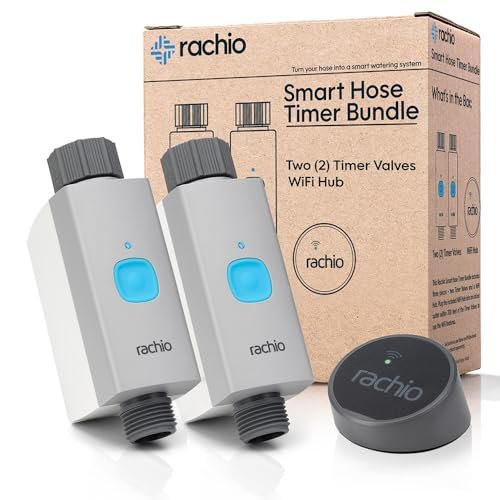
The Rachio Smart Hose Timer is a connected valve system that attaches to an outdoor faucet and automatically controls water flow according to schedules configured in the Rachio app.
The supplied package includes two hose-timer valves and one WiFi Hub.
According to the supplied product information, the system offers:
- App-based watering control
- Customizable watering schedules
- Automatic Rain Skips
- Flow monitoring
- Low-battery notifications
- Manual Quick Run
- Physical start/stop button
- Support for up to eight valves per WiFi Hub
- Alexa integration
- Google Home integration
- IFTTT compatibility
- 2.4 GHz WiFi connectivity through the hub
Each valve requires two AA batteries, which are not included.
Why Choose a Smart Hose Timer?
A basic hose timer can automate watering, but most traditional models rely on a small display or physical dial.
That works well when the schedule rarely changes. It becomes less convenient when you need to respond to:
- Rain
- Hot weather
- Seasonal changes
- Travel
- New plantings
- Temporary watering needs
A connected timer lets you make those adjustments from a phone rather than repeatedly reprogramming the device outside.
Control Watering From the Rachio App
The Rachio app acts as the main control center.
Instead of relying on the hardware interface, users can create schedules, manage valves, and start watering remotely.
That can be useful when the faucet is:
- Behind the house
- Near a garden shed
- In a difficult-to-reach location
It is also convenient when managing more than one watering area.
Remote Control While Away From Home
One of the strongest reasons to use a smart hose timer is the ability to manage irrigation while traveling or at work.
If conditions change, you can potentially modify watering without being physically present.
For example, you may want to:
- Cancel irrigation after heavy rain
- Start an extra cycle during very hot weather
- Stop watering if a problem occurs
This can make hose-fed irrigation much easier to manage over time.
Flexible Watering Schedules
The system supports programmable watering schedules through the app.
That makes it suitable for recurring irrigation tasks such as:
- Lawn sprinklers
- Vegetable gardens
- Flower beds
- Shrubs
- Drip systems
- Patio containers
Once the schedule is configured, the system can handle routine watering automatically.
Different Areas Need Different Schedules
A major advantage of using multiple valves is the ability to treat parts of the yard separately.
For example:
- A lawn may need longer, less frequent watering
- Vegetable beds may need more regular irrigation
- Patio containers may dry quickly
- Established shrubs may need water less often
Using separate valves prevents every watering area from being forced onto the same schedule.
Automatic Rain Skips
Rachio's Rain Skip feature is one of the system's most useful automation tools.
When rain is forecast, scheduled watering can be skipped automatically.
That can reduce unnecessary irrigation and help prevent the common problem of sprinklers running while natural rainfall is already providing water.
Why Rain Skips Can Save Water
A traditional timer does not know whether rain is coming.
It simply follows the programmed clock.
Weather-aware automation can avoid watering when conditions make irrigation unnecessary.
That is particularly useful for:
- Lawns
- Garden beds
- Shrubs
where natural rainfall may already provide enough moisture.
Rain Forecasts Are Not Perfect
Rain Skip automation should still be treated as a decision aid rather than a perfect measurement of conditions at the plant.
A forecast cannot directly determine the moisture level in every part of your yard.
For example:
- A covered patio may receive no rain
- Containers may dry faster than soil beds
- Rainfall can vary substantially within a small area
Check actual soil and plant conditions periodically.
Flow Monitoring
The Rachio Smart Hose Timer includes flow monitoring.
This adds an important layer of awareness beyond simple scheduling.
A traditional timer may successfully open its valve without knowing whether the watering system is operating normally.
Flow monitoring can help identify unexpected water behavior.
What Flow Alerts Might Reveal
Abnormal flow can potentially indicate issues such as:
- A disconnected hose
- A damaged irrigation line
- A kinked hose
- A blocked line
- A leaking fitting
Receiving an alert allows the homeowner to investigate before a minor irrigation problem becomes a larger water-waste issue.
Why Flow Monitoring Is Useful When Traveling
Flow monitoring is especially helpful when irrigation is operating unattended.
Imagine a hose connection comes loose while you are away.
Without monitoring, water could run somewhere unintended while the timer continues following the normal schedule.
An abnormal-flow notification gives you a better chance of noticing the problem.
Low-Battery Alerts
Each smart valve uses two AA batteries.
The app can notify users when battery levels become low.
This is a simple feature, but it matters because automated watering systems are easy to forget once they are working reliably.
Low-battery alerts reduce the chance of discovering that irrigation has stopped only after plants begin to dry out.
Replace Batteries Before Extended Travel
If you plan to rely on the system during a vacation, check the batteries beforehand.
Smart notifications are useful, but they do not help much if no one is available to replace the batteries.
Fresh or sufficiently charged batteries provide additional peace of mind before leaving.
Manual Quick Run
Automation does not eliminate the need for occasional manual watering.
The Rachio system supports Quick Run, allowing a user to start watering on demand.
This can be triggered from the app or directly from the valve's built-in button.
When Manual Watering Is Useful
Quick watering can be helpful after:
- Planting new flowers
- Transplanting vegetables
- Applying fertilizer
- Seeding grass
- An unusually hot afternoon
You can run an extra cycle without permanently altering the normal schedule.
Physical Button for Local Control
The valve includes a manual button.
This is important because a smart device should not require a phone for every basic action.
If you are already standing next to the faucet, the physical control is often faster than opening an app.
It also makes installation and troubleshooting easier.
Two Smart Valves Included
The supplied configuration includes two valves.
That means you can automate two separate hose-fed watering circuits from the start.
One common arrangement might be:
- Valve 1: lawn sprinkler
- Valve 2: garden drip system
Another might be:
- Front yard
- Backyard
The two circuits can then be managed independently.
Expand Up to Eight Valves Per Hub
The WiFi Hub can reportedly support up to eight smart hose valves.
This makes the system significantly more scalable than a standalone single-faucet timer.
A larger property could potentially use separate valves for:
- Front lawn
- Rear lawn
- Side yard
- Vegetable garden
- Flower beds
- Patio
- Shrubs
- Greenhouse
while still managing them through one Rachio ecosystem.
Why Scalability Matters
Many homeowners begin with one or two automated watering areas and expand later.
A hub that supports several valves means you do not necessarily need to replace the original system when the garden becomes more complex.
You can add additional valves as watering needs grow.
WiFi Hub Required
The smart valves rely on the Rachio WiFi Hub for connected operation.
This is an important distinction from hose timers that connect directly to the home's router.
The hub provides the communication bridge between the valves and the Rachio platform.
The valves should therefore not be treated as standalone WiFi devices.
2.4 GHz WiFi Requirement
The WiFi Hub requires a 2.4 GHz WiFi network.
This frequency is widely used by smart-home products because it typically offers greater range through walls than higher-frequency WiFi.
If your router supports both 2.4 and 5 GHz, ensure the 2.4 GHz band is available during setup.
Wireless Coverage Should Be Tested
Outdoor faucets can be surprisingly difficult wireless environments.
Signal quality may be affected by:
- Concrete walls
- Metal siding
- Garages
- Distance
- Landscaping structures
After installation, verify reliable communication with every valve before trusting the system with unattended irrigation.
Smart Home Integration
The product is advertised as compatible with:
- Amazon Alexa
- Google Home
- IFTTT
These integrations can make the system part of a broader connected-home setup.
Voice Control
Alexa or Google Home can be convenient for simple watering commands.
For example, voice control may be useful when you want to quickly start or stop a valve while working around the house.
Detailed schedules are still better managed through the Rachio app.
IFTTT Integration
IFTTT can potentially connect Rachio watering with other supported services or smart devices.
The exact triggers and actions available can change over time, so current integration support should be verified before buying specifically for a particular automation workflow.
Best Applications for the Rachio Smart Hose Timer
Lawn Sprinklers
Attach a hose-fed sprinkler and let the valve control the watering schedule.
Drip Irrigation
A strong use case for:
- Raised beds
- Vegetable gardens
- Shrubs
- Flower beds
Patio Containers
Multiple pots can be connected through a small drip network and watered automatically.
Soaker Hoses
The timer can manage watering periods for soaker-hose systems in gardens and landscape beds.
Smart Hose Timer vs. Traditional Dial Timer
A traditional timer still has advantages.
Traditional Timer Advantages
- Simple
- No WiFi required
- No hub
- Fewer electronic components
Rachio Smart Hose Timer Advantages
- Remote app control
- Weather-based Rain Skips
- Flow monitoring
- Low-battery alerts
- Multi-valve expansion
- Smart-home compatibility
The Rachio system makes more sense when these connected features will actually be used.
Smart Hose Timer vs. In-Ground Irrigation Controller
A smart hose timer is not the same as a conventional multi-zone sprinkler controller.
The Rachio Smart Hose Timer controls water at outdoor faucets.
It is intended for:
- Garden hoses
- Above-ground sprinklers
- Drip irrigation
- Soaker hoses
A traditional irrigation controller operates electrically controlled underground valves and is better suited to permanent multi-zone sprinkler systems.
Installation Overview
A typical setup should be fairly straightforward.
The basic process involves:
- Installing two AA batteries in each valve.
- Connecting each valve to an outdoor faucet.
- Connecting the hose or irrigation system.
- Installing and powering the WiFi Hub.
- Connecting the hub to 2.4 GHz WiFi.
- Pairing the valves with the hub.
- Creating schedules in the Rachio app.
Follow current Rachio installation instructions for the exact pairing procedure.
Check for Leaks After Installation
Once the timer is attached, turn on the upstream faucet and inspect the fittings.
Look carefully around:
- Faucet connection
- Valve threads
- Hose connection
Even a small leak can waste water continuously because the upstream faucet generally remains pressurized.
Do Not Overtighten Connections
Garden-hose fittings rely heavily on washers and properly seated threads.
Overtightening can damage plastic or threaded components.
Tighten connections firmly enough to prevent leaks but follow the manufacturer's recommendations rather than applying excessive force.
Reduce Hose Weight on the Valve
A heavy garden hose can pull downward on a faucet-mounted timer.
Where practical, position the hose so its full weight is not hanging directly from the valve connection.
Reducing mechanical stress can help protect fittings.
Drip Irrigation May Need Pressure Regulation
Many drip systems operate at lower pressure than a household hose bibb.
The supplied description does not state that a pressure regulator is included.
If your drip components specify a lower operating pressure, use an appropriate regulator.
A Filter May Also Be Helpful
Drip emitters have very small water passages and can clog from sediment.
A suitable filter can help reduce clogging and maintain more consistent flow.
Seasonal Schedule Changes
Even a weather-aware smart timer should not be programmed once and ignored indefinitely.
Plant water requirements change with:
- Temperature
- Rainfall
- Sun exposure
- Plant growth
- Season
Review schedules periodically to make sure they still match the landscape.
Avoid Overwatering
Smart automation makes irrigation easier, but easier watering can still be excessive watering.
Signs that a schedule may need adjustment include:
- Persistent puddles
- Runoff
- Constantly saturated soil
- Weak shallow roots
Water should match plant and soil needs rather than simply run because a schedule exists.
Common Mistakes
Forgetting Batteries Are Not Included
Each valve needs two AA batteries.
Expecting the Valves to Work Without the Hub
The WiFi Hub is required for smart operation.
Using Only 5 GHz WiFi
The hub requires 2.4 GHz.
Ignoring Flow Alerts
Unexpected water flow should be investigated.
Leaving the Same Schedule All Year
Seasonal adjustment is still necessary.
Installing Without Testing Wireless Coverage
Confirm stable valve communication before relying on automatic watering.
Advantages and Considerations
Advantages
- Rachio app control
- Remote watering management
- Flexible schedules
- Automatic Rain Skips
- Flow monitoring
- Low-battery notifications
- Manual Quick Run
- Physical valve controls
- Two valves included
- Up to eight valves per WiFi Hub
- Alexa compatibility
- Google Home compatibility
- IFTTT integration
Potential Considerations
- Requires a dedicated WiFi Hub
- 2.4 GHz WiFi required
- Two AA batteries needed per valve
- Batteries are not included
- Weather skips rely on forecast data
- Intended for hose-fed irrigation rather than conventional wired sprinkler zones
Frequently Asked Questions
How many smart valves are included?
Two.
How many valves can one WiFi Hub support?
Up to eight according to the supplied product description.
Are AA batteries included?
No. Each valve requires two AA batteries.
Does the system require WiFi?
Yes, the hub requires a 2.4 GHz WiFi connection for connected functionality.
Does it support 5 GHz WiFi?
The supplied information specifies 2.4 GHz WiFi.
Can I control watering from my phone?
Yes, through the Rachio app.
Can I water manually?
Yes. You can use Quick Run in the app or press the button on the valve.
What are Rain Skips?
Rain Skips can automatically cancel scheduled watering when rain is forecast.
Does the timer monitor water flow?
Yes, according to the supplied product information.
Will it notify me about low batteries?
Yes.
Can I add more valves later?
Yes, up to the stated eight-valve capacity per hub.
Does it work with Alexa?
Yes, according to the supplied information.
Does it work with Google Home?
Yes.
Does it support IFTTT?
Yes, according to the supplied description.
Can I use it with drip irrigation?
Yes. Drip irrigation is one of the strongest applications for this type of timer.
Final Thoughts
The Rachio Smart Hose Timer is a practical upgrade for homeowners who already water through outdoor faucets but want more control than a traditional dial timer can provide.
Its strongest features are the Rachio app, automatic Rain Skips, flow monitoring, low-battery alerts, manual Quick Run, and support for as many as eight valves on one WiFi Hub. This combination makes the system useful not only for a single sprinkler but also for increasingly complex hose-fed irrigation layouts.
The main tradeoffs are the dedicated hub requirement, 2.4 GHz WiFi dependence, and battery maintenance for each valve. Those requirements add complexity compared with a simple mechanical timer, but they enable much greater visibility and flexibility.
For homeowners looking for a smart hose timer with app control, weather-aware Rain Skips, flow monitoring, multi-valve expansion, manual watering, and Alexa or Google Home integration, the Rachio system provides a flexible way to automate lawns, gardens, drip irrigation, and other hose-fed outdoor watering.