Heavy-Duty PVC Pipe Cutter Review: Clean, Accurate Cuts for PVC, PEX, CPVC, and Plastic Tubing
Cutting plastic pipe cleanly is one of those jobs that looks simple until the blade crushes the tube, leaves a crooked edge, or forces you to use far more effort than expected. Whether you're working on plumbing, irrigation, electrical conduit, automotive tubing, or a home repair project, the quality of the cutter can make a noticeable difference in both speed and finish.
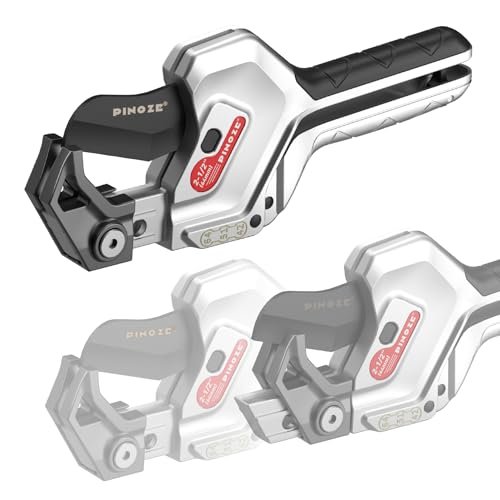
The PINOZE heavy-duty PVC pipe cutter is designed for plastic pipe and flexible tubing up to 2-1/2 inches (63 mm) outside diameter. It combines a die-cast aluminum body, SK5 steel blade, ratcheting mechanism, adjustable jaw opening, ergonomic handle, and locking system in a tool intended for repeated use.
Its broad material compatibility makes it useful for DIYers as well as plumbers, electricians, installers, and mechanics who regularly work with PVC, CPVC, PEX, PE, PP-R, rubber hose, and similar materials.
What Is a Ratcheting PVC Pipe Cutter?
A ratcheting pipe cutter uses a progressively advancing blade rather than requiring the user to complete the cut in one movement.
Each squeeze of the handle moves the blade farther through the pipe. The ratchet then holds the blade's position while the user releases and squeezes again.
This design has two important benefits.
First, it multiplies the force applied to the blade, making larger or more rigid plastic pipe easier to cut. Second, it gives the user better control throughout the cut compared with forcing a blade through the material in a single motion.
For frequent plumbing or irrigation work, this mechanism can reduce hand fatigue considerably.
Cutting Capacity Up to 2-1/2 Inches
The cutter is designed for pipe with an outside diameter of up to approximately 2-1/2 inches, or 63 mm.
That capacity allows it to handle a broad range of common plastic plumbing and tubing sizes.
Potential applications include:
- PVC pipe
- CPVC pipe
- PEX tubing
- PE tubing
- PP-R pipe
- Plastic conduit
- Rubber hose
- Irrigation pipe
- Flexible plastic tubing
However, diameter alone does not determine whether a pipe will cut cleanly.
Wall thickness, temperature, material hardness, age, and pipe condition also affect performance. Extremely brittle or heavily aged PVC may crack even when its diameter falls within the rated range.
SK5 Steel Blade for Cleaner Cuts
The cutter uses an SK5 steel blade, a high-carbon tool steel commonly used for cutting tools because of its hardness and ability to hold an edge.
A sharp blade is essential when working with plastic pipe. A dull cutter tends to squeeze the tube before cutting through it, increasing the risk of distortion, cracking, or an angled edge.
The blade is also described as having a Teflon-style coating intended to reduce friction as it travels through the material.
Lower cutting resistance can help create a smoother cut while reducing the amount of force required at the handles.
V-Shaped Blade Design
The V-shaped cutting profile helps center the pipe before the blade advances.
When a round tube is placed against a flat cutting surface, it can shift sideways as pressure increases. A V-shaped geometry supports the pipe from both sides, helping stabilize it during the cut.
This can improve:
- Cut accuracy
- Pipe positioning
- Blade alignment
- Control
- Edge quality
It is still important to align the blade correctly before beginning. Even a well-designed cutter can produce an angled cut if the tool is held improperly.
Die-Cast Aluminum Body
The main body is made from die-cast aluminum.
Aluminum offers a useful balance between strength and weight. Compared with an all-plastic frame, a metal body can better resist flexing when significant pressure is applied to larger pipe.
At the same time, aluminum keeps the tool lighter than many steel-frame alternatives.
This combination is particularly helpful during repeated cutting tasks where both durability and hand fatigue matter.
Three-Position Adjustment System
One of the more practical features is the three-position sliding adjustment button.
Instead of opening the cutter to its maximum size for every pipe, the jaw opening can be adjusted to better match the diameter being cut.
This helps reduce unnecessary handle movement and positions the pipe more securely before the ratchet begins advancing.
Why Jaw Adjustment Matters
For small tubing, an oversized jaw requires additional squeezing before the blade reaches the pipe.
By selecting a smaller opening, the user can engage the material faster and maintain better control.
For larger pipe, the wider position provides the clearance needed to fit the tube correctly.
The result is a more efficient cutting process across multiple pipe sizes.
Ratcheting Mechanism Reduces Hand Effort
The ratchet mechanism is one of the main reasons to choose this style of cutter over simple shears.
Rather than relying entirely on grip strength, the tool advances incrementally with each squeeze.
This can be especially beneficial when cutting:
- Larger PVC
- Thick-wall plastic tubing
- Multiple pipes during installation
- Stiffer materials
- Pipe in confined working areas
The mechanism can often be operated with one hand, although two-handed control may still be useful when positioning larger pipe or maintaining alignment.
Ergonomic Non-Slip Handle
The dual-material handle is designed to improve grip and comfort.
A secure handle matters because substantial pressure may be required when cutting rigid plastic. Slippery or narrow grips can lead to hand fatigue and poor blade control.
The larger ergonomic surface helps distribute pressure across the hand while the textured exterior improves grip.
This becomes particularly noticeable when making many cuts during a plumbing, irrigation, or remodeling project.
Stainless Steel Safety Lock
When the cutter is not in use, the handles can be secured using the built-in locking mechanism.
This serves two purposes.
First, it keeps the tool compact for storage in a toolbox or work bag. Second, it helps prevent the blade from remaining unnecessarily exposed.
A pipe cutter should still be stored carefully because the cutting edge is extremely sharp.
Keep it away from children and avoid carrying it loose in a bag where the blade or mechanism could be damaged.
How to Make a Straight PVC Pipe Cut
A square cut is important because many plumbing connections depend on the end of the pipe being perpendicular to its length.
An angled cut can make insertion into fittings uneven and may interfere with proper solvent-welded, compression, or push-fit connections.
Step 1: Mark the Cutting Point
Measure carefully and mark the pipe clearly.
A fine marker line around the pipe can make alignment easier.
Step 2: Position the Pipe in the Cutter
Place the pipe firmly against the support area.
Choose the appropriate jaw adjustment for the diameter.
Step 3: Align the Blade
Make sure the blade is perpendicular to the length of the pipe.
Look at the cutter from more than one angle if necessary.
Step 4: Begin Ratcheting Slowly
Use the first few squeezes to establish the cut while maintaining alignment.
Avoid twisting the cutter once the blade begins entering the pipe.
Step 5: Complete the Cut
Continue ratcheting until the blade passes fully through the material.
Do not force the handles beyond their normal operating range.
Step 6: Inspect the Edge
Check the cut for squareness, burrs, cracking, or deformation.
Deburr or chamfer the edge if required for the fitting or installation method.
Cutting Thin-Wall PVC Without Cracking It
Thin PVC can behave differently from heavier pipe.
Because the wall offers less resistance, squeezing too aggressively may flatten or crack the tube before the blade cleanly penetrates it.
The manufacturer recommends partially scoring the circumference before completing the cut.
A practical method is:
- Position the tube securely.
- Apply only enough pressure to begin the cut.
- Rotate the pipe slightly.
- Continue creating a shallow circumferential score.
- Return the pipe to its original position.
- Complete the cut gradually.
This approach distributes stress more evenly around the pipe wall.
It is especially useful with thin, brittle, or cold plastic.
Why Cold PVC Can Crack More Easily
Plastic becomes more brittle at lower temperatures.
PVC that cuts cleanly in a warm workshop may crack when worked outdoors during cold weather.
If possible, allow stored pipe to reach a moderate temperature before cutting.
Also reduce cutting speed and pressure when working with cold material.
A sharp blade becomes particularly important under these conditions.
Cutting PEX Tubing
PEX is softer and more flexible than rigid PVC, which generally makes it easier to cut.
A clean, square cut is especially important for PEX connections because many fittings depend on proper tube insertion and even sealing.
Before installing a fitting:
- Check that the edge is square.
- Make sure the tube is not crushed.
- Remove any debris.
- Avoid cuts with visible tearing.
Because PEX is flexible, support the tube properly so it does not shift while the blade closes.
Cutting CPVC Pipe
CPVC has different material properties from standard PVC and may become brittle with age.
Use a sharp blade and controlled pressure.
If an older CPVC pipe cracks easily, forcing a ratcheting cutter through it may not be the best approach. A fine-tooth saw or another recommended cutting method may be safer depending on the condition of the pipe.
Always inspect existing plumbing before deciding which tool to use.
Cutting PP-R and PE Pipe
PP-R and polyethylene are commonly used in plumbing, irrigation, and fluid-transfer systems.
A sharp ratcheting cutter can provide a quick, square cut on compatible sizes.
For heat-fusion systems such as PP-R, cut quality is particularly important because the pipe end must fit correctly into the fusion equipment and fitting.
Avoid angled cuts or excessive deformation before joining.
Rubber Hose and Flexible Tubing
The cutter can also be useful for rubber and flexible plastic hose.
Soft tubing tends to compress before cutting, so a sharp edge and controlled pressure are important.
For very soft hose, avoid forcing the ratchet too quickly. Gradual pressure can produce a cleaner result.
Make sure the tubing is not under pressure or carrying fluid before cutting.
Pipe Cutter vs. Hacksaw
A hacksaw can cut many of the same plastic materials, but the two tools offer different advantages.
A ratcheting pipe cutter is generally:
- Faster
- Cleaner
- Easier to use in tight spaces
- Less likely to create plastic dust
- Better for repetitive cuts
A hacksaw may be preferable when:
- The pipe is too large for the cutter
- The plastic is unusually brittle
- The pipe wall is extremely thick
- There is insufficient clearance for the cutter
- The shape is not compatible with the jaw
Professionals often keep both tools available.
Pipe Cutter vs. Powered Cutting Tools
Powered reciprocating saws and oscillating tools can cut plastic pipe quickly, but they also introduce vibration and make precise alignment more difficult.
For smaller pipe and tubing, a manual ratcheting cutter typically provides a cleaner edge with less cleanup.
Powered tools become more useful for demolition, large-diameter pipe, or areas where speed matters more than finish.
Common Mistakes When Using a PVC Pipe Cutter
Cutting at an Angle
If the blade is not perpendicular before the first squeeze, the cut may drift.
Take a moment to align the tool carefully.
Cutting Brittle Pipe Too Quickly
Older or cold PVC may crack under sudden pressure.
Advance the blade gradually.
Using a Dull Blade
A dull blade crushes rather than slices.
Replace or sharpen the blade according to the manufacturer's instructions when cutting performance deteriorates.
Twisting the Cutter During the Cut
Rotating the tool unintentionally can create an uneven or spiral cut.
Maintain steady alignment throughout the process.
Using It on Unsupported Pipe
Long pipe can shift or bend while being cut.
Support the section on both sides when possible.
Cutting Pressurized Pipe
Never cut plumbing while it is pressurized.
Shut off the supply, drain the system, and confirm pressure has been relieved first.
How to Maintain the Pipe Cutter
A little maintenance helps preserve both cutting performance and safety.
After use, wipe the blade clean and remove plastic residue from the mechanism.
Periodically inspect:
- Blade sharpness
- Pivot points
- Ratchet operation
- Adjustment button
- Handle lock
- Fasteners
If permitted by the manufacturer, a small amount of suitable lubricant on the moving mechanism can help maintain smooth operation.
Avoid leaving the tool wet or storing it in a corrosive environment.
Blade Safety
SK5 steel can hold a very sharp cutting edge.
Never place fingers inside the cutting jaw, even when the tool appears fully open.
When clearing debris, lock the handles or otherwise secure the blade according to the manufacturer's instructions.
During storage, engage the safety lock.
If the blade is damaged, chipped, or significantly dull, replace it rather than applying excessive force during cutting.
Who Is This Pipe Cutter Best For?
This tool can be useful for a broad range of users.
DIY Homeowners
Useful for small plumbing repairs, irrigation systems, and remodeling projects.
Plumbers
Helpful for quick cuts on compatible PVC, CPVC, PEX, and other plastic pipe.
Electricians
Can be useful with compatible nonmetallic conduit and tubing where appropriate.
Irrigation Installers
Suitable for cutting many common plastic water lines and tubing.
Automotive and Mechanical Users
May be useful for compatible rubber or plastic hose applications.
The rated materials and dimensions should always be checked before use.
Advantages and Considerations
Advantages
- Up to 2-1/2-inch (63 mm) outside-diameter capacity
- Heavy-duty die-cast aluminum body
- SK5 steel cutting blade
- Teflon-style blade coating
- V-shaped cutting geometry
- Three-position jaw adjustment
- Ratcheting mechanism reduces hand effort
- Ergonomic non-slip handle
- Safety lock for storage
- Suitable for multiple plastic pipe materials
- Can often be operated one-handed
Potential Considerations
The cutter is intended for compatible plastic and flexible materials, not metal pipe.
Old, brittle, or cold PVC may crack rather than cut cleanly, particularly when pressure is applied too quickly.
Very soft tubing may deform if unsupported, and extremely thick or oversized pipe may require a different cutting tool.
Blade sharpness has a major impact on cut quality.
Frequently Asked Questions
What is the maximum pipe size?
The stated maximum outside diameter is approximately 2-1/2 inches (63 mm).
Can it cut PVC pipe?
Yes. PVC is one of the primary materials the cutter is designed to handle.
Can it cut PEX tubing?
Yes, provided the outside diameter fits within the tool's capacity.
Can it cut CPVC?
Yes, but older or brittle CPVC should be cut carefully to avoid cracking.
Can it cut metal pipe?
No. This style of cutter is intended for compatible plastic and rubber materials rather than copper, steel, or other metal pipe.
Why does PVC sometimes crack when cut?
Cold temperatures, aging, thin walls, brittleness, dull blades, and excessive cutting force can all contribute to cracking.
How do I get a straight cut?
Align the blade perpendicular to the pipe before beginning and keep the cutter steady throughout the ratcheting process.
Why should thin PVC be rotated?
Lightly scoring around the circumference can distribute cutting stress and reduce the risk of crushing or cracking thin-wall pipe.
Is the blade replaceable?
The source does not specify replacement-blade availability. Check the current product documentation before purchase if long-term blade replacement is important.
Is a ratcheting cutter better than a hacksaw?
For compatible plastic pipe, it often produces faster, cleaner cuts with less debris. A hacksaw remains useful for oversized or unusually brittle material.
Final Thoughts
The PINOZE heavy-duty PVC pipe cutter is designed as a versatile manual cutting tool for PVC, CPVC, PEX, PP-R, PE, rubber hose, and other compatible plastic tubing up to 2-1/2 inches in outside diameter.
Its SK5 steel V-shaped blade, die-cast aluminum frame, three-position opening adjustment, and ratcheting mechanism are all focused on one goal: producing cleaner cuts with less physical effort.
The tool is especially useful for plumbing, irrigation, electrical, mechanical, and DIY applications where repeated plastic-pipe cutting is required. However, good technique remains just as important as tool design. Keeping the blade square to the pipe, cutting brittle materials gradually, supporting flexible tubing, and maintaining a sharp blade will have a major impact on the final result.
For users who regularly cut plastic pipe and want a cleaner, faster alternative to a hacksaw, a heavy-duty ratcheting pipe cutter can be a valuable addition to the toolbox.