YoLink 1-Inch Smart Water Shutoff Valve Kit Review: NSF-Certified Leak Protection With LoRa and Offline D2D Control
A water leak detector is useful, but a system that can actually stop the incoming water adds a much stronger layer of protection. That is the purpose of this YoLink 1-inch smart water shutoff valve kit: detect a leak, send alerts, and automatically close the main water supply before the problem has more time to spread.
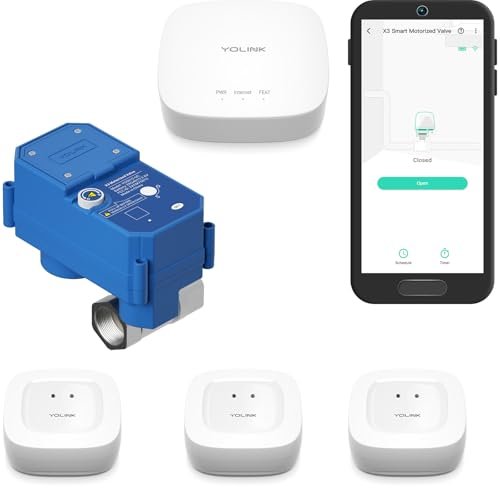
The kit combines a motorized 1-inch shutoff valve, a hub, and three leak sensors. It is designed for potable-water applications and uses YoLink's long-range LoRa-based wireless technology rather than relying entirely on household WiFi. One of its most important features is Control-D2D, which allows compatible leak sensors to communicate directly with the shutoff valve even if internet service or normal AC power is unavailable.
For homeowners who want more than a basic floor alarm—and especially for basements, mechanical rooms, large properties, or areas with weak WiFi—this system offers a more resilient approach to smart water protection.
What Is Included in the YoLink 1-Inch Water Shutoff Kit?
The supplied description identifies the package as a complete leak-detection and shutoff system with:
- One 1-inch motorized water shutoff valve
- Integrated valve controller
- Three water leak sensors
- YoLink hub
- Battery-powered operation
- App and cloud connectivity
- LoRa wireless communication
- Direct sensor-to-valve pairing
That combination means the system can provide both local automatic protection and connected smart-home features.
NSF-Certified for Potable Water Applications
One of the most important product claims is that the valve is NSF certified for potable water.
That matters because a device installed directly in a drinking-water supply should be appropriate for that application.
For homeowners, this makes the valve relevant to main domestic water lines serving:
- Kitchen faucets
- Bathroom fixtures
- Showers
- Appliances
- Other potable-water plumbing
Certification claims should always be verified against the documentation for the exact model before installation, especially in regulated commercial or code-sensitive projects.
Why Potable-Water Certification Matters
Not every valve or fitting is intended for drinking-water service.
A product installed in a potable supply line should use materials and construction appropriate for that environment.
For a whole-home shutoff system, this is more important than it would be for a simple external valve actuator that never contacts the water directly.
Automatic Leak Detection and Water Shutoff
The core purpose of the system is automatic response.
When a compatible leak sensor detects water, the system can trigger the motorized valve to close.
That changes the role of the product from simple monitoring to active leak mitigation.
A conventional leak detector tells you:
"There is water here."
An automatic shutoff system can also respond:
"Stop supplying more water."
Why Automatic Shutoff Can Be Valuable
Leaks often happen when nobody is available to react immediately.
Common scenarios include:
- Washing-machine hose failure
- Water-heater leak
- Burst supply line
- Sink plumbing failure
- Toilet supply-line leak
If the main valve remains open, water can continue flowing until someone notices and manually intervenes.
Automatic shutoff reduces that dependence on human response.
Automatic Shutoff Does Not Eliminate All Water Damage
Closing the valve cannot remove water that has already escaped.
It also cannot necessarily stop water stored inside:
- Water-heater tank
- Appliance reservoir
- Plumbing downstream of the valve
The system should therefore be viewed as a way to limit continued water flow, not a guarantee against all damage.
YoLink Control-D2D: Direct Device-to-Device Operation
The most distinctive feature described here is YoLink Control-D2D.
With D2D pairing, the leak sensors and valve can communicate directly rather than depending on the cloud for the actual shutoff command.
That means the protection logic can continue even if:
- Internet service fails
- WiFi is unavailable
- The hub loses cloud connectivity
For a safety-related automation, that local path is a major advantage.
Why Offline Automation Matters
Many smart-home devices depend heavily on the internet.
A cloud-dependent chain might require:
- Sensor detects water.
- Sensor communicates with hub.
- Hub communicates with cloud.
- Cloud sends automation command.
- Valve receives shutdown command.
If the internet connection fails anywhere in that path, the automation may not occur.
Direct sensor-to-valve communication removes part of that dependency.
Protection During Power Outages
The system is described as battery powered, allowing critical operation during AC power interruptions.
That can matter because plumbing failures do not wait for electricity to return.
A battery-powered valve and sensor arrangement may continue protecting the home during:
- Blackouts
- Storm-related outages
- Electrical service interruptions
Actual backup duration will depend on the batteries, operating conditions, and exact hardware configuration.
Battery-Powered Motorized Valve
Battery operation also simplifies placement because the valve does not necessarily require a permanent nearby electrical outlet for basic operation.
That can be useful around:
- Main shutoff locations
- Meter rooms
- Basements
- Mechanical spaces
However, battery condition becomes a maintenance item and should be checked periodically.
Claimed 10+ Year Lithium Battery Life
The supplied description states a battery life of 10 years or more for the ultra-low-power devices.
That is an unusually long maintenance interval and is enabled in part by low-power radio operation and wake-up behavior.
As with any battery-life estimate, real-world results can vary depending on:
- Temperature
- Number of activations
- Wireless conditions
- Battery chemistry
- Device usage
Treat the figure as a manufacturer claim rather than a guaranteed service interval.
Long-Range LoRa Wireless Connectivity
YoLink uses LoRa-based wireless communication rather than conventional WiFi for its device network.
The supplied description lists a maximum open-air range of up to 1/4 mile.
That is valuable in locations where WiFi coverage is unreliable.
Examples include:
- Basements
- Detached garages
- Meter pits
- Utility rooms
- Mechanical rooms
- Outbuildings
Open-Air Range vs. Real-World Range
The quarter-mile figure is an open-air specification.
Actual range inside a building can be reduced by:
- Concrete
- Metal
- Soil
- Utility equipment
- Walls
- Building geometry
Even so, LoRa is generally designed for longer-range, lower-power communication than standard household WiFi.
Why LoRa Fits Leak Detection Well
Leak sensors usually do not need to transmit large amounts of data.
They mainly need to send small messages such as:
- Leak detected
- Battery status
- Device state
That makes a low-power, long-range protocol particularly appropriate.
It helps maximize both coverage and battery life.
Useful for Basements and Mechanical Rooms
Water-protection devices are often needed in exactly the locations where WiFi performs worst.
Basements may contain:
- Concrete walls
- Utility equipment
- Metal pipes
- Electrical panels
A longer-range wireless system can make sensor placement more flexible.
Hub Included for Smart Features
The kit includes a YoLink hub.
The hub provides connected functionality such as:
- App access
- Cloud notifications
- Remote monitoring
- Broader smart-home integrations
The important distinction is that the hub supports those convenience features, while D2D pairing can preserve certain local safety automations independently.
App Control and Cloud Alerts
With the hub connected, the homeowner can use the YoLink app to monitor system state and receive remote notifications.
That may include information such as:
- Leak events
- Valve state
- Device status
Remote awareness is useful when the automatic shutoff occurs while nobody is home.
Direct Protection Plus Cloud Convenience
This combination is one of the system's strongest architectural advantages.
You get:
- Local automatic shutoff through D2D
- Remote awareness through the hub and app
That is more robust than relying exclusively on either approach.
Three Leak Sensors Included
The kit includes three leak sensors.
That gives enough coverage to monitor several high-risk locations immediately.
A practical starting layout might be:
- Water heater
- Washing machine
- Kitchen sink or dishwasher
The exact locations should reflect the home's plumbing risks.
Best Places to Install Leak Sensors
Near the Water Heater
Place the sensor where leaking water is likely to collect first.
Behind or Beside the Washing Machine
Supply hoses can release large amounts of water if they fail.
Under a Sink
Cabinet plumbing can leak slowly and remain hidden.
Near a Dishwasher
A dishwasher leak can spread beneath cabinets before becoming visible.
Near a Sump or Mechanical Area
Mechanical rooms often contain several potential water sources.
Placement Strategy Matters
The sensor should sit in the likely path of escaping water.
Consider:
- Floor slope
- Low points
- Pipe location
- Appliance orientation
A sensor several feet away from the leak source may not help until significant water has already spread.
One-Inch Valve Size
This kit uses a 1-inch valve.
That specification is critical.
Before purchase, confirm the actual nominal size of the pipe where the valve will be installed.
Common residential main lines may use different pipe sizes depending on the property.
Do not assume that a 1-inch valve will fit every home.
Professional Plumbing Installation
Unlike an external valve actuator that clamps onto an existing handle, an inline potable-water valve generally requires plumbing modification.
Installation may involve:
- Cutting pipe
- Adding fittings
- Pressure testing
- Confirming flow direction
- Checking for leaks
For a main domestic water line, professional plumbing installation is often the safest choice.
Shutoff Valve Location
The valve should be positioned where closing it will stop water to the intended parts of the property.
For whole-home protection, this usually means somewhere downstream of the main supply entry.
However, installation planning should account for:
- Fire suppression systems
- Irrigation branches
- Outdoor taps
- Water treatment equipment
A plumber can determine the correct placement.
Keep the Valve Accessible
Do not bury a smart shutoff valve behind inaccessible finishes.
Future service may require access to:
- Valve body
- Batteries
- Controller
- Manual override
Accessibility matters even for a system designed for long maintenance intervals.
Expandable to 80+ Devices
The supplied information states that the YoLink ecosystem can scale to more than 80 devices.
That makes the kit suitable as a starting point rather than an isolated system.
Over time, a homeowner could potentially add compatible:
- Leak sensors
- Environmental sensors
- Door sensors
- Smart plugs
- Other YoLink devices
The exact supported device count and integrations should be verified for the current hub.
No Subscription Fees
The product description states that the system does not require subscription fees for its core functionality.
That can be important for long-term ownership because recurring cloud fees can significantly affect the total cost of a smart-home safety system.
Always verify current service terms because cloud-service policies can change.
Smart Shutoff System vs. Basic Leak Sensor
A simple leak sensor costs less and is easier to install.
But it only alerts.
This YoLink system adds:
- Automatic shutoff
- Long-range wireless
- Direct device-to-device control
- App monitoring
- Whole-home valve integration
For higher-risk properties, those additions may justify the added installation complexity.
Smart Inline Valve vs. External Valve Robot
An external valve controller mounts over an existing ball valve handle.
External Actuator Advantages
- Usually easier installation
- No need to cut the pipe
- Potentially DIY-friendly
Inline Valve Advantages
- Purpose-built flow control
- Integrated valve construction
- Often cleaner installation
The best choice depends on existing plumbing and installation preferences.
Why an Inline Valve May Be More Reliable
A motorized inline valve does not need to physically manipulate an old manual handle.
That removes variables such as:
- Stiff valve stem
- Corroded handle
- Poor actuator alignment
However, inline installation is more invasive and usually more expensive.
D2D vs. WiFi-Based Shutoff Systems
A conventional WiFi system may depend on:
- Router
- Internet
- Cloud
- Power
The YoLink D2D design is intended to maintain core automatic shutoff even when those services are unavailable.
That is a meaningful distinction for users who prioritize resilience.
Common Buying Mistakes
Buying the Wrong Valve Size
Confirm the pipe diameter first.
Assuming WiFi Coverage Is Required at Every Sensor
YoLink devices use their own long-range wireless network.
Forgetting to Configure D2D Pairing
Offline protection depends on correct setup.
Installing Sensors Without Testing Them
Test each sensor and valve response after installation.
Hiding the Valve Where It Cannot Be Serviced
Maintain physical access.
Testing the System
After installation, verify:
- Each sensor detects water
- Valve closes when expected
- D2D operation works
- App notifications arrive
- Manual control works
Periodic testing is prudent for any automated safety system.
Battery Maintenance
Long battery life does not mean the batteries should be ignored indefinitely.
Check device status periodically through the app and replace batteries when required.
A leak-protection system should not be assumed healthy simply because it has not generated an alert recently.
Who Is This Kit Best For?
This YoLink kit may be a strong choice for:
- Homeowners wanting automatic whole-home shutoff
- Large homes
- Properties with weak WiFi areas
- Basements
- Vacation homes
- Mechanical rooms
- Existing YoLink users
- Buyers who value offline automation
It may be excessive for someone who only needs a single audible leak alarm under a sink.
Advantages and Considerations
Advantages
- NSF-certified potable-water valve according to the supplied description
- 1-inch motorized shutoff valve
- Three leak sensors included
- Hub included
- Automatic water shutoff
- Control-D2D local automation
- Operation without internet for direct pairing
- Battery-powered resilience
- Long-range LoRa communication
- Up to quarter-mile open-air range
- Claimed 10+ year battery life
- Expandable ecosystem
- No subscription fees stated
Potential Considerations
Requires inline plumbing installation.
One-inch size will not fit every home.
Long-range claims vary in real buildings.
Battery-life figures depend on actual conditions.
Remote notifications still rely on connected hub infrastructure.
Frequently Asked Questions
Is the valve suitable for drinking water?
The supplied description states that it is NSF certified for potable-water applications.
What size is the valve?
This kit uses a 1-inch valve.
How many leak sensors are included?
Three.
Is a hub included?
Yes.
Can the sensors shut off the valve automatically?
Yes, when properly configured.
Does automatic shutoff require internet?
The supplied description states that compatible sensors can trigger the valve directly through YoLink Control-D2D without internet.
Can it work during a power outage?
The system is described as battery powered for continued protection during outages, subject to available battery charge.
What wireless technology does it use?
YoLink uses LoRa-based long-range wireless communication.
What is the maximum range?
The source lists up to 1/4 mile in open air.
How long do the batteries last?
The product description claims more than ten years for the low-power lithium-powered devices under suitable conditions.
Does it require a subscription?
The supplied information states that no subscription fees are required.
Can the system be expanded?
Yes. The description states support for more than 80 devices within the broader YoLink ecosystem.
Final Thoughts
The YoLink 1-inch smart water shutoff valve kit offers a more resilient form of leak protection than a standard WiFi-only alarm.
Its biggest strengths are the combination of an inline potable-water valve, three leak sensors, long-range LoRa communication, and direct D2D pairing. That direct communication means the core leak-to-shutoff automation does not have to rely entirely on internet service or cloud connectivity.
The battery-powered design adds another layer of resilience during outages, while the included hub provides remote monitoring and broader smart-home functionality when normal connectivity is available.
The main tradeoff is installation complexity. Because this is a 1-inch inline plumbing valve, compatibility and professional installation need to be considered carefully.
For homeowners looking for a whole-home smart water shutoff system with potable-water certification, automatic leak response, long-range LoRa sensors, battery backup, and offline device-to-device control, this YoLink kit offers a particularly robust approach to residential water protection.