Moen Flo Smart Water Monitor and Shutoff Review: Whole-Home Leak Detection, Automatic Shutoff, and Real-Time Water Monitoring
A water leak does not need to be dramatic to become expensive. A slow drip behind a wall, a toilet that keeps running, a failing appliance connection, or a burst pipe can waste water and damage floors, cabinets, drywall, and personal belongings before anyone notices.
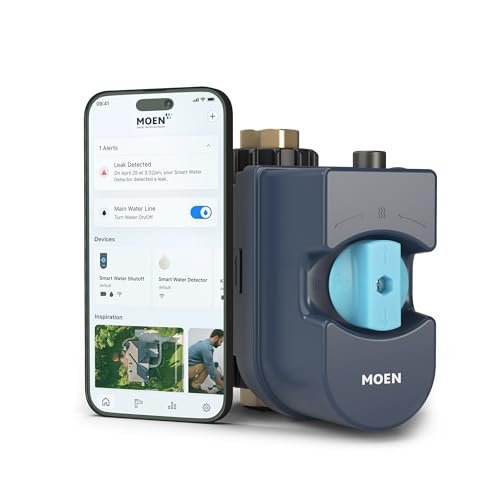
The Moen Flo Smart Water Monitor and Shutoff is designed to give homeowners a more comprehensive way to monitor the entire plumbing system from one device. Installed on the home's main water supply line, it tracks flow, pressure, and temperature, learns normal household water-use patterns, and looks for unusual activity that may indicate a leak or another plumbing problem.
When something appears abnormal, the system can alert the homeowner through the Moen Smart Water Network app. Depending on how it is configured, the valve can also shut off the home's water automatically to help limit damage from a serious leak.
For homeowners looking beyond simple point sensors, Flo offers a whole-house approach that combines monitoring, leak detection, remote control, and automatic shutoff in a single plumbing device.
What Is the Moen Flo Smart Water Monitor and Shutoff?
The Moen Flo Smart Water Monitor and Shutoff is an in-line smart plumbing valve installed on the main water supply entering the home.
Instead of waiting for water to reach a floor sensor, the device monitors characteristics of the water moving through the plumbing system.
These include:
- Water flow
- Water pressure
- Water temperature
- Usage patterns
By analyzing changes in these measurements, the system can identify abnormal conditions that may indicate a leak, a fixture left running, excessive pressure, or potentially freezing conditions.
Whole-House Monitoring Instead of Single-Point Detection
Traditional water leak sensors monitor one physical location.
A sensor placed near a water heater may catch a leak there, but it cannot tell you that a bathroom faucet upstairs has been left running.
Moen Flo takes a different approach.
Because it is installed on the main supply line, it monitors water use throughout the home.
That can potentially help detect problems involving:
- Toilets
- Faucets
- Showers
- Washing machines
- Dishwashers
- Irrigation connections
- Hidden plumbing leaks
This broader view is one of the main reasons to consider a whole-house smart shutoff system.
Automatic Water Shutoff
Automatic shutoff is arguably the most important feature.
When the system identifies a severe abnormality and is configured for automatic response, it can close the main water valve.
That can help limit continued water flow from problems such as:
- Burst pipes
- Failed supply hoses
- Major fixture leaks
- Unexpected high-flow events
It cannot undo water damage that has already occurred, but stopping the supply can prevent a leak from being continuously fed.
Why Automatic Shutoff Matters When You Are Away
Imagine a pipe failure while the house is empty.
A phone notification is useful, but if nobody can reach the property quickly, water may continue flowing.
Automatic shutoff reduces dependence on immediate human intervention.
This can be especially valuable for:
- Vacation homes
- Rental properties
- Frequent travelers
- Homes with finished basements
- Properties with expensive flooring
Learns Normal Water Usage Patterns
Moen describes the system as using FloSense technology to learn how water is normally used in the home.
Instead of treating every flow event as suspicious, the system builds an understanding of typical household behavior.
For example, it may learn patterns associated with:
- Morning showers
- Dishwasher cycles
- Laundry
- Toilet use
- Evening routines
This allows the system to look for activity that differs significantly from normal usage.
Why Usage Learning Is Useful
A static leak threshold can produce false alarms.
A household with five people may use far more water than a single-person home.
Learning typical behavior can make the system more context-aware.
The goal is to distinguish normal activity from patterns that could indicate:
- Continuous flow
- Unexpected nighttime use
- A slow leak
- A fixture left running
Detecting Small Leaks
The manufacturer states that the system can identify very small leaks, potentially down to approximately one drop per minute under suitable conditions.
That is a notable claim because slow leaks can be difficult to notice.
Examples include:
- Toilet flapper leaks
- Dripping faucets
- Small pipe leaks
- Loose fittings
In practice, detection capability can depend on plumbing layout, water pressure, fixtures, and household usage patterns.
Real-Time Water Flow Monitoring
The Moen Smart Water Network app allows users to view live water activity.
This can help answer questions such as:
- Is water currently flowing?
- How much water is being used?
- Is there unusual activity?
- Is someone using water while the house should be empty?
Live monitoring can also make household water consumption more visible.
Water Pressure Monitoring
The system also tracks water pressure.
Excessive pressure can stress:
- Supply hoses
- Faucets
- Valves
- Appliance connections
- Plumbing joints
If the system detects abnormal pressure, it can notify the homeowner.
A smart monitor does not replace a properly installed pressure-reducing valve, but it can help identify when pressure may need professional attention.
Water Temperature Monitoring
Water temperature at the main supply can also provide useful information.
The system may notify users if temperatures become low enough to suggest an increased risk of freezing.
This can be particularly useful during winter or in:
- Vacant homes
- Cold climates
- Utility spaces
- Seasonal properties
It does not physically heat pipes, but an early warning can give the homeowner time to respond.
Alerts for Potential Freezing Conditions
Frozen pipes can lead to significant leaks when the pipe expands, cracks, and later thaws.
A low-temperature alert gives homeowners an opportunity to:
- Increase heat
- Open cabinet doors
- Investigate exposed pipes
- Arrange property access
This turns the monitor into more than a basic leak detector.
Fixture-Left-On Detection
The system can also identify prolonged or unusual water use.
That may help detect situations such as:
- Faucet left running
- Hose left on
- Toilet continuously filling
- Shower running unexpectedly
These events may not involve a broken pipe, but they can still waste substantial amounts of water.
Moen Smart Water Network App
The app serves as the main interface for the system.
Users can use it to:
- View water activity
- Receive alerts
- Review abnormalities
- Shut the water off remotely
- Check system status
Remote control means the main valve can potentially be closed even when the homeowner is far from the property.
Remote Shutoff From Anywhere
If the system identifies a problem but does not automatically close the valve, users can shut the water off manually through the app.
This may be useful when:
- A neighbor reports water
- A camera shows a leak
- A contractor is working in the home
- You are leaving for an extended trip
Remote shutoff can be much faster than arranging physical access to the main valve.
Multiple Notification Methods
The source states that alerts may be delivered through:
- App notifications
- Phone calls
Multiple notification channels provide useful redundancy.
If one alert method is missed, another may still reach the user.
Current availability of specific notification methods should be verified in the Moen app and service terms.
Free App Without a Required Subscription
The supplied product information states that the main app functionality does not require a subscription.
That is important because some smart-home monitoring systems charge ongoing fees for advanced features.
However, smart-platform policies can change, so current pricing and service terms should always be checked at the time of purchase.
Protection During WiFi Outages
One notable feature in the supplied description is the ability to retain some learned behavior locally.
The manufacturer states that if WiFi connectivity is lost, the device can continue protecting the home using locally stored information.
That is important because a plumbing safety system should not become completely useless simply because internet service is unavailable.
What You Lose Without WiFi
Even if local protection continues, remote features may be unavailable during an outage.
These can include:
- App notifications
- Remote shutoff
- Cloud-based analytics
Local automatic protection and internet-dependent remote services should be thought of as two separate layers.
Main-Line Installation
The device is installed directly on the home's main incoming water line.
That means it can monitor essentially all downstream water use.
Installation may involve:
- Shutting off water
- Cutting pipe
- Adding fittings
- Mounting the device
- Connecting power
- Leak testing
This is more involved than installing a battery-powered floor sensor.
Professional Installation Is Recommended
Moen recommends professional installation.
That is sensible because the system becomes part of the home's pressurized plumbing.
Improper installation can cause:
- Leaks
- Pipe stress
- Flow restrictions
- Incorrect readings
A plumber can also confirm that the valve size and location are appropriate for the home.
Compatible Pipe Sizes
The supplied information states that Model 900-001 is designed for pipe sizes ranging from approximately 3/4 inch to 1-1/4 inch, depending on the installation configuration.
A professional should verify compatibility before installation.
Pipe size should not be guessed based solely on outside diameter.
Choose an Accessible Installation Location
The device should be installed where it can be:
- Serviced
- Inspected
- Reached manually
- Protected from unsuitable environmental conditions
Avoid burying the valve behind permanently closed walls.
Future maintenance is much easier when the device remains accessible.
Power Requirements Matter
Unlike passive plumbing valves, smart shutoff systems require electrical power.
The installation location therefore needs appropriate access to power according to the manufacturer's instructions.
Consider power availability before selecting the final valve location.
Smart Water Shutoff vs. Floor Leak Sensors
Both approaches have value.
Whole-House Smart Shutoff
Advantages:
- Monitors the entire water supply
- Can detect abnormal flow
- Can automatically close the main valve
- Tracks pressure and temperature
Floor Leak Sensors
Advantages:
- Detect actual water at a specific location
- Simple installation
- Useful around appliances
The strongest protection may come from using both approaches together.
Why Point Sensors Can Still Be Useful
Flow-based monitoring can identify unusual usage, but a physical leak sensor tells you exactly when water reaches a specific area.
Point sensors can be especially useful around:
- Water heaters
- Sump areas
- Washing machines
- Under sinks
Moen also offers compatible smart water sensing products as part of its wider ecosystem.
Flo vs. Basic Smart Shutoff Valves
Some smart valves simply allow remote opening and closing.
Flo adds monitoring and analytics.
It can observe:
- Flow
- Pressure
- Temperature
- Usage behavior
That makes it closer to a plumbing monitoring platform than a simple remote-controlled valve.
Water Monitoring and Conservation
Because the device tracks water use, it can also help homeowners become more aware of consumption.
That may reveal:
- Long showers
- Continuous toilet leaks
- Irrigation overuse
- Unexpected nighttime flow
Greater visibility can make it easier to identify unnecessary water consumption.
Smart-Home Integration
The supplied information lists compatibility with services including:
- Alarm.com
- Ring
- Google Assistant
- NICE
Integration capabilities may vary over time, so current platform support should be verified before purchase if a specific ecosystem is important.
Google Assistant Integration
Google Assistant compatibility can make basic voice interaction possible depending on current supported commands.
However, for water safety, automatic protection should be the primary mechanism rather than voice control.
Ring Integration
Ring integration may be useful for homeowners already using Ring as part of their property monitoring setup.
This can help bring plumbing alerts into a wider smart-home security ecosystem.
Check current integration capabilities because supported features can change.
Daily Health Testing
One of the broader benefits of whole-house monitoring is the ability to evaluate plumbing behavior over time.
Some smart water systems perform periodic checks designed to identify pressure loss or small leaks.
When such testing is available and properly configured, it can help uncover problems before they become obvious.
Common Plumbing Problems the System May Help Identify
Potential issues include:
- Running toilets
- Dripping fixtures
- Supply-line leaks
- Burst pipes
- High water pressure
- Low-temperature conditions
- Unusual continuous flow
It is still important to investigate the cause rather than assuming the smart device provides a diagnosis.
What Flo Cannot Do
No smart water system can prevent every form of water damage.
Flo cannot necessarily stop water from:
- A roof leak
- Groundwater intrusion
- An overflowing sump
- A failed aquarium
- A pre-filled water heater tank
It primarily controls water supplied through the plumbing line where it is installed.
It Does Not Replace Plumbing Maintenance
Homeowners should still inspect:
- Washing-machine hoses
- Water heater condition
- Supply valves
- Toilet components
- Under-sink fittings
Smart monitoring is an additional safety layer, not a replacement for maintenance.
Common Installation Mistakes
Choosing the Wrong Valve Size
Have the pipe size verified before purchasing.
Installing in an Inaccessible Location
Future servicing should be possible.
Ignoring Power Requirements
The smart device needs a suitable power source.
Failing to Test Shutoff
Verify that the valve actually closes the home's water.
Assuming Every Alert Is a Leak
Some abnormal usage may have legitimate explanations.
Test the System After Installation
After installation, verify:
- Water flow readings
- Valve operation
- App connectivity
- Notifications
- Remote shutoff
- Automatic shutoff settings
A safety system should be tested before relying on it.
Test the Manual Shutoff
You should also know how to operate the home's water supply manually.
Smart technology should never replace basic knowledge of:
- Main shutoff valve location
- Emergency plumbing procedure
If electronics fail, a manual shutoff remains essential.
Who Is Moen Flo Best For?
The system may be especially useful for:
- Homeowners
- Vacation properties
- Finished basements
- Larger homes
- Rental properties
- Smart-home users
- Frequent travelers
It is best suited to people who want whole-house monitoring rather than only point-of-leak alarms.
Advantages and Considerations
Advantages
- Whole-house monitoring
- Automatic water shutoff
- Remote valve control
- Flow monitoring
- Pressure monitoring
- Temperature monitoring
- Usage-pattern learning
- Small-leak detection
- Freeze-risk alerts
- Fixture-left-on alerts
- Multiple notification methods
- No required subscription stated
- Local protection during WiFi outages
- Smart-home integrations
Potential Considerations
Professional installation is recommended.
The device requires access to power.
Pipe-size compatibility must be verified.
It cannot stop water from every possible source.
Remote features depend on internet connectivity.
The system is more expensive and complex than simple floor sensors.
Frequently Asked Questions
What does Moen Flo monitor?
It monitors water flow, pressure, temperature, and usage patterns.
Can it shut off the home's water automatically?
Yes, when configured to do so and when the system detects certain abnormal conditions.
Can I shut off the water remotely?
Yes, through the Moen Smart Water Network app.
Does it detect small leaks?
The manufacturer states that it can identify very small leaks under appropriate conditions.
Does it warn about freezing?
Yes. Low-temperature conditions are one of the stated monitoring functions.
Can it tell if water has been left running?
It is designed to identify unusual or continuous water usage.
Does the app require a monthly subscription?
The supplied description states that the core app does not require a subscription.
Does the system still work if WiFi goes down?
The manufacturer states that it stores recent learned behavior locally and can continue providing certain protection without WiFi.
Does installation require cutting into the main water line?
Yes. This is an in-line plumbing device.
Is professional installation recommended?
Yes.
What pipe sizes are supported?
The supplied description states that Model 900-001 is intended for approximately 3/4-inch to 1-1/4-inch pipe applications, subject to installation compatibility.
Can it integrate with other smart-home platforms?
The source lists integrations including Alarm.com, Ring, Google Assistant, and NICE.
Final Thoughts
The Moen Flo Smart Water Monitor and Shutoff is more than a conventional leak alarm. By installing directly on the main water line, it can monitor water behavior throughout the home, detect unusual conditions, provide remote alerts, and automatically close the supply when a serious problem is identified.
Its strongest advantages are whole-house visibility and active response. Flow, pressure, temperature, and usage monitoring provide more information than a simple floor sensor, while automatic shutoff can help reduce continued water release during a major plumbing failure.
The tradeoff is greater installation complexity. This is not a device you simply place beneath a sink; it becomes part of the main plumbing system, and professional installation is recommended.
For homeowners looking for a whole-home smart water monitor with automatic shutoff, real-time usage tracking, pressure monitoring, leak detection, and remote app control, Moen Flo offers a comprehensive approach to plumbing protection and water management.