Meross Smart WiFi Water Timer Review: Weather-Based Watering, App Control, and Smart Home Integration
A smart hose timer can turn a basic outdoor faucet into a much more capable irrigation system. Instead of relying on a mechanical dial or fixed schedule, a connected water timer can respond to weather conditions, track usage, send alerts, and let you adjust watering from your phone.
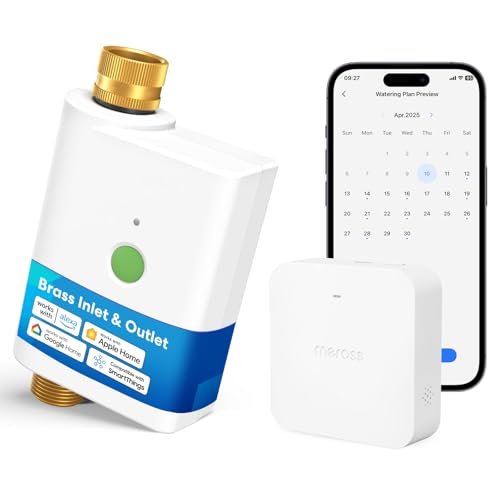
The Meross Smart WiFi Water Timer is designed for that kind of connected outdoor watering. It combines brass inlet and outlet fittings with customizable schedules, weather-based watering skips, manual control, water-usage tracking, and support for Apple HomeKit, Alexa, and Google Assistant.
Its strongest appeal is the balance between automation and scalability. One compatible WiFi hub can reportedly support up to 24 timers, making the system suitable not only for a single hose bibb but also for larger properties with several independent watering areas.
What Is the Meross Smart WiFi Water Timer?
This is a smart faucet-mounted irrigation controller designed for hose-fed watering systems.
According to the supplied product information, it offers:
- 2.4 GHz WiFi connectivity
- Brass inlet and outlet fittings
- Weather-based automatic watering skips
- Customizable schedules
- Watering durations from 1 minute to 11 hours 59 minutes
- Day-of-week scheduling
- Meross app control
- Water-usage tracking
- Alerts and notifications
- Manual watering
- Automatic shutoff
- Apple HomeKit support
- Alexa compatibility
- Google Assistant compatibility
- Multi-timer expansion through a compatible Meross hub
The source also notes that this specific timer does not support Apple HomeKit automation, even though it can be integrated with HomeKit for compatible control functions.
Why Choose a Smart Hose Timer?
A conventional hose timer can already automate basic watering, but it usually lacks awareness of changing weather and provides little visibility into how the system is actually operating.
A connected timer adds useful capabilities when you need to:
- Change schedules remotely
- Skip irrigation after rain
- Track watering activity
- Control several outdoor zones
- Receive notifications about problems
That makes smart hose timers especially useful for homeowners who want more control without installing a full in-ground irrigation controller.
Durable Brass Inlet and Outlet
The supplied description emphasizes brass construction on both the inlet and outlet.
That is an important hardware feature because threaded hose connections take a lot of stress over time.
They are repeatedly exposed to:
- Installation and removal
- Hose weight
- Outdoor weather
- Water pressure
Brass is generally more resistant to thread deformation than lightweight plastic fittings.
Why Brass Matters Outdoors
Plastic hose threads can wear or become damaged if they are:
- Cross-threaded
- Overtightened
- Repeatedly removed
Brass connections are usually more forgiving under repeated use.
That does not eliminate the need for careful installation, but it can improve long-term durability.
Weather-Based Automatic Watering Skips
One of the standout features is weather-aware schedule skipping.
The source states that the timer can use hyper-local weather data to avoid unnecessary watering before, during, or after rain and under freezing or windy conditions.
This is more sophisticated than a basic rain delay that must be activated manually.
Why Automatic Weather Skips Matter
A fixed timer follows the clock regardless of conditions.
That can lead to irrigation running:
- During rainfall
- Immediately after rain
- When temperatures are near freezing
- During strong wind
Weather-aware automation can reduce unnecessary watering and help avoid poor sprinkler performance.
Rain-Based Skips
If rain is expected, the timer can suspend watering rather than running the regular schedule.
This may help reduce:
- Water waste
- Saturated soil
- Runoff
For lawn and garden irrigation, that is one of the clearest advantages of a smart controller.
Freeze-Based Skips
Watering during freezing conditions can be undesirable because water may freeze on:
- Plants
- Walkways
- Irrigation components
The supplied description indicates that freezing conditions can be used as a reason to skip irrigation.
That can provide an extra layer of seasonal protection.
Wind-Based Skips
Strong wind can make above-ground sprinklers inefficient.
Water may drift away from the intended area instead of landing evenly across the lawn.
A wind-based skip can therefore make sense for sprinkler applications.
It may be less important for drip irrigation, where water is delivered close to the soil.
Weather Data Is Not Soil Moisture
Weather automation is useful, but it should not be treated as a perfect measurement of your garden.
A weather service cannot directly determine moisture in:
- Containers
- Covered beds
- Greenhouses
- Different soil types
Use weather-based skips as a helpful automation layer, but still check actual landscape conditions periodically.
Customizable Watering Schedules
The timer supports flexible programming through the app.
The supplied information lists watering durations from approximately 1 minute to 11 hours and 59 minutes.
That wide range allows the controller to support several irrigation methods.
Short watering periods may work for:
- Small sprinklers
- Patio plants
Longer sessions may be more appropriate for:
- Drip irrigation
- Soaker hoses
- Deep watering
Day-of-Week Scheduling
Schedules can be assigned across Monday through Sunday.
This makes it possible to create recurring routines such as:
- Monday, Wednesday, Friday
- Tuesday and Saturday
- Weekend-only watering
This is useful when local watering rules or plant needs require specific days.
Avoid Overwatering Just Because Scheduling Is Easy
Smart scheduling makes it easy to add more watering, but more water is not always better.
An overly aggressive schedule can lead to:
- Runoff
- Constantly wet soil
- Plant stress
- Wasted water
Start conservatively and adjust based on actual soil and plant response.
App-Based Remote Management
The Meross app allows users to control the timer remotely.
That can be useful when:
- Away from home
- Traveling
- Weather changes suddenly
- One area needs an extra watering cycle
Remote access is a major convenience compared with a traditional dial timer.
Water-Usage Tracking
The system can track water consumption through the Meross app according to the supplied description.
This gives users more visibility into irrigation than simply knowing how long the valve was open.
Why Water-Usage Data Is Useful
Watering duration alone does not always tell you how much water was delivered.
Usage tracking can help you compare:
- Different schedules
- Seasonal watering
- Long-term consumption
This can be useful for identifying whether irrigation is increasing over time.
Use Water Data to Improve Scheduling
The best use of water-consumption history is not simply to collect data.
Use it to ask:
- Is this zone using more water than expected?
- Can the schedule be shortened?
- Did rain skips reduce consumption?
- Are plants still healthy after reducing runtime?
That turns the timer into a tool for better irrigation management.
Alerts and Notifications
The timer can send notifications if it detects an issue according to the supplied information.
That can be especially useful when irrigation is operating unattended.
Potential problems may include:
- Unexpected flow
- Valve issues
- Watering anomalies
The exact alert types should be confirmed in the current Meross app documentation.
Manual Watering
The timer includes a physical button for immediate watering.
This allows you to start irrigation without opening the app.
That is useful when you are already outside and want to:
- Test a sprinkler
- Water new plants
- Run an extra cycle
Adjustable Automatic Shutoff
Manual watering includes an automatic shutoff feature.
The source states that the default manual run is approximately 15 minutes, with the duration adjustable through the app.
That can help prevent water from running indefinitely if you forget to return and shut it off manually.
Why Auto Shutoff Is Valuable
A simple outdoor faucet can remain open until someone notices.
An automatic timeout adds a useful safeguard.
It can reduce the risk of:
- Water waste
- Oversaturated soil
- Accidental flooding
especially during one-off manual watering.
Apple HomeKit Compatibility
The timer is advertised as compatible with Apple HomeKit.
That may allow supported control through Apple's smart-home ecosystem.
However, the supplied description includes an important limitation:
This smart hose timer does not support Apple HomeKit automation.
That distinction should be understood before purchase.
HomeKit Control vs. HomeKit Automation
A device may appear in HomeKit and still not support every automation capability.
If your main goal is to build advanced Apple Home automations, verify the exact supported functions for this model before buying.
Alexa Compatibility
The timer also works with Amazon Alexa according to the supplied information.
Voice commands can make simple irrigation control more convenient.
For example, voice control may be useful for:
- Starting watering
- Stopping watering
Detailed schedule configuration is still better handled in the app.
Google Assistant Compatibility
Google Assistant support is also listed.
As with Alexa, voice control is best treated as an additional convenience rather than the primary irrigation interface.
Multi-Timer Expansion
One of the strongest scalability features is support for up to 24 water timers on one compatible WiFi hub, according to the supplied description.
That is substantially more capacity than many residential smart hose systems offer.
Why 24-Timer Support Matters
A large property could potentially assign separate timers to:
- Front lawn
- Backyard
- Side yard
- Vegetable garden
- Greenhouse
- Flower beds
- Shrubs
- Patio containers
without requiring a completely separate hub for every faucet.
Large-Scale Expansion Still Requires Planning
Supporting 24 timers does not mean every property should install that many.
Before expanding, consider:
- Water pressure
- Faucet availability
- Wireless range
- Hose routing
- App organization
A large smart irrigation network should be planned carefully to avoid unnecessary complexity.
2.4 GHz WiFi Requirement
The system is compatible only with 2.4 GHz WiFi according to the source.
This is common for smart-home devices because 2.4 GHz generally provides better range through walls than 5 GHz.
Make sure the required network is enabled during setup.
Hub Placement Matters
If the system uses a hub for multiple timers, the hub should be located where it can communicate reliably with both the home network and outdoor devices.
Avoid placing it:
- Behind large metal appliances
- Inside dense cabinets
- Far from outdoor watering areas
Wireless coverage should be tested before relying on unattended irrigation.
Battery Compartment Design
The source notes that the power compartment is tightly secured as part of the waterproof design.
Opening it may require a screwdriver used carefully from both sides.
This is a useful reminder that weather sealing can make the battery compartment intentionally snug.
Insert Batteries With Correct Polarity
When installing batteries, confirm the polarity markings before closing the compartment.
Incorrect battery orientation can prevent the timer from functioning and may complicate troubleshooting.
Outdoor Installation
The timer is designed to attach directly to an outdoor faucet.
A typical setup is:
Outdoor faucet → Meross smart timer → hose or irrigation system
After installation, the upstream faucet generally remains open so the smart valve can control water flow.
Check Every Connection for Leaks
Because the faucet remains pressurized, small leaks can continue even while irrigation is off.
Inspect:
- Faucet connection
- Timer outlet
- Hose fitting
before leaving the system unattended.
Do Not Overtighten Brass Threads
Brass is durable, but threads can still be damaged if excessively tightened.
Use properly seated washers and hand-tighten connections according to the manufacturer's instructions.
Drip Irrigation Applications
The timer can be useful with drip irrigation.
Drip systems work particularly well with smart schedules because they deliver water slowly near the root zone.
A timer can automate:
- Start time
- Duration
- Frequency
while weather skips reduce unnecessary irrigation.
Pressure Regulation May Be Required
Many drip systems operate at lower pressure than a standard outdoor faucet.
The source does not state that a pressure regulator is included.
Use an appropriate regulator if required by the connected irrigation components.
Lawn Watering
The timer can also automate hose-fed lawn sprinklers.
Weather-based rain and wind skips are particularly useful in this application because sprinkler performance depends heavily on outdoor conditions.
Garden and Raised-Bed Irrigation
Vegetable beds and raised gardens can be connected through:
- Drip tubing
- Soaker hoses
- Micro-sprayers
The long scheduling range provides flexibility for different watering methods.
Pool-Related Use
The supplied description mentions pool applications.
That should be interpreted conservatively.
The timer may be suitable for certain hose-based fill tasks, but it should not automatically be considered a controller for:
- Pool pumps
- Filtration
- Chemical treatment
Use it only for applications supported by the manufacturer.
Smart Timer vs. Basic Hose Timer
Basic Timer Advantages
- Simpler
- No app
- No smart-home dependency
Meross Smart Timer Advantages
- Remote control
- Weather-based skips
- Usage tracking
- Notifications
- Voice integration
- Large multi-timer expansion
The smart version is more useful when remote monitoring and automation matter.
Smart Hose Timer vs. In-Ground Irrigation Controller
A smart hose timer controls water at an outdoor faucet.
A conventional irrigation controller operates electrically controlled valves in a permanent sprinkler system.
Choose the Meross timer for:
- Hose-fed sprinklers
- Drip irrigation
- Soaker hoses
- Garden watering
Choose an in-ground controller for permanent multi-zone underground irrigation.
Common Mistakes
Connecting to 5 GHz Only
The system requires 2.4 GHz WiFi.
Assuming HomeKit Means Full Automation Support
The supplied description explicitly says HomeKit automation is not supported.
Ignoring Weather Skip Settings
Review how aggressive the skip logic is for your landscape.
Forgetting to Inspect Pressurized Connections
Small faucet leaks can waste water continuously.
Using Long Durations Without Checking Runoff
An 11-hour maximum does not mean long watering is appropriate for every application.
How to Create a Better Schedule
Begin by identifying the watering method.
A sprinkler, soaker hose, and drip line deliver water very differently.
Then determine:
- How quickly water reaches the root zone
- Whether runoff develops
- How long soil stays moist
Use the app to create a schedule based on those observations rather than arbitrary durations.
Seasonal Adjustments Matter
Even with automated weather skips, watering requirements change throughout the year.
Review schedules as:
- Temperatures rise or fall
- Plants mature
- Rain patterns change
A smart timer should make adjustment easier, not eliminate the need for observation.
Advantages and Considerations
Advantages
- Brass inlet and outlet
- Weather-based automatic skips
- Rain, freeze, and wind considerations
- Custom scheduling
- 1-minute to 11-hour-59-minute duration range
- Meross app control
- Water-usage tracking
- Notifications
- Manual watering
- Adjustable automatic shutoff
- Apple HomeKit compatibility
- Alexa compatibility
- Google Assistant compatibility
- Up to 24 timers per compatible hub
Potential Considerations
- 2.4 GHz WiFi only
- HomeKit automation is not supported according to the source
- Weather data is not a direct soil-moisture measurement
- Multi-timer installations require good wireless coverage
- Drip systems may need pressure regulation
- Battery compartment is intentionally tight for weather protection
Frequently Asked Questions
Does the Meross water timer connect to 5 GHz WiFi?
No. The supplied information specifies 2.4 GHz networks.
Does it support weather-based watering?
Yes. The source describes automatic skips for rain and certain freezing or windy conditions.
Can I control it from my phone?
Yes, through the Meross app.
Can I track water usage?
Yes, according to the supplied product information.
How long can a programmed watering session run?
From approximately 1 minute to 11 hours and 59 minutes.
Can I water manually?
Yes.
Does manual watering shut off automatically?
Yes. The source lists a 15-minute default that can be adjusted in the app.
Does it work with Apple HomeKit?
Yes, according to the supplied description.
Does it support HomeKit automations?
The supplied description explicitly says no.
Does it work with Alexa?
Yes.
Does it work with Google Assistant?
Yes.
How many timers can one hub support?
Up to 24 according to the source.
Are the hose connections plastic?
No. The supplied description specifies brass inlet and outlet fittings.
Can I use it with drip irrigation?
Yes, provided the connected irrigation components are compatible with the available pressure.
Final Thoughts
The Meross Smart WiFi Water Timer is a strong option for homeowners who want more than simple schedule automation from an outdoor faucet.
Its main strengths are the brass hose connections, weather-based watering skips, long scheduling range, water-usage tracking, manual auto-shutoff, and broad smart-home compatibility. The ability to support as many as 24 timers on one compatible hub also makes it unusually scalable for larger hose-fed irrigation setups.
The most important caveats are the 2.4 GHz WiFi requirement and the distinction between HomeKit compatibility and HomeKit automation support. Weather-based skips are also only as useful as the underlying weather data and should not completely replace observation of actual soil conditions.
For users looking for a smart WiFi hose timer with brass fittings, weather-based rain and freeze skips, water-usage tracking, Apple HomeKit, Alexa and Google Assistant support, manual auto-shutoff, and large multi-zone expansion, the Meross system offers a capable platform for automating lawns, gardens, drip irrigation, and other outdoor watering tasks.