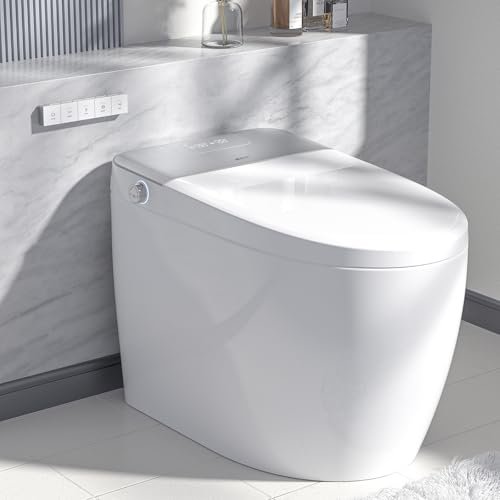
LEIVI T162A Smart Toilet Review: Auto Lid, Automatic Flush, Bidet Controls and Nightlight
A smart toilet is most useful when its technology removes friction from everyday bathroom routines rather than adding complexity. Automatic lid movement, hands-free flushing, adjustable bidet washing, and night lighting can all make a toilet more convenient, but only when those features are intuitive and reliable.
The LEIVI T162A smart toilet is designed around that type of automation. It combines motion-activated lid opening and closing, automatic flushing, adjustable bidet spray settings, ambient night lighting, remote control, a side control knob, and automatic self-cleaning functions.
Its appeal is straightforward: fewer surfaces to touch, less need to remember individual controls, and more flexibility than a traditional toilet or basic bidet attachment.
This guide examines the LEIVI T162A from a practical perspective, including its hands-free functions, bidet controls, nighttime usability, flushing, maintenance, installation considerations, and the tradeoffs that come with choosing a highly automated toilet.
What Is the LEIVI T162A Smart Toilet?
The LEIVI T162A is an integrated smart toilet with electronic bidet functions and automated controls.
Instead of adding a separate bidet seat to a conventional toilet, the cleansing system, lid motor, sensors, flush controls, lighting, and electronic interface are built into one fixture.
Its main advertised features include automatic lid opening and closing, automatic flushing, adjustable water pressure and spray modes, night lighting, remote operation, side controls, and self-cleaning functions.
The result is a toilet intended to provide a largely hands-free experience while still giving the user manual control when desired.
Automatic Lid Opening
When a user approaches the toilet, the lid is designed to open automatically.
This is one of the most visible smart features and contributes to the toilet's touch-free operation.
Instead of reaching down and lifting the lid manually, the motion or proximity system handles the action.
That can be particularly convenient in a primary bathroom where the toilet is used frequently.
It may also reduce fingerprints and repeated contact with exterior surfaces.
Automatic Lid Closing
After the user leaves, the LEIVI T162A can close its lid automatically.
This completes the hands-free cycle and helps keep the fixture looking orderly between uses.
Automatic closing can also be useful in households where users routinely forget to lower the lid.
As with any motorized system, the mechanism should be allowed to operate without being forced manually.
Repeatedly pushing against the lid motor can create unnecessary wear.
Why Touch-Free Lid Operation Matters
Automatic lid movement is primarily a convenience feature, but it also reduces the number of surfaces a user has to touch.
That can make the bathroom routine feel cleaner and more streamlined.
For some people, particularly older adults or users with limited flexibility, eliminating the need to bend and lift the lid can also make the toilet easier to use.
The benefit is not dramatic in isolation, but when combined with automatic flushing and bidet washing, it contributes to a more complete hands-free experience.
Automatic Flushing
The LEIVI T162A is designed to flush automatically after use.
That removes the need to press a handle or button and reduces the chance of the toilet being left unflushed.
Automatic flushing is one of the most practical smart-toilet features because it improves both convenience and consistency.
The toilet's sensor system detects departure and initiates the flush sequence.
High-Efficiency Flushing
The product description also emphasizes high-efficiency flushing.
The goal is to clear waste effectively while helping keep the bowl cleaner between manual cleanings.
Strong flushing performance is especially important in a smart toilet because advanced features should not come at the expense of basic toilet functionality.
The exact gallons-per-flush figure is not included in the source material, so water-use claims should be evaluated against the current manufacturer specifications.
Automatic Flush vs. Manual Flush
Automatic flushing is convenient, but a smart toilet should still provide a manual alternative.
The LEIVI includes both a remote control and a side control knob, which means users are not completely dependent on automatic behavior.
This is important if the sensor does not activate as expected or if a user wants direct control.
Redundancy makes smart fixtures more practical.
Adjustable Bidet Washing
The integrated bidet provides several spray settings.
Users can adjust the water pressure and select between different spray modes to suit personal comfort.
This is a meaningful advantage over a basic fixed-pressure bidet attachment.
Bidet preference varies widely from person to person, so customization matters.
Why Adjustable Water Pressure Matters
A spray that feels comfortable to one user may be too strong or too weak for another.
Adjustable pressure allows new users to begin with a gentler setting and increase the intensity if desired.
This makes the bidet easier to share within a household.
It also reduces the risk that users abandon the feature because the default spray is uncomfortable.
Multiple Spray Modes
Different spray patterns can change both coverage and comfort.
The source material does not identify every specific wash mode, so it is better to view the T162A as offering configurable cleansing rather than assume features not explicitly listed.
The important point is that users are not limited to one fixed spray behavior.
That flexibility is one of the core advantages of an electronic bidet toilet.
Automatic Self-Cleaning Functions
The LEIVI T162A is designed so that many of its hygiene-related functions operate automatically.
The supplied description specifically emphasizes self-cleaning technologies that do not require the user to manage every cycle manually.
This is useful because a smart toilet can become cumbersome if users have to remember a long sequence of maintenance commands after every use.
Automation simplifies the process.
What Self-Cleaning Does and Does Not Mean
A self-cleaning bidet system can rinse its nozzle or perform other automated hygiene cycles, but it does not mean the entire toilet is maintenance-free.
The bowl, seat, nozzle area, hinges, and exterior still require routine cleaning.
Mineral deposits can also develop over time, particularly in hard-water areas.
Automatic cleaning should therefore be viewed as a supplement to regular bathroom maintenance rather than a substitute for it.
Remote Control
The toilet includes a remote control for manual operation.
A remote is particularly useful on a smart bidet because several functions may need adjustment from the seated position.
Instead of reaching down to a side-mounted control panel, users can operate settings from a more comfortable position.
The remote also gives guests and household members an alternative to relying entirely on automatic functions.
Side Control Knob
In addition to the remote, the LEIVI T162A includes a side control knob.
This is an important backup.
Remote controls can be misplaced, require batteries, or simply be unfamiliar to guests.
A physical control on the toilet ensures that basic operations remain accessible.
The combination of remote and side controls makes the system easier to use than a toilet that depends on a single electronic interface.
Automatic and Manual Control Together
One of the more appealing aspects of this design is that it does not force users to choose between automation and direct control.
Automatic functions can handle routine tasks such as lid movement, flushing, and self-cleaning.
The remote and side knob remain available when users want to make adjustments manually.
That is usually the best approach for a smart bathroom fixture.
Automation should simplify the experience without taking control away from the user.
Built-In Nightlight
The LEIVI T162A includes ambient night lighting.
This can be surprisingly useful in everyday life.
During nighttime bathroom visits, a low-level light can make the toilet easier to locate without switching on bright overhead fixtures.
That may be particularly helpful for children, older adults, or anyone who wants to avoid fully waking up during the night.
Why a Toilet Nightlight Is More Useful Than It Sounds
A bathroom nightlight is not only decorative.
It improves orientation in a dark room.
An integrated light also avoids the need for a separate plug-in nightlight that occupies an outlet.
Because the toilet already requires electricity for its smart functions, incorporating lighting is a natural extension of the system.
Automatic Shut-Off for Energy Conservation
The source information states that the nightlight includes an auto shut-off feature to help conserve energy.
This prevents the light from remaining active unnecessarily.
Energy-saving behavior is a useful addition because smart toilets may remain powered continuously.
No individual feature consumes enormous amounts of energy on its own, but automatic shutoff and standby management can reduce unnecessary consumption over time.
Smart Toilet vs. Conventional Toilet
A conventional toilet remains simpler.
It requires no electronic controls, contains fewer moving parts, and can often be repaired with standardized components.
The LEIVI T162A provides a different kind of value.
It adds hands-free lid movement, automatic flushing, bidet cleansing, night lighting, and electronic controls.
The tradeoff is greater complexity.
Sensors, motors, electronic controls, and bidet components can eventually require maintenance or replacement.
Smart Toilet vs. Electronic Bidet Seat
An electronic bidet seat can provide much of the cleansing functionality without replacing the entire toilet.
That may be a better option when the existing toilet is already in good condition.
A premium bidet seat can offer adjustable washing, remote controls, heating, and other comfort features depending on the model.
The LEIVI T162A becomes more compelling when the buyer also wants automatic lid operation, integrated flushing, night lighting, and a unified smart-toilet design.
Integrated Design vs. Add-On Accessories
An integrated smart toilet creates a cleaner appearance than combining a conventional toilet with several separate accessories.
There are fewer visible add-ons and fewer mismatched components.
The downside is that the systems are more interconnected.
If the electronic control system fails, repair may require manufacturer-specific parts rather than replacing one inexpensive accessory.
This is why long-term support matters when buying a smart toilet.
Electrical Requirements
The LEIVI T162A requires electricity for its sensors, motorized lid, bidet functions, lighting, and automatic controls.
A suitable electrical outlet must therefore be available near the toilet.
Bathroom electrical installations should comply with applicable local safety codes.
Depending on jurisdiction, ground-fault protection may be required.
A permanent extension cord should not be used as a substitute for a properly installed bathroom receptacle.
Check Power Before Ordering
One of the easiest mistakes to make is buying a smart toilet before confirming electrical access.
If the existing toilet location has no nearby outlet, additional electrical work may be required.
That is much easier to plan before installing the new fixture or finishing a bathroom renovation.
The power cord should also be able to reach the outlet without stretching across the room or creating an awkward installation.
Plumbing Compatibility
The toilet still needs to match the home's plumbing.
Before purchasing, verify:
- Rough-in dimension
- Drain location
- Water supply position
- Shutoff-valve condition
- Available bathroom clearance
- Electrical outlet location
Smart toilets can have larger or differently shaped bases than standard toilets because they contain more internal equipment.
Accurate measurements are therefore essential.
Why Rough-In Distance Matters
The rough-in is the distance from the finished wall to the center of the toilet drain.
If the smart toilet requires a different rough-in than the existing installation, the drain may need to be moved.
That can turn a simple replacement into a much larger plumbing project.
Always confirm the exact requirement for the specific T162A configuration before ordering.
Installation Considerations
A fully integrated smart toilet can be heavier and more awkward to install than a standard toilet.
The installer must account for plumbing, power, electronic connections, sensors, and the toilet's base geometry.
Professional installation may be worthwhile if you are not comfortable with both plumbing and bathroom electrical requirements.
Even if the fixture itself is marketed for straightforward installation, correct alignment and leak-free connections are essential.
Cleaning the LEIVI T162A
Routine cleaning should account for the electronic components.
The ceramic bowl can be cleaned normally with products approved by the manufacturer, but the seat, sensor areas, control knob, and motorized lid require more care.
Avoid saturating electronic openings with water.
Use non-abrasive cleaners on plastic and finished surfaces.
The self-cleaning nozzle system should still be inspected periodically.
Avoid Harsh Cleaning Products
Strong acids, abrasive powders, and aggressive scrubbing pads can damage some smart-toilet surfaces or internal components.
A cleaner that is appropriate for porcelain may not necessarily be appropriate for the electronic seat or nozzle assembly.
Always follow the manufacturer's cleaning recommendations.
This is particularly important with an integrated toilet because replacement parts may be proprietary.
Do Not Force the Motorized Lid
The automatic lid should be allowed to open and close under motor power.
Forcing it manually can place stress on gears or hinges.
If the lid does not respond properly, inspect the sensor area and controls before pushing it.
Objects positioned too close to the toilet may also interfere with motion detection.
Sensor Placement and Bathroom Layout
Automatic proximity sensors work best when the bathroom layout gives them a clear distinction between someone approaching the toilet and someone merely passing nearby.
In a very compact bathroom, the lid may occasionally activate when a person enters the room for another reason.
This is not necessarily a defect, but it is something to consider when placing a sensor-driven fixture in a small space.
If sensitivity settings are available, they may help fine-tune behavior.
Is It Suitable for Older Adults?
Potentially.
Automatic lid operation, automatic flushing, remote controls, and bidet washing can reduce the amount of bending, reaching, and manual interaction required.
The nightlight may also improve nighttime visibility.
However, the source information does not provide seat-height specifications, so buyers specifically concerned with accessibility should verify the exact height before purchase.
Toilet height can be just as important as automation for older users.
Is It Good for Families?
Yes, especially if different users prefer different bidet settings.
Adjustable water pressure and multiple spray modes make the cleansing system more flexible.
The nightlight can also be useful for children.
At the same time, younger users should be taught not to force the automatic lid or play with the moving seat mechanism.
Is It Good for a Primary Bathroom?
A feature-rich smart toilet usually makes the most sense in a frequently used primary bathroom.
That is where automatic lid movement, hands-free flushing, bidet cleansing, and nighttime lighting are likely to provide daily value.
In a lightly used guest bathroom, the additional cost and complexity may be harder to justify.
Smart Features and Long-Term Reliability
The LEIVI T162A contains more electronic and mechanical systems than a conventional toilet.
That means long-term ownership should be considered before purchase.
Potential service components include:
- Lid motor
- Sensors
- Remote
- Control knob
- Bidet wand
- Control electronics
- Flushing controls
- Lighting system
A strong warranty helps reduce some of the uncertainty around these components.
Three-Year Warranty
The supplied product information states that LEIVI provides a three-year warranty against defects in materials and workmanship under normal use when properly installed and serviced.
That is notable because many smart toilets are sold with shorter base warranty periods.
Warranty terms should still be reviewed carefully before purchase.
Coverage may differ between electronic, mechanical, and wear components.
Why Warranty Length Matters
A smart toilet contains many manufacturer-specific parts.
If the remote, lid motor, sensor, or bidet system fails, generic plumbing components may not be suitable replacements.
A longer warranty can provide additional reassurance during the early years of ownership.
However, buyers should also consider whether parts remain available after the warranty expires.
Replacement Parts and Support
Long-term serviceability is one of the most important but least discussed factors in smart-toilet ownership.
A conventional toilet can often be repaired with widely available parts.
An integrated smart toilet may require a specific sensor board, actuator, remote, or nozzle assembly.
Before purchasing, it is worth checking whether LEIVI provides parts, documentation, and technical support for the T162A.
Common Buying Mistakes
One common mistake is choosing the toilet solely because of its automation features.
Fit and infrastructure should come first.
Verify the rough-in, water supply, available space, and electrical outlet before ordering.
Another mistake is assuming "self-cleaning" means no routine maintenance.
The nozzle, bowl, lid, and sensor areas still require attention.
Buyers should also review the warranty and replacement-parts situation before committing to a highly integrated fixture.
Advantages of the LEIVI T162A Smart Toilet
The main advantage is convenience.
Automatic lid opening and closing creates a touch-free experience from the moment the user approaches.
Automatic flushing removes the need to operate a traditional lever.
Adjustable bidet spray settings allow the washing experience to be customized.
The remote and side control knob provide useful manual alternatives.
Night lighting improves low-light usability, while automatic self-cleaning functions reduce the number of steps the user needs to manage.
The three-year warranty is also a meaningful advantage in a category where electronics and motorized components can increase ownership risk.
Potential Drawbacks
The biggest drawback is complexity.
The toilet relies on electricity and contains sensors, motors, electronic controls, lighting, and bidet hardware.
That creates more potential service points than a conventional toilet.
The source information also does not provide detailed flushing specifications such as GPF, MaP rating, or pump design, so buyers prioritizing hydraulic performance may want to verify those details before purchase.
Installation may require electrical work if there is no outlet near the existing toilet.
Finally, users who do not care about bidet functionality or automation may find a simpler toilet more economical.
Who Should Consider the LEIVI T162A?
The T162A is best suited to buyers who want a highly automated smart toilet with integrated bidet functionality.
It may be particularly attractive for:
- Modern primary bathrooms
- Complete bathroom renovations
- Buyers who prefer touch-free operation
- Users who want adjustable bidet cleansing
- Homes where nighttime lighting is useful
- People who value automatic flushing
- Households that want both remote and physical controls
Someone who prioritizes simple repairs and minimal electronics may be happier with a conventional toilet and separate bidet seat.
Frequently Asked Questions
Does the LEIVI T162A open automatically?
Yes. The lid is designed to open automatically when the toilet senses a user approaching.
Does the lid close automatically?
Yes. It can close automatically after the user leaves.
Does it flush automatically?
Yes. Automatic flushing is one of the core smart functions.
Does it have a bidet?
Yes. It includes an integrated bidet cleansing system.
Can the water pressure be adjusted?
Yes. The supplied product information states that bidet water pressure is adjustable.
Does it offer different spray modes?
Yes. Multiple spray settings are available.
Does the bidet clean itself?
The toilet includes automatic self-cleaning technologies, including bidet-related cleaning functions.
Routine manual cleaning is still necessary.
Does it come with a remote?
Yes. A remote control is included.
Does it also have controls on the toilet?
Yes. A side control knob provides another way to operate the toilet manually.
Does it have a nightlight?
Yes. Ambient night lighting is included.
Does the nightlight turn off automatically?
The source information states that the nightlight includes an automatic shut-off feature intended to conserve energy.
Does it require electricity?
Yes. Electricity is necessary for the sensors, automatic lid, bidet controls, lighting, and other smart functions.
What happens during a power outage?
The supplied source does not provide enough information to confirm which functions remain available without power. The manual should be checked for emergency flushing provisions.
Does it have a heated seat?
The provided source for this specific model does not explicitly state heated-seat functionality, so buyers should verify the current T162A specifications before assuming it is included.
How much water does it use per flush?
The source does not provide a specific GPF figure. Confirm the current manufacturer specifications if water efficiency is a priority.
What is the warranty?
LEIVI states a three-year warranty for defects in materials and workmanship under normal use when properly installed and serviced.
Final Verdict
The LEIVI T162A smart toilet focuses heavily on automation and convenience.
Its automatic lid opening and closing, self-activating flush, adjustable bidet spray settings, nightlight, remote control, side control knob, and automated self-cleaning functions create a bathroom experience with far fewer manual steps than a traditional toilet.
The combination of automatic operation and physical backup controls is particularly useful. Users can allow the toilet to handle most routine functions while still retaining direct control through the remote or side knob.
The three-year warranty is another noteworthy advantage for a fixture containing multiple electronic and motorized components.
Its main tradeoff is the same one that applies to most integrated smart toilets: increased complexity. The system requires electricity, more careful cleaning, compatible installation, and access to manufacturer-specific parts if something eventually needs repair.
For homeowners who specifically want hands-free operation, automated flushing, customizable bidet cleansing, and smart nighttime convenience, the LEIVI T162A is a compelling type of toilet to consider. For buyers whose priorities are simple mechanics and easy long-term repairs, a conventional toilet with a separate bidet seat remains the less complicated alternative.