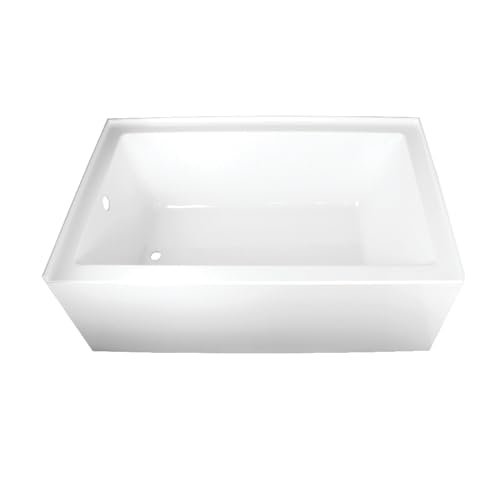
Kingston Brass Aqua Eden 60-Inch Alcove Bathtub Review: Acrylic Tub with Left-Hand Drain and Deep Soaking Capacity
A good alcove bathtub has to do more than simply fit between three walls. It needs to be comfortable, durable, easy to maintain, and compatible with the plumbing layout of the bathroom. For remodels where a standard 60-inch footprint is required, the Kingston Brass Aqua Eden offers a familiar alcove format with a deeper soaking profile and a clean high-gloss acrylic finish.
This model measures 60 inches long by 36 inches wide by 21-5/8 inches high and is designed for a three-wall alcove installation with a left-hand drain. Its acrylic shell is reinforced with fiberglass and resin, while the integrated apron creates a finished front face without requiring a separate panel.
With a listed water depth of 14-3/8 inches to the overflow and a capacity of approximately 60.85 gallons, the tub is designed to provide more room for soaking than many shallow builder-grade alcove tubs. It can be a practical choice for family bathrooms, guest baths, or remodels where homeowners want to keep the traditional alcove layout while upgrading comfort and appearance.
What Is the Kingston Brass Aqua Eden Alcove Bathtub?
The Aqua Eden is a 60-inch alcove bathtub designed to fit into a three-wall recess.
Its main specifications include:
- 60-inch length
- 36-inch width
- 21-5/8-inch overall height
- 14-3/8-inch water depth to overflow
- Approximately 60.85-gallon capacity
- Left-hand drain placement
- Integrated apron
- Tile flange for alcove installation
- High-gloss white finish
- Acrylic construction with fiberglass and resin reinforcement
This format is especially relevant for bathroom renovations where the existing space is already built around a standard 60-inch tub opening.
Why 60 Inches Is Such a Common Bathtub Size
A 60-inch tub is one of the most common residential alcove dimensions.
Many standard bathrooms are framed specifically around a five-foot tub, which makes a 60-inch replacement easier to integrate than an oversized freestanding or drop-in model.
That can reduce the need to modify:
- Wall framing
- Plumbing locations
- Flooring
- Shower surrounds
However, the Aqua Eden is wider and deeper than some basic tubs, so homeowners should still verify all dimensions before purchase.
36-Inch Width Provides More Bathing Space
At approximately 36 inches wide, this model offers more interior room than narrower alcove tubs.
That extra width can improve comfort for:
- Adult soaking
- Bathing children
- Relaxed reclined bathing
It also means the bathroom must have enough floor and wall clearance to accommodate the wider footprint.
Measure both the framed opening and surrounding fixtures before ordering.
Deep 14-3/8-Inch Water Level
The listed water depth to overflow is approximately 14-3/8 inches.
That is an important specification because overall tub height does not tell you how deep the usable bathwater will actually be.
A deeper overflow level generally allows more of the body to remain submerged, which can create a more comfortable soaking experience.
Actual water depth will vary once a person enters the tub because body displacement raises the water level.
Approximately 60.85-Gallon Capacity
The tub's stated capacity is approximately 60.85 gallons.
That makes hot-water availability an important consideration.
A larger-capacity tub may require more hot water than a shallow standard bathtub, particularly if the user prefers a high fill level.
Before installation, consider:
- Water-heater tank size
- Tankless heater flow capacity
- Recovery rate
- Other simultaneous hot-water use
A deep soaking tub is much less enjoyable if the hot-water system cannot fill it comfortably.
Acrylic Construction
The tub is made from an acrylic-based material reinforced with fiberglass and resin.
Acrylic is widely used in residential bathtubs because it offers several advantages.
It is:
- Smooth
- Relatively lightweight
- Warm to the touch
- Easy to clean
- Capable of forming ergonomic shapes
Compared with cast iron, acrylic tubs are generally easier to transport and install.
Fiberglass and Resin Reinforcement
The acrylic shell is reinforced with fiberglass and resin to improve structural rigidity.
Acrylic alone provides the finished surface, while reinforcement helps support the tub body.
This construction method is common in modern alcove and freestanding tubs.
Proper installation remains important because the tub still needs adequate structural support beneath it according to the manufacturer's instructions.
High-Gloss White Finish
The tub is finished in a bright high-gloss white.
This finish has several practical advantages.
It can:
- Reflect light
- Make the bathroom feel brighter
- Coordinate with white toilets and sinks
- Work with nearly any tile color
- Create a clean, classic appearance
Because white is widely used in bathroom fixtures, it is also easier to coordinate with future design changes.
Finished Front Apron
The tub includes an integrated apron on the exposed front side.
This eliminates the need to build and tile a separate front panel.
An apron-front design is particularly practical for straightforward alcove installations because it provides a finished exterior immediately.
It can reduce both labor and material requirements during a remodel.
Three-Wall Alcove Installation
The tub is designed for installation against three walls.
This is the classic alcove configuration commonly found in:
- Family bathrooms
- Guest bathrooms
- Combination tub-and-shower spaces
The back and both ends of the tub are enclosed by walls, while the apron faces the room.
This design is space-efficient and works well in rectangular bathrooms.
Integrated Tile Flange
The Aqua Eden includes a tile flange for alcove installation.
A tile flange helps manage water at the edges where the tub meets the wall.
During installation, the wall-surround or tile system overlaps the flange so water is directed back into the tub rather than behind the wall.
This is especially important when the tub is also used as a shower.
Why the Tile Flange Matters
Without proper water management, moisture can migrate behind wall finishes and potentially damage:
- Drywall
- Framing
- Insulation
- Subflooring
The flange is only one part of the waterproofing system.
The wall assembly, backer board, waterproof membrane, sealants, and tile installation must also be completed correctly.
Left-Hand Drain Configuration
This model uses a left-hand drain.
Drain orientation is one of the most important details to verify before ordering an alcove bathtub.
A left-hand drain means that when you stand facing the tub from the room, the drain is positioned on the left side.
This should match the existing plumbing whenever possible.
Left-Hand vs. Right-Hand Drain
Drain orientation is not interchangeable without plumbing changes.
If your existing waste connection is on the right side and you purchase a left-drain tub, the installer may need to relocate the plumbing.
That can increase:
- Labor
- Cost
- Installation time
Always confirm the current drain position before ordering.
Wall-Mount Tub Filler Ready
The tub is described as suitable for use with a wall-mounted tub filler.
That gives homeowners flexibility in choosing faucet hardware.
Common configurations include:
- Wall-mounted tub spout
- Tub-and-shower valve
- Hand shower
- Overhead shower system
Because the tub does not depend on deck-mounted faucet holes, the surrounding wall can be configured according to the bathroom design.
Good Option for Tub-and-Shower Combinations
Alcove tubs are often used as the base of a combined bathtub and shower.
The tile flange, apron front, and wall-mounted filler compatibility make this model suitable for that type of installation.
A tub-and-shower combination is especially useful in:
- Family bathrooms
- Smaller homes
- Guest baths
- Rental properties
It provides both bathing and showering without requiring separate fixtures.
Ergonomic Interior Design
The product description highlights an ergonomic design intended to improve comfort.
In practical terms, this usually means the interior contours are shaped to support a more relaxed bathing posture.
Comfort depends on:
- Back slope
- Tub length
- Seating area
- Water depth
- User height
A 60-inch alcove tub will feel comfortable to many users, but very tall bathers may prefer a longer model if space allows.
Suitable for Family Bathrooms
A wide, deep alcove tub can work well in family bathrooms.
It provides enough room for:
- Children's baths
- Everyday washing
- Adult soaking
The integrated apron and standard alcove format also make it practical for homes where the bathroom needs to serve multiple users rather than functioning solely as a luxury retreat.
Easier Maintenance Than Some Specialty Materials
Acrylic is generally straightforward to clean.
For routine care, use:
- Mild soap
- Warm water
- Soft sponge
- Microfiber cloth
Avoid harsh abrasives that can dull the glossy surface.
Because acrylic can scratch more easily than cast iron enamel, aggressive scouring pads should be avoided.
Repairability of Acrylic
One advantage of acrylic is that minor surface damage can sometimes be repaired more easily than damage to certain other bathtub materials.
Light scratches may be polishable, while some chips or surface defects can be professionally repaired.
The appropriate method depends on the severity of the damage.
Do not attempt aggressive sanding or chemical repairs without following manufacturer guidance.
Acrylic vs. Cast Iron Bathtubs
Both materials have advantages.
Acrylic Advantages
Acrylic tubs are generally:
- Lighter
- Easier to transport
- Warmer to the touch
- Easier to repair
- Available in more molded shapes
Cast Iron Advantages
Cast iron offers:
- Exceptional rigidity
- Strong heat retention
- Very durable enamel surfaces
- Premium solid feel
The tradeoff is weight.
Cast-iron tubs can be extremely heavy and may require additional structural planning.
Acrylic vs. Fiberglass Tubs
Basic fiberglass tubs are often less expensive, but acrylic typically provides a more refined surface and greater long-term durability.
Acrylic generally offers:
- Better gloss retention
- Stronger resistance to fading
- More substantial feel
- Easier cleaning
Because this tub uses acrylic reinforced with fiberglass, it combines a finished acrylic surface with structural backing.
Alcove Tub vs. Freestanding Tub
A freestanding tub makes a stronger visual statement but requires more floor area.
An alcove tub is often more practical because it:
- Uses wall space efficiently
- Can support a shower
- Works well in family bathrooms
- Fits common bathroom layouts
For bathrooms that already have a three-wall recess, an alcove replacement is usually much simpler than converting to a freestanding layout.
Alcove Tub vs. Drop-In Tub
A drop-in tub requires a separate deck or platform.
An alcove apron tub already includes its visible front panel.
That typically means:
- Less framing
- Less tile work
- Faster installation
- Lower complexity
For a straightforward renovation, the alcove format is often more economical.
Installation Planning
Before ordering, verify:
- Framed opening dimensions
- Doorway clearance
- Drain location
- Overflow location
- Faucet placement
- Subfloor condition
- Water heater capacity
A tub can fit the alcove but still be difficult to physically move through hallways or doorways.
Always plan the delivery path.
Check the Bathroom Floor
A filled bathtub creates substantial weight.
The load includes:
- Tub itself
- Water
- Bather
Most properly constructed residential bathrooms are designed for bathtub loads, but older homes or damaged subfloors may need inspection.
If there is evidence of rot, sagging, or previous leaks, repair the floor before installing the new tub.
Professional Installation Is Often Worthwhile
An alcove tub involves more than simply setting the fixture in place.
Installation may require:
- Drain connection
- Overflow connection
- Leveling
- Structural support
- Waterproofing
- Wall finishing
- Faucet plumbing
A professional plumber or experienced bathroom installer can help ensure that the tub is properly supported and sealed.
Common Installation Mistakes
Ordering the Wrong Drain Orientation
Confirm left vs. right before purchase.
Measuring Only the Old Tub
Measure the actual framed opening.
Ignoring Tub Width
This model is 36 inches wide.
Failing to Plan Hot-Water Capacity
A 60.85-gallon tub can demand a significant volume of hot water.
Improper Tile Flange Waterproofing
The flange must integrate correctly with the wall system.
Using Abrasive Cleaners
These can dull or scratch acrylic.
Who Is the Kingston Brass Aqua Eden Best For?
This tub may be a good fit for:
- Bathroom remodels
- Family bathrooms
- Guest bathrooms
- Tub-and-shower combinations
- Homeowners wanting deeper soaking
- Standard 60-inch alcove layouts
It is especially relevant for buyers who want the practicality of a traditional alcove tub with more soaking depth than a basic builder-grade model.
Advantages and Considerations
Advantages
- Standard 60-inch alcove length
- Generous 36-inch width
- 14-3/8-inch water depth to overflow
- Approximately 60.85-gallon capacity
- Acrylic construction
- Fiberglass and resin reinforcement
- Integrated apron
- Tile flange
- High-gloss white finish
- Ergonomic design
- Suitable for wall-mounted tub fillers
- Works well in tub-and-shower configurations
Potential Considerations
The left-hand drain must match the plumbing layout.
The 36-inch width may require more room than narrower standard tubs.
Large water capacity can place greater demand on the home's hot-water supply.
Acrylic requires non-abrasive cleaning.
Professional installation is recommended for many remodels.
Frequently Asked Questions
What are the tub dimensions?
Approximately 60 inches long x 36 inches wide x 21-5/8 inches high.
How deep is the water?
The water depth to the overflow is approximately 14-3/8 inches.
What is the capacity?
The listed capacity is about 60.85 gallons.
Which side is the drain on?
This model has a left-hand drain.
What material is the bathtub made from?
It uses acrylic construction reinforced with fiberglass and resin.
Does it include a front apron?
Yes. It is an apron-front alcove tub.
Does it have a tile flange?
Yes.
Can it be used with a shower?
Yes. Its alcove configuration and tile flange make it suitable for many tub-and-shower installations when properly waterproofed.
Is the faucet included?
The source states that the tub is ready for a wall-mounted filler but does not indicate that a faucet is included.
Is acrylic easy to maintain?
Yes. Mild soap and a soft cloth or sponge are generally sufficient.
Is it suitable for a deep soak?
Yes. The 14-3/8-inch water depth provides more soaking depth than many shallow alcove tubs.
Final Thoughts
The Kingston Brass Aqua Eden 60-inch alcove bathtub combines a familiar residential footprint with a deeper, wider bathing area than many standard builder-grade tubs.
Its acrylic construction keeps weight manageable, while fiberglass and resin reinforcement add structure. The integrated apron and tile flange simplify the three-wall alcove format, and the high-gloss white finish works with a wide variety of bathroom styles.
The main factors to verify are size, drain orientation, and hot-water capacity. At 36 inches wide and approximately 60.85 gallons, this is not a minimal tub, and it requires more planning than a shallow basic replacement.
For homeowners who want a 60-inch left-drain alcove bathtub with deeper soaking capacity, acrylic construction, and a clean integrated apron, the Aqua Eden offers a practical upgrade for both family bathrooms and more relaxing everyday baths.