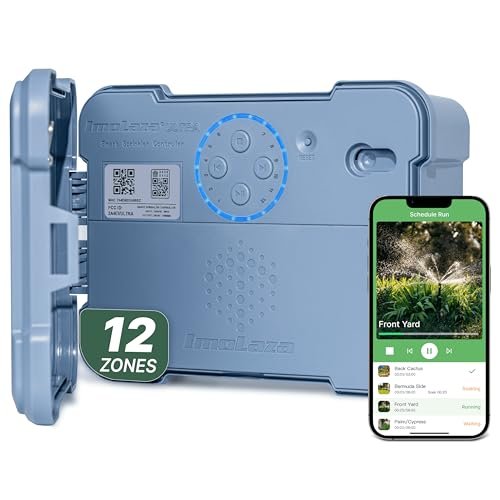
ImoLaza Ultra Smart Sprinkler Controller Review: Weather-Based Irrigation, Fault Detection, ET Scheduling, and App Control
A smart irrigation controller can do much more than run sprinklers on a fixed weekly schedule. The better systems are designed to respond to weather, plant needs, soil conditions, and equipment problems so watering becomes more precise and easier to manage.
The ImoLaza Ultra Smart Sprinkler Controller is positioned as an advanced replacement for a traditional irrigation timer. According to the supplied product information, it combines app-based remote control, weather-aware scheduling, evapotranspiration-based adjustments, automatic rain, wind, freeze, and saturation skips, equipment fault detection, surge protection, and support for Alexa and Google Assistant.
It is aimed at both higher-end residential landscapes and lighter commercial irrigation applications. The controller is also designed for outdoor installation and can continue basic operation during internet or power interruptions through features such as a real-time clock and locally stored programming.
For homeowners or property managers who want more automation than a conventional sprinkler controller can provide, the ImoLaza Ultra offers a broad set of irrigation-management tools. Its real value, however, depends on correct system setup. Smart software can optimize a well-designed irrigation system, but it cannot compensate for broken sprinkler heads, poor zone layout, inadequate water pressure, or incorrect landscape information.
What Is the ImoLaza Ultra Smart Sprinkler Controller?
The ImoLaza Ultra is a connected irrigation controller designed to operate an existing multi-zone sprinkler system.
Instead of using a simple fixed timer, it creates irrigation schedules based on information about the landscape and current environmental conditions.
The supplied description highlights several major capabilities:
- App-based irrigation control
- Remote schedule management
- Weather-based watering adjustments
- Evapotranspiration, or ET, calculations
- Plant-specific zone configuration
- Soil-type configuration
- Sprinkler-nozzle configuration
- Sun-exposure settings
- Rain skip
- Wind skip
- Freeze skip
- Saturation skip
- Seasonal adjustment
- Fault detection
- Surge protection
- Real-time clock backup
- Alexa integration
- Google Assistant integration
- Outdoor installation
- Hardwired installation support
- Continued operation during network interruptions
Together, these features place it closer to an intelligent irrigation-management platform than a basic digital sprinkler timer.
Why Smart Irrigation Is Different From a Standard Timer
Traditional sprinkler controllers usually follow a programmed schedule unless someone manually changes it.
If Zone 1 is scheduled to run for 20 minutes every Monday, Wednesday, and Friday, the controller may follow that routine regardless of whether the previous week was cool and rainy or unusually hot and dry.
A smart controller can modify irrigation according to changing conditions.
That may include:
- Skipping watering during rain
- Reducing watering in cooler seasons
- Increasing irrigation during hotter periods
- Avoiding operation during freezing weather
- Adjusting runtime based on plant and soil characteristics
The goal is not simply to automate sprinklers. It is to make the schedule more responsive to the landscape.
Precision Irrigation Based on Each Zone
One of the most important features described for the ImoLaza Ultra is individualized zone setup.
Each irrigation zone can be configured according to factors such as:
- Plant type
- Soil type
- Sprinkler or nozzle type
- Sun exposure
This matters because different areas of the same property can have very different watering requirements.
A sunny lawn zone should not necessarily receive the same schedule as a shaded shrub bed or drip-irrigated vegetable garden.
Plant Type Matters
Different plants use water differently.
Turfgrass generally has different irrigation needs from:
- Mature shrubs
- Trees
- Flowers
- Vegetables
- Ground cover
If several plant types are mixed within the same zone, even a smart controller cannot water each one independently.
Good irrigation design begins by grouping plants with similar needs whenever practical.
Soil Type Matters Just as Much
Soil determines how quickly water moves into the ground and how long moisture remains available.
Sandy Soil
Sandy soil allows water to infiltrate quickly but also tends to drain faster.
Clay Soil
Clay retains moisture well but absorbs water more slowly, making runoff more likely during long watering cycles.
Loamy Soil
Loam often offers a balance between water retention and drainage.
A controller that incorporates soil type can potentially adjust irrigation more intelligently than one using identical runtimes everywhere.
Sun Exposure Changes Water Demand
A lawn in full afternoon sun may dry much faster than grass growing beneath trees or beside a shaded building.
The ImoLaza system allows sunlight exposure to be included in zone configuration according to the supplied description.
That gives the scheduling algorithm another way to differentiate zones with different environmental conditions.
Sprinkler and Nozzle Type Affect Runtime
Not all irrigation hardware applies water at the same rate.
A spray head can deliver water much faster than a rotor sprinkler.
Drip irrigation may deliver water far more slowly.
If two zones run for the same number of minutes but use different emitters, they may receive very different amounts of water.
Including nozzle type in irrigation calculations can improve runtime accuracy.
Evapotranspiration-Based Scheduling
The ImoLaza Ultra is described as using evapotranspiration, or ET, algorithms to help determine watering needs.
ET is an important concept in professional irrigation management.
It represents water lost through two main processes:
Evaporation: water leaving soil and other surfaces.
Transpiration: water released by plants.
Together, they provide an estimate of how much moisture the landscape is losing.
Why ET Is More Useful Than a Fixed Schedule
Consider two weeks with very different weather.
During a cool, cloudy week, plants may lose relatively little water.
During a hot, dry, windy week, moisture loss can be much greater.
A fixed timer might irrigate exactly the same amount in both situations.
An ET-based system can potentially respond to those changing conditions.
ET Does Not Directly Measure Every Plant
It is important to understand what ET scheduling does and does not do.
It uses environmental information and landscape settings to estimate water demand.
It does not necessarily measure moisture directly around every plant root.
Actual conditions can still vary because of:
- Shade
- Soil compaction
- Drainage
- Irrigation coverage
- Microclimates
Smart scheduling should therefore be combined with occasional visual inspection of the landscape.
Real-Time Weather Adjustments
The controller uses weather information to dynamically adjust irrigation according to the supplied description.
That can help reduce unnecessary watering when conditions change.
For example, irrigation demand may decrease during:
- Cooler weather
- Rainy periods
- High humidity
and increase during:
- Hot weather
- Dry conditions
- Increased evaporation
This makes the schedule more adaptable than a simple calendar-based program.
Rain Skip
The controller includes automatic rain skipping.
When relevant weather conditions indicate that irrigation is unnecessary, a scheduled watering event can be paused.
This helps avoid one of the most visible forms of irrigation waste: sprinklers running during or immediately after meaningful rainfall.
Wind Skip
The system can also skip irrigation during strong wind conditions according to the supplied information.
Wind matters because it can distort sprinkler spray patterns.
Instead of falling evenly across the lawn, water may be blown onto:
- Sidewalks
- Driveways
- Buildings
- Adjacent zones
Skipping irrigation during strong winds can improve watering uniformity and reduce overspray.
Freeze Skip
The controller can suspend irrigation during freezing conditions.
This is useful because operating outdoor sprinklers around freezing temperatures can create several problems.
Water may freeze on:
- Walkways
- Roads
- Plants
- Sprinkler components
Freeze-aware scheduling reduces the chance of unnecessary irrigation during unsuitable conditions.
Saturation Skip
The supplied description also mentions a saturation skip designed to avoid watering when the soil is already sufficiently wet.
This is potentially useful because rainfall alone does not always tell the entire story.
However, the source does not explain exactly how soil saturation is determined.
It may rely on modeled moisture conditions rather than a direct soil-moisture sensor.
Buyers should verify the current implementation if this feature is especially important.
Seasonal Adjustment
Plant-water demand changes throughout the year.
A schedule that works in midsummer may be excessive during spring or fall.
Seasonal adjustment allows irrigation to scale up or down without rebuilding every zone schedule manually.
This can be one of the most practical features of a smart controller because seasonal changes are easy to overlook with traditional timers.
Smart Fault Detection
The ImoLaza Ultra includes a Smart Fault Detection system according to the supplied information.
Its purpose is to monitor irrigation operation and identify potential problems.
The exact faults it can detect should be confirmed in the current product documentation, but irrigation-controller diagnostics can potentially help identify abnormal electrical or zone behavior.
Why Fault Detection Matters
Irrigation problems often remain unnoticed because sprinklers operate early in the morning or while homeowners are away.
A problem may continue for days before someone notices:
- A valve is not operating
- A zone failed to run
- Electrical conditions are abnormal
Smart alerts can shorten the time between a fault occurring and someone investigating it.
Fault Detection Does Not Replace Physical Inspection
Even advanced controllers cannot identify every irrigation problem.
Examples of issues that may still require visual inspection include:
- Broken sprinkler heads
- Poor spray alignment
- Clogged nozzles
- Underground pipe leaks
- Blocked drip emitters
Smart diagnostics provide another layer of monitoring, but landscape maintenance remains necessary.
Surge Protection
The controller includes surge protection intended to help shield irrigation electronics from voltage spikes.
Outdoor irrigation systems can be exposed to electrical disturbances caused by:
- Utility fluctuations
- Nearby lightning events
- Switching surges
Surge protection can improve resilience, but it should not be treated as a guarantee against direct lightning damage.
Appropriate electrical installation and grounding are still important.
Real-Time Clock for Outages
The ImoLaza Ultra is described as including a real-time clock, or RTC.
The purpose of the RTC is to maintain accurate timing when internet connectivity or power conditions are interrupted.
This is useful because an irrigation controller should not become completely dependent on cloud connectivity for basic scheduling.
Why Offline Operation Matters
Smart-home products are most reliable when essential functions continue even if the internet goes down.
A sprinkler system may need to operate for years, while:
- Routers are replaced
- ISPs experience outages
- Cloud connections temporarily fail
Locally maintained schedules and accurate timekeeping make the system more resilient.
What Happens During an Internet Outage?
The supplied information states that the controller can continue operating during network interruptions.
That likely means already configured schedules remain available locally.
However, cloud-dependent features such as remote app access and live weather updates may become unavailable until the connection returns.
The exact offline behavior should be verified in the current manual.
ImoLaza App Control
The controller is managed through the ImoLaza app.
According to the source, users can remotely:
- Monitor irrigation
- Adjust schedules
- Manage zones
- Make changes in real time
This eliminates much of the inconvenience of walking to a garage or utility area every time irrigation settings need to change.
Remote Control Is Useful for Maintenance
Remote access is particularly useful while testing sprinkler zones.
Instead of repeatedly walking between the controller and lawn, you can stand near a sprinkler head and activate the relevant zone from a phone.
This makes it easier to inspect:
- Spray direction
- Coverage
- Leaks
- Broken heads
Alexa and Google Assistant Integration
The controller is described as compatible with both Amazon Alexa and Google Assistant.
That allows supported irrigation functions to participate in a broader smart-home setup.
Voice control is most useful for temporary tasks such as starting or stopping a zone.
However, automated weather-based scheduling remains more important for everyday irrigation management.
Free App Features
The supplied product description states that the app, including premium features, is provided without an ongoing subscription charge.
That can be an important consideration because some connected irrigation platforms reserve advanced features for paid plans.
Still, pricing policies can change over time.
Anyone choosing the system specifically because of lifetime free access should verify the current terms before purchasing.
Outdoor Installation
The ImoLaza Ultra is designed for outdoor installation according to the source.
That makes it suitable for replacing controllers mounted on exterior walls or other protected outdoor locations.
The housing is described as weatherproof.
Installation should still follow the manufacturer's environmental requirements regarding:
- Direct exposure
- Mounting orientation
- Water ingress
- Temperature limits
- Electrical connection
Weather-resistant does not mean the enclosure should be intentionally exposed to flooding or high-pressure water.
Hardwired Installation
The controller supports hardwired installation, making it suitable for more permanent residential and light-commercial setups.
Hardwiring can be preferable to plug-in adapters in installations where reliability and outdoor durability are priorities.
Electrical work should comply with local code and the manufacturer's specifications.
DIY Installation
The product is marketed as relatively simple to install.
The source suggests a typical setup time of approximately 15 to 30 minutes and claims broad compatibility with existing irrigation systems.
For a straightforward replacement where all existing valve wires are clearly labeled, installation may indeed be manageable for an experienced DIY homeowner.
Why the “99.99% Compatible” Claim Should Be Treated Carefully
The supplied description claims compatibility with 99.99% of existing irrigation systems.
That figure should be treated as marketing rather than a universal guarantee.
Compatibility can depend on:
- Valve voltage
- Pump-control requirements
- Master valves
- Sensor wiring
- Number of zones
- Existing transformers
- Local electrical setup
Check the technical requirements of the existing irrigation system before replacing the controller.
When Professional Installation Is Worthwhile
Professional help is sensible when:
- Existing wires are unlabeled
- A pump or master valve is involved
- Electrical connections need modification
- Zones already have operational problems
- The irrigation system is unusually complex
A controller replacement is easy only when the underlying system is healthy and clearly understood.
Designed for Residential and Light Commercial Use
The source positions the ImoLaza Ultra for both high-end residential and light-commercial applications.
That may include:
- Larger homes
- Small offices
- Retail landscaping
- Multifamily properties
- Small commercial grounds
The appropriate use depends on the number of irrigation zones, electrical requirements, and system complexity.
Large commercial landscapes may still require dedicated commercial irrigation platforms.
Smart Controller vs. Basic Irrigation Timer
A standard digital controller can handle:
- Weekly schedules
- Manual zone operation
- Basic seasonal adjustments
The ImoLaza system adds:
- Weather-aware automation
- ET calculations
- Remote app control
- Fault detection
- Weather skips
- Zone-specific landscape inputs
- Voice-assistant integration
Those features are most valuable for users who want the irrigation system to respond automatically to changing conditions.
Smart Controller vs. Hose Timer
The ImoLaza Ultra is intended for installed sprinkler systems with electrically controlled irrigation valves.
It should not be confused with a smart hose timer attached directly to an outdoor faucet.
A hose timer is better for:
- Portable sprinklers
- Small gardens
- Temporary drip systems
The ImoLaza controller is more appropriate for permanent multi-zone irrigation.
Smart Irrigation Cannot Fix Poor Zone Design
No controller can make a badly designed irrigation zone perform perfectly.
If one valve serves both:
- Full-sun lawn
- Deep shade
- Shrubs
- Spray heads
the controller can only run that zone as a single unit.
Landscape areas with significantly different water needs should ideally be separated physically into different irrigation zones.
Check Sprinkler Hardware Before Enabling Smart Scheduling
Before relying on precision automation, inspect the system.
Look for:
- Broken heads
- Clogged nozzles
- Leaking valves
- Misaligned spray
- Low pressure
- Uneven coverage
Smart scheduling is most effective when the irrigation hardware itself works correctly.
Distribution Uniformity Matters
One area of lawn may receive twice as much water as another even when both are in the same zone.
This can happen when:
- Sprinklers are spaced poorly
- Different nozzle types are mixed
- Pressure varies
- Heads are obstructed
A smart controller cannot fully compensate for large differences in water distribution.
Correct physical coverage first.
Zone-by-Zone Setup Is Worth the Time
When installing the controller, resist the temptation to enter generic information for every zone.
Accurate configuration improves the quality of automated decisions.
Take time to identify:
- Turf or plant category
- Soil texture
- Irrigation equipment
- Sun exposure
That initial effort is central to getting value from ET-based scheduling.
Common Mistakes
Leaving Default Zone Information
Smart scheduling depends on accurate landscape data.
Mixing Very Different Plants on One Valve
The controller cannot independently water plants sharing the same zone.
Assuming Weather Forecasts Are Perfect
Local conditions can differ from weather data.
Ignoring Irrigation Hardware
Broken sprinklers still require physical repair.
Treating Surge Protection as Lightning Immunity
Electrical protection has limits.
Assuming “Free Forever” Can Never Change
Verify current software and subscription terms.
Assuming Universal Compatibility
Check technical specifications before replacing an unusual controller.
Best Practices for Initial Setup
Start by mapping the irrigation zones accurately.
For each zone, identify:
- What plants are being watered
- Soil type
- Irrigation-emitter type
- Approximate sunlight exposure
Then test every zone manually.
After confirming that the hardware works correctly, enable weather and smart scheduling features gradually.
This makes troubleshooting much easier than changing everything at once.
Review the First Several Weeks of Operation
A smart controller should still be observed after installation.
Watch for:
- Dry patches
- Excessively wet soil
- Runoff
- Plant stress
- Unexpected skipped cycles
If problems appear, adjust the landscape configuration or schedule.
Automation becomes more effective when refined using real-world results.
Who Is the ImoLaza Ultra Best For?
The controller may be a strong fit for users who:
- Already have a multi-zone irrigation system
- Want weather-based automation
- Prefer app-based remote access
- Need more advanced scheduling than a basic timer
- Want fault notifications
- Need outdoor installation
- Prefer a system without a stated mandatory premium subscription
It may be particularly appealing for larger residential landscapes and smaller commercial properties.
Who May Prefer a Simpler Controller?
A standard irrigation timer may be sufficient if:
- The property has only a few simple zones
- The schedule rarely changes
- Remote control is unnecessary
- Weather-based adjustment is not important
The ImoLaza Ultra makes the most sense when its advanced automation features will actually be used.
Advantages and Considerations
Advantages
The ImoLaza Ultra combines weather-based irrigation, ET-driven schedule adjustments, plant and soil customization, rain/wind/freeze/saturation skips, seasonal adjustment, remote app control, fault detection, surge protection, Alexa and Google Assistant support, outdoor installation, and offline scheduling resilience.
That is a broad feature set for users who want more than a fixed sprinkler timer.
Considerations
The quality of smart irrigation depends heavily on accurate landscape configuration and healthy irrigation hardware. Weather and ET calculations estimate water demand but do not directly measure moisture at every root zone.
Claims such as 99.99% system compatibility and permanently free premium software should also be confirmed against current manufacturer documentation before purchase.
Frequently Asked Questions
What type of system is the ImoLaza Ultra designed for?
It is designed for permanent multi-zone irrigation systems using electrically controlled valves.
Can it be controlled through an app?
Yes.
Can I control it while away from home?
Yes, when the controller has an active internet connection.
Does it use weather information?
Yes, according to the supplied description.
What is ET-based irrigation?
ET, or evapotranspiration, estimates water loss from soil evaporation and plant transpiration to help determine irrigation demand.
Does it customize watering for each zone?
Yes.
What information can be assigned to a zone?
The source lists plant type, soil type, nozzle type, and sunlight exposure.
Does it automatically skip watering during rain?
Yes.
Can it skip watering during strong winds?
Yes.
Can it skip during freezing conditions?
Yes.
What is saturation skip?
It is intended to avoid irrigation when the soil is already sufficiently wet, although the exact calculation method should be confirmed.
Does it adjust schedules by season?
Yes.
Does it detect irrigation faults?
The supplied information says yes.
Does it send alerts?
The fault-detection system is described as providing alerts when problems are detected.
Does it have surge protection?
Yes, according to the listing.
Why does it have a real-time clock?
The RTC helps maintain accurate scheduling during connectivity or power-related interruptions.
Will schedules still run if the internet goes down?
The supplied description states that the controller can continue operating during internet outages, although remote and live weather features may temporarily be unavailable.
Does it work with Alexa?
Yes.
Does it work with Google Assistant?
Yes.
Does the app require a subscription?
The supplied product description says all features are free, but current terms should be verified before purchase.
Can it be installed outdoors?
Yes, it is described as weatherproof and outdoor capable.
Can it be hardwired?
Yes.
Is it suitable for DIY installation?
The manufacturer presents it as DIY friendly, particularly for straightforward controller replacements.
How long does installation take?
The source suggests approximately 15 to 30 minutes, though actual time depends on the existing system.
Does it work with every irrigation system?
The source claims extremely broad compatibility, but technical compatibility should always be verified.
Can it be used commercially?
It is positioned for light-commercial as well as residential applications.
Will it fix broken sprinkler heads?
No. Physical irrigation problems still require maintenance.
Does it directly measure soil moisture?
The supplied description does not establish that a physical soil-moisture sensor is included, so soil saturation features should not automatically be interpreted as direct measurement.
Final Thoughts
The ImoLaza Ultra Smart Sprinkler Controller is designed for homeowners and property managers who want irrigation to respond more intelligently to actual landscape conditions.
Its strongest feature is the combination of zone-specific configuration and weather-driven automation. By incorporating plant type, soil type, sprinkler characteristics, sunlight exposure, ET data, and current weather, the controller can potentially make more informed watering decisions than a conventional fixed timer.
Features such as rain, wind, freeze, and saturation skips, seasonal adjustment, smart fault detection, surge protection, remote app access, voice-assistant integration, and offline scheduling support further strengthen its position as an advanced irrigation-management system.
The controller is not a substitute for good landscape design. Accurate zone configuration, healthy sprinkler hardware, proper water pressure, and good coverage remain essential. ET and weather algorithms can improve scheduling, but they work best when the physical irrigation system is already functioning correctly.
For users with an existing multi-zone sprinkler system who want more precise watering, stronger automation, remote control, proactive fault monitoring, and a controller designed for both residential and lighter commercial environments, the ImoLaza Ultra offers a comprehensive smart-irrigation feature set worth considering.