24 x 15-Inch Metal Ice Maker Drain Pan Review: Welded Leak Protection with a Built-In Drain Outlet
Ice makers are convenient appliances, but their constant connection to a water supply creates a potential leak risk. A loose fitting, cracked tube, failed inlet valve, or blocked drain can release water beneath the appliance, where it may remain hidden until cabinets, flooring, or nearby walls have already been damaged.
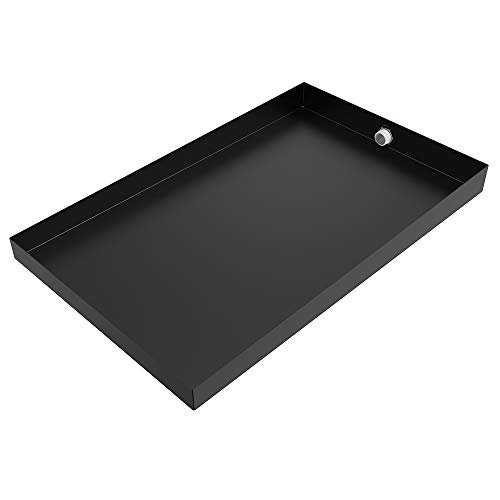
This 24 x 15-inch metal ice maker drain pan is designed to provide a protective barrier beneath compact, built-in, and under-counter ice makers. Unlike a basic drip tray that only holds a limited amount of water, this model includes a drain opening that can be connected to an appropriate discharge line.
Its steel construction, welded corners, hemmed edges, flat black finish, and sloped height profile make it a practical option for homeowners, offices, hospitality spaces, and other installations where long-term water-damage prevention is a priority.
Why Install a Drain Pan Under an Ice Maker?
An ice maker receives water through a pressurized supply line. Even when the appliance is correctly installed, leaks can develop over time because of vibration, aging components, mineral buildup, accidental movement, or failed seals.
Common sources of ice maker leaks include:
- Loose supply-line connections
- Damaged plastic or copper tubing
- Failing inlet valves
- Cracked internal hoses
- Blocked or improperly installed drain lines
- Excess condensation
- Overflowing reservoirs
- Appliance leveling problems
A drain pan creates a controlled area beneath the appliance. Small leaks collect inside the pan rather than spreading immediately into cabinetry or flooring.
When connected to a suitable drain, the pan can also direct water away from the installation area instead of relying solely on its storage capacity.
Key Dimensions and Construction Details
The pan measures approximately:
- 24 inches long
- 15 inches wide
- 2 inches high at the taller wall
- 1.5 inches high at the lower section
It also includes a drain opening measuring approximately 1.05 inches in diameter. The opening is positioned on the 2-inch-high by 15-inch-wide wall, according to the supplied product details.
The height transition from 2 inches to 1.5 inches may help encourage water movement toward the intended drainage point, although the actual slope, drain orientation, and final installation should be confirmed using the manufacturer’s drawing.
Heavy-Duty Metal Construction
The pan is made from painted metal rather than flexible plastic.
A rigid metal drain pan offers several advantages beneath a compact appliance. It is less likely to flex, buckle, or deform when the ice maker is installed, removed, or serviced.
Metal construction also helps the pan maintain a stable shape around the drain outlet and welded seams.
This can be especially useful in:
- Built-in kitchen cabinets
- Office breakrooms
- Home bars
- Hospitality beverage stations
- Conference rooms
- Restaurant service areas
- Entertainment spaces
The exact metal gauge is not stated in the supplied description, so buyers who require a specific thickness should confirm that detail before ordering.
Flat Black Corrosion-Resistant Finish
The pan has a flat black painted finish intended to provide a clean appearance and a degree of corrosion resistance.
A dark finish can blend discreetly beneath black, stainless-steel, or built-in appliances. This may be preferable to a bright galvanized surface in installations where part of the pan remains visible.
The coating also helps protect the underlying metal from ordinary indoor moisture. However, painted metal is not immune to corrosion.
Scratches, chips, abrasive cleaning, and standing water may expose the base material. Inspecting the finish regularly and drying the pan after leaks can help extend its useful life.
Welded Corners for Watertight Protection
The corners are welded rather than simply folded or mechanically joined.
Welded construction reduces the number of seams where water could escape. This is important because corners are common weak points in low-quality appliance pans.
A properly welded drain pan can provide more reliable containment for:
- Slow supply-line leaks
- Condensation
- Minor appliance overflow
- Drainage backups
- Water released during maintenance
The pan should still be inspected before installation. Shipping damage, coating cracks, or defects around the drain opening could affect performance.
A simple water test before placing the appliance can confirm that the tray and corners hold water as expected.
Built-In Drain Hole for Controlled Water Removal
The approximately 1.05-inch drain opening distinguishes this pan from a standard catch tray.
When connected to compatible drainage hardware, the opening allows collected water to leave the pan and move toward an approved drain location.
This can provide better protection than a pan without a drain, particularly when the ice maker is installed in an area that is not checked frequently.
Potential drain destinations may include:
- A floor drain
- An approved indirect waste receptor
- A dedicated drain line
- Another code-compliant discharge point
Drain connections must comply with local plumbing codes. A professional plumber may be needed to select the correct fittings, slope, air-gap arrangement, and discharge location.
Understanding the 2-Inch to 1.5-Inch Height Change
The pan is described as transitioning from a 2-inch wall height to a 1.5-inch height.
This profile may be intended to create directional drainage or accommodate the pan’s installation geometry. However, the written description alone does not provide enough detail to confirm the exact slope and orientation.
Before installation, review the manufacturer’s drawing to determine:
- Which side should face the drain connection
- Whether the pan floor is sloped
- How the height transition affects appliance placement
- Whether shimming is required
- How much usable interior clearance remains
The appliance must sit level even if the pan incorporates a drainage slope. Do not allow the ice maker to rest unevenly unless the manufacturer specifically approves that arrangement.
Hemmed Edges Improve Durability
All edges are hemmed approximately 0.5 inch.
Hemming folds the raw metal edge over itself, producing a thicker and more finished perimeter.
This design improves the pan in several ways:
- Adds stiffness around the outer walls
- Reduces edge deformation
- Creates a cleaner appearance
- Makes handling safer
- Helps the pan maintain its shape during installation
Although hemmed edges are less exposed than raw sheet metal, gloves are still advisable when handling a metal appliance pan.
Suitable for Residential and Commercial-Like Settings
The pan can be used anywhere a compatible compact ice maker is installed and a drain connection can be provided.
Common applications include:
Residential Kitchens
Built-in ice makers located beneath counters can leak into expensive cabinetry and finished flooring. A drained pan adds a protective layer beneath the appliance.
Home Bars
Bar areas often contain wood cabinets, electrical equipment, and decorative flooring that are vulnerable to moisture.
Office Breakrooms
Leaks may remain unnoticed overnight or over weekends. A drain pan can reduce the amount of standing water left beneath the appliance.
Hospitality and Entertainment Areas
Hotels, lounges, event spaces, and beverage stations may benefit from a more durable metal pan with active drainage capability.
Rental and Vacation Properties
A pan connected to a proper drain can provide added protection in properties that are not occupied continuously.
Measuring Before Purchase
Correct sizing is essential.
Measure the appliance footprint, including feet, trim, and any components that extend near the base. Then compare those measurements with the pan’s usable interior dimensions, not only its external 24 x 15-inch size.
Also verify:
- Cabinet width and depth
- Door clearance
- Ventilation requirements
- Drain location
- Supply-line routing
- Power-cord clearance
- Service access
- Appliance leveling space
The hemmed edges and raised walls reduce the usable interior area slightly.
An ice maker should not rest on the pan walls or block its own ventilation openings.
Planning the Drain Connection
The pan’s drain opening is useful only when the discharge system is correctly designed.
Before installation, determine:
- The correct drain fitting size
- Whether an adapter is needed
- The route to the drain destination
- Required pipe slope
- Whether an air gap is required
- Whether local code permits the proposed connection
- How the line will remain accessible for cleaning
The stated 1.05-inch hole diameter does not necessarily identify the exact plumbing fitting or nominal pipe size required.
Do not assume that a standard 1-inch fitting will connect directly without checking the manufacturer’s specifications.
Installation Overview
A typical installation may follow these steps:
- Measure the ice maker and cabinet opening.
- Review the pan drawing and drain-hole orientation.
- Inspect the pan for shipping damage.
- Perform a basic watertightness test.
- Position the pan in the installation area.
- Connect the drain using approved fittings.
- Confirm that the drain line has the correct slope.
- Secure the pan if required.
- Lift the ice maker into place rather than dragging it.
- Level the appliance independently of the pan slope.
- Connect the water supply, drain, and power.
- Test the ice maker and inspect for leaks.
Professional installation is advisable when the work involves modifying plumbing, cabinetry, drainage, or electrical connections.
Why the Appliance Must Remain Level
Ice makers often depend on correct leveling for drainage, ice production, door alignment, and internal operation.
Even if the pan includes a height variation or slope, the appliance itself should usually remain level according to its installation manual.
An unlevel ice maker may experience:
- Poor drainage
- Water overflow
- Irregular ice production
- Door-sealing problems
- Unusual vibration
- Increased mechanical wear
Use the appliance’s adjustable feet or an approved support method rather than relying on the pan walls to position the unit.
Pairing the Pan with a Leak Detector
A drain pan helps control water, but it does not necessarily notify anyone that a leak has occurred.
Adding a water sensor can provide earlier warning.
Depending on the sensor system, an alert may be delivered through:
- An audible alarm
- A mobile notification
- A smart-home platform
- A building monitoring system
- An automatic shutoff valve
A sensor can be placed inside the pan or near the drain outlet, provided its contacts remain positioned where water will reach them.
Metal can affect some wireless devices, so test communication before relying on remote alerts.
Adding an Automatic Water Shutoff
For more complete protection, the pan may be combined with an automatic shutoff valve installed on the ice maker supply line.
When a compatible sensor detects water, the valve closes and stops the incoming supply.
This is valuable because a pan and drain can become overwhelmed if a pressurized line separates completely.
A layered protection strategy may include:
- Secure plumbing connections
- A welded drain pan
- A functioning drain line
- A leak sensor
- An automatic shutoff valve
- Regular inspection
No single component eliminates all water-damage risk.
Cleaning and Maintenance
The drain pan should remain accessible enough for periodic inspection.
Check the Drain Opening
Confirm that the outlet is not blocked by dust, debris, scale, insects, or installation materials.
Inspect the Drain Line
Look for kinks, disconnections, sagging sections, or buildup that could prevent water from flowing.
Examine the Welded Corners
Check for cracks, corrosion, or coating damage.
Clean the Surface
Use mild soap, water, and a soft cloth. Avoid abrasive pads that could damage the paint.
Dry Standing Water
If water remains in the pan, determine whether the drain is blocked or the pan is not installed at the correct orientation.
Inspect the Ice Maker
Any moisture in the pan should lead to an inspection of supply lines, valves, internal components, and the appliance drain.
Testing the Drain Pan
A controlled test can verify the installation before the appliance is put into regular use.
Pour a small amount of clean water into the pan while monitoring:
- The welded corners
- The drain opening
- The fitting connection
- The drain line
- The discharge location
- The area beneath the pan
Water should flow toward the outlet without leaking into the surrounding cabinet.
Do not flood the pan beyond its intended capacity during testing.
Common Installation Mistakes
Ordering Based Only on External Dimensions
The appliance must fit inside the usable area between the raised walls.
Using the Wrong Drain Fitting
A 1.05-inch opening does not automatically correspond to every fitting marketed as one inch.
Ignoring Appliance Ventilation
Raised pan walls must not block cooling air or service access.
Dragging the Ice Maker Across the Pan
This can scratch the finish, deform the walls, or damage the drain connection.
Failing to Test the Welds
A simple water test can reveal damage before installation becomes difficult to access.
Installing Without Proper Drain Slope
A flat or uphill drain line may retain water and allow the pan to overflow.
Assuming the Pan Replaces Leak Detection
A pan controls water but does not provide an alert or stop a broken supply line.
Leaving Water in the Pan
Standing water can encourage corrosion, odor, and microbial growth.
Advantages and Considerations
Advantages
- Approximately 24 x 15-inch footprint
- Raised walls up to 2 inches high
- Built-in 1.05-inch drain opening
- Welded corners for improved water containment
- Hemmed 0.5-inch edges for added rigidity
- Flat black painted finish
- Metal construction
- Suitable for built-in and under-counter ice makers
- Can direct water toward an approved drain
- Made in the United States
- Appropriate for homes, offices, bars, and hospitality spaces
Potential Considerations
The pan’s exact metal gauge is not provided in the source description. The required drain fitting is also not clearly identified and should be confirmed before installation.
Painted metal can corrode if scratched or left wet. The pan also cannot guarantee protection against a major supply-line rupture unless the drain has adequate capacity.
The 2-inch to 1.5-inch height change requires careful review of the manufacturer’s drawing to ensure correct orientation and appliance clearance.
Frequently Asked Questions
What are the drain pan dimensions?
The pan measures approximately 24 inches long, 15 inches wide, and up to 2 inches high.
How large is the drain hole?
The opening is approximately 1.05 inches in diameter.
Where is the drain opening located?
It is positioned on the 2-inch-high by 15-inch-wide wall, according to the supplied description.
Is the pan sloped?
The description mentions a height change from 2 inches to 1.5 inches, but the exact pan geometry should be confirmed using the manufacturer’s drawing.
Are the corners watertight?
The corners are welded for improved water containment. The pan should still be tested before installation.
Is the pan rustproof?
It has a corrosion-resistant painted finish, but scratches and prolonged standing water may still lead to corrosion.
What are hemmed edges?
Hemmed edges are folded metal borders that improve rigidity, handling safety, and appearance.
Does the pan include a drain fitting?
A fitting is not mentioned in the supplied information. It may need to be purchased separately.
Can it connect directly to a floor drain?
Potentially, but the connection must use compatible fittings and comply with local plumbing codes.
Will it fit every ice maker?
No. Measure the appliance footprint and compare it with the usable interior area of the pan.
Can it prevent all water damage?
No. It can contain and drain minor leaks, but a major pressurized-line failure may exceed its capacity.
Should I add a water sensor?
A leak detector is strongly worth considering because the pan itself does not notify you when water is present.
Is it made in the USA?
Yes, according to the product description.
Final Thoughts
This 24 x 15-inch metal ice maker drain pan provides a more complete form of leak protection than a simple catch tray. Its welded corners help contain water, while the built-in drain opening allows collected moisture to be routed toward an approved discharge location.
The flat black finish, hemmed edges, and rigid metal construction make it appropriate for residential kitchens, office breakrooms, bars, hospitality installations, and other spaces where appliance leaks could damage cabinetry or flooring.
Its performance depends on correct sizing, drain orientation, fitting selection, and installation. The appliance must remain level, the drain line must flow properly, and the pan should be inspected periodically for corrosion or blockage.
For stronger protection, pair the pan with a water sensor and an automatic supply shutoff. When installed as part of a layered leak-prevention strategy, it can significantly reduce the risk that a minor ice maker failure develops into expensive water damage.