Multi-Directional Plumbing Press Tool Review: A Rotating Crimper for Copper, PEX Sleeves, and Tight Spaces
Working with press fittings in a cramped plumbing layout can be difficult even when the actual connection is straightforward. Pipes may sit close to walls, inside cabinets, between framing, or beside other fittings, leaving little room to position a conventional crimping or pressing tool.
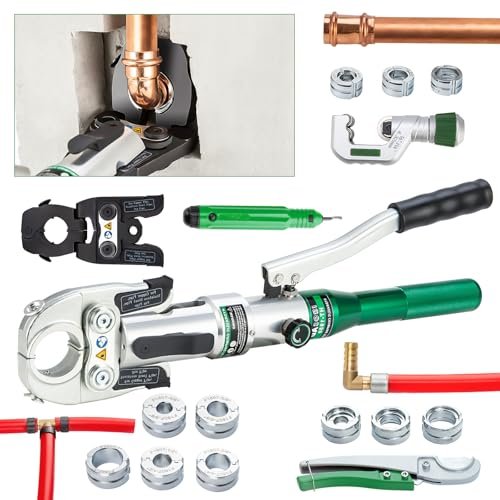
This multi-directional plumbing press tool is designed to solve that access problem. It uses an adjustable jaw system and a rotating head that can turn approximately 350 degrees, allowing the tool to approach fittings from multiple angles. That flexibility can be especially useful when pressing connections near walls or in other confined spaces.
The tool is described as supporting several common copper and PEX connection sizes, including copper pipe, stainless PEX press sleeves, and ASTM F1807 copper crimp rings. For plumbers, remodelers, maintenance technicians, and experienced DIY users, that broad compatibility can make it a practical multipurpose tool—provided the correct jaws and fitting systems are matched carefully.
What Is a Rotating Plumbing Press Tool?
A plumbing press tool mechanically compresses a compatible fitting or ring around pipe or tubing.
Rather than soldering, threading, or gluing a joint, the tool applies controlled force through a shaped jaw.
Depending on the connection system, this may involve:
- Pressing a copper fitting
- Compressing a stainless PEX sleeve
- Crimping a copper PEX ring
The key advantage is speed and repeatability.
Once the tubing and fitting are correctly prepared, the actual pressing operation can often be completed quickly.
Why the Rotating Head Matters
Traditional pressing tools can become difficult to position when a fitting is close to a wall.
The body of the tool may interfere with:
- Drywall
- Framing
- Cabinets
- Adjacent pipe
- T-fittings
- Appliances
- Mechanical equipment
A rotating head allows the jaws to remain aligned with the fitting while the handles or main tool body are moved into a more convenient position.
This tool is described as allowing approximately 350 degrees of head rotation, which provides substantial flexibility during installation.
Multi-Directional Jaw for Wall-Side Connections
The extra multi-directional jaw is specifically intended to help when fittings sit close to walls or other obstacles.
This can be useful in retrofit plumbing, where the installer must work with the existing pipe layout rather than designing ideal tool clearance from scratch.
Typical situations include:
- Bathroom renovations
- Kitchen plumbing
- Utility-room repairs
- Mechanical closets
- Existing copper runs
- Tight PEX manifolds
The ability to approach the fitting from different directions can reduce the amount of pipe that needs to be removed simply to gain tool access.
Aluminum Alloy Body
The body is described as aluminum alloy.
Aluminum offers a useful compromise between strength and weight.
Compared with a heavy all-steel tool, an aluminum body can reduce fatigue when the tool is carried frequently or operated overhead.
The source also states that the design is intended to help prevent hydraulic oil leakage, although the exact internal sealing system is not described.
For any hydraulic or mechanically assisted tool, regular inspection is still important.
Copper Pipe Compatibility
The tool is described as supporting copper pipe sizes of:
- 1/2 inch
- 3/4 inch
- 1 inch
These are common residential plumbing sizes.
Press-style copper connections can provide a convenient alternative to soldering when used with compatible fittings and jaw profiles.
However, not every press fitting uses the same profile.
Before use, verify that the included or selected jaws are approved for the fitting system being installed.
Nominal pipe size alone is not enough to confirm compatibility.
Stainless PEX Press Sleeve Compatibility
The tool is also listed for use with F877 stainless PEX press sleeves in the following sizes:
- 1/2 inch
- 3/4 inch
- 1 inch
ASTM F877 relates to cross-linked polyethylene plumbing systems, but different manufacturers may use different sleeve geometries and installation requirements.
Always verify that the jaw and sleeve system are designed to work together.
A sleeve that appears to fit physically may still require a specific press profile.
ASTM F1807 Copper Crimp Ring Compatibility
The source also lists compatibility with ASTM F1807 PEX copper crimp rings in:
- 3/8 inch
- 1/2 inch
- 5/8 inch
- 3/4 inch
- 1 inch
F1807 copper-ring connections work differently from stainless press sleeves.
The copper ring is placed around the PEX tubing over a compatible insert fitting, then compressed to the required dimension.
Proper ring placement and final crimp dimensions are critical.
Press Sleeves vs. Copper Crimp Rings
These systems should not be treated as interchangeable.
Stainless Press Sleeve
A stainless sleeve is compressed around the tubing and fitting using the appropriate press profile.
Copper Crimp Ring
A copper ring is compressed around PEX using an F1807-compatible crimping die.
The connection methods differ in both geometry and verification.
Use only the jaw designed for the specific system.
How to Prepare Copper Pipe for Pressing
Preparation directly affects joint reliability.
Cut the Pipe Square
Use a proper tubing cutter so the end is perpendicular to the pipe.
Deburr the Edge
Sharp copper edges can damage sealing elements inside the fitting.
Clean the Surface
Remove dirt, oxidation, and residue from the insertion area.
Mark Insertion Depth
A depth mark helps confirm that the pipe remains fully seated during pressing.
Inspect the Fitting
Make sure seals and internal components are present and undamaged.
How to Prepare PEX for Crimping or Pressing
PEX tubing should also be prepared carefully.
Make a clean square cut and inspect the tube for:
- Crushing
- Cracks
- Deep scratches
- Contamination
For copper crimp rings, slide the ring onto the tube, insert the fitting fully, and position the ring according to the fitting manufacturer's specifications.
For stainless sleeves, follow the sleeve manufacturer's installation instructions.
How to Use the Rotating Press Tool
1. Select the Correct Jaw
Match the jaw to the pipe size and connection system.
2. Prepare the Pipe
Cut, clean, and assemble the fitting correctly.
3. Rotate the Head
Position the tool so the handles have enough clearance to operate.
4. Seat the Jaw Fully
The jaw should sit squarely around the designated pressing area.
5. Complete the Press Cycle
Apply pressure until the connection has been fully formed.
6. Inspect the Joint
Check for incomplete or uneven compression.
7. Test the Plumbing
Pressure-test the system before concealing the connection.
Why Jaw Alignment Is Critical
A jaw that is tilted can create uneven deformation.
That may result in:
- Incomplete sealing
- Distorted fittings
- Reduced mechanical strength
- Premature failure
The rotating head helps with accessibility, but it does not remove the need for accurate jaw placement.
Always confirm that the jaw is centered and square before pressing.
Working Near Walls
A fitting close to a wall is one of the most difficult scenarios for a conventional tool.
The rotating head allows the jaw to remain on the fitting while the body is moved away from the obstruction.
This can be particularly useful when replacing short sections of existing plumbing.
Instead of opening a larger area of wall simply for tool clearance, the installer may be able to complete the press within the existing space.
Manual or Hydraulic Effort
The exact actuation method should be confirmed from the current product documentation, but the description of oil-leak prevention suggests a hydraulic-assisted mechanism may be involved.
Hydraulic assistance can reduce the manual effort needed to generate high pressing force.
If the tool uses hydraulic components, inspect it periodically for:
- Oil seepage
- Damaged seals
- Slow return
- Reduced pressing force
Never continue using a hydraulic tool that shows signs of leakage or inconsistent operation.
Copper Press Tool vs. Soldering
Both methods can create reliable plumbing connections when used correctly.
Pressing Advantages
Pressing eliminates the need for:
- Torch
- Solder
- Flux
- Open flame
This can be useful in finished buildings or spaces where heat would be risky.
Soldering Advantages
Soldered fittings are widely available and often less expensive per joint.
Soldering also does not require a specialized press tool.
The better choice depends on project scale, access, experience, and fitting availability.
PEX Press vs. PEX Crimp
PEX can be joined using several different systems.
Copper Crimp
Generally economical and widely used. The connection should be checked with the appropriate gauge where required.
Stainless Press Sleeve
Can provide fast and consistent joining with compatible tooling.
Neither system is automatically better for every application.
The important factor is using the correct tubing, fitting, sleeve or ring, and tool combination.
Advantages of a Multi-System Tool
A tool that supports several connection types can reduce the number of separate tools needed in a plumbing kit.
For users working with both copper and PEX, that may mean carrying one tool body with multiple jaws rather than several dedicated crimpers.
This can be especially useful for:
- Remodeling
- Property maintenance
- Mixed-material plumbing
- Service calls
However, versatility only helps if the jaws are clearly identified and used correctly.
Common Mistakes to Avoid
Using the Wrong Jaw Profile
The most serious mistake is assuming all fittings of the same nominal size use the same pressing geometry.
Pressing Without Full Pipe Insertion
A partially seated fitting may leak even if the crimp appears correct.
Skipping Deburring
Sharp copper edges can damage seals.
Pressing at an Angle
The jaw should remain square to the fitting.
Using Damaged Rings or Sleeves
Never reuse a deformed or previously compressed component.
Ignoring Tool Condition
Worn or damaged jaws can create inconsistent connections.
Tool Inspection and Maintenance
Before each use, inspect the tool for:
- Cracked body components
- Damaged jaws
- Loose fasteners
- Rough head rotation
- Hydraulic leakage
- Excessive play
- Uneven jaw closure
Clean debris from the jaw surfaces after use.
Store the tool in a dry location to protect moving parts and prevent corrosion on steel components.
Who Is This Tool Best For?
This style of press tool may be useful for:
- Plumbers
- Remodeling contractors
- Maintenance technicians
- Property managers
- Advanced DIYers
- Mechanical installers
It is especially relevant for users who work with mixed copper and PEX systems and frequently encounter cramped installation spaces.
Advantages and Considerations
Advantages
- Approximately 350-degree rotating head
- Multi-directional jaw design
- Useful close to walls and other obstructions
- Aluminum alloy body
- Supports common copper pipe sizes
- Compatible with listed F877 stainless PEX sleeves
- Compatible with listed ASTM F1807 copper crimp rings
- Portable design
- Useful for mixed plumbing systems
Potential Considerations
Exact jaw and fitting compatibility must be confirmed before use.
Different press systems may require different profiles even when the nominal pipe size is identical.
The source does not provide detailed pressure ratings, calibration requirements, or complete certification information for the tool.
If the tool uses hydraulic assistance, regular inspection for leaks or loss of force is important.
Frequently Asked Questions
How far does the head rotate?
The source states approximately 350 degrees.
What copper pipe sizes does it support?
The listed copper sizes are 1/2 inch, 3/4 inch, and 1 inch.
Can it be used with PEX?
Yes. It is described as compatible with selected stainless PEX press sleeves and ASTM F1807 copper crimp rings.
What F1807 ring sizes are supported?
The listed sizes are 3/8 inch, 1/2 inch, 5/8 inch, 3/4 inch, and 1 inch.
Is the tool useful near walls?
Yes. The rotating head and multi-directional jaw are specifically designed to improve access in confined spaces.
Does it eliminate soldering?
For compatible copper press fitting systems, yes. Pressing can replace soldered joints where the fitting system and code allow.
Can one jaw be used for every fitting type?
No. Different connection systems require different jaw profiles.
Should press connections be tested?
Yes. Pressure-test the completed plumbing before concealing or finishing the installation.
Final Thoughts
A multi-directional plumbing press tool with a 350-degree rotating head can be especially useful when working in the confined spaces that make plumbing repairs difficult.
Its ability to support common copper sizes, selected stainless PEX sleeves, and ASTM F1807 copper crimp rings gives it broad potential across mixed plumbing systems. The aluminum alloy body also keeps the tool relatively portable, while the rotating head helps users position the jaws close to walls and around existing pipework.
The main consideration is compatibility. Press fittings, sleeves, and crimp rings are system-specific, and using the correct size alone is not enough. The jaw profile must match the connection method.
For installers who regularly work with copper and PEX in tight spaces, this type of rotating press tool can offer a useful combination of versatility, portability, and improved access—as long as each connection is prepared, pressed, and tested according to the fitting manufacturer's requirements.