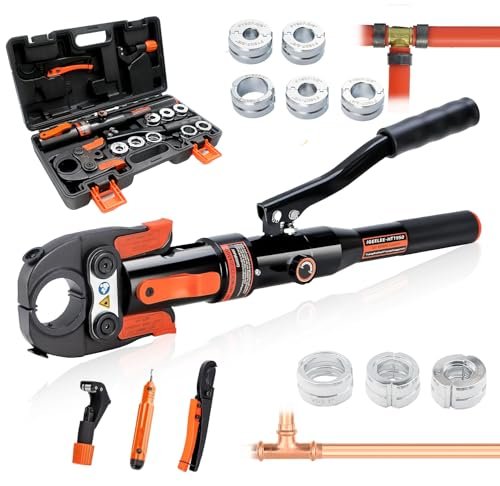
ProPress Tool with 360° Rotating Head: A Versatile Pressing Tool for Copper and PEX Connections
Press fittings have become increasingly popular because they allow plumbers and experienced DIYers to make secure pipe connections without using an open flame. Instead of soldering copper joints, a press tool mechanically compresses a compatible fitting around the pipe, creating a sealed connection in a matter of seconds.
This manual ProPress-style tool is designed to work with several common copper pipe sizes and ASTM F1807 PEX copper crimp rings. Its rotating head, interchangeable jaw compatibility, lightweight aluminum construction, and compact form make it particularly useful in tight spaces where conventional tools can be awkward to position.
For repairs, remodeling, plumbing installations, and maintenance work, a properly matched press tool can significantly simplify the connection process. The most important factor is compatibility: the tool, jaw profile, fitting, pipe, and installation method must all be designed to work together.
What Is a ProPress Tool?
A ProPress tool is used to mechanically compress compatible press fittings onto pipe.
Instead of heating the joint and applying solder, the tool closes a specially shaped jaw around the fitting. The pressing force deforms the fitting in a controlled way so it grips the pipe and compresses the internal sealing element.
This method can make installation faster and cleaner because it eliminates the need for:
- Torches
- Solder
- Flux
- Open flames
- Flaring
However, press connections are only reliable when the correct fitting system and jaw profile are used.
360-Degree Rotating Head for Tight Spaces
One of the standout features of this tool is its 360-degree rotating head.
Plumbing installations rarely provide perfect working angles. Pipes may be positioned against walls, between joists, behind cabinets, or close to other fittings.
A rotating head allows the user to change jaw orientation without repositioning the entire tool.
This can be especially useful when working around:
- T-fittings
- Wall penetrations
- Closely spaced pipes
- Under-sink connections
- Utility rooms
- Mechanical rooms
- Tight renovation spaces
The ability to rotate the head improves flexibility and can reduce the amount of clearance needed around the pipe.
Designed for Copper Press Connections
The tool is described as supporting copper pipe sizes including:
- 1/2 inch
- 3/4 inch
- 1 inch
These are common residential and light-commercial plumbing sizes.
When used with the correct jaws and compatible fittings, press connections can provide a fast alternative to soldering.
The source lists compatibility with fitting families associated with brands such as Viega, ProPress-style systems, Elkhart, and Conex. Because press profiles are not universally interchangeable, users should verify exact compatibility before use.
Do not assume that any copper press fitting can be used simply because the nominal pipe size matches.
Why Press Connections Are Popular
Traditional copper plumbing often uses soldered joints. While soldering remains a reliable method, it requires preparation, heat, and skill.
Press connections offer several practical advantages.
No Open Flame
Because no torch is required, press fitting can be convenient in areas where heat would be difficult or risky.
Faster Installation
Once the pipe and fitting are properly prepared, the pressing operation itself can be completed quickly.
Cleaner Work Area
There is no flux residue, solder drip, or flame-related cleanup.
Consistent Mechanical Compression
A properly calibrated tool and correct jaw profile can produce repeatable connections.
That said, press tools do not eliminate the need for proper pipe preparation and fitting inspection.
Leak-Free Connections Depend on Proper Installation
The product is marketed as creating leak-proof connections, but no tool can guarantee a leak-free joint under every condition.
A reliable press connection depends on:
- Correct pipe size
- Compatible fitting
- Correct jaw profile
- Fully inserted pipe
- Clean pipe surface
- Proper fitting condition
- Correct press location
- Complete tool cycle
If the pipe is not inserted fully, the seal is damaged, or the wrong jaw is used, the connection may fail.
For critical plumbing systems, always follow the fitting manufacturer's installation instructions.
Automatic Locking and Controlled Pressing
The tool is described as using an automatic locking mechanism during the pressing cycle.
This helps keep the jaws engaged as pressure is applied, reducing the chance of the tool slipping away from the fitting mid-press.
Controlled jaw closure is important because press fittings are designed to deform in a specific pattern.
If pressure is applied unevenly, the fitting can be damaged or incorrectly compressed.
Lightweight Aluminum Alloy Construction
The tool body is described as being made from aluminum alloy.
This helps reduce weight compared with an all-steel body while still providing sufficient structural rigidity for manual pressing.
Lower tool weight is valuable during repeated installation work, especially when operating overhead or in confined areas.
Because the tool is manually powered, leverage and handle length remain important. Users still need enough room to operate the handles through the required motion.
Two-Handed Manual Operation
This is a manual press tool rather than a battery-powered hydraulic model.
The user applies force through the handles to close the jaws around the fitting.
Advantages of a manual tool include:
- No battery to charge
- No electrical power required
- Lower purchase cost
- Simple mechanical design
- Easier transport
- Useful for occasional repairs
The tradeoff is that manual pressing requires more physical effort than powered tools.
For a large number of fittings, a battery-powered press tool may be considerably faster and less tiring.
PEX Crimp Ring Compatibility
In addition to copper press fittings, the tool is described as working with ASTM F1807 PEX copper crimp rings.
Reported ring sizes include:
- 3/8 inch
- 1/2 inch
- 5/8 inch
- 3/4 inch
- 1 inch
ASTM F1807 is associated with metal insert fittings used with PEX tubing and copper crimp rings.
The crimping method differs from copper press fitting, so the correct jaw or die configuration must be used for the specific system.
Copper Press vs. PEX Crimp Connections
Although the same general tool platform may support both applications, copper press fittings and PEX crimp rings are different connection systems.
Copper Press
A shaped press jaw compresses the fitting body around copper pipe.
PEX Crimp
A copper ring is compressed around PEX tubing and a compatible insert fitting.
Each system has its own dimensional requirements and verification procedures.
Do not mix jaw types or assume a copper press jaw can be used for PEX crimp rings.
Working with ASTM F1807 PEX Systems
For a typical copper-ring PEX connection:
- Cut the PEX tubing squarely.
- Slide the copper crimp ring onto the pipe.
- Insert the compatible fitting fully.
- Position the ring according to the fitting manufacturer's instructions.
- Place the correct crimp jaw over the ring.
- Complete the crimp.
- Verify the finished connection with an appropriate go/no-go gauge when required.
Proper verification is important because an under-crimped or over-crimped ring may not seal correctly.
How to Prepare Copper Pipe for Press Fittings
Good preparation is essential.
Cut the Pipe Squarely
Use a proper tubing cutter to create a clean, perpendicular end.
Deburr the Inside and Outside
Sharp edges can damage the fitting's internal seal during insertion.
Clean the Pipe Surface
Remove dirt, oxidation, or contaminants that may interfere with insertion or sealing.
Mark Insertion Depth
Many installers mark the pipe so they can verify that it remains fully inserted during pressing.
Inspect the Fitting
Make sure the internal seal is present, clean, and undamaged.
Skipping these steps can compromise an otherwise properly pressed joint.
How to Use the Press Tool
The exact procedure depends on the fitting system, but a typical process looks like this.
1. Select the Correct Jaw
Match the jaw to the fitting type and nominal pipe size.
2. Prepare the Pipe and Fitting
Cut, deburr, clean, and fully insert the pipe.
3. Position the Jaw
Place the jaw squarely around the designated press zone on the fitting.
4. Rotate the Head if Necessary
Use the 360-degree swivel to find an angle that provides adequate handle clearance.
5. Apply Pressure
Close the handles smoothly until the press cycle is fully completed.
6. Release and Inspect
Remove the tool and visually inspect the pressed fitting.
7. Pressure-Test the System
Test the completed plumbing according to applicable codes and manufacturer instructions before concealing the work.
Why Jaw Alignment Matters
The jaw must sit squarely on the fitting.
If it is tilted or only partially engaged, the press profile may be distorted.
This can lead to:
- Uneven compression
- Damaged fittings
- Poor sealing
- Reduced mechanical strength
Always confirm full jaw engagement before applying force.
Working Around T-Fittings
T-fittings are often difficult because nearby branches limit tool access.
The rotating head is particularly useful here.
By changing the orientation of the jaw relative to the handles, the tool can often fit into spaces where a fixed-head design would require more clearance.
This feature is especially valuable during retrofit work where existing pipes cannot easily be repositioned.
Manual Press Tool vs. Battery Press Tool
Manual Tool Advantages
A manual tool is generally:
- Less expensive
- Lighter
- Easier to store
- Independent of batteries
- Suitable for occasional jobs
Battery Tool Advantages
A powered tool is generally:
- Faster
- Easier for repeated pressing
- Better for large installations
- Less physically demanding
- More consistent during high-volume work
For a homeowner or occasional installer, manual operation may be sufficient.
For professional plumbers pressing dozens or hundreds of fittings, a powered system is usually more efficient.
Press Tool vs. Soldering Copper
Both methods can produce reliable copper plumbing when performed correctly.
Press Fitting Advantages
Pressing avoids flame and can be faster in many situations.
Soldering Advantages
Soldered fittings are widely available and often less expensive per connection.
Skill Differences
Soldering requires proper cleaning, flux application, heating, and solder control.
Pressing shifts more of the process toward mechanical preparation and correct tool use.
Neither method eliminates the need for good workmanship.
Common Pressing Mistakes
Using the Wrong Jaw
This can deform the fitting incorrectly.
Failing to Deburr Copper
Sharp pipe edges may damage the internal sealing element.
Incomplete Pipe Insertion
The fitting may be pressed with the pipe too shallow.
Pressing at an Angle
Poor jaw alignment can create an uneven press.
Pressing the Same Fitting Twice Without Guidance
Do not automatically repress a connection unless the fitting manufacturer specifically allows it.
Using Damaged Fittings
Never install a fitting with a missing or damaged sealing ring.
Skipping Pressure Testing
Every completed plumbing system should be tested before walls or ceilings are closed.
Maintenance and Tool Inspection
A manual press tool should be inspected periodically.
Check:
- Jaw condition
- Hinge pins
- Handle movement
- Rotating head
- Locking mechanism
- Fasteners
- Visible cracks or deformation
Keep the jaws clean so debris does not interfere with the press profile.
If the tool becomes difficult to operate or no longer closes consistently, stop using it until it has been inspected.
Who Is This Tool Best For?
This style of tool can be useful for:
- DIY homeowners
- Maintenance technicians
- Plumbing apprentices
- Remodelers
- Small contractors
- Irrigation installers
- Property managers
It is particularly appealing for users who need occasional press connections but do not want to invest in an expensive powered press system.
Advantages and Considerations
Advantages
- 360-degree rotating head
- Useful in confined spaces
- Supports several common copper pipe sizes
- Compatible with specified ASTM F1807 PEX crimp ring sizes
- No soldering or open flame required for press fittings
- Lightweight aluminum alloy body
- Manual operation requires no batteries
- Suitable for repair and installation work
- Can reduce setup time on compatible systems
Potential Considerations
Compatibility must be verified carefully. Press fittings use specific jaw profiles, and nominal size alone does not guarantee compatibility.
Manual pressing requires more physical effort than battery-powered tools.
The claim of leak-proof performance depends on correct preparation, compatible components, and a fully completed press.
Professional or code-regulated plumbing work may require approved tools, fittings, and installation procedures.
Frequently Asked Questions
What pipe sizes does the tool support for copper press fittings?
The supplied description lists 1/2-inch, 3/4-inch, and 1-inch copper pipe.
Can it be used with PEX?
Yes, it is described as supporting ASTM F1807 copper crimp rings in several common sizes.
Does it require electricity?
No. It is a manual tool operated by hand.
Can the head rotate?
Yes. The head rotates through 360 degrees to improve access in tight spaces.
Can it replace soldering?
For compatible press-fitting systems, yes. Press fittings are specifically designed to be installed without soldering.
Is it compatible with every ProPress fitting?
No. Compatibility depends on jaw profile, fitting manufacturer, and pipe size. Verify before use.
Can it be used on T-fittings?
Yes, the rotating head is specifically useful when working around T-fittings and other confined configurations.
Is a go/no-go gauge needed for PEX?
Many ASTM F1807 systems use a go/no-go gauge to verify crimp dimensions. Follow the fitting and tool manufacturer's instructions.
Is it suitable for professional plumbing?
It may be useful for professional work if the tool and fittings meet the required standards and local code requirements. For frequent use, powered tools may be more practical.
Final Thoughts
A manual ProPress-style tool with a 360-degree rotating head can be a practical solution for copper press fittings and compatible PEX crimp applications, especially when working in cramped spaces where access is limited.
Its strongest advantages are flexibility, portability, and the ability to make mechanical connections without soldering or open flame. The rotating head improves access around T-fittings and closely spaced pipes, while the aluminum construction helps keep the tool manageable during repeated use.
The biggest consideration is compatibility. Copper press systems and PEX crimp systems require the correct jaws, fitting profiles, and installation procedures. A tool should never be selected based on pipe size alone.
For occasional repairs, remodeling, or smaller plumbing projects, this type of manual press tool can provide an economical alternative to expensive powered equipment while still delivering fast, clean connections when used correctly.