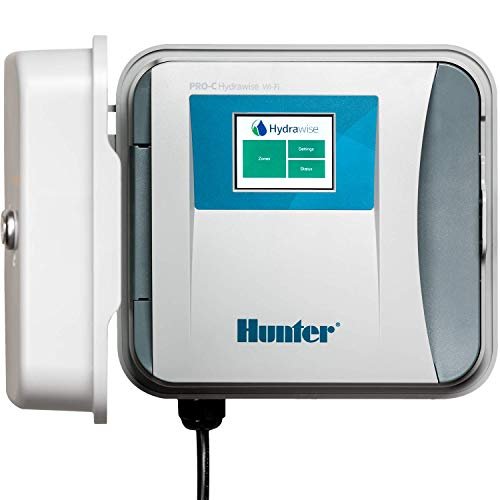
Hunter Hydrawise HPC400 Smart WiFi Irrigation Controller Review: 4-Zone Smart Watering With Expansion Up to 16 Zones
A good irrigation controller should do more than turn sprinklers on and off. It should help match watering to actual landscape conditions, adapt when the weather changes, and make the system easier to manage without adding unnecessary complexity.
The Hunter Hydrawise HPC400 Smart WiFi Irrigation Controller is designed around that goal. It combines app-based remote control, weather-aware scheduling, touchscreen programming, and modular zone expansion in a controller aimed at residential lawns and gardens.
The base unit supports 4 watering zones, while optional expansion modules can increase capacity to 16 zones. That makes the HPC400 suitable for homeowners who want a controller that can start small and scale as the irrigation system becomes more complex.
Its most important advantage is Hydrawise connectivity. Instead of relying only on a fixed weekly timer, users can monitor and adjust irrigation from a smartphone, tablet, or web browser while allowing weather information to influence scheduled watering.
What Is the Hunter Hydrawise HPC400?
The Hunter HPC400 is a WiFi-connected irrigation controller designed to operate the electric valves used in a residential sprinkler system.
It replaces or upgrades a traditional irrigation timer and gives users more control over when individual landscape zones receive water.
According to the supplied product information, the system includes:
- 4-zone control out of the box
- Expansion capability up to 16 zones
- Hydrawise app connectivity
- Smartphone, tablet, and web-browser access
- Weather-based watering adjustments
- Touchscreen programming
- WiFi connectivity
- Outdoor-oriented enclosure
- Modular expansion through separately purchased modules
It is intended for permanent irrigation systems rather than hose-end sprinklers or faucet timers.
Why a Smart Irrigation Controller Can Be Better Than a Basic Timer
A traditional sprinkler timer generally follows the schedule programmed into it regardless of what is happening outside.
If it is programmed to water at 5:00 a.m. on Tuesday, it may do so even after a wet Monday unless someone manually intervenes or an external sensor stops the cycle.
A smart irrigation controller can make irrigation more responsive.
Instead of treating every scheduled watering event as mandatory, the controller can use weather information and user-defined rules to make better decisions about when irrigation should run.
Hydrawise App Control
The HPC400 works with Hunter's Hydrawise platform.
This allows irrigation settings to be viewed and adjusted from compatible internet-connected devices.
Depending on the Hydrawise configuration and account features, users can manage watering from:
- Smartphone
- Tablet
- Desktop or laptop browser
This is useful because sprinkler schedules no longer need to be changed while standing in front of the controller.
Remote Irrigation Management
Remote control can be especially valuable while traveling.
If weather changes unexpectedly, users can potentially review their irrigation setup and make adjustments without being at home.
It is also convenient during regular maintenance.
A homeowner testing a sprinkler head at the far end of the yard can operate a zone from a phone instead of repeatedly walking back to the controller.
Why Remote Zone Testing Is Useful
Sprinkler maintenance often involves checking:
- Broken heads
- Incorrect spray direction
- Clogged nozzles
- Leaking fittings
- Coverage gaps
Remote zone activation makes this process much easier.
You can stand beside the sprinkler being inspected and turn that specific irrigation zone on or off from the app.
Weather-Based Watering
One of the central features of the Hydrawise platform is weather-aware irrigation.
Rather than relying exclusively on rigid schedules, the system can use weather information to help modify watering.
This can be valuable during:
- Rainy periods
- Cooler weather
- Hot dry periods
- Seasonal transitions
The goal is to avoid applying the same amount of water regardless of environmental conditions.
What Weather-Based Irrigation Actually Means
Weather-aware watering does not mean the controller knows the exact moisture content of every section of soil.
Instead, it uses available weather information and irrigation rules to make more informed scheduling decisions.
Actual performance depends on:
- Weather data accuracy
- Controller configuration
- Sprinkler precipitation rates
- Soil type
- Plant type
- Zone design
The technology is useful, but correct setup still matters.
The “Up to 50% Water Savings” Claim
The supplied product description states that weather-based scheduling can help reduce water use by up to 50%.
That should be treated as a potential manufacturer claim rather than a guaranteed household result.
Actual savings vary substantially depending on what the smart controller replaces.
A poorly programmed traditional irrigation system that waters heavily during rain may offer substantial opportunities for savings.
A homeowner who already manages irrigation carefully may see a smaller difference.
Where Smart Controllers Can Reduce Waste
The greatest savings usually come from avoiding unnecessary irrigation.
Examples include:
- Watering during rainfall
- Running the same schedule during cool and hot weather
- Irrigating longer than plants require
- Forgetting to adjust schedules seasonally
Automation can reduce these problems, particularly for users who do not want to continually reprogram a conventional timer.
Four Zones Included
The HPC400 begins with support for four irrigation zones.
Each zone usually corresponds to a separate electric valve controlling a particular part of the landscape.
For example:
Zone 1: front lawn
Zone 2: backyard lawn
Zone 3: flower beds
Zone 4: vegetable garden
Each zone can then be managed according to its own watering requirements.
Why Irrigation Zones Matter
Different parts of a landscape often require different irrigation strategies.
Grass may use spray or rotor sprinklers.
Shrubs may use drip irrigation.
Vegetable gardens may need more frequent watering.
Trees may require deeper, less frequent irrigation.
Separating those areas into zones makes it possible to give each one a more appropriate schedule.
Expandable to 16 Zones
The controller can reportedly be expanded to 16 total zones using separately available modules.
That expandability is one of the HPC400's strongest practical advantages.
A homeowner can begin with a simple four-zone landscape and later add irrigation for:
- New garden beds
- Side yards
- Trees
- Additional lawn areas
- Drip systems
without necessarily replacing the entire controller.
Why Modular Expansion Can Save Money
Buying a controller with far more capacity than needed can be unnecessary.
A modular design lets the irrigation system grow incrementally.
This is particularly useful for homeowners improving their landscaping over several years rather than installing everything at once.
Who Needs More Than Four Zones?
Four zones may be enough for a small residential landscape.
Larger properties can easily require more.
For example:
- Front lawn
- Rear lawn
- Left side yard
- Right side yard
- Foundation beds
- Trees
- Vegetable garden
- Patio planters
already creates eight distinct watering areas.
A controller expandable to 16 zones provides significant headroom.
Touchscreen Interface
The HPC400 includes touchscreen programming according to the source.
This means the controller can still be operated locally rather than depending entirely on the mobile app.
That is important because a good smart-home product should remain usable even when a phone is unavailable.
The local screen can be useful for:
- Initial setup
- Manual watering
- Basic schedule adjustments
- Troubleshooting
Why Local Controls Still Matter
App control is convenient, but internet-connected products should not make basic operation unnecessarily difficult.
A physical touchscreen provides an additional layer of accessibility.
It is useful for:
- Other household members
- Contractors
- Landscapers
- Situations where WiFi is temporarily unavailable
WiFi Setup
The controller connects to the home's WiFi network.
A reliable signal at the controller location is therefore important.
Before installation, check WiFi strength where the irrigation controller will be mounted.
This matters especially in:
- Garages
- Exterior utility walls
- Detached structures
- Basements
where wireless coverage may be weaker.
Improving WiFi Reliability
If signal strength is poor, options may include:
- Moving the router
- Adding a mesh WiFi node
- Installing a nearby access point
- Relocating the controller if practical
Reliable connectivity is important for remote management and weather-based features.
Outdoor Installation
The controller is described as having a weather-resistant enclosure suitable for outdoor environments.
That can make installation more flexible than an indoor-only controller.
However, weather-resistant does not mean it should be placed wherever convenient without regard to exposure.
Follow Hunter's installation requirements regarding:
- Mounting position
- Clearance
- Electrical protection
- Direct water exposure
- Environmental limits
Outdoor-Rated Does Not Mean Maintenance-Free
Even durable irrigation electronics should be inspected periodically.
Check for:
- Damaged enclosure seals
- Insect intrusion
- Loose wiring
- Corrosion
- Water ingress
A controller may remain outdoors for years, but its installation environment still affects longevity.
How Installation Works
A sprinkler controller is connected to low-voltage wires that run to electric irrigation valves.
In a replacement installation, the existing zone wires may already be available.
The basic process generally involves:
- Identifying each existing valve wire.
- Disconnecting the old controller.
- Mounting the new controller.
- Connecting common and zone wires.
- Connecting power correctly.
- Configuring WiFi.
- Setting up Hydrawise.
- Testing each zone.
The exact process should follow Hunter's official installation instructions.
Is the HPC400 Really a DIY Installation?
The product is marketed as DIY friendly.
For homeowners replacing an existing controller where wires are clearly labeled and accessible, installation may indeed be relatively straightforward.
However, the claim of completing installation in less than 30 minutes should be treated as an ideal scenario.
Actual installation time can increase if:
- Existing wires are unlabeled
- Connections are corroded
- WiFi is difficult to configure
- Expansion modules are needed
- The existing system has faults
When Professional Installation Makes Sense
A professional irrigation technician may be worthwhile if:
- Existing valve wiring is confusing
- Zones do not operate correctly
- New valves need to be added
- Electrical installation is required
- The system includes pumps or specialized equipment
Smart software cannot compensate for incorrectly wired valves or poorly designed irrigation hydraulics.
Watering Schedules Should Match the Landscape
Installing a smart controller does not automatically create a good irrigation strategy.
Each zone should be configured according to:
- Plant type
- Soil
- Sun exposure
- Sprinkler type
- Slope
- Seasonal conditions
Good controller technology works best when paired with accurate zone information.
Lawn Zones
Grass typically needs different irrigation than shrubs or drip systems.
Spray heads may deliver water relatively quickly.
Rotor sprinklers may require longer runtimes because their application rate can be lower.
The schedule should account for the actual sprinkler type rather than simply assigning the same runtime to every zone.
Drip Irrigation Zones
Drip systems apply water more slowly and directly to the soil.
They often require longer runtimes than spray sprinklers.
A smart controller can manage both types, but the programs should not be identical.
Soil Type Matters
Soil strongly influences irrigation strategy.
Sandy Soil
Water infiltrates quickly but may drain rapidly.
Clay Soil
Water enters more slowly and is more prone to runoff.
Loamy Soil
Often provides a useful balance of drainage and moisture retention.
The controller's schedule should reflect these differences.
Cycle-and-Soak Strategies
On heavy clay or sloped terrain, long continuous irrigation cycles can cause runoff.
Breaking watering into shorter cycles with pauses between them can give water more time to soak into the soil.
If supported by the selected Hydrawise configuration, this type of strategy can improve effective irrigation without simply increasing total runtime.
Sun and Shade Should Be Separated When Possible
A sunny lawn area can dry much faster than grass under trees or beside a north-facing wall.
If both are controlled by the same valve, the controller cannot water them independently.
Smart irrigation begins with good zone design.
Whenever practical, landscapes with significantly different exposure should be separated into different irrigation zones.
Weather Data Does Not Fix Poor Sprinkler Coverage
A smart controller can determine when and how long to water, but it cannot repair physical irrigation problems.
Common hardware issues include:
- Broken sprinkler heads
- Mismatched nozzles
- Low pressure
- Clogged filters
- Poor head spacing
- Leaking valves
These problems should be corrected before relying on advanced scheduling.
Check Distribution Uniformity
One of the most overlooked parts of irrigation management is checking whether water is actually distributed evenly.
If one section of lawn receives twice as much water as another, the controller may be forced to overwater one area to keep the dry section alive.
Improving sprinkler coverage can often save as much water as changing the schedule.
Smart Scheduling Works Best With Healthy Hardware
The optimal sequence is:
- Repair leaks.
- Fix damaged sprinklers.
- Correct obvious coverage problems.
- Configure zones accurately.
- Enable smart scheduling.
Automation should optimize a functional irrigation system, not compensate for a broken one.
Seasonal Adjustments
Plant-water demand changes throughout the year.
A lawn may require much less irrigation during cool weather than during a hot dry period.
Weather-aware scheduling can reduce the need to manually update seasonal runtimes.
That is one of the biggest practical advantages of Hydrawise compared with a fixed timer.
Vacation Use
Smart irrigation is particularly convenient while away from home.
Before traveling, users can check:
- Controller connectivity
- Valve operation
- Current schedules
- Weather adjustments
If conditions change, irrigation can be reviewed remotely.
This is much more flexible than asking someone to physically reprogram the controller.
Monitoring System Performance
A connected controller can provide more visibility into irrigation than a traditional timer.
Depending on the Hydrawise setup and connected hardware, users may be able to review watering activity and system status.
Monitoring is valuable because irrigation failures are often not noticed immediately.
A lawn can begin drying for several days before the homeowner realizes a valve or controller has stopped operating.
Notifications and Alerts
Hydrawise systems can support various monitoring and notification capabilities depending on configuration.
These may help surface unusual irrigation behavior or controller issues.
Exact alert features can vary by system setup, so users should review the current Hydrawise documentation for the functionality available with the HPC400.
Smart Controller vs. Basic Digital Controller
A basic controller may provide:
- Weekly schedules
- Manual zone activation
- Seasonal adjustment
The HPC400 adds network connectivity and weather-aware management.
For users who rarely change their irrigation program, a basic controller may be enough.
For users who want remote management and automated weather response, Hydrawise offers substantially more flexibility.
Smart Controller vs. Hose Timer
The HPC400 is not a hose-faucet timer.
It is intended for a permanent irrigation system using electric valves.
A hose timer is more appropriate for:
- One or two portable sprinklers
- Temporary drip systems
- Garden hoses
The Hunter controller is more suitable for multi-zone residential landscaping.
Smart Controller vs. Fully Professional Irrigation Platform
The HPC400 provides advanced residential capability without necessarily requiring a commercial irrigation system.
Its scalability to 16 zones makes it suitable for many larger homes.
Properties with dozens of zones, complex pumping systems, or commercial landscapes may require a different controller class.
Water-Saving Potential
The greatest opportunities for reducing irrigation consumption usually come from combining several improvements:
- Weather-aware scheduling
- Correct zone programming
- Efficient sprinkler heads
- Leak repair
- Proper watering times
- Good soil management
The controller is one piece of that system.
Do Not Chase Water Savings at the Expense of Plant Health
Reducing irrigation is useful only when plants still receive enough water.
Over-aggressive schedule reductions can cause:
- Lawn stress
- Wilting
- Shallow rooting
- Plant loss
Use smart adjustments together with observation of the actual landscape.
Common Mistakes
Leaving Default Schedules Unchanged
Every landscape is different.
Assuming Weather Automation Is Perfect
Weather data should complement, not replace, occasional inspection.
Putting Every Plant Type on One Zone
Different vegetation often requires different irrigation.
Ignoring Weak WiFi
Remote features depend on a stable connection.
Expanding Zones Without Checking System Capacity
The controller may support 16 zones, but the irrigation system still needs properly designed valves and water supply.
Expecting a Smart Controller to Fix Broken Sprinklers
Hardware problems still require physical repair.
Who Is the Hunter Hydrawise HPC400 Best For?
The HPC400 is especially well suited to homeowners who:
- Have a permanent sprinkler system
- Want app-based control
- Need at least four zones
- May expand later
- Want weather-aware scheduling
- Prefer a local touchscreen as well as remote control
Its modular design makes it particularly useful for properties where landscaping may evolve over time.
Who Might Prefer a Simpler Controller?
A less expensive conventional timer may be sufficient when:
- The irrigation system has only a few zones
- Schedules rarely change
- Remote access is unnecessary
- Weather-based automation is not important
The HPC400's value comes primarily from connectivity, automation, and expansion.
Advantages and Considerations
Advantages
The Hunter Hydrawise HPC400 combines 4-zone irrigation control, expansion up to 16 zones, Hydrawise app management, browser access, weather-based scheduling, touchscreen programming, WiFi connectivity, and an outdoor-oriented enclosure.
The modular architecture means homeowners can begin with a modest system and add zones later without replacing the core controller.
Considerations
Weather-based water savings will vary significantly by climate, existing irrigation habits, and system efficiency. The advertised installation time may also be optimistic for older or poorly labeled systems.
Expansion modules are sold separately, and reliable WiFi coverage is important if remote and weather-connected features are going to be used consistently.
Frequently Asked Questions
How many zones does the HPC400 support out of the box?
It starts with 4 irrigation zones.
How many zones can it support after expansion?
Up to 16 zones, according to the supplied information.
Are expansion modules included?
No. Additional modules are described as separately available.
Does it connect to WiFi?
Yes.
Which app does it use?
Hunter's Hydrawise platform.
Can I control it from a smartphone?
Yes.
Can I use a tablet?
Yes.
Can I manage it through a web browser?
The supplied information says yes.
Does it adjust watering based on weather?
Yes, weather-based scheduling is a central feature of the Hydrawise system.
Does it require a separate rain sensor?
The supplied description says weather adjustments can operate without requiring an additional sensor, although compatible physical sensors may still be useful in certain installations.
Will it really cut my water bill by 50%?
The source claims savings of up to 50%, but actual results depend on existing irrigation habits and site conditions.
Does it have a touchscreen?
Yes.
Can it still be controlled without a smartphone?
Yes, the local touchscreen provides controller access.
Is it intended for outdoor installation?
The supplied description presents it as having a weather-resistant outdoor enclosure.
How long does installation take?
The source claims under 30 minutes for straightforward installations, but actual time varies.
Can homeowners install it themselves?
Potentially, especially when replacing an existing clearly wired controller.
Does it require underground sprinkler valves?
It is designed for conventional irrigation systems using electrically controlled valves.
Can I use it with a garden hose?
It is not primarily a hose-faucet timer.
Can I control lawn and drip irrigation separately?
Yes, provided they are installed on separate irrigation zones.
Can each zone have different watering requirements?
Yes. That is one of the core advantages of a multi-zone controller.
Is 16 zones enough for a large residential property?
For many homes, yes. Very complex properties may require more specialized irrigation equipment.
Does WiFi quality matter?
Yes. A reliable WiFi signal at the controller location is important for connected features.
Can the controller repair irrigation problems automatically?
No. Leaks, blocked sprinklers, damaged heads, and hydraulic issues still need physical maintenance.
Final Thoughts
The Hunter Hydrawise HPC400 Smart WiFi Irrigation Controller is a strong option for homeowners who want to move beyond fixed sprinkler schedules and manage irrigation as a connected, weather-aware system.
Its biggest strengths are Hydrawise remote control, four included zones, expansion up to 16 zones, touchscreen operation, and weather-based scheduling. That combination makes it useful for both relatively simple residential landscapes and more complex yards that may grow over time.
The controller's potential water savings are best viewed as the result of better irrigation management rather than a guaranteed percentage reduction. Weather-aware automation can help eliminate unnecessary watering, but the best results still depend on good zone design, healthy sprinkler hardware, appropriate runtimes, and accurate landscape configuration.
For a homeowner with a permanent multi-zone sprinkler system who values remote access, scalable zone capacity, weather-responsive watering, and local touchscreen control, the Hunter HPC400 offers a capable and flexible foundation for smarter residential irrigation.