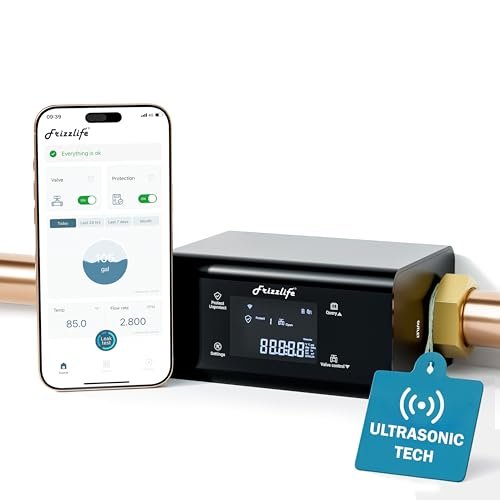
Frizzlife LP365 Smart Water Leak Detector Review: Ultrasonic Flow Monitoring, Automatic Shutoff, and App Control
A small plumbing leak can be easy to miss until it becomes an expensive problem. Slow drips behind walls, running toilets, failing appliance hoses, and hidden supply-line leaks can waste water for days while gradually damaging flooring, cabinets, drywall, and structural materials.
The Frizzlife LP365 smart water leak detector and automatic shutoff system is designed to monitor the home's main water supply continuously and respond when abnormal water use is detected. Installed directly on the plumbing line, it uses ultrasonic flow monitoring to track water movement and can automatically close the valve if the system identifies a potentially serious leak.
Unlike a simple floor sensor, the LP365 also provides broader plumbing data through the Smart Life app. Users can monitor flow rate, water pressure, temperature, and overall usage while controlling the valve remotely. For homeowners looking for both leak protection and water-consumption insight, this makes the system more comprehensive than a basic alarm.
What Is the Frizzlife LP365?
The Frizzlife LP365 is a smart whole-home water monitoring and automatic shutoff device.
It installs directly into the incoming water line and is designed to monitor how water moves through the plumbing system.
Its main functions include:
- Real-time leak monitoring
- Automatic water shutoff
- Ultrasonic flow measurement
- Remote valve control
- Flow-rate monitoring
- Water pressure monitoring
- Temperature monitoring
- Daily and monthly usage tracking
- Smart Life app connectivity
- Customizable leak-protection settings
Because the device is installed upstream of most household fixtures, it can monitor water use throughout much of the property rather than protecting only one appliance.
How the Automatic Shutoff Works
The system continuously monitors water flowing through the line.
When it identifies activity that falls outside the configured protection rules, it can alert the homeowner and, depending on the situation and settings, automatically close the valve.
A typical sequence may look like this:
- Water begins flowing unexpectedly.
- The LP365 measures the change.
- The system evaluates the event against its configured rules.
- An alert is sent through the connected app and supported notification channels.
- The valve can close automatically to reduce continued water flow.
This makes it an active protection device rather than a notification-only leak detector.
Why Automatic Shutoff Matters
Remote alerts are useful, but they still require someone to act.
If a major leak begins while you are:
- At work
- Sleeping
- Traveling
- Away for the weekend
water may continue flowing while you read the alert, contact someone, or return home.
Automatic shutoff can reduce that response delay.
It cannot remove water that has already leaked, but it can stop the plumbing system from continuously feeding the problem.
Ultrasonic Flow Monitoring
One of the LP365's core features is ultrasonic water-flow measurement.
Traditional mechanical meters use moving parts to measure flow. Ultrasonic systems instead infer flow using sound waves passing through the water.
This approach can offer several practical advantages:
- No turbine or paddle in the flow path
- Reduced mechanical wear
- Ability to monitor subtle flow changes
- Less dependence on moving measurement components
The manufacturer states that the system can detect flow changes down to approximately 0.01 gallons per minute.
What 0.01 GPM Means
A flow rate of 0.01 GPM is extremely small compared with normal household water use.
For perspective, typical active fixtures use substantially more water than that.
This sensitivity is intended to help the system recognize small ongoing flows that might indicate:
- Running toilet
- Dripping faucet
- Small pipe leak
- Loose connection
Real-world detection performance can vary depending on plumbing configuration, household usage, and system settings.
Why Micro-Leak Detection Is Useful
Major pipe failures are easy to recognize.
Slow leaks are more difficult.
A very small leak may not produce:
- Visible pooling
- Loud dripping
- Immediate pressure loss
but it can continue for days or weeks.
Flow-based monitoring gives homeowners a way to identify unusual continuous consumption before the damage becomes obvious.
Real-Time Leak Alerts
The product description states that the system can provide real-time alerts when it identifies a leak or abnormal condition.
Notification methods may include:
- Smart Life app notifications
- SMS
- Phone-call alerts
Availability and pricing for individual notification channels can depend on the current app and service configuration, so users should verify those settings after installation.
Remote Monitoring From Anywhere
Because the LP365 connects to the Smart Life ecosystem, users can monitor the system remotely while away from home.
That means you can potentially check:
- Current flow rate
- Valve status
- Water pressure
- Water temperature
- Recent usage
This can be especially useful for:
- Vacation homes
- Rental properties
- Frequent travelers
- Unoccupied houses
Remote Valve Control
The Smart Life app can also be used to open or close the valve remotely.
This provides a useful manual backup to automatic shutoff.
For example, you could close the water when:
- Leaving for vacation
- A neighbor reports a leak
- A contractor needs the supply shut down
- A plumbing issue is suspected
Remote control is convenient, but homeowners should still know where the physical main shutoff valve is located.
Water Usage Monitoring
The LP365 is not only a safety device.
It also tracks water consumption.
The source states that users can review both daily and monthly usage.
This can help identify patterns such as:
- Rising consumption
- Unexpected nighttime use
- Excessive irrigation
- Long-running fixtures
- Recurring leaks
That makes the system useful for both protection and conservation.
Why Usage Data Can Be Valuable
Most homeowners only see water consumption on a utility bill.
A smart monitor provides more immediate feedback.
If usage suddenly rises, it may indicate:
- A hidden leak
- A malfunctioning toilet
- Changes in household habits
- New appliance use
The data can help homeowners investigate before the next billing cycle.
Flow Rate Monitoring
Real-time flow rate can also help distinguish normal activity from suspicious use.
A short, high-flow event may correspond to:
- Shower
- Tub filling
- Washing machine
A small continuous flow for hours may be more suspicious.
The system's effectiveness depends partly on how well its protection thresholds are configured.
Water Pressure Monitoring
The LP365 also reports water pressure.
Pressure is important because excessive pressure can increase stress on:
- Supply hoses
- Faucet cartridges
- Appliance connections
- Shutoff valves
- Plumbing joints
If the system reveals persistently high pressure, a plumber may recommend a pressure-regulating valve or other corrective work.
The smart monitor itself is not a substitute for proper pressure control.
Temperature Monitoring
Water temperature is also available through the system.
This can provide useful context, particularly in areas exposed to colder conditions.
However, temperature monitoring does not physically protect pipes from freezing.
If the device reports unusually low temperatures, homeowners may need to investigate insulation, heating, or exposed plumbing.
Personalized Leak Protection Settings
Households do not all use water the same way.
A family of five may have very different usage patterns from a single occupant.
The LP365 allows protection settings to be tailored around:
- Household size
- Typical usage
- Daily schedule
- Flow thresholds
- Expected activity
This can help reduce nuisance alerts while still maintaining sensitivity to real problems.
Why Customization Matters
An overly sensitive system may interpret normal activity as a leak.
An overly permissive system may miss smaller problems.
The goal is to balance:
- Fast detection
- Low false-alarm rate
- Normal household behavior
Spend time configuring the system after installation rather than relying entirely on default settings.
Compatible Pipe Sizes
The LP365 is designed to support both 1-inch and 3/4-inch plumbing.
The main unit uses a 1-inch male NPT connection, and the kit includes two 3/4-inch male NPT adapters.
This gives the system flexibility for many residential installations.
Before purchasing, verify the actual pipe size and thread requirements with a plumber.
What Comes in the Box?
According to the supplied product information, the kit includes:
- Frizzlife LP365 main unit
- 1-inch male NPT connection
- Two 3/4-inch male NPT adapters
- Power plug
- Approximately 6.6-foot power cable
- Plumbing tape
That covers many of the basic hardware requirements, although additional fittings may still be needed depending on the home's plumbing.
Professional Installation Is Recommended
Although the product includes installation hardware, this is not the same as placing a battery-powered sensor beneath a sink.
The LP365 becomes part of the home's pressurized water line.
Installation may involve:
- Shutting off the main water
- Cutting pipe
- Adding adapters
- Sealing threaded joints
- Positioning the unit
- Pressure testing
- Connecting power
Professional plumbing installation is a sensible choice for most homeowners.
Why Proper Installation Matters
A water leak protection device should not create a new leak.
Poor installation can result in:
- Cross-threaded fittings
- Slow seepage
- Pipe stress
- Restricted flow
- Incorrect sensor readings
A professional can also verify that the unit is oriented correctly and sized appropriately.
Electrical Power Is Required
The device must be plugged in for networking and operation according to the product description.
That means installation planning should account for a nearby electrical outlet.
Before choosing the final plumbing location, confirm that:
- Power is available
- The cord can reach safely
- The outlet location meets local requirements
Avoid unsafe extension-cord arrangements around plumbing.
Outdoor Installation Considerations
The source states that when installed outdoors, additional insulation or wrapping may be advisable to protect the device from low temperatures.
This is important because smart plumbing electronics are not automatically suitable for every outdoor environment.
Consider:
- Freezing temperatures
- Rain exposure
- Direct sunlight
- Condensation
- Local electrical requirements
If outdoor installation is necessary, follow the manufacturer's environmental specifications rather than improvising.
Cold Weather Does Not Equal Freeze Protection
Wrapping the device may reduce cold exposure, but it does not make the entire plumbing system freeze-proof.
Pipes, fittings, and valves still need appropriate:
- Insulation
- Heat protection
- Winterization
In freezing climates, consult a plumber about installation location.
Use the Built-In Leak Test Function
The manufacturer specifically recommends using the system's LEAK TEST function when simulating a leak.
This is important because artificially creating unusual water usage in another way may not accurately reproduce how the device's real detection logic works.
After installation, use the dedicated test function to verify:
- Alerts
- Valve closure
- App connectivity
- System response
Test Before Relying on the System
A smart safety product should never be assumed to work simply because it appears online.
Perform a complete test after setup.
Confirm that:
- The device registers flow.
- The app receives data.
- Alerts arrive correctly.
- The valve closes when instructed.
- Remote control works.
- The system returns to normal after the test.
Whole-House Monitoring vs. Floor Sensors
The LP365 detects abnormal flow in the plumbing system.
Floor leak detectors sense actual water in a specific location.
Each approach has advantages.
Whole-House Flow Monitoring
Can identify:
- Hidden leaks
- Running toilets
- Unusual water use
- Major plumbing failures
Floor Sensors
Can detect actual water near:
- Water heater
- Dishwasher
- Washing machine
- Sump pit
For the strongest protection, some homeowners use both.
Why Point Sensors Can Still Be Helpful
A flow-based system may tell you that water is being used abnormally, but a point sensor can reveal where water has physically appeared.
That can make diagnosis faster.
For example, a floor sensor near the water heater can confirm the location while the LP365 shuts off the main supply.
LP365 vs. Notification-Only Leak Detectors
A basic leak detector provides warning.
The LP365 can also control the main water supply.
Notification-Only Sensor
Advantages:
- Inexpensive
- Easy to install
Limitations:
- Someone still has to close the water
LP365 Automatic Shutoff
Advantages:
- Whole-house monitoring
- Automatic intervention
- Remote control
- Usage analytics
The tradeoff is higher cost and more complex installation.
LP365 vs. Smart Valve Controllers
Some smart valves only allow remote opening and closing.
The LP365 adds monitoring.
It tracks:
- Flow
- Pressure
- Temperature
- Usage
This provides more context and enables automated leak detection rather than relying solely on manual control.
Smart Life Ecosystem Integration
The product also references compatibility with other smart devices.
Because the LP365 uses the Smart Life platform, it may be possible to include the valve in broader smart-home routines.
Potential examples include:
- Away mode
- Vacation mode
- Emergency automation
- Home-status routines
The exact integration options depend on the current Smart Life ecosystem and connected devices.
Avoid Making Cloud Automation the Only Safety Layer
Smart-home integrations are useful, but the core shutoff functionality should remain reliable on its own.
Do not rely entirely on:
- Voice assistants
- Third-party cloud services
- Complex routines
for emergency leak response.
The valve's built-in protection should remain the primary safety mechanism.
Common Setup Mistakes
Using the Wrong Pipe Adapters
Verify pipe size and thread type before installation.
Skipping Professional Leak Testing
All joints should be pressure-tested after installation.
Ignoring the Electrical Requirement
The device needs power for networking and operation.
Using Unapproved Leak Simulation Methods
Use the built-in LEAK TEST feature.
Installing Outdoors Without Temperature Protection
Follow environmental installation guidance carefully.
Leaving Default Settings Unreviewed
Customize thresholds to suit household usage.
Who Is the Frizzlife LP365 Best For?
The system may be particularly useful for:
- Homeowners
- Vacation properties
- Rental homes
- Finished basements
- Large households
- Frequent travelers
- Smart-home users
- Anyone wanting water-usage visibility
It makes the most sense for buyers looking for whole-house monitoring and automatic shutoff rather than simple point detection.
Advantages and Considerations
Advantages
- Automatic water shutoff
- Ultrasonic flow monitoring
- Claimed sensitivity down to 0.01 GPM
- Real-time app control
- Pressure monitoring
- Temperature monitoring
- Daily usage tracking
- Monthly usage tracking
- Personalized leak settings
- 1-inch and 3/4-inch pipe compatibility
- Smart Life app integration
- Remote valve control
Potential Considerations
Professional installation is recommended.
The unit requires electrical power.
Outdoor use requires additional environmental planning.
Real-world micro-leak sensitivity may vary.
Phone-call and SMS notification availability may depend on current service terms.
The system does not replace floor sensors for location-specific detection.
Frequently Asked Questions
Does the Frizzlife LP365 shut off water automatically?
Yes. It is designed to close the valve automatically when configured leak conditions are detected.
What technology does it use to measure flow?
Ultrasonic flow monitoring.
What is the stated minimum detectable flow?
The manufacturer states approximately 0.01 gallons per minute.
Can I control the valve remotely?
Yes, through the Smart Life app.
What water information can I see?
The source lists flow rate, pressure, temperature, and water-usage data.
Does it track daily water usage?
Yes.
Does it track monthly usage?
Yes.
What pipe sizes does it support?
It is designed for 1-inch plumbing and includes adapters for 3/4-inch connections.
Does it need electrical power?
Yes. The device must be plugged in for networking and operation.
Is professional installation recommended?
Yes.
Can it be installed outdoors?
The manufacturer provides cold-weather precautions for outdoor installation. Exact environmental limits should be verified before installing outside.
How should I test the leak detection feature?
The manufacturer recommends using the built-in LEAK TEST function.
Does it replace individual water leak sensors?
Not necessarily. Point sensors can still add useful location-specific protection.
Final Thoughts
The Frizzlife LP365 smart water leak detector and automatic shutoff system is designed for homeowners who want more than a basic floor alarm.
Its main strength is whole-house visibility. Ultrasonic flow monitoring allows the system to track subtle changes in water use, while pressure, temperature, and consumption data provide a broader picture of plumbing performance. Automatic valve control adds active protection by reducing continued water flow when a serious abnormality is detected.
The Smart Life app also makes the system useful beyond emergency situations, giving users remote control and day-to-day insight into household water consumption.
The tradeoff is installation complexity. This is an in-line plumbing device that requires power and should ideally be installed by a professional.
For homeowners looking for a smart whole-house water leak monitor with ultrasonic flow detection, automatic shutoff, real-time water usage tracking, and remote app control, the Frizzlife LP365 offers a comprehensive approach to plumbing protection and water management.