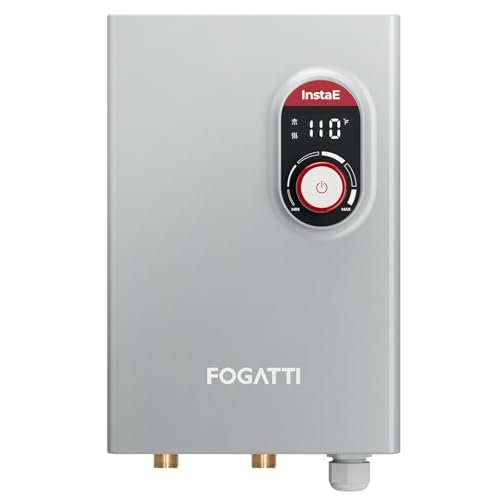
FOGATTI 14kW Electric Tankless Water Heater Review: 3.3 GPM On-Demand Hot Water for Multiple Fixtures
An electric tankless water heater can be a practical alternative to a traditional storage tank when space is limited and the electrical system can support the substantial power demand. Instead of keeping a reservoir of water hot around the clock, a tankless unit heats water only when a faucet or shower is running.
The FOGATTI 14kW electric tankless water heater is designed for considerably higher demand than small point-of-use models. With a stated maximum flow of 3.3 gallons per minute, adjustable temperatures from 86°F to 140°F, compact wall-mounted dimensions, and ETL certification, it is positioned for households that want on-demand hot water without installing a bulky storage tank.
Its 14kW output also means installation requirements are significant. The manufacturer specifies a 60A two-pole breaker and one set of 6 AWG conductors, so electrical compatibility should be evaluated before purchase. This is not a plug-in appliance, and professional installation is the sensible approach for most homes.
What Is the FOGATTI 14kW Electric Tankless Water Heater?
The FOGATTI is an electric on-demand water heater designed to raise the temperature of water as it passes through the unit.
According to the supplied specifications, its main characteristics include:
- 14kW electric heating capacity
- Up to 3.3 GPM maximum flow
- Adjustable temperature from 86°F to 140°F
- LED temperature display
- Rotary control knob
- 1/2-inch NPT male inlet and outlet
- ETL certification
- Compact 14.2" × 9.5" × 3.5" enclosure
- 60A two-pole breaker requirement
- 6 AWG wiring requirement
Unlike a conventional tank heater, there is no stored reserve of hot water.
How an Electric Tankless Water Heater Works
When hot water is requested, cold water enters the heater and passes through an electrically heated chamber. The heating elements raise its temperature while it is moving, and the heated water then continues to the shower or faucet.
When flow stops, the heater stops actively heating.
This means the appliance does not need to maintain a large quantity of stored water at temperature throughout the day.
What 14kW Means for Hot-Water Performance
A 14kW heater has substantially more heating capacity than compact 3kW to 7kW point-of-use units.
That extra power allows it to handle greater flow or a larger temperature increase.
However, even a 14kW heater has limits.
Tankless performance always depends primarily on:
incoming water temperature + desired outlet temperature + flow rate
The colder the incoming water, the fewer gallons per minute the heater can typically deliver at a comfortable hot-water temperature.
Understanding the 3.3 GPM Rating
The manufacturer lists a maximum flow rate of up to 3.3 GPM.
That can be enough for meaningful residential use, but the word "maximum" is important.
The heater will not necessarily produce 3.3 GPM of 120°F water under every condition.
If incoming water is relatively warm, the unit can support more flow.
If inlet water is very cold, practical hot-water flow may be lower.
Temperature Rise Is the Key Sizing Metric
Suppose incoming water is 65°F and you want 105°F water.
The required temperature rise is 40°F.
If winter inlet water drops to 40°F, reaching the same 105°F requires a 65°F rise.
The second case places a much larger demand on the heater.
This is why selecting a tankless unit only by advertised GPM can lead to disappointment.
Can It Run a Shower?
A 14kW unit with a stated maximum flow of 3.3 GPM may be suitable for a typical shower under favorable inlet-water conditions.
A shower using around 1.5 to 2.0 GPM leaves some capacity for additional modest demand.
However, shower performance should always be evaluated using the manufacturer's flow-versus-temperature-rise data.
Can It Run Two Showers at Once?
Possibly under limited conditions, but that should not be assumed.
Two 1.8 GPM showers would require approximately 3.6 GPM total, already above the stated 3.3 GPM maximum.
Two very low-flow fixtures might operate together, but water temperature and local inlet conditions remain important.
Support for 2–3 Points of Use
The manufacturer describes the heater as capable of supporting approximately 2 to 3 points of use simultaneously.
Fixture count, however, is less useful than actual flow.
A bathroom faucet using 0.8 GPM is very different from a shower using 2.0 GPM.
A more accurate approach is to total the flow rates of all fixtures likely to operate simultaneously.
Example of Simultaneous Use
A moderate-demand scenario might include:
- Shower: 1.8 GPM
- Bathroom faucet: 0.7 GPM
Total demand: 2.5 GPM
That may fall comfortably within the heater's stated maximum under suitable temperature conditions.
Add a second shower, however, and demand can quickly exceed the unit's capacity.
Continuous Hot Water—Within the Heater's Limits
One of the main advantages of a tankless system is that there is no fixed volume of stored hot water to deplete.
As long as:
- Electricity remains available
- Water continues to flow
- Demand stays within heating capacity
the unit can keep producing heated water.
That is different from a tank heater, where the stored supply can eventually run cold.
“Endless” Does Not Mean Unlimited Flow
Continuous hot water is not the same as unlimited hot water.
A tankless heater can operate indefinitely, but only within its maximum thermal output.
If too many fixtures are opened at once, the unit may not maintain the selected temperature.
Adjustable Temperature From 86°F to 140°F
The FOGATTI allows users to select an outlet temperature between approximately 86°F and 140°F.
This broad range supports different household applications.
Lower temperatures can be appropriate for handwashing, while higher settings may be selected for other uses.
Use High Temperature Settings Carefully
Water approaching 140°F can cause burns quickly.
The ability to select a high temperature should not be interpreted as a recommendation to use the maximum setting for routine bathing.
Households with children, older adults, or people with reduced sensation should be particularly careful with hot-water temperature.
LED Display
The front LED display provides an easy way to see the selected temperature or operating information.
This is useful when the heater is installed somewhere accessible, such as:
- Utility room
- Closet
- Mechanical area
- Wall near the point of use
A clear display reduces guesswork compared with older heaters that rely only on mechanical controls.
Simple Rotary Control
Rather than using a complex menu system, this model uses an intuitive adjustment knob.
That makes temperature changes straightforward.
For many homeowners, simple local control is preferable to an appliance that depends heavily on apps or complicated interfaces.
Compact 14.2 × 9.5 × 3.5-Inch Design
The heater measures approximately:
14.2 inches high × 9.5 inches wide × 3.5 inches deep
That is far smaller than a traditional storage water heater.
Its slim wall-mounted form can be advantageous in compact homes, apartments, utility spaces, or remodels where floor area is limited.
Where Can It Be Installed?
Potential locations include:
- Utility closets
- Wall-mounted mechanical spaces
- Under some counters
- Near bathrooms
- Near kitchen plumbing
Actual placement must still comply with required electrical, plumbing, clearance, and moisture-protection instructions.
Why Tankless Saves Space
A storage heater needs room for a tank that may hold dozens of gallons of water.
A tankless model eliminates that reservoir.
The result is a much smaller appliance that can often be installed vertically on a wall.
Electrical Requirements Are Substantial
The manufacturer specifies:
- 60A two-pole circuit breaker
- One set of 6 AWG conductors
These requirements are among the most important things to check before buying.
A 14kW electric tankless water heater represents a major electrical load.
Why a Dedicated Circuit Is Necessary
A device drawing this much power should not share a circuit with:
- General outlets
- Lighting
- Kitchen appliances
- Other heating equipment
A dedicated branch circuit allows the heater to operate without overloading unrelated wiring.
Electrical Panel Capacity Should Be Checked First
Before installation, verify that the home's main electrical service can support the additional demand.
Homes with several other major electric loads—such as electric HVAC, ranges, dryers, or EV chargers—may need a load calculation.
A physically small heater can still place a large demand on the electrical service.
Do Not Assume Every 60A Circuit Is Suitable
Correct installation involves more than installing a breaker marked 60A.
The following must all be appropriate:
- Conductor material
- Wire gauge
- Insulation rating
- Breaker type
- Termination method
- Electrical panel capacity
- Local electrical code
The manufacturer's wiring instructions should be followed precisely.
Professional Installation Is Recommended
The source explicitly recommends professional installation, and that recommendation is appropriate.
This appliance combines high-current electrical work with pressurized plumbing.
A licensed electrician can verify:
- Circuit capacity
- Breaker sizing
- Wire sizing
- Grounding
- Panel load
A plumber can verify:
- Water pressure
- Connection integrity
- Shutoff valves
- Leak-free installation
1/2-Inch NPT Plumbing Connections
The inlet and outlet use standard 1/2-inch NPT male connections.
This size is commonly encountered in residential plumbing and can simplify integration with compatible piping.
However, a 1/2-inch connection does not guarantee adequate flow in every plumbing system.
Water Pressure and Pipe Size Matter
Flow rate also depends on the home's:
- Supply pressure
- Pipe diameter
- Number of bends
- Fixture restrictions
A heater cannot deliver its maximum rated flow if the plumbing feeding it cannot provide enough water.
Install Isolation Valves
Accessible shutoff valves on both sides of a water heater make service much easier.
They allow the unit to be isolated for:
- Maintenance
- Flushing
- Repair
- Replacement
without shutting off the entire building's water supply.
ETL Certification
The heater is described as ETL certified.
Third-party electrical safety certification is important for a high-voltage appliance because it indicates evaluation against applicable safety standards for the product category.
Certification should still be paired with correct installation.
Heating Elements Isolated From Water
The source states that the heating elements are separated from direct water contact.
This design is intended to help reduce mineral accumulation and corrosion around the heating components.
That can potentially improve long-term reliability.
Why Scale Is a Problem in Tankless Heaters
Hard water contains dissolved minerals.
When water is repeatedly heated, those minerals may form deposits inside the heater.
Scale can eventually:
- Restrict water passages
- Reduce heat transfer
- Affect flow
- Increase maintenance requirements
A scale-resistant design helps, but it does not eliminate water-quality considerations.
Hard Water May Still Require Maintenance
Even with isolated heating elements, the internal water passages can accumulate mineral deposits.
Periodic flushing or descaling may still be recommended depending on local water hardness.
Follow FOGATTI's maintenance instructions rather than assuming the unit is maintenance-free.
Tankless vs. Traditional Storage Water Heater
The most obvious difference is the absence of a storage tank.
Tankless Advantages
A tankless heater offers:
- Compact size
- Continuous hot water within capacity
- No large reservoir
- Reduced standby heat loss
Storage-Tank Advantages
A traditional tank can provide:
- High short-term flow from stored water
- Simpler electrical requirements on many models
- Greater tolerance for temporary simultaneous demand
Each technology has strengths.
Tankless vs. Smaller Point-of-Use Heater
A 14kW heater occupies the middle ground between tiny under-sink units and very large whole-home electric tankless systems.
Compared with a 3.5kW point-of-use heater, it can support considerably greater flow.
But it also needs a much larger electrical circuit.
Is It a Whole-House Water Heater?
That depends on household demand.
For a small household with modest simultaneous use and relatively warm inlet water, 3.3 GPM may cover much of the daily demand.
For a larger home with multiple showers, laundry, dishwasher use, and large tubs, it may be undersized.
The phrase "whole house" should therefore be evaluated against actual fixture flow.
Good Fit for Small or Moderate Households
This model may work particularly well where hot-water demand usually consists of:
- One shower
- Shower plus sink
- Kitchen and bathroom use at separate times
It is less suited to situations where several high-flow fixtures operate together.
Climate Makes a Big Difference
In warm regions, incoming water may already be relatively warm.
That allows a 14kW heater to provide a higher flow at a comfortable outlet temperature.
In colder regions, the heater must add much more heat, reducing practical flow.
Summer vs. Winter Performance
The same heater can feel significantly more powerful in summer than winter.
This is not necessarily a fault.
It reflects the greater energy required to raise colder inlet water to the same target temperature.
Reducing Flow Can Improve Water Temperature
If the outlet temperature is lower than desired, reducing flow can sometimes help.
With less water passing through the heater each minute, more heating energy is available for each gallon.
This tradeoff is inherent to tankless systems.
Water-Saving Fixtures Can Improve Compatibility
Low-flow showerheads and faucets can make a moderate-capacity tankless heater more practical.
If the household reduces fixture flow, more appliances can potentially operate within the heater's available capacity.
Energy Use and Efficiency
An electric tankless heater uses significant power while operating, but it does not continually reheat a storage tank.
This eliminates most tank standby heat loss.
Actual electricity costs depend on:
- Hot-water consumption
- Electricity rate
- Inlet temperature
- Temperature setting
Tankless operation should not be interpreted as guaranteed lower utility bills in every household.
Standby Loss Reduction
Storage tanks gradually lose heat through their insulation.
A tankless heater largely avoids that problem because there is no reservoir maintained at temperature.
This can be particularly useful in homes with intermittent hot-water use.
Maintenance Access Matters
Because the heater is compact, it may be tempting to hide it tightly inside a cabinet.
Leave enough space to:
- Inspect wiring
- Access water connections
- Perform maintenance
- Remove the unit later
A clean-looking installation should not sacrifice serviceability.
Do Not Energize Before Plumbing Is Ready
Electric tankless heaters depend on flowing water to absorb heat.
Follow the manufacturer's commissioning procedure before applying power.
Operating a heating system without the required water conditions can damage components.
Common Buying Mistakes
Choosing Based Only on 3.3 GPM
Always consider the temperature rise at that flow.
Ignoring Electrical Service Capacity
A 60A circuit is a significant load.
Assuming It Can Run Three Showers
Three “points of use” does not mean three high-flow fixtures.
Selecting 140°F for Routine Bathing
Higher temperature increases scalding risk.
Forgetting About Water Hardness
Mineral buildup can affect long-term operation.
Installing It Where Service Is Impossible
Leave adequate maintenance access.
Who Is the FOGATTI 14kW Best For?
This model may be a strong option for:
- Small homes
- Apartments
- Condos
- Moderate-demand households
- Properties needing one primary shower plus smaller fixtures
- Installations where a large storage tank is undesirable
Its 14kW output offers substantially more flexibility than a basic point-of-use heater without reaching the extreme electrical demands of some larger whole-home tankless systems.
Who May Need More Capacity?
A larger heater may be more appropriate for homes that regularly use:
- Two or more showers simultaneously
- Large bathtub fillers
- Multiple high-flow fixtures
- Very cold incoming water
A higher-output unit will also require a correspondingly larger electrical service.
Advantages and Considerations
Advantages
- 14kW electric tankless heating
- Up to 3.3 GPM stated maximum flow
- Continuous hot water within rated capacity
- Compact 14.2" × 9.5" × 3.5" design
- Adjustable 86°F–140°F temperature
- LED display
- Simple knob control
- ETL certification
- Isolated heating-element design
- Standard 1/2-inch NPT connections
- No storage tank
Potential Considerations
- Requires a dedicated 60A two-pole circuit
- Requires 6 AWG wiring according to the source
- Practical flow depends on incoming water temperature
- May not support several high-flow fixtures simultaneously
- High temperature settings require caution
- Professional installation is strongly recommended
- Hard water can still require maintenance
Frequently Asked Questions
How powerful is the FOGATTI tankless water heater?
It is rated at 14kW.
What is the maximum stated flow rate?
Up to 3.3 GPM.
Will it always deliver 3.3 GPM of hot water?
No. Actual hot-water flow depends on inlet temperature and selected outlet temperature.
Can it run a shower?
Potentially yes, assuming the flow and required temperature rise are within its rated capacity.
Can it run two showers simultaneously?
That may exceed the heater's capacity depending on shower flow and incoming water temperature.
Can it support multiple fixtures?
The manufacturer describes support for up to 2–3 points of use, but actual combined flow should be calculated.
Does it provide continuous hot water?
Yes, as long as demand remains within the heater's output capacity.
What temperature range does it support?
Approximately 86°F to 140°F.
How large is the heater?
Approximately 14.2 × 9.5 × 3.5 inches.
What plumbing connection size does it use?
The inlet and outlet are 1/2-inch NPT male connections.
What breaker does it require?
The supplied specifications call for a 60A two-pole breaker.
What wire size does it require?
The manufacturer specifies one set of 6 AWG wires in the supplied information.
Can it share an electrical circuit?
A heater with these requirements should be installed on the dedicated circuit specified by the manufacturer.
Is professional installation recommended?
Yes.
Is it ETL certified?
Yes, according to the supplied product information.
Do the heating elements touch the water?
The source states that the heating elements are isolated from the water.
Does that mean it cannot develop scale?
No. Mineral deposits can still affect internal water passages.
Is this a whole-house heater?
It may serve a small or moderate-demand household, but suitability depends on peak simultaneous flow and inlet-water temperature.
Does tankless mean instant hot water at the faucet?
The heater begins heating on demand, but water still has to travel through the plumbing between the heater and fixture.
Final Thoughts
The FOGATTI 14kW electric tankless water heater offers a useful balance between compact point-of-use heaters and much larger whole-house electric systems. With a stated 3.3 GPM maximum flow, adjustable 86°F–140°F output, ETL certification, simple LED controls, and a compact 14.2 × 9.5 × 3.5-inch enclosure, it has enough capacity for meaningful residential hot-water demand without requiring a bulky storage tank.
Its biggest constraint is electrical infrastructure. The manufacturer specifies a 60A two-pole breaker and 6 AWG wiring, so buyers should confirm panel capacity and installation costs before focusing on the appliance's compact size.
The other key consideration is realistic flow. The advertised 3.3 GPM maximum does not mean every combination of fixtures will receive full-temperature hot water at that rate. Incoming water temperature and the required temperature rise remain critical.
For households that typically use one shower plus a smaller fixture, want continuous on-demand hot water, and have an electrical system capable of supporting a dedicated 60A circuit, this FOGATTI 14kW model can be a practical and space-efficient alternative to a conventional storage water heater.