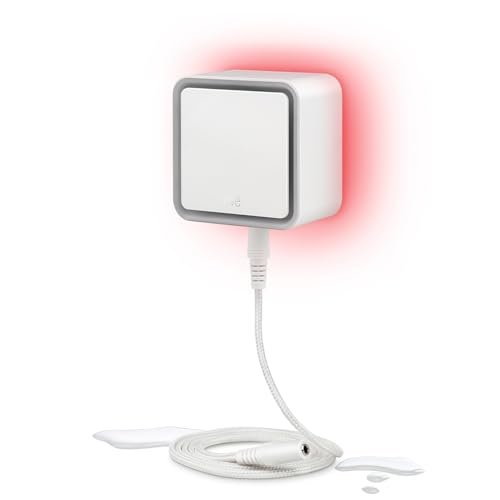
Eve Water Guard Review: Smart Leak Detection With Thread, Apple Home, and a 100 dB Alarm
A hidden water leak can become expensive long before it becomes obvious. A washing machine connection may begin dripping behind an appliance, a pipe under a sink may seep slowly into cabinetry, or water may collect in a basement that nobody checks every day. A smart leak detector helps close that gap by monitoring vulnerable areas continuously and alerting you when water appears.
The Eve Water Guard takes a broader approach than a simple point sensor. Instead of relying only on a small set of probes beneath the device, it uses a 6.5-foot sensing cable that detects water along its full length. That cable can also be extended substantially, making the system suitable for larger areas such as utility rooms, basements, kitchens, and spaces around water-using appliances.
The device also integrates with Apple Home and Thread, provides a loud audible alarm and visual warning, and is designed around local processing rather than an account-based cloud service. For users already invested in Apple’s smart-home ecosystem, it is a particularly focused option for leak detection without adding another proprietary hub.
What Is the Eve Water Guard?
Eve Water Guard is a smart indoor water leak detector designed for Apple-centric smart homes.
Its key features include:
- Full-length water-sensing cable
- 6.5-foot included cable
- Cable extension up to a stated 490 feet
- 100 dB audible alarm
- Red flashing warning light
- Notifications to Apple devices
- Apple Home compatibility
- Thread connectivity
- Bluetooth support
- Local processing
- No Eve cloud account requirement
- Periodic test reminders through the Eve app
The product is best understood as an early-warning system. It detects water and alerts you, but it does not physically close a plumbing valve on its own.
Full-Length Cable Sensing Is the Main Advantage
Many leak detectors monitor only the exact spot beneath a small sensor.
Eve Water Guard uses a cable that acts as the sensing element along its entire length.
That significantly changes how the device can be deployed.
Instead of guessing exactly where water might first appear, the cable can be routed across a broader area where leaks are likely to travel.
This can be especially useful around:
- Washing machines
- Dishwashers
- Water heaters
- Under-sink cabinets
- Basement walls
- Utility equipment
- Exposed plumbing runs
Why Cable-Based Leak Detection Can Be More Flexible
Water does not always leak directly beneath a fitting.
It may follow:
- Floor slope
- Cabinet edges
- Pipe runs
- Grout lines
- Appliance bases
A longer sensing cable can cover these likely pathways more effectively than one compact sensor placed in a single spot.
That makes the system particularly useful in rooms where the exact source of a future leak is unpredictable.
6.5-Foot Sensing Cable Included
The supplied cable is approximately 6.5 feet / 2 meters long.
For many household applications, that is already enough to wrap around or route beneath:
- A washing machine
- A water heater
- A row of plumbing connections
- A sink cabinet
The important point is that the entire cable is used for sensing, rather than merely serving as an extension wire to one small probe.
Expandable Up to 490 Feet
The supplied description states that the sensing cable can be extended up to approximately 490 feet / 150 meters.
That dramatically increases the potential coverage area.
A long extended run could be useful in:
- Large basements
- Utility rooms
- Mechanical areas
- Long cabinet runs
- Spaces with multiple plumbing risk points
Before planning an unusually large installation, confirm current cable compatibility and maximum supported length for the exact model.
Good Placement Matters
Even with a long cable, placement still determines how quickly water is detected.
Think about where water would move if a fitting failed.
Good locations are often:
- Along low points
- Around appliance bases
- Beneath exposed plumbing
- Near valves
- Along cabinet backs
The objective is to intercept water early, not simply place the cable where it is easiest to hide.
Monitoring a Washing Machine
Washing machines have several common leak points:
- Hot and cold supply hoses
- Drain hose
- Internal pump
- Door seals on front loaders
Routing sensing cable around the machine's rear or base can provide broader coverage than a single point detector.
That can be valuable because a failed supply hose may release water rapidly.
Monitoring Under a Sink
Under-sink cabinets can conceal slow leaks for a long time.
Potential sources include:
- Faucet supply lines
- Shutoff valves
- Drain traps
- Disposal connections
- Dishwasher hoses
A sensing cable can be routed along the cabinet floor to monitor multiple connection points at once.
Basement and Utility Room Monitoring
Basements are another strong use case because they may contain:
- Water heaters
- Sump systems
- Utility sinks
- Main plumbing
- HVAC condensate lines
They are also often checked less frequently than living areas.
A connected leak detector can provide warning without requiring someone to inspect the space constantly.
100 dB Audible Alarm
The Eve Water Guard includes a 100 dB siren according to the supplied information.
That provides a strong local warning when someone is inside the home.
A loud local alarm is important because app notifications are not always noticed immediately.
A person may have:
- Phone on silent
- Dead battery
- Disabled notifications
The audible alarm adds another independent layer.
Red Flashing Warning Light
The device also provides a red visual warning when a leak is detected.
This is useful in noisy environments or when locating which device has triggered.
The combination of:
- Audible alarm
- Visual warning
- Device notification
creates multiple ways to surface the same event.
Notifications Through Apple Devices
When properly configured, the system can notify compatible Apple devices such as:
- iPhone
- iPad
- Apple Watch
This allows homeowners to learn about a leak even when they are not near the detector.
Remote alerts are especially valuable when:
- Away from home
- Traveling
- At work
- Monitoring a second property
Apple Home Integration
Eve Water Guard is designed to work with Apple Home.
That makes it most attractive for users already relying on Apple’s smart-home ecosystem.
Rather than adding a separate proprietary control platform, the detector can become part of an existing Apple Home setup.
Thread Connectivity
The device supports Thread, a low-power mesh networking technology used by many modern smart-home accessories.
One advantage of Thread is that compatible powered devices can help strengthen the network by forwarding data for other Thread accessories.
The supplied description states that Eve Water Guard can act as a router node, helping extend network stability and reach.
Why Thread Is Useful in a Smart Home
Thread differs from traditional direct-to-WiFi devices.
It is designed for:
- Low latency
- Low power consumption
- Mesh networking
- Local smart-home communication
For a leak detector, that architecture can be useful because reliability matters more than high bandwidth.
Bluetooth Support
The product also supports Bluetooth.
This can help with setup and local communication depending on the configuration.
The exact behavior may vary depending on the Apple Home architecture and devices available in the home.
No Proprietary Bridge Required
The supplied description emphasizes that Eve Water Guard does not require a separate Eve bridge or gateway.
That reduces the number of additional boxes needed for setup.
However, full remote Apple Home functionality can depend on your wider Apple Home configuration and compatible home hub architecture.
Local Processing and Privacy
Eve emphasizes a local-processing model rather than routing everything through an Eve cloud account.
According to the supplied description:
- No Eve cloud account is required
- No registration is required
- Eve states that it does not track users through a proprietary cloud service
This may appeal to users who prefer smart-home devices that minimize vendor-cloud dependence.
What Local Intelligence Means
Local processing means core communication is designed to happen within the user's smart-home environment rather than requiring every action to pass through a manufacturer-operated cloud.
That can offer advantages in:
- Privacy
- Latency
- Reduced vendor dependency
It does not mean every smart-home feature is completely independent of your broader Apple setup or internet connection.
Periodic Test Reminders
One particularly useful feature is that the Eve app can remind users to test the Water Guard periodically.
This addresses a common weakness of safety devices: people install them and then forget about them for years.
Regular testing helps confirm that:
- Alarm still works
- Cable still senses water
- Notifications still arrive
- Network connection remains healthy
Why Testing Matters
A leak detector should not be trusted solely because it has never generated an alert.
That could mean:
- No leak has occurred
- The device is working correctly
- Or the device has silently stopped functioning
Periodic controlled testing removes that uncertainty.
Test After Network Changes
It is especially wise to retest after:
- Router changes
- Apple Home reconfiguration
- Software updates
- Moving the detector
- Extending the sensing cable
Changes elsewhere in the smart-home environment can affect connectivity.
Eve Water Guard vs. Basic Water Alarm
A basic water alarm is simpler and usually cheaper.
Basic Alarm Advantages
- No smart-home setup
- No ecosystem dependency
- Low cost
Eve Water Guard Advantages
- Remote notifications
- Full-length sensing cable
- Expandable coverage
- Thread integration
- Apple Home automations
- Local processing model
The Eve model makes more sense when remote awareness and broader coverage are priorities.
Eve Water Guard vs. Point-Style Smart Sensor
Point-style sensors typically detect water only beneath a compact device.
The Eve cable can monitor a longer continuous path.
That gives it an advantage in areas where water might escape from several different points.
A point sensor may still be better for one very specific low spot where all water naturally collects.
Leak Detector vs. Automatic Water Shutoff
The distinction is important.
Eve Water Guard alerts you to water.
It does not contain an inline shutoff valve.
If you want the home’s water supply to close automatically, you need a separate compatible water-control solution.
Can Apple Home Trigger Other Devices?
Depending on your Apple Home setup, a detected leak may be usable as part of automation involving compatible devices.
For example, you might trigger:
- Lights
- Notifications
- Other smart-home responses
Whether an automatic plumbing shutoff can be created depends on the compatibility of the separate valve or actuator being used.
Best Practices for Installation
The sensor itself should remain in an appropriate indoor location while the sensing cable is routed where water is most likely to appear.
Avoid placing the cable where routine moisture will cause unnecessary alarms.
Potential nuisance locations include:
- Directly inside a shower splash zone
- Areas regularly soaked during mopping
- Places where condensation is normal
Keep the System Serviceable
Do not route the cable so permanently that it becomes impossible to inspect, test, or replace.
Accessibility matters for long-term reliability.
If installed behind an appliance, make sure the cable is not:
- Crushed
- Cut
- Pinched
- Exposed to excessive heat
Common Mistakes
Treating the Cable Like a Normal Extension Wire
The cable itself is the sensor, so routing matters.
Never Testing the Device
Use the periodic reminder function and verify alerts.
Assuming It Automatically Stops Water
It is a detector, not a shutoff valve.
Placing It in Routine Wet Areas
Normal splashing can cause nuisance alarms.
Ignoring Apple Ecosystem Requirements
This product is specifically optimized for Apple Home users.
Who Is Eve Water Guard Best For?
This device may be a strong choice for:
- iPhone users
- Apple Home households
- Thread-based smart homes
- Basements
- Utility rooms
- Laundry rooms
- Kitchens
- Buyers who prefer local smart-home processing
- Users needing larger sensing coverage
It may be less attractive for households centered on non-Apple smart-home platforms.
Advantages and Considerations
Advantages
- 6.5-foot full-length sensing cable
- Extendable up to the stated 490 feet
- 100 dB audible alarm
- Red visual warning
- Apple device notifications
- Apple Home support
- Thread connectivity
- Bluetooth support
- Thread router functionality
- No proprietary Eve cloud account
- Local processing model
- Periodic test reminders
- No separate Eve bridge required
Potential Considerations
Primarily designed for Apple users.
Does not automatically shut off water.
Long cable installations require careful routing.
Remote functionality depends on the wider Apple Home environment.
Large extension lengths should be verified for current compatibility.
Frequently Asked Questions
Does Eve Water Guard detect water along the whole cable?
Yes. The supplied description states that the sensing cable acts as a full-length water sensor.
How long is the included cable?
Approximately 6.5 feet / 2 meters.
Can the cable be extended?
Yes. The supplied information states that total cable length can reach approximately 490 feet / 150 meters.
How loud is the alarm?
The siren is rated at approximately 100 dB.
Does it provide a visual alert?
Yes. A red flashing warning light is included.
Can it send notifications to an iPhone?
Yes.
Does it work with Apple Watch?
Yes, according to the supplied description.
Does it support Apple Home?
Yes.
Does it support Thread?
Yes.
Does it support Bluetooth?
Yes.
Does it require an Eve bridge?
No separate Eve bridge is required.
Does Eve require a cloud account?
The supplied description states that Eve does not require an Eve cloud account or registration.
Does it automatically shut off water?
No. It is a leak detector, not an integrated water shutoff valve.
Where should it be installed?
Typical locations include bathrooms, kitchens, utility rooms, basements, under sinks, and near water-using appliances.
Final Thoughts
The Eve Water Guard stands out because it monitors a continuous sensing cable rather than only the area beneath a compact detector.
That makes it especially useful in large or irregular leak-prone spaces such as laundry rooms, basements, under-sink cabinets, and areas surrounding water heaters or plumbing runs. The included 6.5-foot cable provides useful coverage out of the box, while the ability to extend it dramatically increases deployment flexibility.
Its smart-home approach is also clearly aimed at Apple users. Thread connectivity, Apple Home integration, Apple-device notifications, and Eve's local-processing philosophy make it particularly attractive for households already invested in that ecosystem.
The main limitation is that it detects and reports leaks rather than stopping them. Buyers who want automatic water shutoff need a separate compatible valve solution.
For Apple Home users looking for a smart water leak detector with a full-length expandable sensing cable, 100 dB alarm, Thread connectivity, local processing, and remote Apple-device alerts, Eve Water Guard offers a distinctive combination of broad physical coverage and privacy-focused smart-home integration.