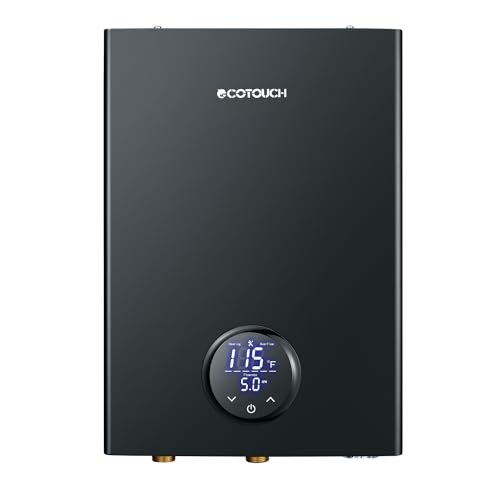
ECO270B 27kW Electric Tankless Water Heater Review: High-Flow 240V Hot Water for Multiple Fixtures
A high-capacity electric tankless water heater can be an attractive option for homes that need continuous hot water but do not want the space requirements or standby losses associated with a traditional storage tank. Instead of keeping dozens of gallons heated around the clock, a tankless system heats water only while fixtures are running.
The ECO270B 27kW electric tankless water heater is designed for substantially higher demand than compact point-of-use models. According to the supplied specifications, it can deliver up to 5.5 gallons per minute, support approximately 2 to 4 usage points, and produce outlet temperatures of 125°F or higher under suitable operating conditions.
That performance comes with equally substantial electrical requirements. The unit can draw up to 113 amps, requires 240V service, and calls for three 40A double-pole breakers. The manufacturer also states that a 200A home electrical service panel is required. For that reason, electrical compatibility should be evaluated before purchase, not after the heater arrives.
What Is the ECO270B 27kW Tankless Water Heater?
The ECO270B is a whole-home or multi-fixture electric tankless water heater intended to heat water on demand.
Its stated features include:
- 27kW electric heating capacity
- Up to 5.5 GPM flow
- 240V operation
- Up to 113A electrical draw
- Three 40A double-pole breakers
- 200A electrical panel requirement
- Digital display
- Touch controls
- Automatic power modulation
- High-temperature protection
- Dry-heating protection
- Electrical leakage protection
- ETL listing
- UL qualification claimed by the manufacturer
- Separated electrical and water pathways
The key advantage is that there is no stored hot-water tank to deplete.
How a 27kW Electric Tankless Water Heater Works
When someone opens a hot-water faucet, the heater detects water flow and activates its heating system.
Electric heating elements transfer energy into the moving water. The heater continuously adjusts output according to flow rate and the selected temperature.
When hot-water demand stops, the unit reduces or stops active heating.
This eliminates the need to maintain a large tank of water at temperature throughout the day.
What “Endless Hot Water” Really Means
The ECO270B is marketed as providing continuous or endless hot water.
That is one of the main advantages of tankless heating, but it should be interpreted correctly.
A tankless heater does not run out of a stored supply in the way a conventional tank does. If someone takes a long shower, the unit can continue producing hot water as long as water and electricity are available.
However, it still has a maximum heating capacity.
If household demand exceeds that capacity, the heater cannot maintain the desired temperature at every fixture.
Endless Duration Does Not Mean Unlimited Flow
This distinction is fundamental.
A storage water heater is limited by tank volume.
A tankless water heater is limited by heating power and flow rate.
The ECO270B may be able to run for hours, but that does not mean it can supply an unlimited number of showers at the same time.
Understanding the 27kW Rating
A 27kW electric heater has significant heating power.
It is much more capable than small 3.5kW, 6kW, or 14kW point-of-use models.
That higher output allows it to support more flow while still delivering a substantial temperature rise.
The real-world result, however, depends heavily on incoming water temperature.
The Importance of Temperature Rise
Temperature rise is the difference between cold-water inlet temperature and the desired outlet temperature.
Suppose incoming water is 70°F and you want 110°F water.
The heater needs to provide a 40°F rise.
If incoming water is 40°F, reaching the same 110°F requires a 70°F rise.
That second situation uses much more of the heater's available power.
As the required temperature rise increases, the maximum hot-water flow generally decreases.
What the 5.5 GPM Rating Means
The manufacturer states a maximum flow rate of up to 5.5 GPM.
That is enough flow for meaningful multi-fixture use.
However, buyers should not assume the unit will produce 5.5 GPM at 125°F in every climate.
Maximum flow ratings are typically achieved under specific inlet-temperature and temperature-rise conditions.
The manufacturer's performance chart is therefore one of the most important documents to review before purchase.
Can It Run Two Showers at Once?
Potentially, yes.
If two efficient showerheads each use around 1.8 GPM, total demand would be approximately 3.6 GPM.
That falls below the claimed 5.5 GPM maximum.
Whether the heater can maintain the desired outlet temperature depends on the incoming-water temperature and the selected temperature setting.
Can It Run Three Showers?
Three 1.8 GPM showers would require roughly 5.4 GPM.
That is already near the maximum advertised flow.
In warm inlet-water conditions, this may be more realistic than in winter conditions where groundwater is very cold.
For consistent performance, it is safer to size based on worst-case seasonal conditions rather than best-case advertised flow.
Support for 2–4 Points of Use
The source states that the ECO270B can support approximately 2 to 4 usage points in small homes or apartments.
Fixture count alone is not a precise sizing method.
Four low-flow bathroom faucets may use less water than two high-flow showers.
A better approach is to calculate the combined gallons per minute of fixtures likely to operate simultaneously.
Example of Multi-Fixture Demand
Consider the following scenario:
Shower: 1.8 GPM
Bathroom faucet: 0.8 GPM
Kitchen faucet: 1.2 GPM
Combined flow is approximately 3.8 GPM.
That may fit comfortably within the heater's stated maximum under suitable temperature conditions.
Add a second shower, however, and total demand can quickly approach or exceed the unit's practical capacity.
Suitable for Small Homes and Apartments
A 27kW tankless heater can make sense in a small home where several fixtures may operate at the same time.
It may be particularly suitable for households with:
- One or two bathrooms
- Efficient showerheads
- Moderate simultaneous use
- Adequate electrical service
The electrical infrastructure is often the deciding factor.
High Electrical Demand: Up to 113A
The source states that the heater can draw as much as 113 amps.
That is a very large electrical load.
This requirement should be taken as seriously as the water-heating performance.
A home that does not have sufficient electrical service may need a significant panel or service upgrade before installation is possible.
200A Service Panel Requirement
The manufacturer specifies a 200A home circuit-breaker panel.
That does not necessarily mean that every home with a 200A panel automatically has enough spare capacity.
The total household electrical load also matters.
A qualified electrician should perform a proper load calculation.
Why Panel Capacity Matters
Many homes already have large electrical loads such as:
- Electric range
- Clothes dryer
- HVAC system
- Heat pump
- EV charger
- Pool equipment
Adding a water heater capable of drawing more than 100 amps can materially affect total service demand.
Three 40A Double-Pole Breakers
The ECO270B requires three 40A double-pole circuit breakers according to the supplied installation information.
That means the heater uses three separate high-current 240V branch circuits.
This requires substantial available space in the electrical panel.
Breaker Space Is Not the Same as Electrical Capacity
A panel may physically have room for six additional breaker positions yet still lack enough service capacity for the heater.
Both factors need to be evaluated:
- Available breaker spaces
- Available electrical service capacity
A professional load calculation is the correct way to determine whether the installation is feasible.
Professional Electrical Installation Is Strongly Recommended
A 27kW fixed appliance drawing over 100 amps is not a casual DIY project.
A licensed electrician should verify:
- Main service size
- Panel capacity
- Breaker configuration
- Wire sizing
- Grounding
- Disconnect requirements
- Local electrical code
The cost of electrical work should be considered part of the total purchase decision.
Self-Modulating Power Control
The ECO270B uses automatic power modulation.
This means it adjusts electrical input based on current demand rather than always consuming the full 27kW.
If water flow is low or incoming water is relatively warm, less heating energy may be required.
At higher flow or greater temperature rise, the unit can increase power accordingly.
Why Self-Modulation Improves Comfort
A properly operating self-modulating heater can help maintain a more stable outlet temperature.
Without modulation, a heater might overheat low-flow water or struggle to respond smoothly to changing demand.
By adjusting output continuously, the system can better match actual conditions.
Reduced Flow Can Reduce Power Consumption
The source points out that reducing water flow can lower power demand.
That makes sense because less water needs to be heated each minute.
This relationship also means that reducing flow can help the heater achieve a larger temperature rise.
Temperature Stability
One of the major goals of electronic modulation is to avoid sudden swings between overly hot and insufficiently warm water.
Actual stability still depends on:
- Incoming water conditions
- Flow changes
- Electrical supply
- Plumbing design
But modulating controls are generally preferable to simple fixed-power heating.
Energy Savings Compared With a Tank Heater
The manufacturer claims savings of up to 50% in electric water-heating costs compared with a typical tank heater.
That figure should be treated as a best-case marketing claim rather than a guaranteed result.
Actual savings depend on:
- Existing heater efficiency
- Hot-water usage
- Local electricity rates
- Standby losses
- Household habits
The main efficiency advantage comes from eliminating most storage-tank standby heat loss.
Why Tank Heaters Lose Energy
A conventional storage tank continually loses some heat through its insulation.
The heater periodically cycles to restore that lost heat even when nobody has used hot water.
A tankless unit largely avoids this because there is no large reservoir maintained at temperature.
High Power Does Not Automatically Mean High Energy Use
A 27kW heater can draw enormous power while operating, but it may run only during actual hot-water use.
Power and energy are different concepts.
High instantaneous power does not necessarily mean higher monthly consumption if runtime is reduced.
The final energy cost depends on total hot-water demand.
Digital Display
The ECO270B includes a digital screen intended to show operating information.
This can make it easier to understand:
- Temperature setting
- Operating status
- Heater activity
Compared with mechanical controls, a digital interface provides more precise feedback.
Touch Control Panel
Temperature adjustment is handled through touch controls.
This offers a clean, modern interface and simplifies configuration.
The source emphasizes that the display provides enough operating information to reduce guesswork during use.
Set an Appropriate Water Temperature
The heater is capable of producing water around 125°F or higher under suitable conditions.
That does not mean the highest temperature is appropriate for every household.
Very hot water can create scalding risk, especially for:
- Children
- Older adults
- People with limited mobility
- People with reduced sensation
Use conservative temperature settings for normal bathing.
ETL Listing and Safety Testing
The source states that the ECO270B is ETL listed and qualifies for applicable UL standards.
Third-party safety certification is important for a high-current electrical appliance.
Certification should still be verified on the exact unit and documentation purchased.
Electrical Leakage Protection
The heater includes electrical leakage protection according to the source.
Because the appliance combines water with high-voltage electrical systems, this is an important safety feature.
It does not replace:
- Correct grounding
- Correct breakers
- Proper wiring
- Code-compliant installation
Built-in protection and professional installation work together.
High-Temperature Protection
High-temperature protection is intended to stop or limit heating if the unit detects an unsafe temperature condition.
This helps protect both the appliance and users.
It is especially important in a high-output 27kW system.
Dry-Heating Protection
Tankless heating elements rely on flowing water to absorb generated heat.
If heating occurs without sufficient water, components can become dangerously hot.
Dry-heating protection is designed to detect and prevent this condition.
The heater should still be commissioned according to the manufacturer’s instructions before electrical power is applied.
Separated Water and Electrical Paths
The source states that internal water and electrical pathways are designed to remain separate.
This helps reduce the risk of electrical leakage into the water path.
The design is also intended to reduce direct scale accumulation around electrical heating components.
Scale Can Still Be a Maintenance Issue
Separated electrical components do not make the water system immune to mineral deposits.
Hard water can still leave scale inside:
- Water channels
- Heat-transfer surfaces
- Connections
Over time, this may reduce flow or heating performance.
Hard-Water Maintenance
Homes with mineral-rich water should follow the manufacturer's maintenance schedule.
Depending on local conditions, maintenance may include:
- Flushing
- Descaling
- Cleaning inlet screens
Water treatment may be worthwhile in particularly hard-water areas.
Tankless vs. Traditional Storage Water Heater
Both systems can provide whole-home hot water, but they do so differently.
Tankless System
A tankless heater offers:
- Continuous hot water within capacity
- No large storage tank
- Reduced standby heat loss
- Compact installation
Storage Tank
A tank heater offers:
- Large stored reserve
- High short-term flow
- Often lower electrical service requirements
- Simpler replacement in homes already designed for tanks
Neither is universally superior.
Tankless vs. Gas Water Heater
Electric tankless heating eliminates combustion.
There is no need for:
- Natural gas
- Propane
- Combustion air
- Exhaust venting
That can simplify some installations.
The tradeoff is electrical demand.
A 27kW electric heater can require far more panel capacity than many households have available.
Does It Provide Instant Hot Water?
The heater begins heating as soon as sufficient water flow is detected.
However, hot water still has to travel from the heater to the fixture.
If the unit is installed far from a bathroom, water already sitting in the pipes must be displaced first.
Tankless does not automatically eliminate plumbing delivery delay.
Long Plumbing Runs Still Matter
A whole-house tankless heater installed in a garage can still take time to deliver hot water to an upstairs bathroom.
If this delay is a major concern, a hot-water recirculation solution may be worth considering.
The supplied article does not mention integrated recirculation.
Seasonal Performance
Winter inlet-water temperature is one of the most important sizing factors.
A heater that comfortably serves several fixtures in summer may have less available flow when winter groundwater is much colder.
Always size for the coldest realistic inlet-water conditions.
Low-Flow Fixtures Can Improve Capacity
Efficient showerheads and faucet aerators reduce gallons-per-minute demand.
That can allow more fixtures to operate simultaneously within the ECO270B's available heating capacity.
For example, two 1.5 GPM showers are easier for the heater to support than two 2.5 GPM showers.
Is 5.5 GPM Enough for a Whole House?
For some homes, yes.
For others, no.
It may be enough for a household where simultaneous demand rarely exceeds:
- Two efficient showers
- Shower plus several faucets
- Moderate kitchen and bathroom use
A larger household with large tubs, multiple showers, or high-flow fixtures may need more capacity.
A Better Way to Size the Heater
Instead of counting bathrooms, calculate peak simultaneous flow.
Add the GPM ratings of the fixtures most likely to operate together.
Then compare that number with the ECO270B's performance at your local winter temperature rise.
This produces a far more realistic sizing decision.
Example Sizing Scenario
Suppose a household may run:
- Shower: 1.8 GPM
- Second shower: 1.8 GPM
- Bathroom sink: 0.7 GPM
Total peak flow would be approximately 4.3 GPM.
That is below the stated maximum 5.5 GPM, but the heater must still have enough power to produce the necessary temperature rise.
Electrical Installation Cost Can Change the Value Proposition
The heater itself may seem competitively priced, but installation can become expensive if the home requires:
- Electrical panel upgrade
- Service upgrade
- Long heavy-gauge cable runs
- Additional disconnect equipment
These costs should be evaluated before deciding that electric tankless is the most economical option.
When 27kW Makes Sense
This heater can make particular sense when:
- The home already has 200A electrical service
- Natural gas is unavailable
- Space is limited
- Several fixtures need hot water
- Continuous tankless operation is desirable
In those conditions, the ECO270B offers substantial heating capacity without requiring combustion equipment.
When Another Water Heater May Be Better
A different solution may be preferable if:
- Electrical service is limited
- Panel upgrade costs are high
- Household peak flow regularly exceeds 5.5 GPM
- Very cold inlet water substantially reduces output
- Natural gas is readily available
A gas tankless or conventional storage system may be more practical in some homes.
Common Buying Mistakes
Assuming 5.5 GPM Is Available at Every Temperature
Actual flow depends on temperature rise.
Ignoring the 113A Electrical Demand
This is one of the product's defining limitations.
Assuming a 200A Panel Automatically Guarantees Compatibility
A load calculation is still necessary.
Counting Fixtures Instead of Adding Flow Rates
Two showers are very different from two faucets.
Believing Tankless Means Zero Hot-Water Delay
Pipe length still matters.
Ignoring Hard Water
Scale can reduce long-term performance.
Who Is the ECO270B Best For?
The ECO270B may be a strong option for:
- Small to medium-sized homes
- Apartments with substantial electrical service
- Households wanting multiple simultaneous fixtures
- Properties without natural gas
- Owners replacing a bulky tank heater
It is especially compelling where the building already has sufficient 240V electrical capacity.
Who Should Consider More Capacity?
A larger unit may be needed for:
- Large families
- Three or more simultaneous showers
- Large bathtub fillers
- High-flow luxury fixtures
- Very cold climates
A larger electric heater will also increase electrical requirements.
Advantages and Considerations
Advantages
The ECO270B combines 27kW of electric heating, up to 5.5 GPM stated flow, self-modulating power control, digital touch operation, multi-fixture capability, and several built-in protection systems.
Its tankless design also removes the need for a large hot-water storage tank and reduces standby storage losses.
Considerations
The main drawback is electrical demand. The heater may draw up to 113A and requires three 40A double-pole breakers, making a robust electrical service essential.
The 5.5 GPM rating should also be evaluated against local winter inlet-water temperature rather than treated as guaranteed flow at every desired temperature.
Frequently Asked Questions
How powerful is the ECO270B?
It is rated at 27kW.
What voltage does it use?
It is described as a 240V electric tankless water heater.
What is the maximum stated flow rate?
Up to 5.5 GPM.
Does it provide endless hot water?
It provides continuous hot water as long as demand remains within its heating capacity.
Can it run multiple showers?
Potentially, depending on total flow and incoming-water temperature.
How many fixtures can it support?
The manufacturer describes approximately 2 to 4 points of use.
Can it serve an entire small home?
Potentially yes, provided household peak demand and temperature rise fit within the heater's capacity.
How much current can it draw?
The source states up to 113 amps.
What size electrical service does it require?
The manufacturer specifies a 200A home circuit-breaker panel.
How many breakers are required?
Three 40A double-pole breakers.
Does having a 200A panel automatically mean I can install it?
No. A professional load calculation is still recommended.
Does the heater modulate its power?
Yes. It adjusts power input according to water flow and temperature requirements.
Does that save energy?
It can reduce unnecessary power consumption compared with operating at maximum output continuously.
Will it save 50% on electricity?
The source claims up to 50% savings compared with a typical tank heater, but actual savings vary considerably.
Does it have a digital display?
Yes.
Does it use touch controls?
Yes.
Is it ETL listed?
The supplied information says yes.
Does it have leakage protection?
Yes, according to the manufacturer.
Does it include high-temperature protection?
Yes.
Does it have dry-heating protection?
Yes.
Are the water and electrical systems separated?
Yes, according to the supplied description.
Can scale still build up?
Yes. Mineral deposits can still affect internal water passages.
Is professional installation recommended?
Absolutely. The high electrical demand makes professional installation particularly important.
Final Thoughts
The ECO270B 27kW electric tankless water heater is a serious high-capacity electric water-heating solution rather than a small point-of-use appliance. With a stated 5.5 GPM maximum flow, support for roughly 2–4 usage points, self-modulating power, digital touch controls, and multiple safety systems, it can potentially provide whole-home hot water for a small or moderate-demand property.
Its biggest advantage is continuous on-demand heating without a large storage tank. Its biggest limitation is electrical infrastructure.
The unit may draw up to 113 amps and requires three 40A double-pole breakers, so buyers should verify panel capacity and service size before making a purchase. A claimed 200A panel requirement should also be treated as a starting point rather than a guarantee that every 200A home can accept the additional load.
For a property with sufficient electrical service, moderate simultaneous hot-water demand, and a desire to avoid a traditional storage tank, the ECO270B offers a compelling combination of high-flow tankless performance, self-modulating energy use, compact installation, and continuous hot-water availability.