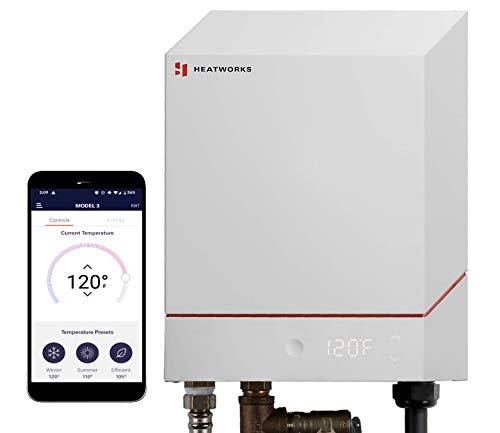
6.2–24kW Electric Tankless Smart Water Heater Review: Metal-Free Heating for Point-of-Use and Whole-Home Hot Water
Electric tankless water heaters are usually built around metal resistance elements that transfer heat directly or indirectly into flowing water. This smart tankless model takes a different approach, positioning itself as a water heater without conventional metal heating elements and offering a broad power range from 6.2kW to 24kW.
That range makes the product unusually flexible. Lower-output configurations may be appropriate for point-of-use applications such as sinks, while higher-output versions may be capable of serving multiple fixtures or, in suitable conditions, an entire small home. The electrical requirements scale accordingly, from approximately 30 amps to 100 amps on 208–240V service.
The most important question is not simply which power level is largest. A properly sized electric tankless water heater has to match three things at once: the home's hot-water demand, the incoming water temperature, and the electrical service available to support the heater.
What Is This Electric Tankless Smart Water Heater?
This product is a variable-capacity electric tankless water heater offered in configurations ranging from approximately 6.2kW to 24kW.
The supplied information identifies it as suitable for either:
- Point-of-use installation
- Whole-home installation
depending on the selected power level and the property's hot-water requirements.
It operates on 208–240V electrical service and may require roughly 30A to 100A, depending on configuration.
The Main Difference: No Conventional Metal Heating Elements
The product's most distinctive claim is that it does not use conventional metal heating elements.
Traditional electric water heaters commonly rely on metallic resistance elements that become hot when electrical current passes through them. Heat then transfers into the water.
A metal-free heating architecture may be intended to reduce some of the issues associated with traditional heating elements, particularly mineral buildup and corrosion around the element itself.
However, buyers should distinguish between metal-free heating elements and a completely metal-free water path. Plumbing fittings, valves, heat-transfer surfaces, or internal structural components may still use metal unless the manufacturer explicitly states otherwise.
Why Heating-Element Design Matters
The heating element is one of the most heavily stressed components inside an electric water heater.
It repeatedly experiences:
- High temperature
- Electrical load
- Rapid heating and cooling
- Mineral-rich water
Traditional elements can gradually develop scale, especially in hard-water areas.
If this design genuinely eliminates exposed metallic heating elements, it may offer an interesting durability advantage.
Does a Metal-Free Heater Eliminate Scale?
Not necessarily.
Mineral scale can form wherever hard water is heated or concentrated, not only on metal resistance elements.
Deposits may still accumulate within:
- Water passages
- Valves
- Sensors
- Heat-transfer surfaces
A nonmetallic heating technology may reduce one major location for scale buildup, but water quality still matters.
Understanding the 6.2–24kW Power Range
One of the strongest aspects of this product family is the wide output range.
A 6.2kW unit and a 24kW unit serve very different applications.
The smaller model is better viewed as a localized water heater, while the largest configuration may support several simultaneous fixtures when correctly sized.
6.2kW: Primarily Point-of-Use
At approximately 6.2kW, the heater is best suited to relatively modest hot-water demand.
Typical applications may include:
- Bathroom sink
- Utility sink
- Office sink
- Workshop sink
- Small kitchenette
The exact flow capability depends on inlet-water temperature.
Mid-Range Configurations
Intermediate power levels can support higher flow and may be suitable for applications such as:
- One shower
- Shower plus sink
- Small apartment
- Guest suite
Again, climate makes a major difference.
A heater that performs comfortably in a warm region may deliver less usable flow in winter where incoming water is much colder.
24kW: Potential Whole-Home Use
The 24kW configuration enters whole-home territory for some properties.
It may be capable of serving multiple fixtures at once, particularly where:
- Groundwater is relatively warm
- Low-flow fixtures are used
- Simultaneous demand is moderate
But "whole-home" capability should always be verified through a flow-versus-temperature-rise calculation.
Why Kilowatts Matter
The kilowatt rating determines how much thermal energy the heater can add to flowing water.
More kilowatts allow either:
- Higher flow at the same temperature rise
or
- Greater temperature rise at the same flow
This relationship is fundamental to tankless water-heater sizing.
Temperature Rise Determines Performance
Suppose incoming water enters at 70°F and you want 105°F water.
The heater needs to produce a 35°F rise.
If incoming water enters at 40°F, achieving the same 105°F outlet requires a 65°F rise.
The colder scenario consumes much more heating capacity.
This is why the same heater may support several fixtures in a warm climate but fewer fixtures in a cold one.
How Flow Rate Changes With Power
A low-power heater can still produce hot water if flow is modest.
As flow increases, each gallon spends less time receiving heat.
A higher-power unit compensates by supplying more energy.
This is why selecting the correct kW model is more important than simply choosing the physically smallest unit.
Point-of-Use vs. Whole-Home Sizing
The product's broad power range makes it suitable for very different installation strategies.
Point-of-Use Installation
A smaller heater can be mounted near a single fixture.
Advantages include:
- Shorter hot-water wait
- Less cooled water in pipes
- Compact installation
- Lower electrical demand
Whole-Home Installation
A larger heater can replace or supplement a central water-heating system.
This requires:
- Higher electrical capacity
- More precise sizing
- Consideration of simultaneous fixture use
Calculate Peak Hot-Water Demand
For whole-home sizing, count the fixtures that may operate at the same time and add their flow rates.
For example:
- Shower: 1.8 GPM
- Second shower: 1.8 GPM
- Bathroom faucet: 0.7 GPM
Peak demand would be approximately 4.3 GPM.
The selected heater then needs to supply that flow at the required winter temperature rise.
Fixture Count Can Be Misleading
A claim such as "supports three fixtures" is much less useful than actual gallons per minute.
Three bathroom faucets may use less water than one large tub filler.
Always size by flow rather than fixture count alone.
Electrical Requirements: 208–240V
All configurations operate on 208–240V electrical service according to the supplied information.
That immediately places them outside the category of ordinary plug-in household appliances.
These heaters require dedicated high-voltage electrical circuits.
Current Range: Approximately 30–100A
Depending on the chosen output, electrical demand may range from roughly:
30 amps to 100 amps
That is a substantial variation.
The smallest unit may fit relatively easily into a modern electrical system, while the largest can represent one of the home's biggest electrical loads.
Why the 24kW Model Is Electrically Demanding
A 24kW heater operating at 240V draws roughly:
24,000 watts ÷ 240 volts ≈ 100 amps
That is a very large continuous appliance load.
Before installing one, the home's service capacity must be evaluated carefully.
A 200A Service May Still Need a Load Calculation
Even if a home has a 200A electrical service, that does not automatically mean 100A of additional water-heating capacity is available.
Other major loads may include:
- Electric range
- Dryer
- HVAC
- Heat pump
- EV charger
- Pool equipment
A licensed electrician should calculate whether the service can accommodate the selected model.
Breaker and Wiring Requirements Vary by Model
Because the product family spans such a wide kW range, breaker and conductor requirements will differ significantly.
Do not assume one installation specification applies to every model.
The exact configuration should be taken from the manufacturer's technical documentation.
Professional Electrical Installation Is Recommended
Any electric tankless heater drawing 30A or more should be treated as a serious fixed electrical appliance.
Professional installation is particularly important for the high-power configurations.
A qualified electrician should verify:
- Service capacity
- Breaker sizing
- Conductor sizing
- Grounding
- Disconnect requirements
- Panel space
- Local electrical code
Smart Water-Heater Functionality
The product is described as a smart water heater, suggesting electronic monitoring or control beyond basic heating.
Depending on the exact model, smart functions may include:
- Digital temperature regulation
- Remote control
- Usage monitoring
- Diagnostic information
- Scheduling
The specific app, connectivity standard, and supported functions should be confirmed before purchase rather than assumed from the word "smart."
Why Smart Controls Are Useful
Smart controls can improve convenience, especially when the heater is installed in a utility room or inaccessible cabinet.
They may also provide better visibility into operating conditions.
However, connectivity does not change the physical limits of the heater.
A 6.2kW model remains limited to 6.2kW regardless of the sophistication of its controls.
Tankless Operation and Energy Use
A tankless heater consumes substantial power only while hot water is being produced.
Unlike a storage heater, it does not continuously maintain a large reservoir at temperature.
This reduces standby storage losses.
Does Tankless Automatically Save Money?
Not necessarily.
Actual operating cost depends on:
- Electricity rate
- Hot-water consumption
- Existing heater
- Selected water temperature
- Household habits
Tankless operation changes when energy is consumed; it does not eliminate the energy required to heat water.
Compact Installation
Electric tankless water heaters are usually much smaller than storage-tank systems.
That can free valuable floor space and make installation possible in:
- Closets
- Utility rooms
- Under counters
- Mechanical walls
The larger electrical infrastructure may still require careful planning even if the heater itself is compact.
Why Installation Near Fixtures Can Help
A point-of-use heater installed close to a sink can reduce the volume of cooled water sitting in the hot-water pipe.
That can shorten the wait before warm water reaches the fixture.
It may also reduce water wasted while waiting.
Whole-Home Placement
For whole-home use, the heater is typically located where it can efficiently connect to the main hot-water distribution system.
Placement should consider:
- Plumbing distance
- Electrical access
- Serviceability
- Freeze protection
- Moisture exposure
The shortest electrical route is not always the best plumbing location, so both systems need to be considered together.
Continuous Hot Water—Within Capacity
A tankless heater can continue producing hot water without waiting for a tank to recover.
That is particularly attractive in households where long showers or back-to-back use frequently exhaust a conventional storage heater.
However, simultaneous demand still cannot exceed the heater's output.
What Happens When Demand Is Too High?
If more water flows through the heater than it can adequately heat, one of several things may happen depending on the control system:
- Outlet temperature drops
- Flow may be restricted
- The unit operates at maximum power without reaching the set temperature
This is a sizing issue rather than necessarily a product defect.
Low-Flow Fixtures Can Improve Performance
Efficient faucets and showerheads can make a tankless system much more capable.
For example, replacing a 2.5 GPM showerhead with a 1.5 GPM model reduces hot-water demand significantly.
That can allow a smaller heater to serve more fixtures simultaneously.
Hard Water Is Still Important
Even with unconventional heating-element technology, hard water can affect the system.
Minerals may accumulate inside plumbing passages and sensors.
If local water hardness is high, maintenance or water treatment may still be worthwhile.
Tankless vs. Storage Water Heater
A conventional tank stores hot water for later use.
A tankless system heats it on demand.
Tankless Advantages
- No large storage tank
- Continuous hot water within capacity
- Compact installation
- Reduced standby losses
Storage-Tank Advantages
- Strong short-term peak flow
- Lower instantaneous electrical demand
- Familiar installation
The best option depends on the building.
Tankless vs. Heat-Pump Water Heater
A heat-pump water heater uses electricity very differently.
Rather than producing heat directly through resistance, it moves heat from surrounding air into stored water.
Heat pumps can use much less electricity in suitable conditions, but they require a tank and more physical space.
Electric tankless heaters offer compactness and continuous heating instead.
Tankless vs. Gas Tankless
Gas tankless heaters can provide high heating output without drawing 100 amps from an electrical panel.
However, they require:
- Gas supply
- Combustion air
- Venting
Electric tankless units avoid combustion entirely but place much greater demands on electrical infrastructure.
Which Power Level Should You Choose?
The correct configuration depends on the intended application.
A rough conceptual guide is:
- 6.2kW: single low-flow fixture
- Mid-range units: one larger fixture or several modest fixtures
- 24kW: possible whole-home use under suitable conditions
Exact sizing should always rely on manufacturer performance data.
Common Buying Mistakes
Choosing by Kilowatt Rating Alone
You still need the required temperature rise and flow.
Assuming 24kW Works for Every Whole House
Large homes or cold climates may need more capacity.
Ignoring Electrical Service
A 100A heater load can be difficult or expensive to accommodate.
Believing “No Metal Heating Element” Means No Scale
Mineral deposits can still occur elsewhere.
Ignoring Winter Inlet Temperature
Cold groundwater can substantially reduce usable flow.
Who Is This Product Best For?
The broad 6.2–24kW range makes this product family interesting for buyers who want one technology platform for different applications.
It may suit:
- Individual sinks
- Apartments
- Guest suites
- Small homes
- Multi-fixture installations
depending on the selected power level.
Who Should Consider Another Technology?
Another water-heating solution may be preferable if:
- Electrical service is limited
- Peak flow is extremely high
- Electricity is expensive
- A heat-pump heater is practical
- Natural gas is available and preferred
The smartest choice depends on the entire building, not just the water heater.
Advantages and Considerations
Advantages
The product offers a broad 6.2–24kW output range, supports both point-of-use and potential whole-home applications, uses 208–240V power, and features an unconventional heating architecture that avoids conventional metal heating elements.
Its tankless design also provides compact installation and continuous hot-water production within the selected model's capacity.
Considerations
Higher-output configurations can place a very large load on the electrical system, with the product family reaching approximately 100A at the upper end.
The absence of conventional metal heating elements does not necessarily eliminate scale maintenance, and whole-home suitability still depends on climate, flow rate, and simultaneous demand.
Frequently Asked Questions
What power levels are available?
The supplied information identifies a range from approximately 6.2kW to 24kW.
What voltage does it use?
Approximately 208–240V.
How much current does it require?
Depending on configuration, approximately 30A to 100A.
Is it a tankless heater?
Yes.
Does it store hot water?
No.
Can it provide continuous hot water?
Yes, provided demand stays within the selected model's heating capacity.
Is it suitable for point-of-use applications?
Yes. Lower-power versions are particularly suited to point-of-use installations.
Can it heat an entire home?
Higher-output models may support whole-home use in appropriately sized applications.
Does it use traditional metal heating elements?
The supplied product description states that it does not use conventional metal heating elements.
Does that mean there is no metal anywhere inside?
That should not be assumed. The claim specifically concerns the heating-element technology.
Does a metal-free heating element eliminate corrosion?
It may reduce corrosion associated with exposed traditional elements, but other water-system components may still be affected by water chemistry.
Can scale still form?
Yes. Mineral buildup can still occur within water passages and other components.
Does the 24kW model require about 100A?
At 240V, 24kW corresponds to roughly 100 amps of electrical load.
Can any home support the 24kW version?
No. Electrical service and panel capacity must be evaluated first.
Is professional installation recommended?
Yes, especially for the higher-power configurations.
Does tankless mean instant hot water?
Heating begins on demand, but water still needs to travel through the plumbing from the heater to the fixture.
Is whole-home sizing based on number of bathrooms?
Not reliably. Peak simultaneous flow and temperature rise are more useful sizing criteria.
Final Thoughts
This 6.2–24kW electric tankless smart water heater is notable for two reasons: its exceptionally broad power range and its unconventional claim of operating without traditional metal heating elements.
The lower-power configurations can potentially provide compact point-of-use hot water for sinks and other modest fixtures, while the 24kW version moves into multi-fixture or potential whole-home territory. That flexibility makes the platform relevant to everything from a remote vanity to a small residence.
Its greatest strength is also its main installation challenge. Moving from 6.2kW toward 24kW dramatically increases electrical demand, from roughly 30 amps to approximately 100 amps on 208–240V service. Buyers considering a high-output model should evaluate their home's electrical capacity before focusing on plumbing or smart features.
For the right installation, the system offers a compelling combination of tankless on-demand heating, compact installation, smart controls, scalable power, and an alternative heating-element design intended to reduce the drawbacks associated with traditional exposed metal elements.